The galaxy J0148-4214 looks back at us from an extraordinarily early chapter of cosmic history. Inside it, three actively feeding black holes appear crowded together, including two near its center that may eventually collide.
Light from J0148-4214 has traveled for more than 12.5 billion years. Its measured redshift of z=5.02 means astronomers see the galaxy as it existed only about 1.2 billion years after the Big Bang.
An international team led by the Max Planck Institute for Extraterrestrial Physics, or MPE, identified the three black holes using observations from the James Webb Space Telescope. Each is actively accreting, meaning material is falling toward it from a surrounding disk.
“This is the first evidence of three active black holes in a single galaxy in the distant Universe,” said Hannah Übler, a research group leader at MPE and lead author of the study.
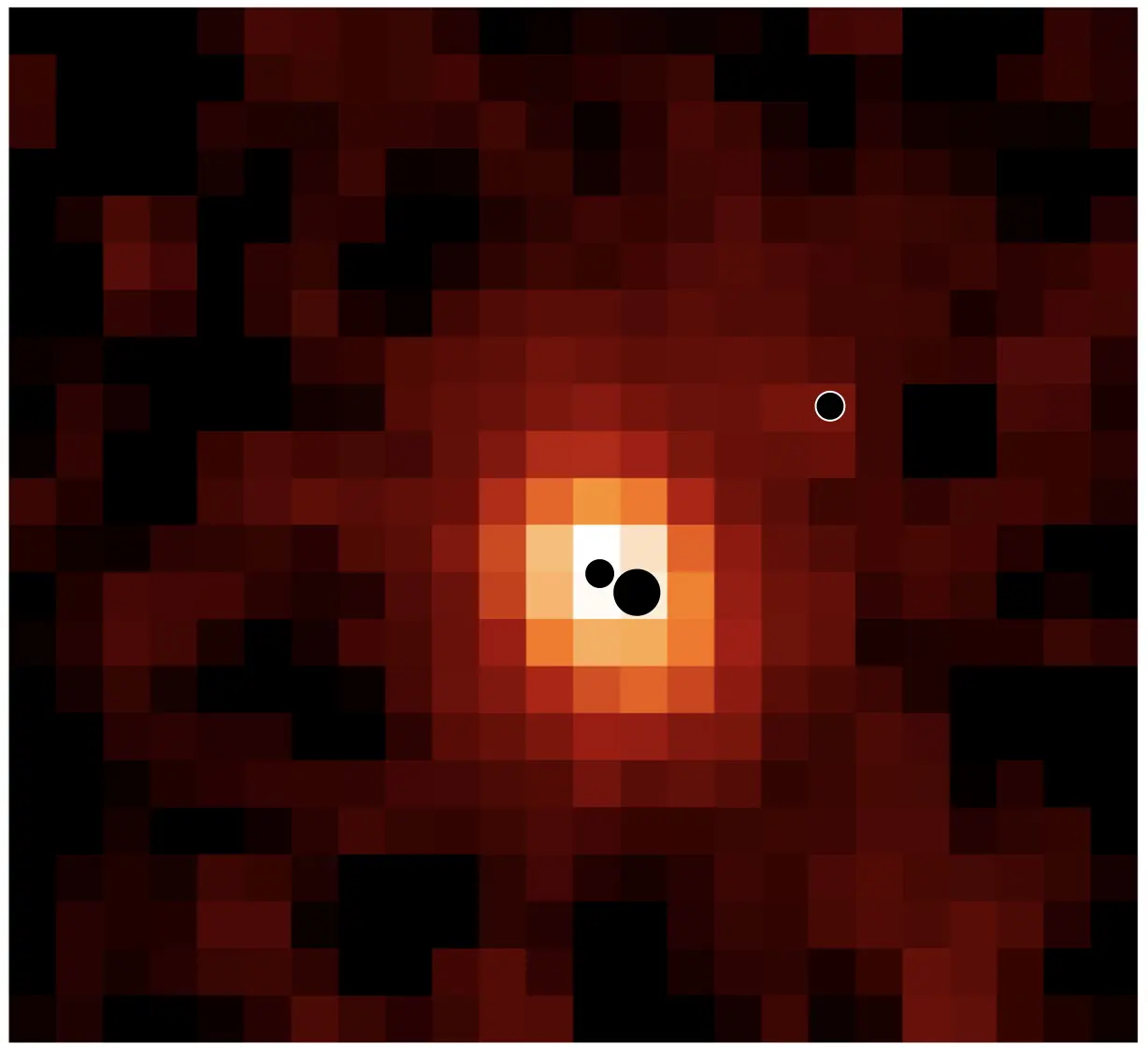
Two of the black holes sit close to the center of J0148-4214. Detailed analysis places their projected separation at about 190 ± 40 parsecs, or roughly 620 light-years.
The third lies farther out, about 1.7 kiloparsecs, or roughly 5,500 light-years, from the central region.
“It suggests that processes in the early Universe were efficient at bringing massive black holes together, setting the stage for the massive black hole mergers we expect to detect with future gravitational wave observatories”, Übler said.
Astronomers expect galaxy mergers to play an important role in black hole growth. As galaxies collide and combine, their central black holes can move toward each other and eventually merge as well.
J0148-4214 offers a rare view of that process at an unusually early time.
The black holes themselves cannot be seen directly. Instead, the team traced hydrogen atoms moving rapidly within their strong gravitational fields.
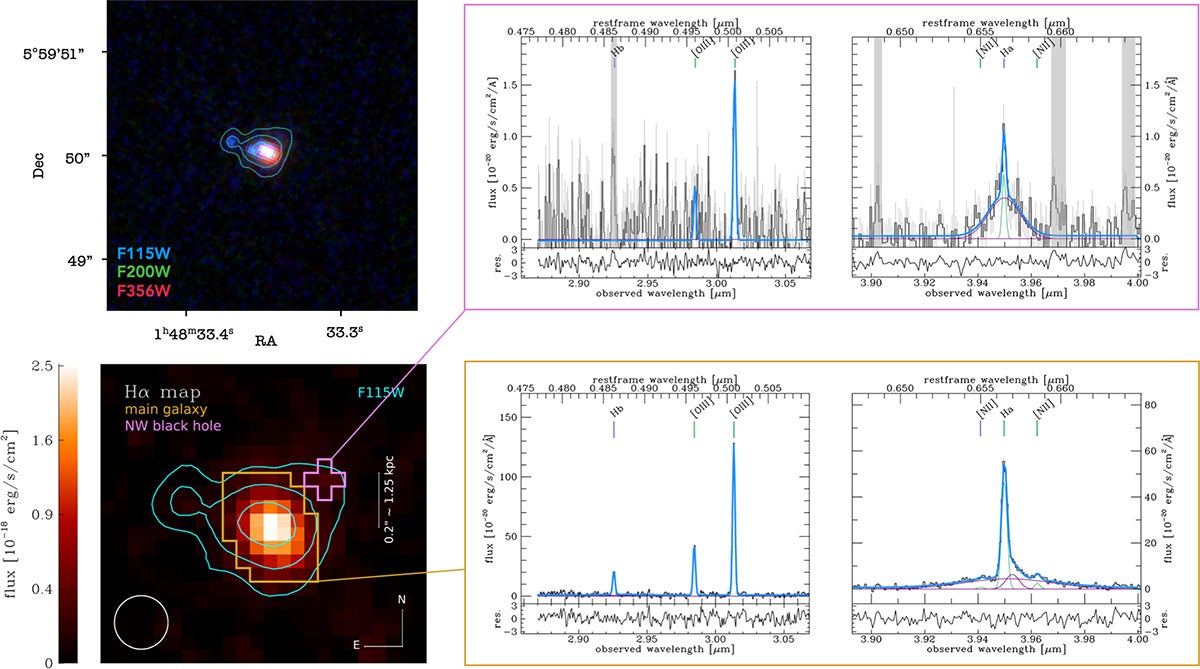
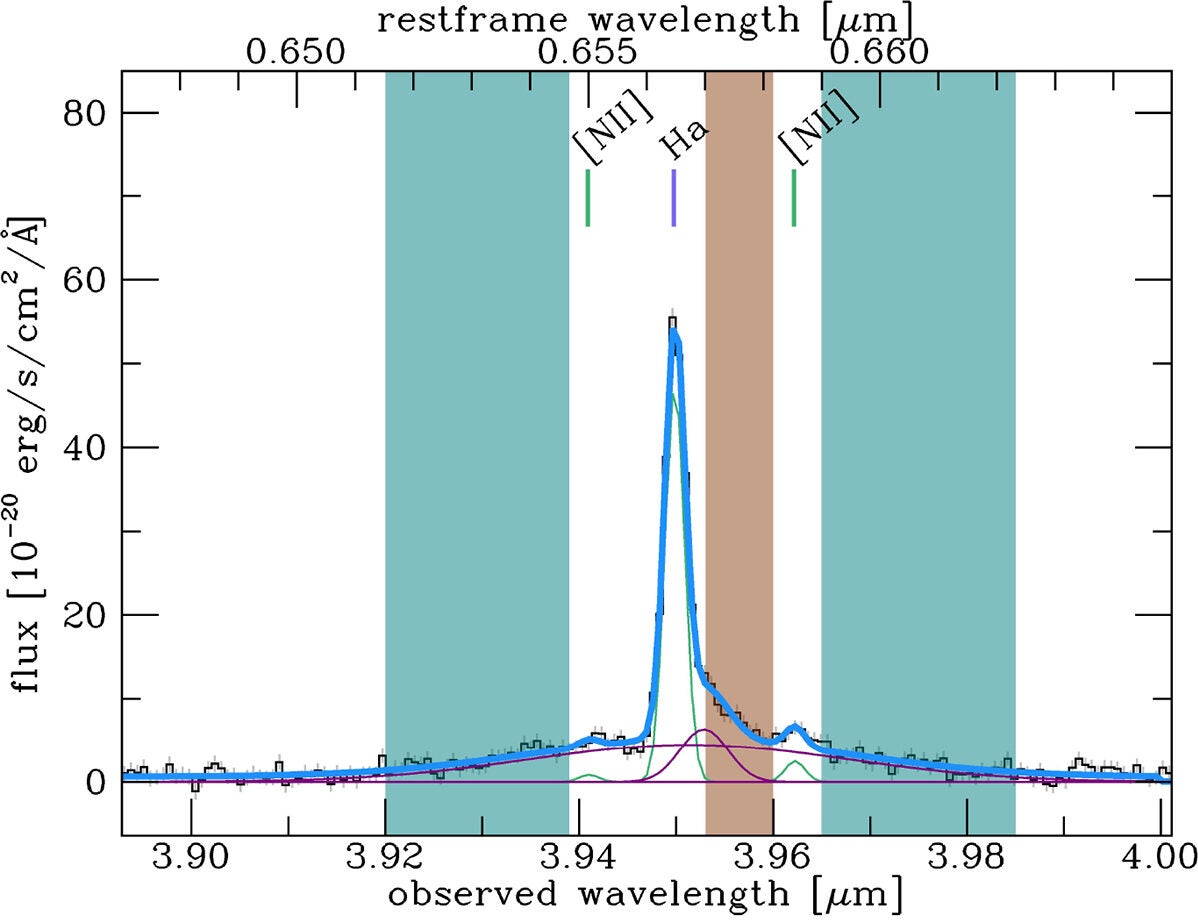
JWST’s Near-Infrared Spectrograph, using integral field spectroscopy, revealed broad hydrogen-alpha emission. Such broad emission can arise from gas moving at high speeds near an actively accreting black hole.
The galaxy’s central spectrum was particularly complex. Instead of behaving like emission from one simple source, it contained two broad components.
To separate them, the researchers used spectro-astrometry, which measures tiny shifts in the position of emission across different wavelengths. The resulting maps showed distinct spatial distributions for the two broad-line regions.
That distinction matters because a strangely shaped emission region around one black hole could also produce an asymmetric spectrum. The spatial offset instead favors two separate central sources.
The third broad hydrogen source appeared northwest of the center.
Other explanations, including supernovae, shocks, stellar winds and massive stars, did not match the full set of observations. In particular, the broad hydrogen emission lacked corresponding broad emission from forbidden oxygen lines that would be expected in several alternative scenarios.
The estimated black hole masses differ dramatically.
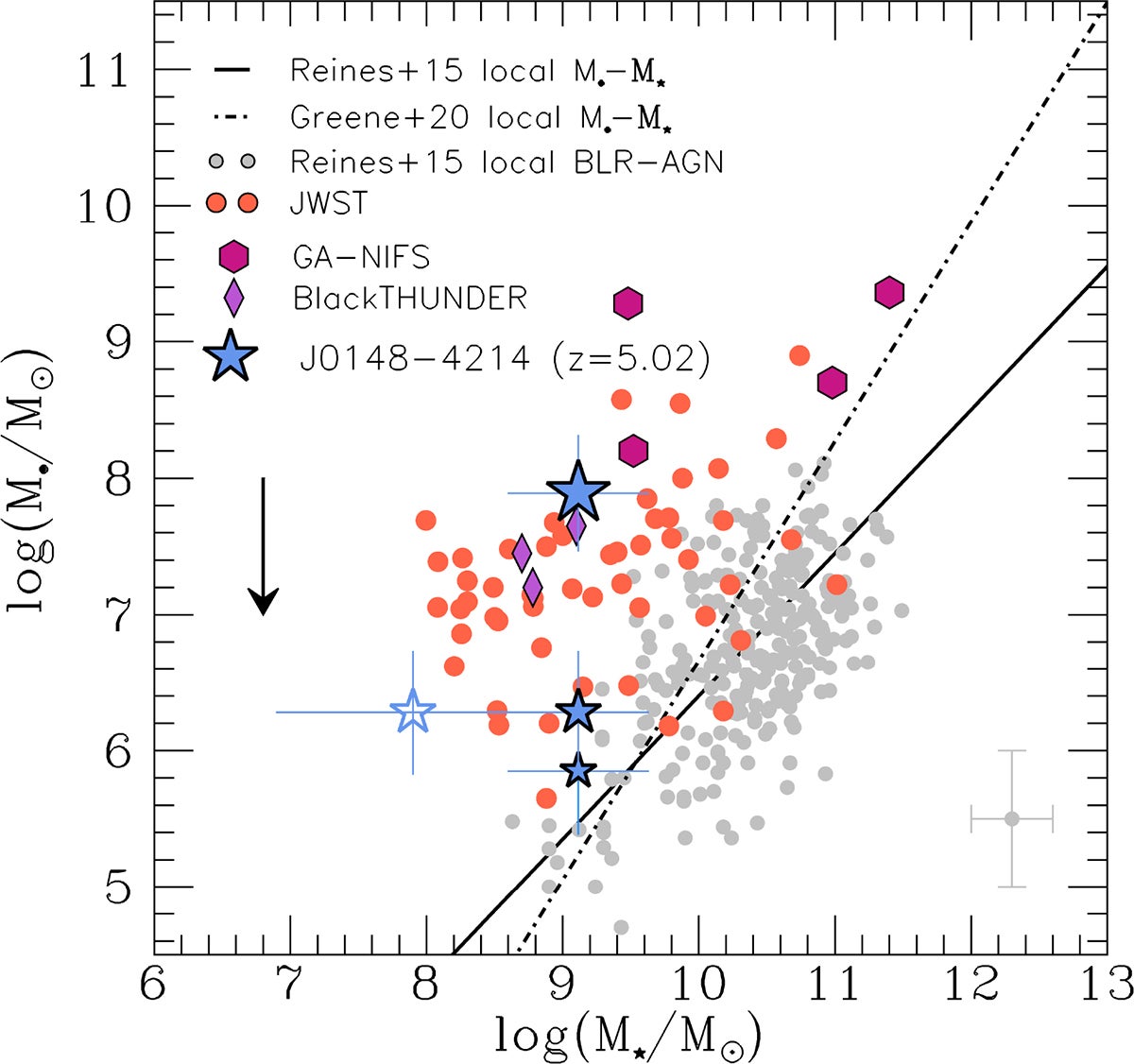
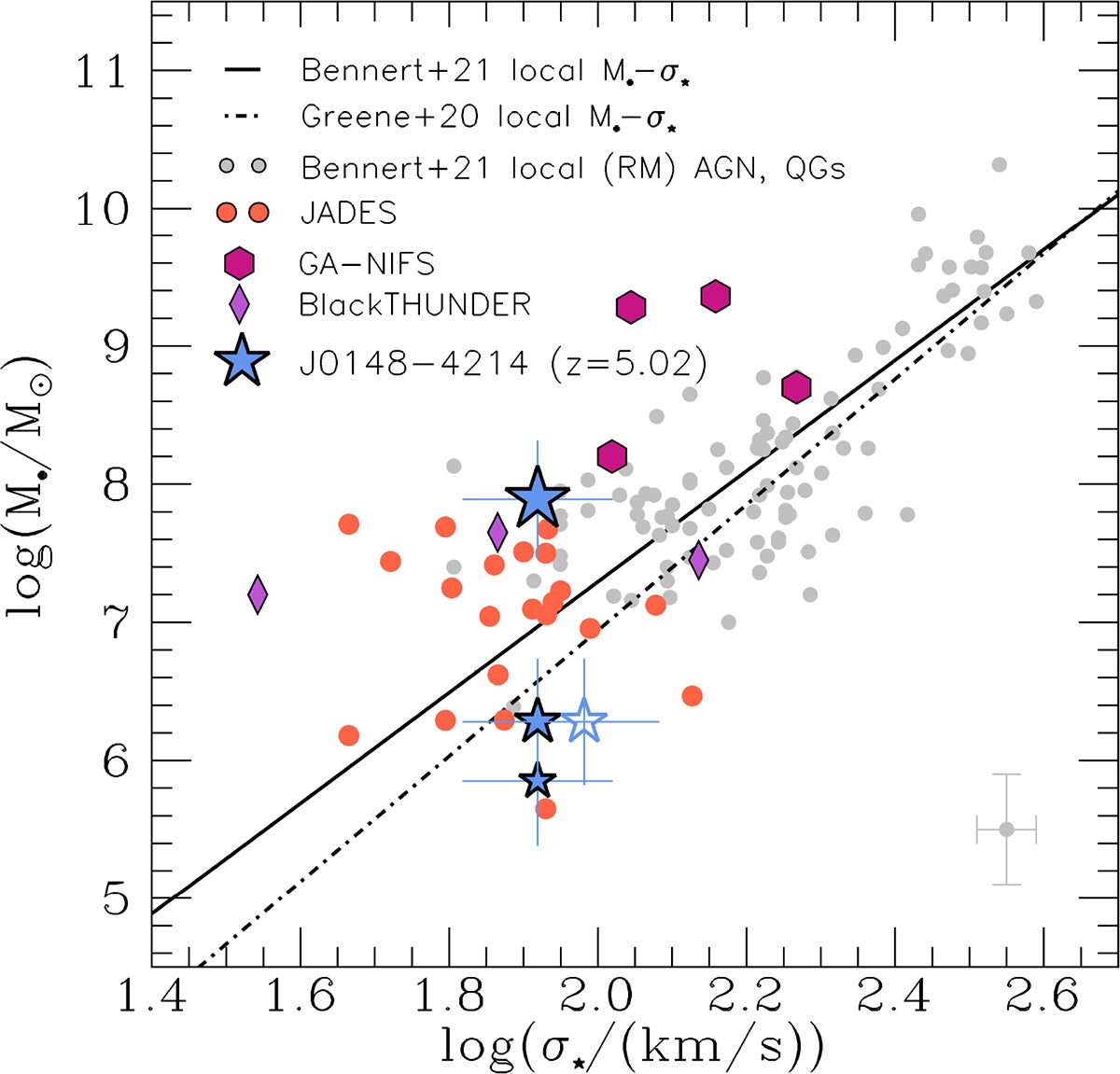
The dominant central black hole weighs about 80 million times the mass of the Sun. The second central object is approximately 600,000 solar masses, while the outer black hole is about 2 million solar masses.
Those estimates carry substantial uncertainty because they rely on relationships calibrated with black holes in the nearby Universe. Conditions around early black holes may differ enough to shift the calculated masses.
Even so, the contrast in their feeding rates stands out.
The most massive black hole is accreting below its Eddington limit, a theoretical benchmark describing how quickly a black hole can feed while radiation pushes outward against incoming material.
The much smaller central companion appears to exceed that limit.
“The JWST data allowed us not only to identify the three black holes, but also to estimate their masses, accretion rates, and the stellar mass of the galaxy,” said Giovanni Mazzolari, an MPE researcher and second author of the study. “We find a total stellar mass of about 1.3 billion suns, and the black holes represent a significant fraction of that.”
The primary black hole appears especially massive relative to the galaxy’s stellar population when compared with relationships measured in nearby galaxies.
The two central objects are expected to move closer through interactions with surrounding stars, gas and dark matter. The team’s simplified calculation gives an inspiral timescale of roughly 0.55 to 0.66 billion years.
“These results are extremely exciting,” said Roberto Maiolino, a University of Cambridge professor and study co-author. “They suggest that black hole merging may be an additional, fast route for their rapid growth in the early Universe.”
The outer black hole presents a more complicated puzzle.
It could be migrating inward after arriving through a galaxy merger. Another possibility is that an earlier black hole merger produced a gravitational recoil kick that pushed it away from the center.
A three-black-hole interaction could also have displaced it.
If it continues moving inward, simplified calculations place its inspiral timescale at roughly 5 to 5.9 billion years. Interactions among three black holes could change that evolution and potentially accelerate future mergers.
J0148-4214 demonstrates how integral field spectroscopy can uncover black holes that ordinary integrated spectra may blend together. Without the spatial information from JWST’s NIRSpec instrument, the researchers estimate that only one of the three active black holes would probably have been recognized.
That has consequences for searches elsewhere in the distant Universe. Other early galaxies with complex broad hydrogen profiles could also contain multiple feeding black holes that remain unresolved.
Finding more systems like this could clarify how frequently galaxy mergers brought black holes together and how much black hole mergers contributed to their rapid early growth.
The system also connects JWST observations with future gravitational-wave astronomy. Descendants of black hole systems like J0148-4214 could eventually produce mergers detectable by the planned Laser Interferometer Space Antenna, or LISA.
For now, higher-resolution observations could refine the dynamics of J0148-4214 and test the interpretation of its crowded center. The discovery shows that some of the early Universe’s growing black holes were not evolving alone.
These resources explore how JWST is uncovering multiple and rapidly growing black holes in young galaxies, along with what their mergers could reveal through future gravitational-wave observations.
GA-NIFS: High number of dual active galactic nuclei at z ∼ 3
JWST/NIRSpec observations found a substantial population of dual active galactic nuclei in distant galaxies, strengthening the case that galaxy interactions and black hole pairing were relatively common at early cosmic times. (Astronomy & Astrophysics, 2025)
GA-NIFS: JWST discovers an offset AGN 740 million years after the Big Bang
This study identified evidence for two accreting black holes in the z=7.15 system ZS7, including one displaced by about 620 parsecs, supporting black hole mergers as a possible route to rapid growth in the early Universe. (Monthly Notices of the Royal Astronomical Society, 2024)
A super-Eddington-accreting black hole ~1.5 Gyr after the Big Bang observed with JWST
JWST observations revealed a roughly 7.2-million-solar-mass black hole undergoing an extreme period of super-Eddington accretion, offering direct evidence that unusually rapid feeding could help early black holes gain mass quickly. (Nature Astronomy, 2025)
Little red dots as young supermassive black holes in dense ionized cocoons
This research examines the enigmatic compact sources known as little red dots and argues that their unusual spectra can be explained by young supermassive black holes embedded in dense gas, adding another dimension to the debate over early black hole growth. (Nature, 2026)
The LISA Astrophysics MBHcatalogues Project
The LISA Astrophysics Working Group compares theoretical predictions for massive black hole merger populations across cosmic history, quantifying uncertainties in the merger rates that the future gravitational-wave observatory could measure. (LISA Astrophysics Working Group, 2026)
Research findings are available online in the journal Astronomy & Astrophysics.
The original story “JWST finds three feeding black holes packed into one early galaxy” is published in The Brighter Side of News.
Like these kind of feel good stories? Get The Brighter Side of News’ newsletter.
The post JWST finds three feeding black holes packed into one early galaxy appeared first on The Brighter Side of News.


Leave a comment
You must be logged in to post a comment.