Just 0.6 light-years from the Milky Way’s central black hole, an aging star is losing mass at a remarkable pace. Yet its enormous dusty envelope has survived, and inside it astronomers have detected something unexpected: water.
The star, known as IRS 3, sits about 42,000 astronomical units from Sagittarius A*, the supermassive black hole at the center of the galaxy. That sounds distant by everyday standards. Voyager 1 would need roughly 10,000 years to cross such a gap. Astronomically, however, IRS 3 lies in the black hole’s immediate neighborhood.
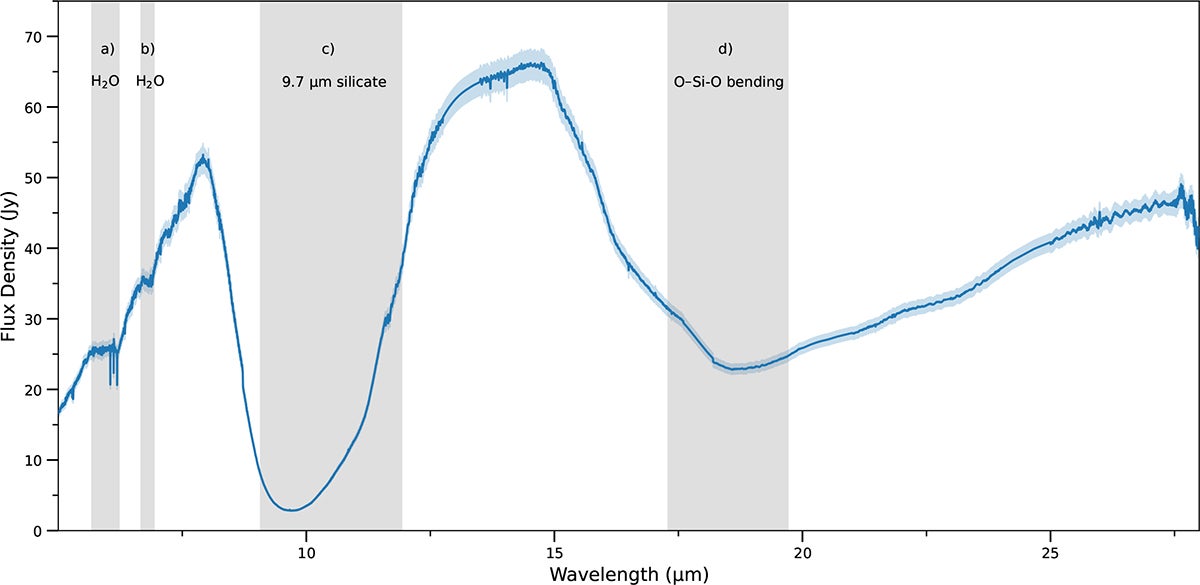
Using the James Webb Space Telescope, astronomers have now produced the first continuous mid-infrared spectrum of IRS 3. The observations reveal an oxygen-rich star surrounded by silicate dust, multiple shells of expelled material and clear signatures of water.
The work, led by PD Dr Florian Peißker of the University of Cologne’s Institute for Astrophysics, was published in Astronomy and Astrophysics. The team used Webb’s Mid-Infrared Instrument, or MIRI, to study wavelengths between 4.9 and 27.9 micrometers.
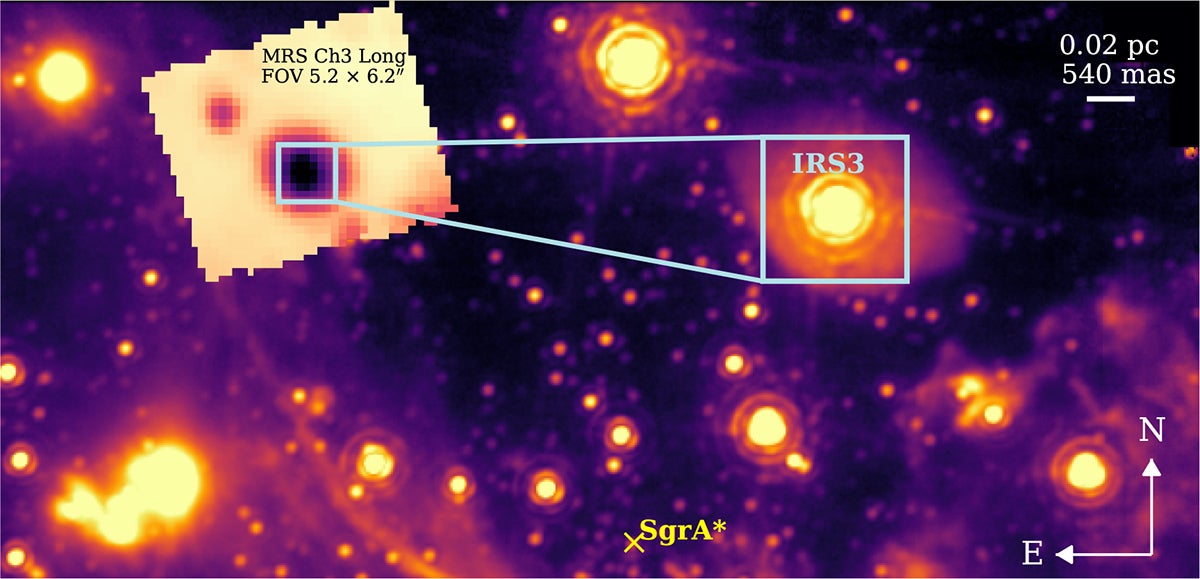
IRS 3 belongs to a class of aging stars called asymptotic giant branch, or AGB, stars. These stars have exhausted the helium in their cores and undergo strong pulsations that can push gas outward.
As the gas travels away from the star, it cools. Dust then condenses within the expanding material, creating a circumstellar envelope.
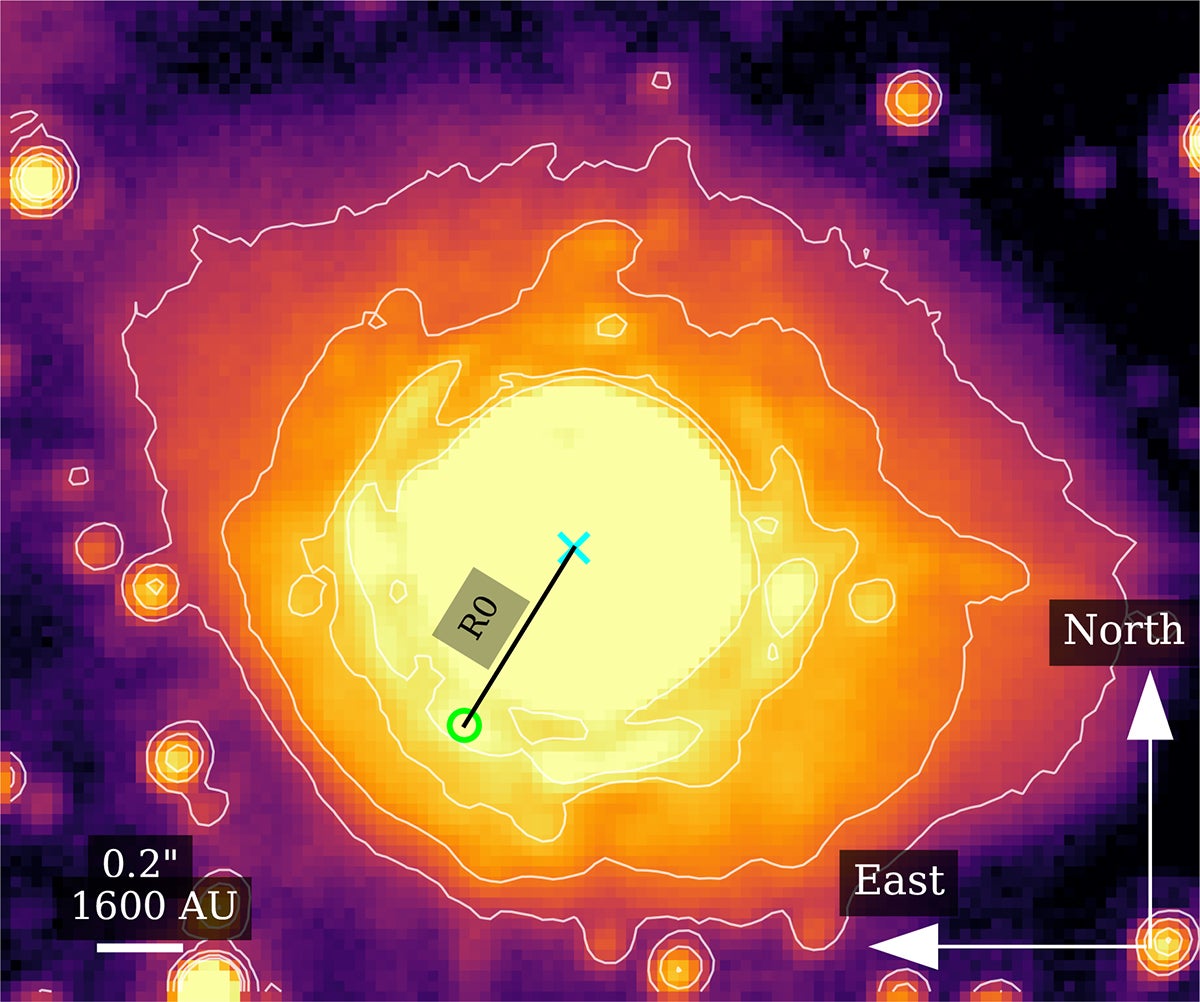
IRS 3 has an exceptionally large one.
Its dusty envelope extends roughly 10,000 astronomical units from the star. That scale is especially striking because the inner region around Sagittarius A* contains millions of stars, yet IRS 3 appears to stand alone as a prominent AGB star with such a large envelope.
The observations indicate that IRS 3 has entered an intense period of mass loss known as the superwind phase. The team estimated a mass-loss rate of about 6 × 10^-5 solar masses per year.
That corresponds roughly to the mass of Earth every 18 days.
Such rapid shedding can explain why the star has created a dense and continuously expanding envelope despite its location in one of the Milky Way’s most extreme stellar environments.
IRS 3 had previously been proposed as a carbon-rich AGB star. The new Webb spectrum points in another direction.
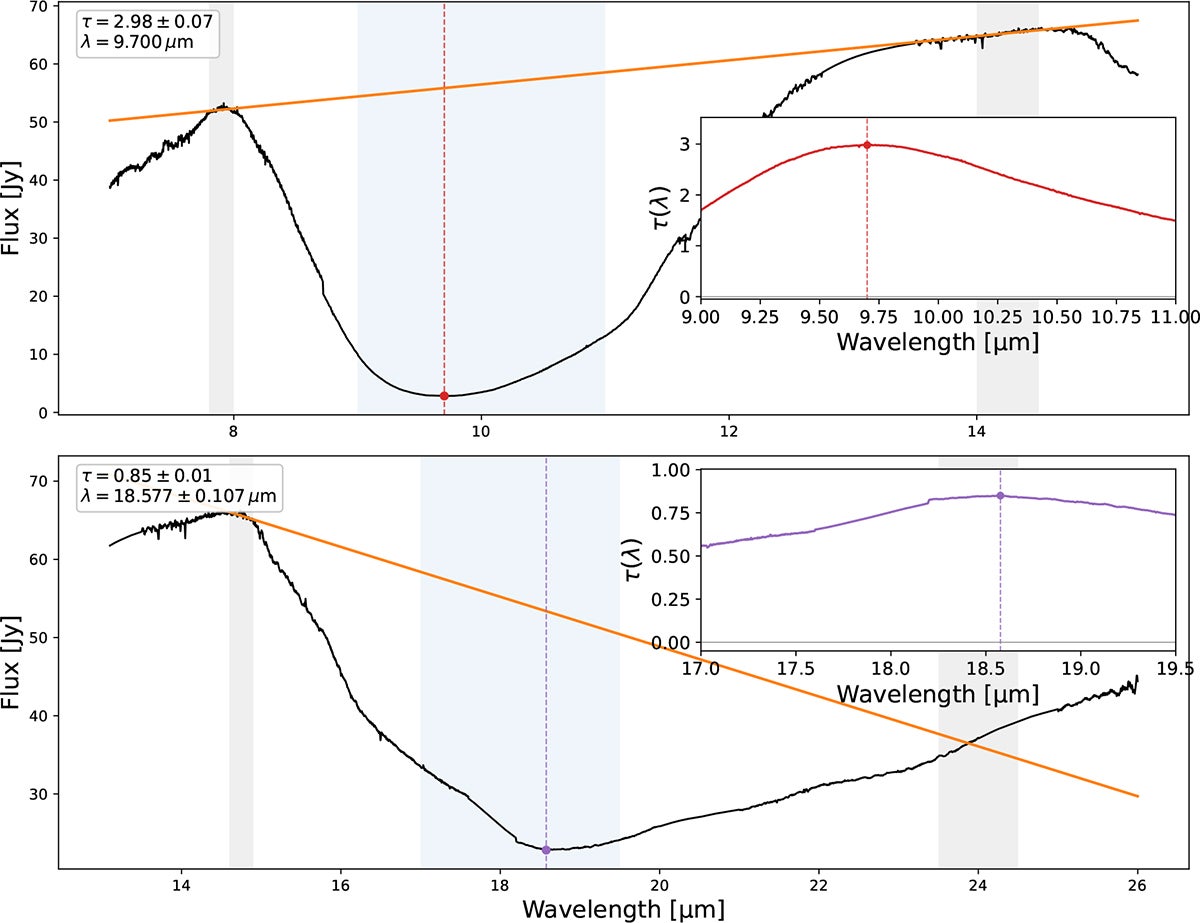
Two strong absorption features appear at wavelengths of 9.7 and 18.5 micrometers. They correspond to characteristic vibrations in silicate dust.
The team measured an optical depth of 2.98 ± 0.07 for the 9.7-micrometer feature and 0.85 ± 0.01 at 18.5 micrometers. Their ratio was 3.5 ± 0.1.
Those features fit an oxygen-rich AGB star whose envelope is dominated by silicate dust.
The astronomers tested three different extinction laws, which account for dust between Earth and the Galactic center that can distort observations. Although parts of the corrected spectra differed, each produced the same overall shape and supported the oxygen-rich classification.
Radiative-transfer models also favored oxygen-rich dust.
The preferred model gave IRS 3 a temperature of about 2,800 kelvins and a characteristic luminosity of 60,000 times that of the Sun. Stellar tracks placed its mass near six solar masses and its age at about 72 million years.
One of the most unusual features appeared near 6 micrometers.
The MIRI spectrum showed absorption lines between about 6.0 and 6.25 micrometers that match transitions from water molecules. Additional water signatures appeared between 6.7 and 7.0 micrometers.
The team modeled the shorter-wavelength feature using molecular transition data from HITRAN. Their model included water at a temperature of 700 kelvins and a column density of 1.5 × 10^17 molecules per square centimeter.
Other broad absorption structures remain harder to identify. They could include ices, large molecules, foreground material or effects from the extinction correction. The researchers therefore treated those components cautiously.
The water detection itself carries particular importance because IRS 3 exists close to Sagittarius A*, where radiation and interactions with surrounding material create harsh conditions.
Rather than having its molecular material completely destroyed, IRS 3 appears able to maintain a substantial envelope containing water.
The Webb data also indicate that the envelope is not a simple, smooth cloud.
Models favored several shells containing dust at different temperatures and distances. The innermost regions reach about 1,200 kelvins, while outer components cool to roughly 80 to 100 kelvins.
Earlier ALMA observations had identified still more distant shells around IRS 3. Together, the observations may provide a record of different stages in the star’s mass-loss history.
Assuming a typical AGB wind speed of about 15 kilometers per second, material at different shell radii corresponds to approximate expansion times of 300, 700, 2,000 and 3,200 years.
Still more distant material seen with ALMA could have been traveling outward for about 5,000 years.
Those layers may have formed through changing rates of stellar outflow. Interactions with Sagittarius A* or a possible stellar companion could also contribute, but the study does not establish which mechanism dominates.
IRS 3 also produces a bow shock where its wind collides with surrounding interstellar material. The measured stand-off distance is about 4,316 astronomical units.
Using that structure, the researchers estimated the density of the surrounding material and found evidence that conditions in the inner Galactic center are highly uneven.
IRS 3 offers astronomers a rare view of how an aging star can continue producing and preserving dust near a supermassive black hole.
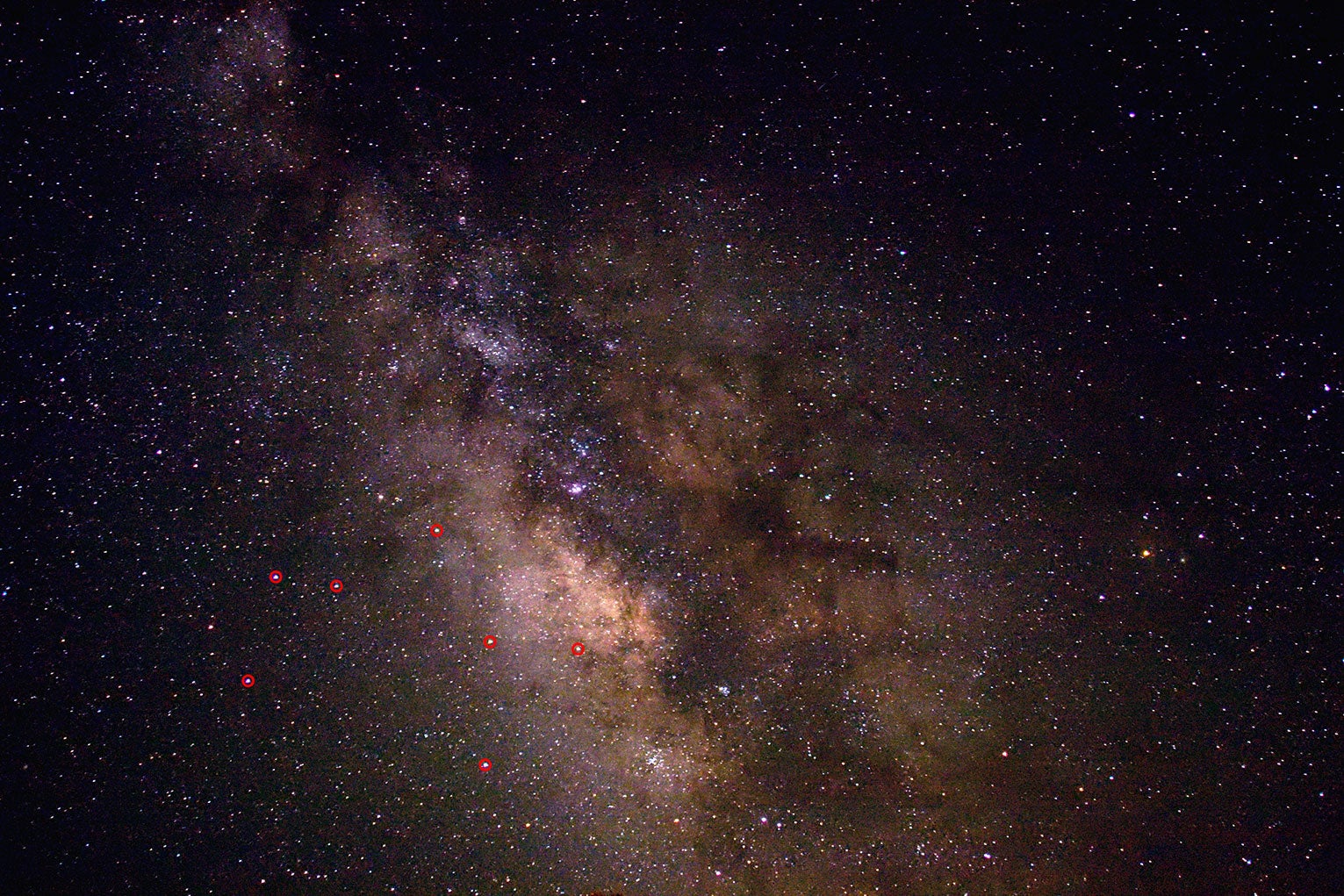
Its high mass-loss rate could replenish material in the immediate surroundings of Sagittarius A*. The findings also offer a possible clue to why so few large red giants with prominent envelopes are observed in the inner parsec. Stars losing material more slowly may have their envelopes stripped away before they become similarly conspicuous.
The water detection further shows that molecules can persist inside a sufficiently dense stellar envelope despite the Galactic center’s difficult environment.
Future observations could sharpen that picture. Researchers at the University of Cologne are helping develop METIS, an instrument planned for the Extremely Large Telescope in Chile’s Atacama Desert. Its observations could probe the structure of IRS 3 in greater detail and help distinguish between episodic stellar outflows, interactions with surrounding gas and possible gravitational effects from Sagittarius A*.
These resources explore oxygen-rich aging stars, molecular and dust production, stellar mass loss, and the unusual population of evolved stars surrounding Sagittarius A*.
ATOMIUM: Molecular inventory of 17 oxygen-rich evolved stars
This large molecular survey examined 17 oxygen-rich AGB stars and red supergiants, identifying a rich circumstellar chemistry that includes highly excited water lines and other molecules linked to stellar winds and dust formation. (Astronomy & Astrophysics, 2024)
Water vapour masers in long-period variable stars III. Mira variables R Cas, U Her, and R Leo
Long-term observations of water emission from evolved stars show how H2O behaves inside their changing circumstellar envelopes, providing useful context for understanding water surviving in material expelled by stars such as IRS 3. (Astronomy & Astrophysics, 2024)
Contemporaneous high-angular-resolution imaging of the oxygen-rich AGB star W Hya from visible to millimeter wavelengths
High-resolution observations across several wavelengths probe the atmosphere, molecular gas and dusty surroundings of the oxygen-rich AGB star W Hydrae, helping researchers understand how material moves outward and develops into an extended stellar envelope. (Astronomy & Astrophysics, 2024)
Age and metallicity of the Milky Way’s nuclear star cluster
This analysis finds that most of the Milky Way’s nuclear star cluster is old and metal-rich while also containing younger populations, providing important context for the unusual mix of stars living around Sagittarius A*. (Astronomy & Astrophysics, 2026)
Nuclear stellar disk-like nature in the kinematics of SiO maser stars around the Galactic center
ALMA measurements of evolved SiO maser stars near Sagittarius A* reveal their three-dimensional motions and suggest many belong to the Milky Way’s nuclear stellar disk, improving our understanding of where aging stars fit within the crowded Galactic center. (Publications of the Astronomical Society of Japan, 2025)
Research findings are available online in the journal Astronomy and Astrophysics.
The original story “JWST finds water around a dying star near the Milky Way’s central black hole” is published in The Brighter Side of News.
Like these kind of feel good stories? Get The Brighter Side of News’ newsletter.
The post JWST finds water around a dying star near the Milky Way’s central black hole appeared first on The Brighter Side of News.


Leave a comment
You must be logged in to post a comment.