The pace, pitch and word choices of everyday speech may carry clues about aging that extend beyond a person’s voice. A large Latin American study found that older-appearing speech profiles were associated with brain aging, memory difficulties and molecular markers of biological aging.
The findings, published in Science Advances, come from 2,928 Spanish-speaking participants across Argentina, Chile, Colombia, Mexico and Peru. The research involved the Multi-Partner Consortium to Expand Dementia Research in Latin America, known as ReDLat. Senior author Agustin Ibanez is a professor at Trinity College Dublin’s Global Brain Health Institute and School of Medicine.
The team developed a machine-learning “speech clock” that estimates chronological age from acoustic and linguistic features. Its broader value may lie in how those estimates differ from actual age. However, the tool remains a research candidate, and the mainly cross-sectional study cannot establish whether it predicts future dementia.
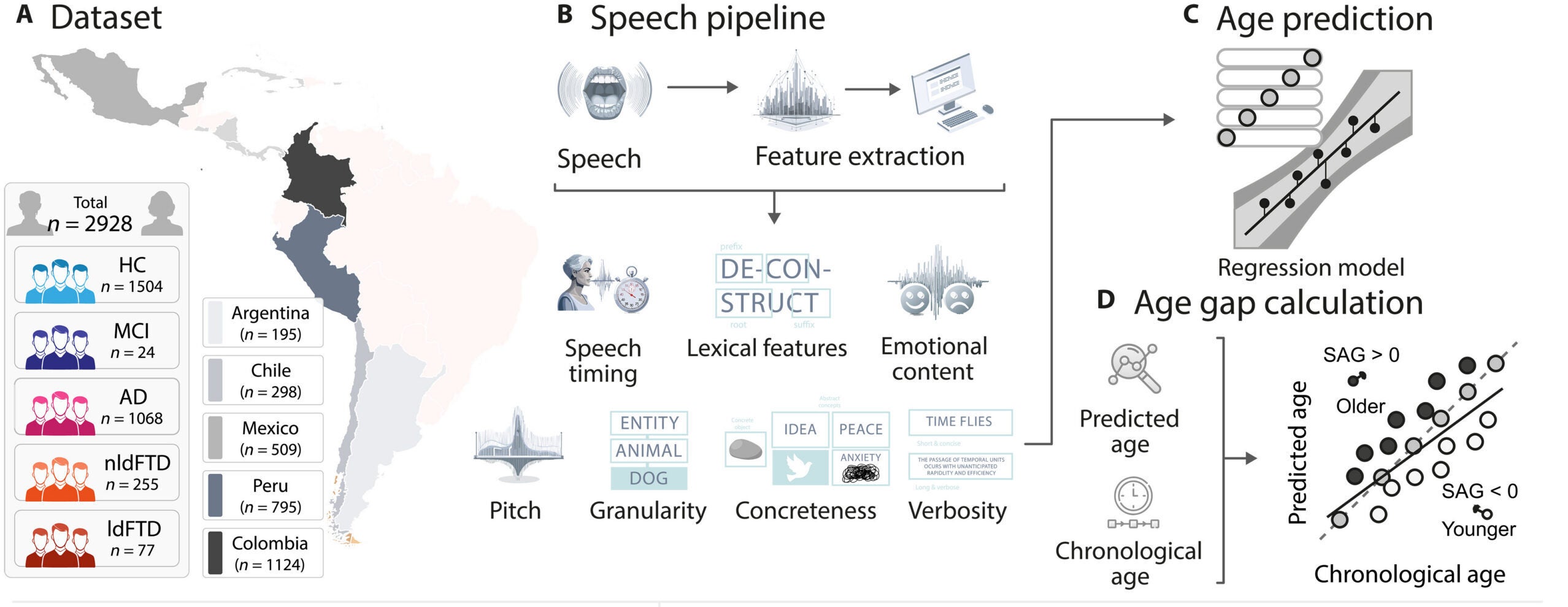
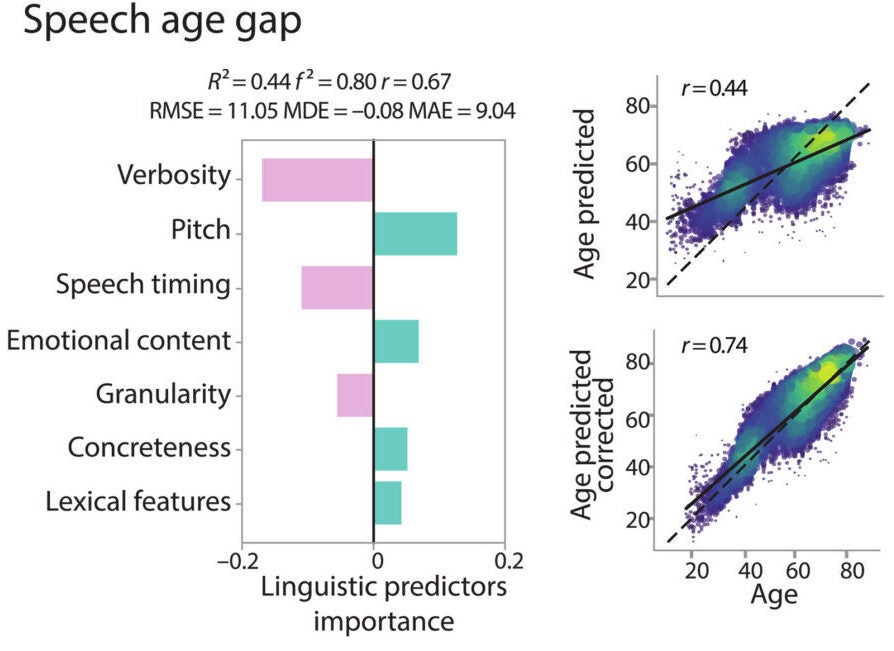
The models examined hundreds of characteristics describing both how participants spoke and what they said. These included speaking rate, pauses, pitch, emotional content, vocabulary, semantic precision and the amount of verbal output. Combining them allowed the researchers to investigate an aging signal across several speech dimensions.
The cohort included 1,504 cognitively healthy participants and 1,424 people with clinical diagnoses. Among the latter were 24 with mild cognitive impairment, 1,068 with Alzheimer’s disease and 332 with frontotemporal dementia syndromes. Those syndromes included forms with prominent language difficulties and forms dominated by other symptoms.
Using standardized speech recordings, the researchers trained models to estimate age and tested performance through cross-validation. One composite model explained 44% of the variation in chronological age. Its mean absolute error was 9.04 years, underscoring that these estimates were far from precise individual age measurements.
The team then calculated each participant’s speech-age gap by subtracting actual age from predicted age. A positive gap described speech that appeared relatively older. A negative gap indicated a relatively younger-appearing profile, rather than proving slower biological aging.
The speech-age gap correlated with brain-age gaps calculated from structural and functional magnetic resonance imaging. The association was strongest for a measure combining both imaging types, with a correlation of 0.53. Structural and functional measures separately produced correlations of 0.42 and 0.49.
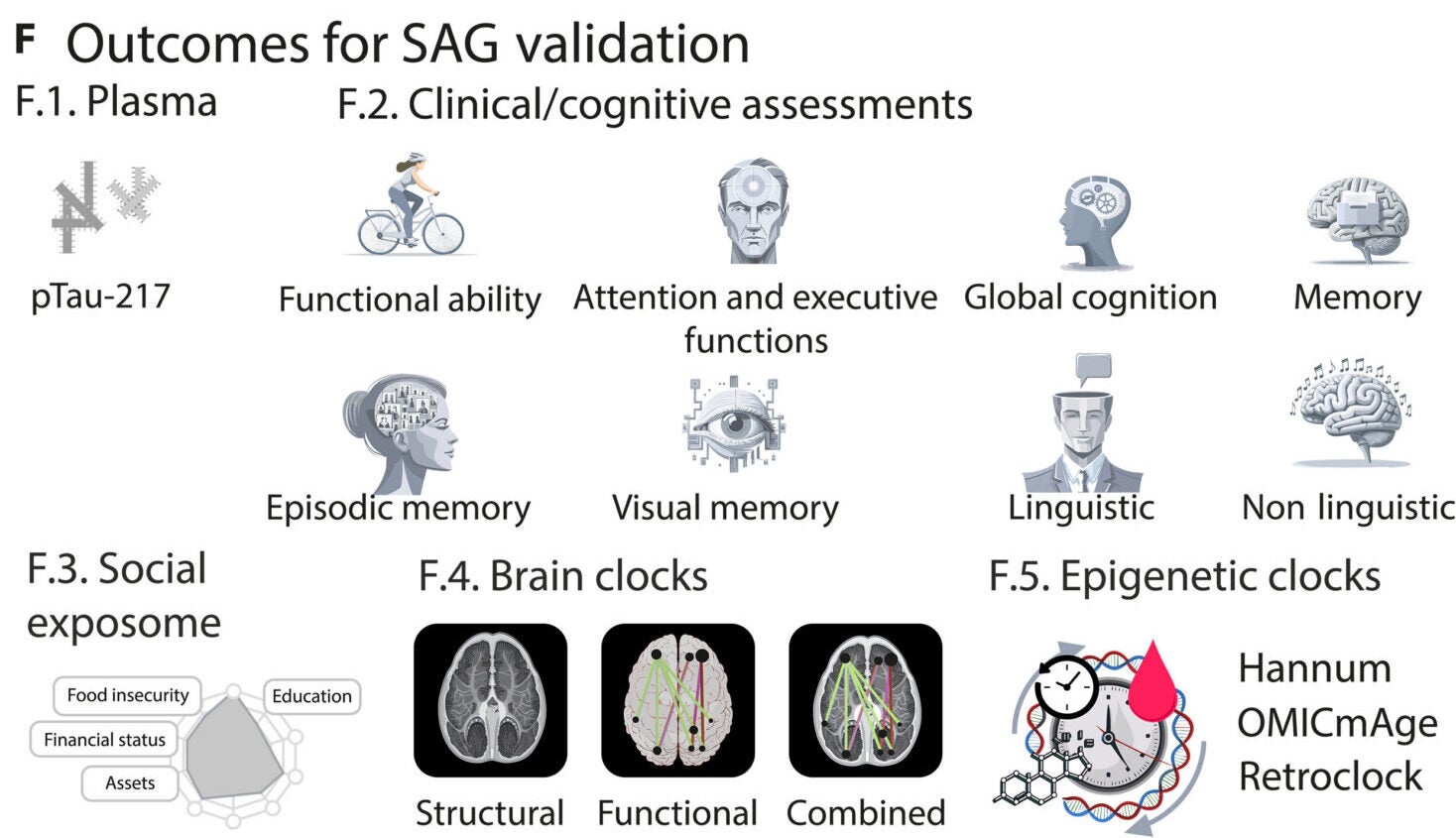
These results suggest that speech carries information related to broader brain aging patterns. They do not make a recording equivalent to an MRI scan. Different methods capture different aspects of aging, and the observed correlations leave substantial variation unexplained.
The team also compared speech-age gaps with three DNA-methylation clocks: Hannum, Retroclock and OMICmAge. These estimate biological age using chemical marks on DNA. All three showed positive associations with older-appearing speech, although the overall correlations were smaller, around 0.20–0.21.
Consistent associations across all three methylation clocks appeared in healthy participants and those with Alzheimer’s disease. Biomarker information was unavailable for some participants, so these comparisons used subsets of the full cohort. That missing information also leaves room for selection bias.
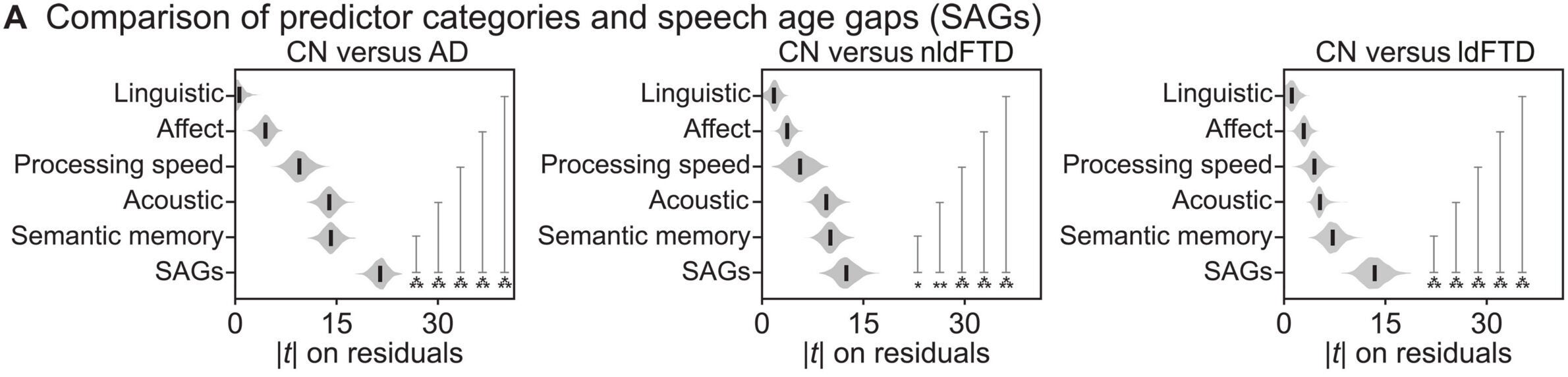
Healthy participants had smaller speech-age gaps than every clinical group. Among the dementia groups, language-dominant frontotemporal dementia produced the largest gaps. The combined speech-age measure distinguished diagnostic groups better than individual speech-feature domains considered separately.
Larger gaps also accompanied poorer global cognition, executive function, functional abilities and several memory measures. The most consistent associations across all assessed domains appeared in Alzheimer’s disease and non-language-dominant frontotemporal dementia. Results in other groups varied by the domain examined.
The associations extended beyond tests requiring spoken answers or other language processing. Across the cohort, older-appearing speech related to poorer performance on both linguistic and nonlinguistic assessments. The relationship was stronger for linguistic tasks, but speech was not simply reproducing a language-test score.
In Alzheimer’s disease, larger gaps were also associated with higher blood levels of phosphorylated tau 217, or p-tau217. This is a biomarker associated with Alzheimer’s pathology. The within-group correlation was modest, at 0.18, and the analysis did not establish a causal relationship.
Speech-age gaps also related to a composite measure of lifelong social conditions. This “social exposome” combined education, financial circumstances, food insecurity, healthcare access and early-life experiences. More adverse profiles were associated with larger gaps across the cohort.
When the researchers examined individual diagnostic groups, that association was significant in healthy participants and people with Alzheimer’s disease. It was not significant in the other groups. The findings therefore do not support a uniform social-adversity relationship across every dementia syndrome.
“Our voice appears to contain much more information about aging than we previously recognised,” Ibanez said. The appeal is practical: speech recordings could potentially provide an accessible complement to assessments requiring blood samples, molecular assays or specialized imaging.
Recording speech remotely and repeatedly could help expand research where advanced testing is difficult to access. The five-country cohort also strengthens evidence from a region historically underrepresented in dementia research. Wider access remains a potential application rather than a demonstrated clinical service.
The study primarily compared participants at one point in time. It cannot determine whether a speech-age gap reflects an ongoing acceleration of aging. Nor can it show whether someone with an older-appearing profile will later develop cognitive decline or dementia.
Other uncertainties include differences in microphones, recording conditions and speech prompts. Automated tools may contain cultural or dialect biases, while mood and medical conditions may influence speech. Some diagnostic groups were small, particularly the 24-person mild cognitive impairment group.
Validation must also extend beyond Spanish-speaking Latin American participants and relatively structured speaking tasks. Longitudinal studies, additional languages and more natural conversation settings will be necessary before clinical implementation. For now, the speech clock offers evidence that several dimensions of aging partly converge in speech, with its predictive value still to be established.
These resources examine speech analysis, its diagnostic limitations and the broader factors shaping dementia risk.
Diagnostic utility of speech-based biomarkers in mild cognitive impairment: a systematic review and meta-analysis: Evaluates evidence for distinguishing mild cognitive impairment through speech and highlights validation needs. (Age and Ageing, 2025)
Natural language processing in Alzheimer’s disease research: Systematic review of methods, data, and efficacy: Reviews computational language methods and the challenges of applying them across datasets and languages. (Alzheimer’s & Dementia: Diagnosis, Assessment & Disease Monitoring, 2025)
Acoustic Speech Analysis in Alzheimer’s Disease: A Systematic Review and Meta-Analysis: Synthesizes evidence on acoustic differences between people with Alzheimer’s disease and healthy controls. (The Journal of Prevention of Alzheimer’s Disease, 2024)
A systematic review of the quantitative markers of speech and language of the frontotemporal degeneration spectrum and their potential for cross-linguistic implementation: Examines speech markers across frontotemporal dementia syndromes and their transferability between languages. (Neuroscience & Biobehavioral Reviews, 2024)
Dementia prevention, intervention, and care: 2024 report of the Lancet standing Commission: Places dementia research within a broader assessment of risk factors, prevention and care. (The Lancet, 2024)
Research findings are available online in the journal Science Advances.
The original story “Large cognitive health study links speech patterns with brain aging” is published in The Brighter Side of News.
Like these kind of feel good stories? Get The Brighter Side of News’ newsletter.
The post Large cognitive health study links speech patterns with brain aging appeared first on The Brighter Side of News.


Leave a comment
You must be logged in to post a comment.