A metal struck by a powerful laser can enter a strange split state. Its electrons become intensely hot within femtoseconds, while its atoms remain comparatively cold. During that brief interval, the entire crystal structure may begin to change.
Calculations led by theoretical physicist Sam Azadi and his team at The University of Manchester suggest that these transformations do not require conventional lattice heating. Instead, the shifting population of electronic energy states can alter which crystal arrangement is most stable.
The research, published in Physical Review Materials, examined 17 elemental metals. Almost all showed at least one predicted solid-to-solid transition caused by electronic excitation alone.
“Our results suggest that electronic entropy should be regarded as a thermodynamic control parameter in its own right. Just as external pressure can transform one crystal structure into another, strong electronic excitation can reshape the free-energy landscape and create entirely new phases of matter,” Azadi said.
Ordinary structural transitions usually involve energy entering the atomic lattice. The atoms vibrate more strongly, cross an energy barrier, and settle into another arrangement.
A laser pulse creates a different sequence.
Electrons collide and reach a high-temperature distribution within a few femtoseconds. Electron-phonon interactions, which transfer that energy to the atoms, take hundreds of femtoseconds or several picoseconds.
That delay opens a short window when the electronic system is hot but the lattice has barely moved. The ions still respond to forces, however, so a changed electronic environment can begin driving structural motion before traditional heating takes over.
The researchers analyzed this condition using finite-temperature density functional theory. Their calculations tracked the Helmholtz free energy of three common crystal structures as electronic temperatures rose to 7 electronvolts.
Those structures were hexagonal close-packed, or hcp; face-centered cubic, or fcc; and body-centered cubic, or bcc. Each arranges atoms differently and can carry a different free energy, density, and electronic structure.
Electronic entropy measures how electrons spread among available energy states. As electronic temperature rises, occupations broaden around the Fermi level, the highest occupied energy region at low temperature.
This redistribution changes bonding, screening, pressure, magnetism, and the relative stability of competing structures.
The effect becomes especially important in transition metals. Their narrow, partly filled d-bands contain rapidly changing distributions of electronic states. Small shifts in occupancy can therefore produce large changes in free energy.
The simulations covered zirconium, titanium, cadmium, zinc, cobalt, magnesium, nickel, copper, silver, aluminum, platinum, lead, chromium, tungsten, vanadium, niobium, and molybdenum.
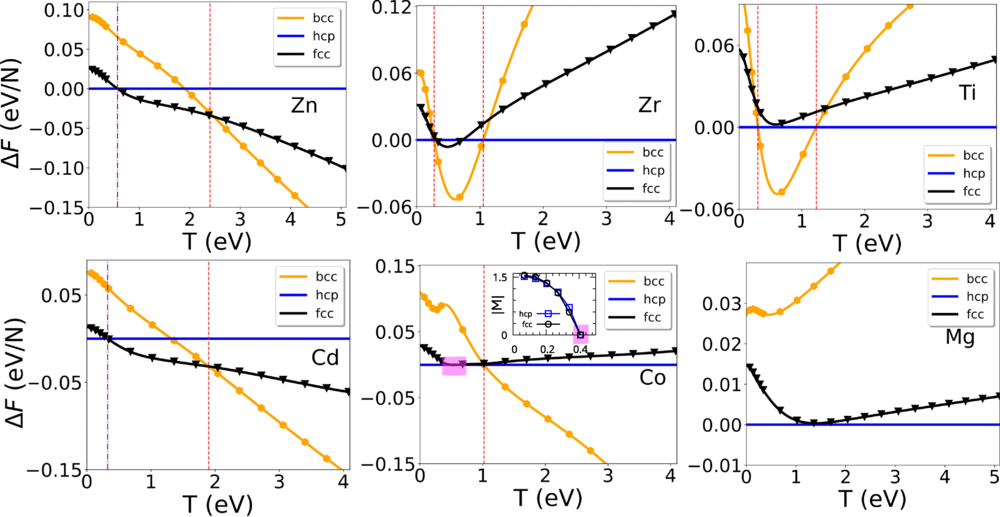
Most changed structure at least once. Magnesium and lead were the main exceptions within the temperature range studied.
The precise pathways differed sharply among elements. Zinc and cadmium shifted from hcp to fcc, then to bcc at higher electronic temperatures. Zirconium and titanium moved from hcp to bcc before returning to hcp.
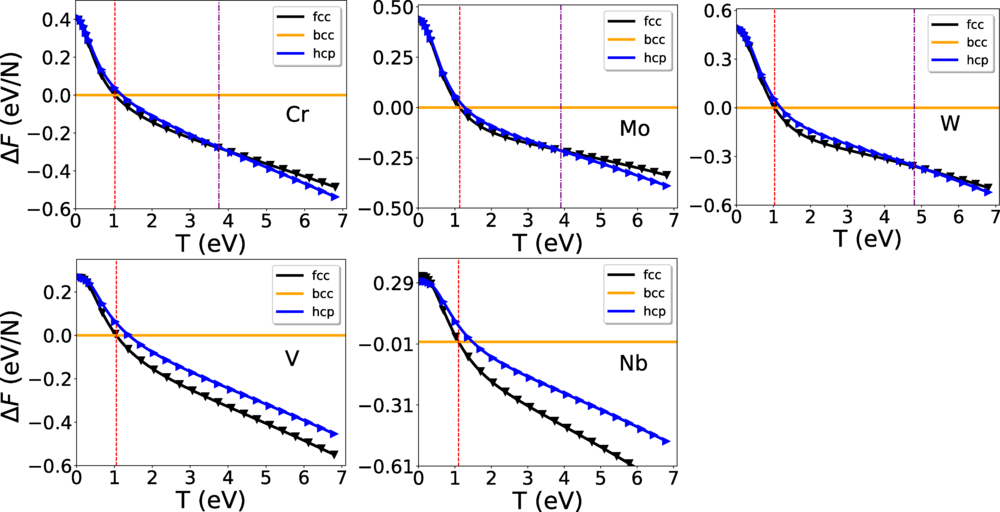
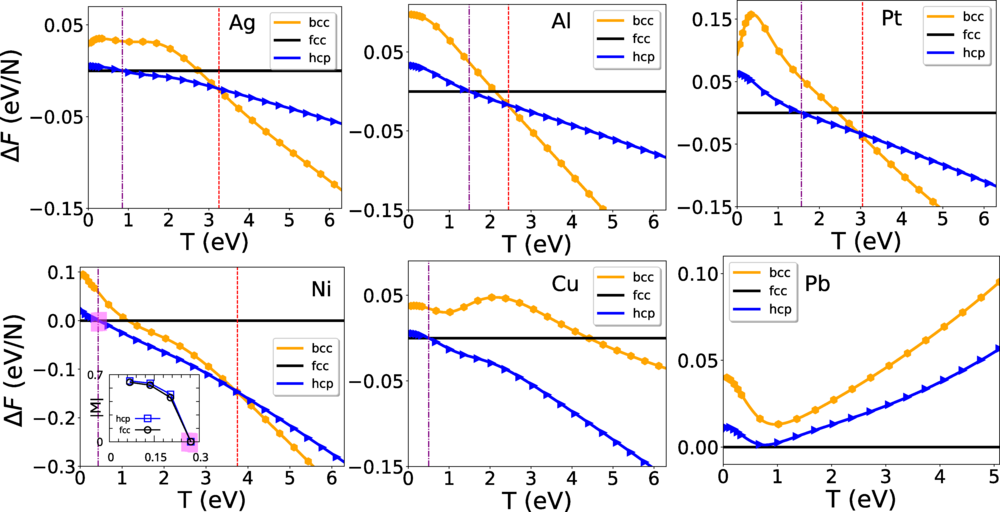
Nickel, silver, aluminum, and platinum moved from fcc to hcp and later to bcc. Copper showed an fcc-to-hcp transition. Chromium, molybdenum, and tungsten changed from bcc to fcc, then to hcp.
Vanadium and niobium made a single predicted change from bcc to fcc.
A broad pattern linked the transitions to electronic thermal pressure. Heating the electrons populates higher-energy states, creating an expansive electronic force even before the ions become hot.
That pressure often favored structures with lower mass density and larger volume per atom.
All five metals that began in the bcc group moved toward a lower-density structure as electronic temperature increased. The original bcc arrangement did not return within the simulated range.
Many metals that began in fcc or hcp structures eventually favored bcc when that phase had the lowest density. Magnesium remained hcp because its hcp structure was already less dense than the alternatives.
Lead also resisted structural change. Its fcc phase remained the lowest-density and lowest-free-energy option throughout the calculations.
Density did not explain everything.
Zirconium provided the clearest exception. Its bcc phase was denser than the hcp structure, yet became stable between electronic temperatures of about 0.27 and 1.05 electronvolts.
The explanation came from zirconium’s electronic density of states. Near the first transition, the bcc phase had more than twice the d-band density of states found in the hcp phase at a key energy below the Fermi level.
That difference produced a stronger entropy contribution and lowered the bcc free energy. At higher temperature, the electronic advantage weakened, allowing hcp zirconium to regain stability.
Cobalt and nickel revealed another layer of complexity. Both are magnetic at low temperature, but their calculated magnetic ordering collapsed as electronic temperature rose.
Cobalt lost its magnetization at about 0.4 electronvolts. Its bcc structure became stable near 1 electronvolt.
Nickel’s magnetization disappeared at about 0.3 electronvolts. Its predicted fcc-to-hcp transition occurred below 0.5 electronvolts.
These overlaps suggest that magnetic collapse and structural instability can develop within the same electronically excited regime.
The researchers did not simulate the complete, real-time atomic pathway. Their results identify where the free energies of ideal crystalline structures cross, showing when the electronic system favors a different symmetry.
An actual laser-driven transformation could pass through distortions, metastable arrangements, or disordered states before reaching another crystal structure.
The calculations provide specific targets for ultrafast experiments. Time-resolved X-ray or electron diffraction could search for temporary symmetry changes and new diffraction peaks before lattice heating, expansion, or melting becomes dominant.
Such measurements could test whether electronic entropy alone can reorganize a metal. The predicted regime has not yet been directly observed.
The work also suggests that femtosecond laser pulses might offer temporary control over crystal structure. A pulse could push a metal into a short-lived phase unavailable under normal equilibrium conditions, then allow it to return as the electrons cool.
That possibility remains a prediction, not a demonstrated switching technology. Still, the phase diagrams can guide experiments by identifying promising elements and electronic temperatures.
More broadly, treating electronic entropy as an independent control variable could improve models of laser-excited materials, warm dense matter, ultrafast magnetism, and other systems far from equilibrium.
Research findings are available online in the journal Physical Review Materials.
The original story “‘Laser-heated electrons can reshape metals in a billionth of a second” is published in The Brighter Side of News.
Like these kind of feel good stories? Get The Brighter Side of News’ newsletter.
The post Laser-heated electrons can reshape metals in a billionth of a second appeared first on The Brighter Side of News.

