Alpha Centauri sits more than four light-years away, close enough to fascinate generations of dreamers and far enough to make today’s rockets look painfully limited. At current speeds, a trip there would take far longer than a human lifetime, or even many civilizations. A new set of experiments points to a very different idea, one in which light itself does the pushing.
Engineers at Texas A&M University have built tiny devices that can be lifted, pushed and steered by laser light without any physical contact. The objects, called metajets, move because their surfaces are carefully structured to redirect light in ways that generate force. In the lab, that force was strong enough to produce not just motion across a surface but controlled movement in three dimensions.
The work comes from Dr. Shoufeng Lan, an assistant professor in the J. Mike Walker ’66 Department of Mechanical Engineering, and researchers in his Lab for Advanced Nanophotonics. Their study describes a way to build control into the material itself, rather than relying only on shaping the incoming beam. That difference matters because it could make light-based propulsion more flexible and easier to scale.
Lan compares the effect to ping pong balls bouncing off a surface. Light carries momentum, and when it reflects or refracts, some of that momentum transfers to the object it hits. The force is small, but it is real, and with the right design it becomes useful.
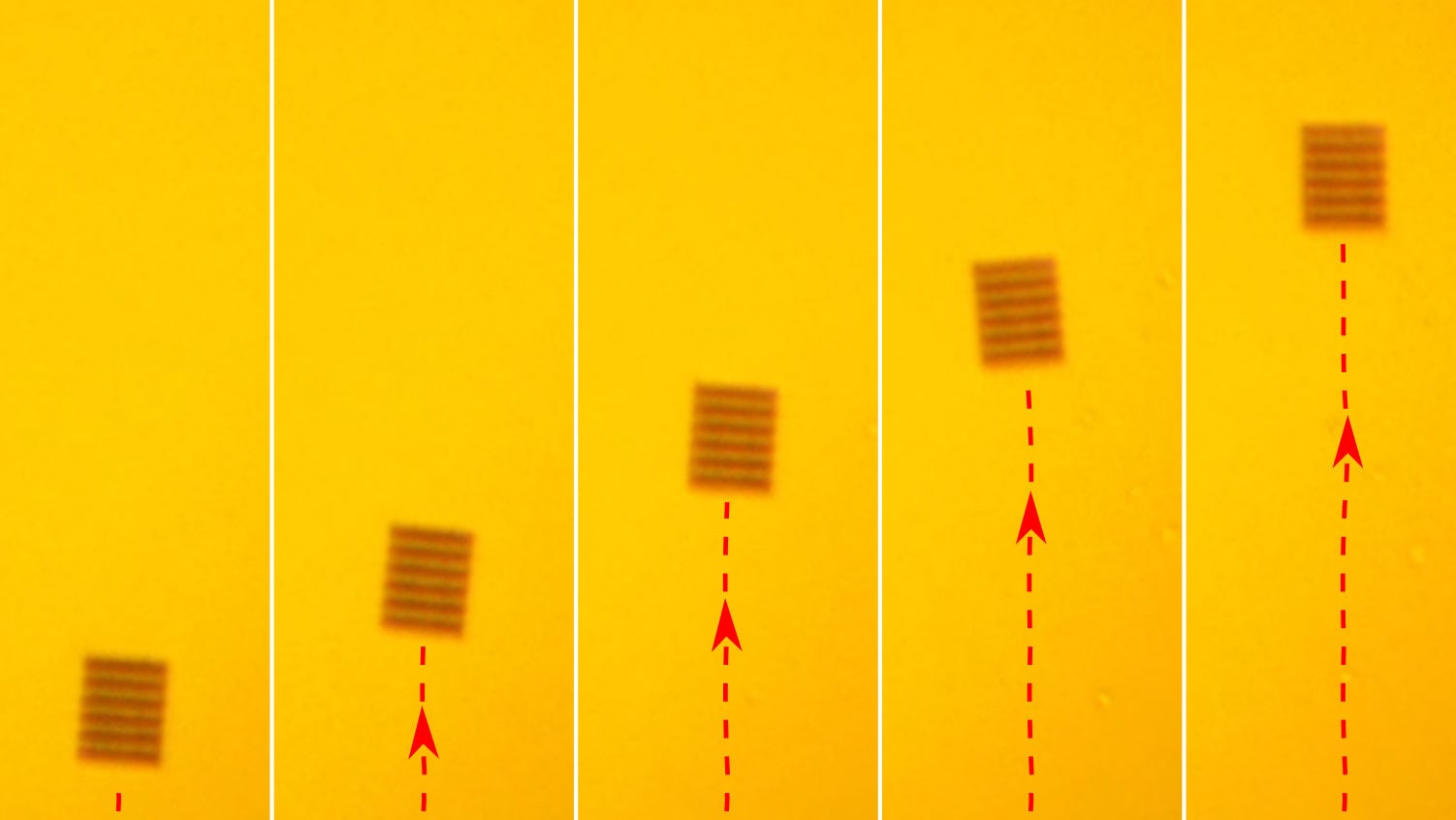
The metajets are made from metasurfaces, ultrathin materials patterned at the nanoscale so they can control how light behaves. Instead of using a traditional curved lens to bend light, the researchers engineered microscopic features that shift the phase of light across the surface. That lets them redirect the beam with much finer control.
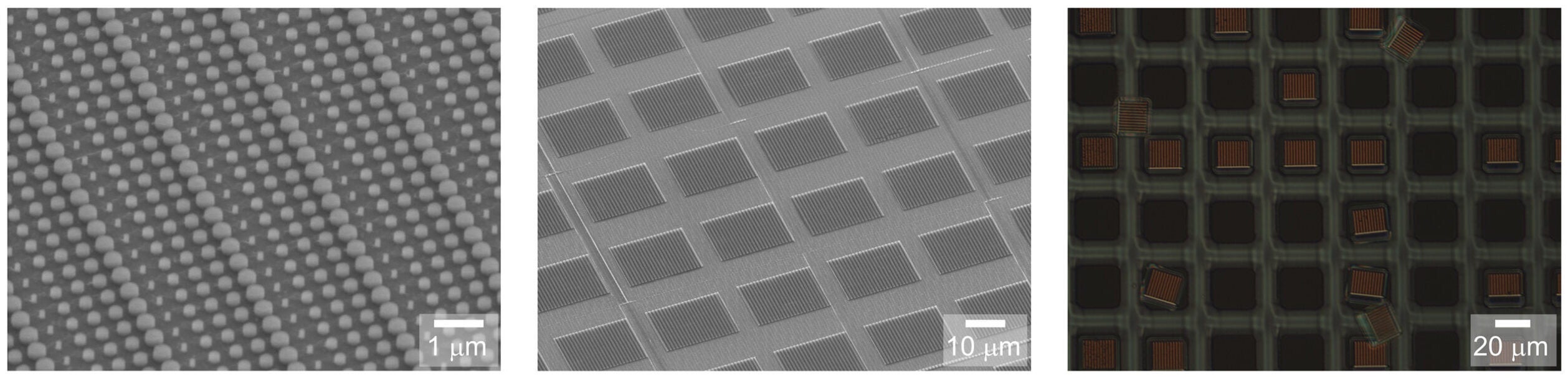
Each metajet is built from arrays of tiny silicon pillars on a silicon dioxide base. The height, spacing and diameter of those pillars were adjusted so the device would strongly refract light at a wavelength of 1 micrometer. By changing how much the phase shifts from one unit cell to the next, the team could tune the angle of the outgoing light, and with it the direction and strength of the resulting force.
That is the key idea behind the motion. If light leaves the object at a certain angle, the object gets pushed the other way. The researchers describe this as a metaphotonic force, a force that comes from the change in momentum between incoming and outgoing light at the metasurface.
Their broader point is that both the input and the output light matter. Earlier work in this area often focused on controlling the outgoing light alone. Here, the team built a framework based on Newton’s law of motion and Snell’s law to describe how structured surfaces can generate controllable optical forces through reflection and refraction.
The group tested several versions of the metajets, each with a different supercell design. In simple terms, they varied the number of pillars used to produce a full phase shift across the surface. Fewer pillars created a steeper phase gradient, which increased the refraction angle and strengthened the sideways force.
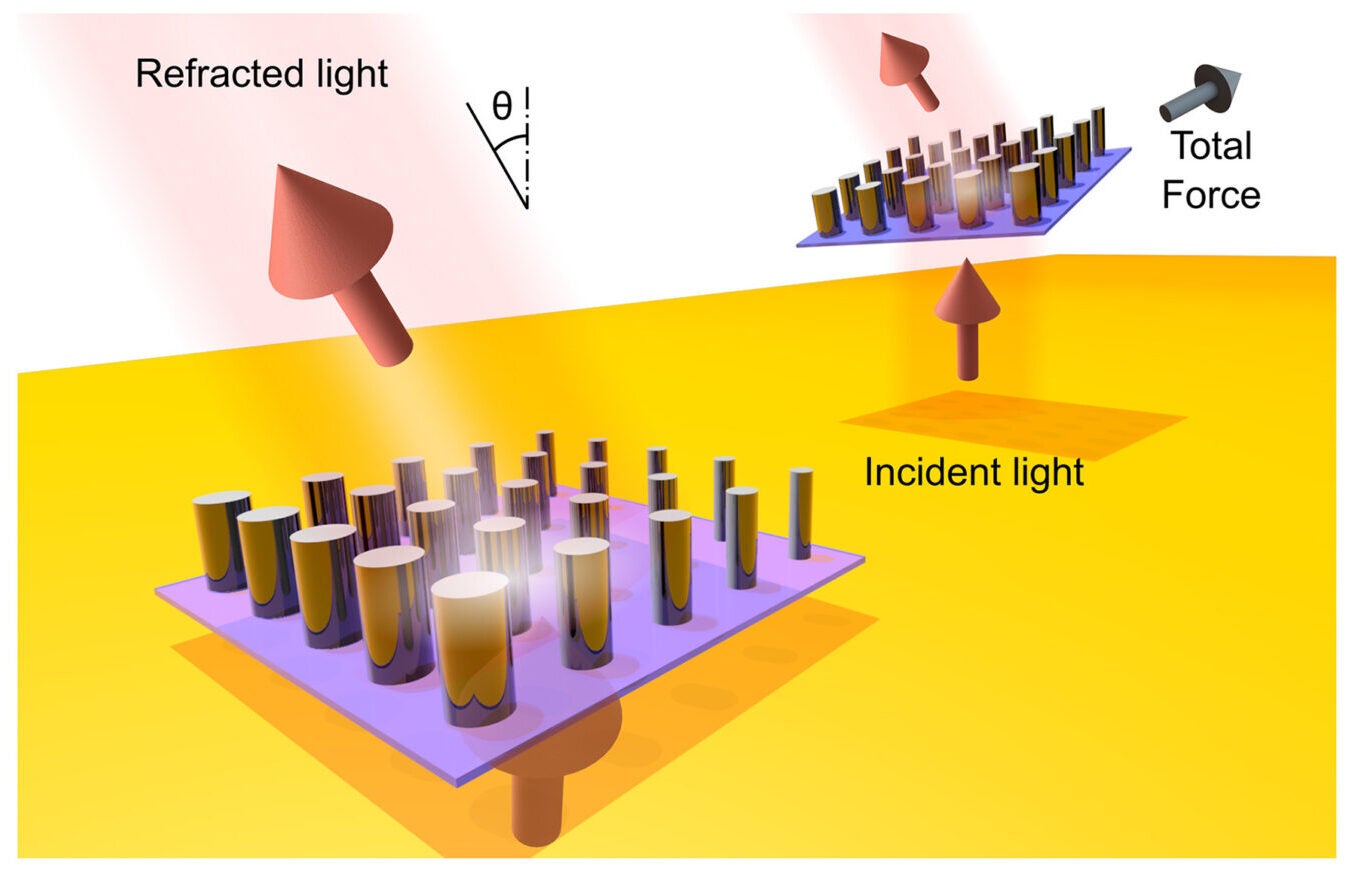
One design produced a refraction intensity of 58%, enough for the team’s initial motion experiments. When placed in a liquid cell and illuminated from below by a linearly polarized laser beam, the metajet moved in the direction predicted by the theory, opposite the refracted light.
The experiments showed a clear pattern. As the phase gradient increased, the horizontal speed of the metajet also increased. Designs with fewer pillars in each supercell tended to create higher refraction efficiency in the desired diffraction order and faster in-plane motion.
The devices did more than slide. They also levitated.
In repeated measurements, the researchers tracked the metajets moving along the x direction while also rising in the z direction. The horizontal motion came from an in-plane force tied to the phase gradient. The vertical motion came from the out-of-plane component of the optical force. Together, those effects created simultaneous propulsion and levitation.
That three-dimensional maneuverability is one of the most striking parts of the study. The team says this kind of full 3D control had not previously been demonstrated with this optical propulsion approach.
The devices themselves are extremely small, only tens of microns across, smaller than the width of a human hair. Fabricating them required nanoscale precision in shape, orientation and placement. The work was carried out at the Texas A&M AggieFab Nanofabrication Facility with support from the Texas A&M Engineering Experiment Station and the university.
The experiments also happened in a fluid environment, partly to offset gravity and make the motion easier to observe. That is an important limitation. The metajets were not tested in microgravity, and the team is now seeking outside funding to move the work into that setting, where light-driven propulsion could be studied without gravity complicating the results.
There were other practical constraints as well. In some recordings, the researchers noted minor tilting caused by residual contact with the substrate and small surface irregularities. They reported that those effects were small compared with the main refraction-driven motion, but they still mark the system as an early-stage experimental platform.
Even so, the study argues for something bigger. The force depends on the power of the light rather than the overall size of the device. In principle, that means the same physics does not have to stay trapped at microscopic scales. If enough optical power were available, similar ideas could be extended much farther.
That possibility helps explain why light sails and interstellar travel keep appearing in discussions around this field. Lan noted related work from groups in Europe, as well as efforts in the United States at the California Institute of Technology on propulsion stability and at Rochester Institute of Technology using diffractive grating platforms. The Texas A&M work adds a broader physics framework and an experimental demonstration of controllable motion in multiple directions.
The immediate value of the study is not a starship launch pad. It is a clearer way to control objects with light, without touching them and without onboard fuel. That matters for research areas where delicate manipulation is essential, including biology, chemistry and physics.
For now, the metajets are microscopic and the testing conditions are tightly controlled. But the experiments show that motion can be designed into a surface itself. A laser then becomes both power source and steering mechanism.
That opens the door to tiny light-driven systems that could one day move through specialized environments with high precision. Farther out, the same physical principles could inform much larger propulsion concepts, including spacecraft that rely on powerful beams instead of conventional propellant.
Reaching Alpha Centauri in a few decades remains a distant ambition, not an engineering reality. But this work suggests that light, once treated mostly as illumination, may also be part of how future vehicles move.
Research findings are available online in the journal Cell Press Newton.
The original story “Laser-powered, ‘metajets’ could be the future of interstellar flight” is published in The Brighter Side of News.
Like these kind of feel good stories? Get The Brighter Side of News’ newsletter.
The post Laser-powered, ‘metajets’ could be the future of interstellar flight appeared first on The Brighter Side of News.

