Nearly a mile beneath South Dakota, an experiment built to catch some of the universe’s most elusive particles has recorded one interaction that scientists cannot easily explain.
That single event is not a dark matter discovery. It is, however, unusual enough that researchers with the LUX-ZEPLIN experiment, known as LZ, have decided the wider physics community should take a close look.
“We’re very intrigued to see this event in the data, in the region where we expect dark matter to show up, and the competing backgrounds are very low,” said Rick Gaitskell, a Brown University physics professor and LZ spokesperson. “With only one event, we don’t want to get ahead of ourselves. We are not claiming to have seen dark matter. But we have seen something interesting that we want to share with the scientific community for their input.”
The findings were presented Sept. 1 at the 2026 TeV Particle Astrophysics conference in Japan. The collaboration plans to release a paper on arXiv and submit it to Physical Review Letters.

The attraction is obvious. Dark matter accounts for roughly 85% of the universe’s matter, yet no experiment has directly identified the particle or particles responsible for it.
LZ searches primarily for weakly interacting massive particles, or WIMPs, one of the longstanding candidates for dark matter.
At the Sanford Underground Research Facility, its central detector contains about 7 tonnes of active liquid xenon inside a larger detector system. Sensors search for tiny flashes of light and freed electrons produced when a particle interacts with a xenon atom. Layers of surrounding detectors, water and nearly a mile of rock help suppress ordinary particles that could imitate dark matter.
The latest analysis used 220 live days of observations collected between March 27, 2023, and April 1, 2024.
Earlier work examined the same dataset for lower-energy signals expected from comparatively simple WIMP interactions. The new search expanded the nuclear-recoil energy range to about 270 kiloelectronvolts and tested interactions described by broader theoretical models.
“This was a detailed study in a region we hadn’t explored within this dataset, and we spent months of additional effort to understand all the possible causes of background events,” said Sam Eriksen of the University of Bristol, the study’s lead author.
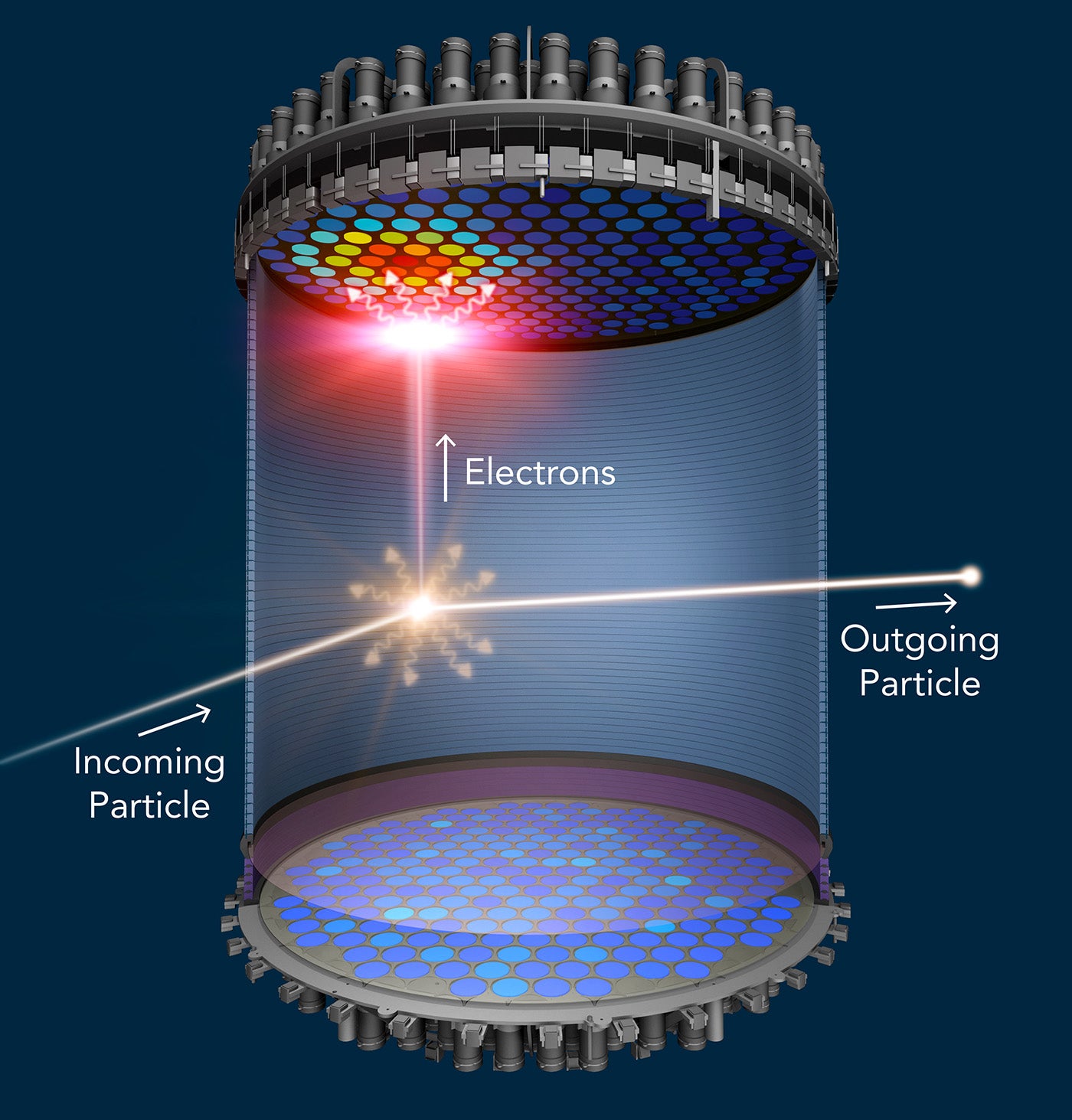
That expanded search is where the unusual event appeared.
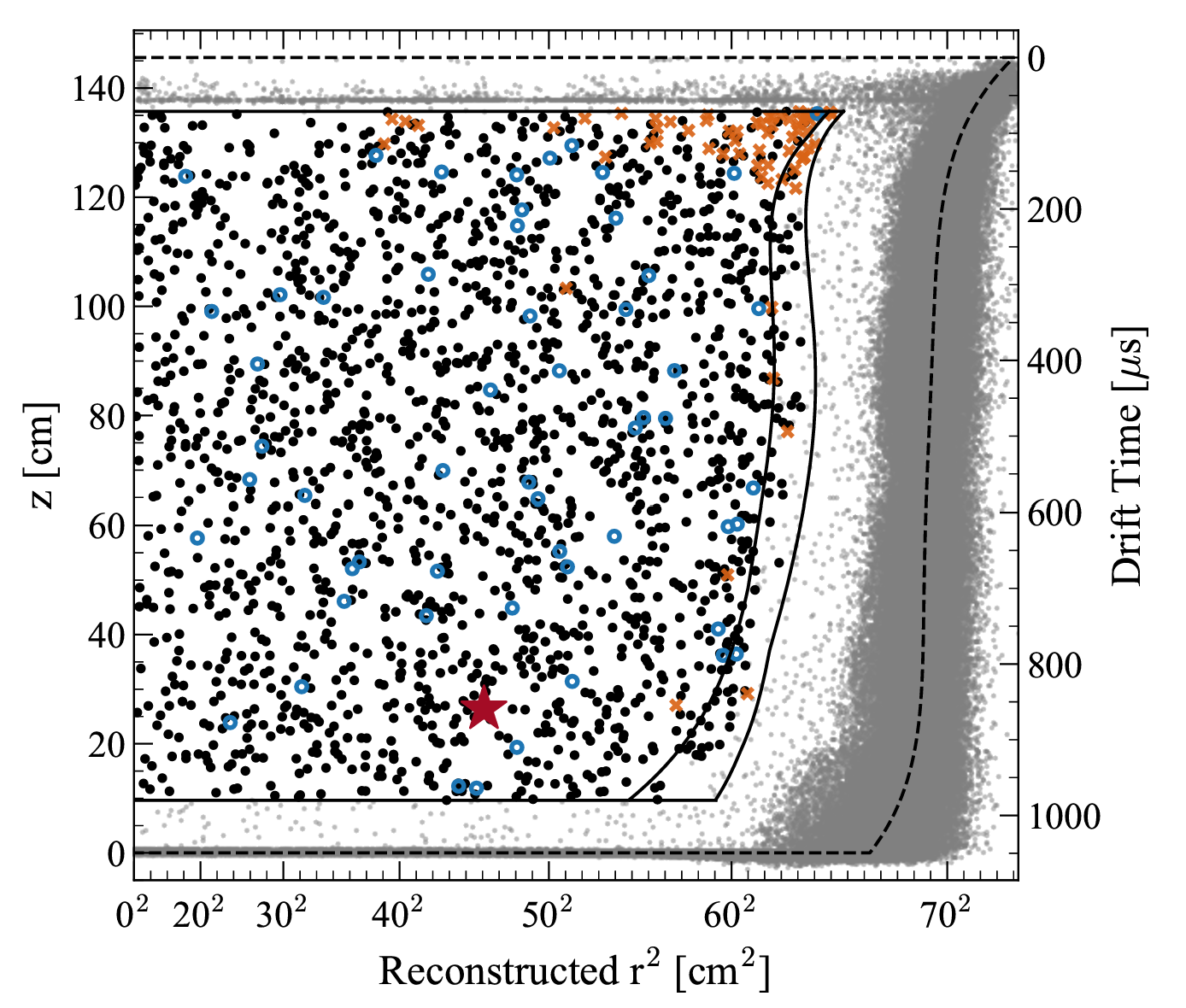
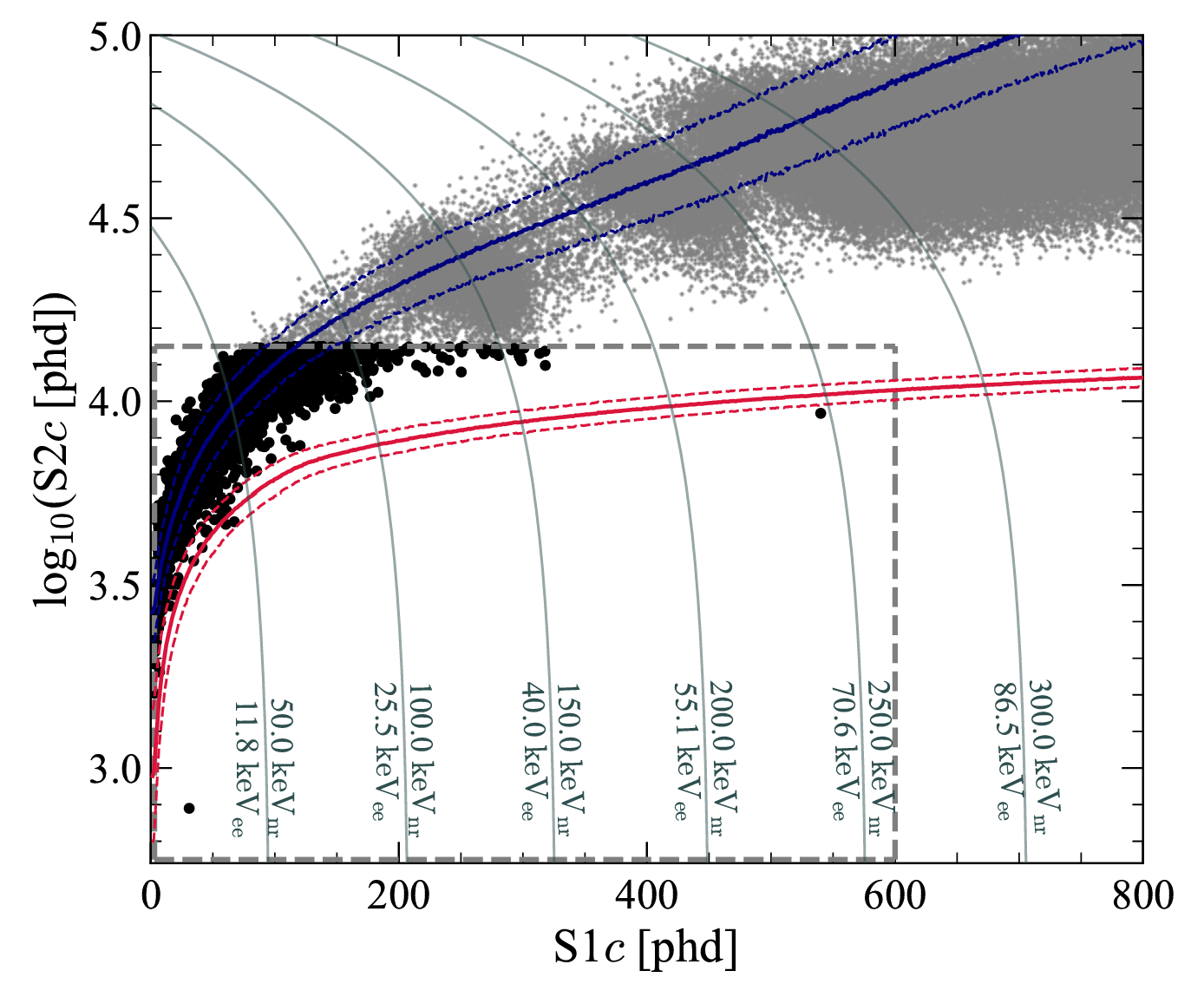
The event occurred on June 16, 2023. LZ reconstructed it as an elastic nuclear recoil with an energy of about 248 kiloelectronvolts, with statistical and systematic uncertainties of 23 kiloelectronvolts each.
That energy places it in a region where ordinary background events are exceptionally scarce.
Researchers examined possible explanations including radioactive decays, accidental combinations of detector signals, atmospheric neutrinos and neutrons generated by several processes. They also investigated detector conditions around the event.
A calibration source had been removed 25 minutes earlier, but it had been positioned on the opposite side of the detector. The previous neutron calibration occurred eight days earlier. No unusual detector behavior or suspicious population of surrounding events was identified.
“This is the first example in any experiment I’ve worked on of an outlier that appears valid in every way,” said Aaron Manalaysay, a Berkeley Lab physicist and chair of LZ’s institutional board.
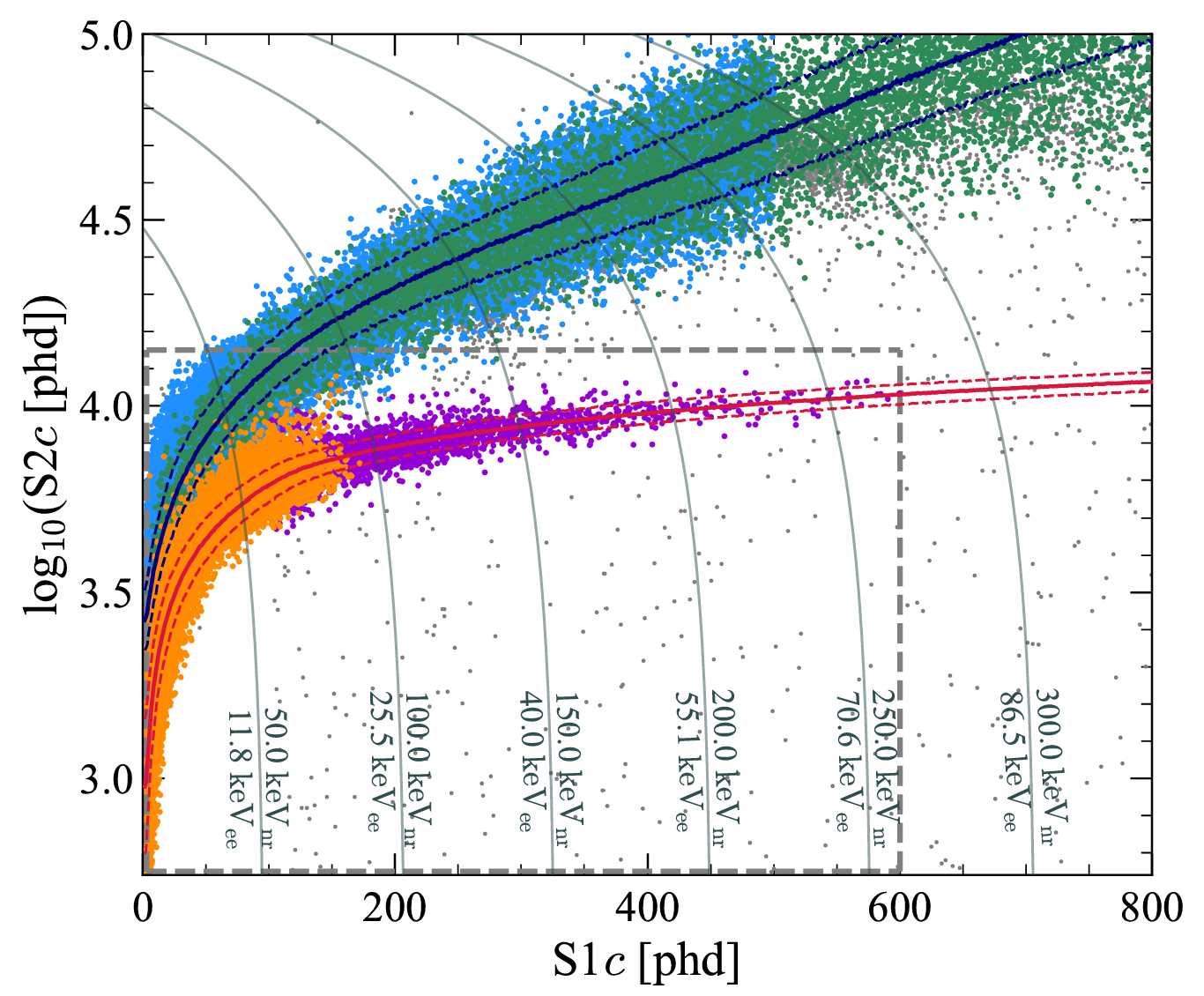
The statistical analysis reflects that tension. Some individual dark matter models produce a local significance above 3 sigma, with the maximum reaching about 3.4 sigma. After accounting for the fact that researchers tested many possible models, the overall, or global, significance drops to 2.6 sigma.
That is interesting, but it is nowhere near the 5-sigma threshold particle physicists generally require before announcing a discovery.
The event also does not fit comfortably into the simplest version of WIMP dark matter.
If a conventional WIMP had produced a recoil at such high energy, LZ would generally expect additional lower-energy recoil events. Only one exceptional event appeared.
The researchers therefore examined more complicated possibilities, including momentum-dependent interactions and inelastic scattering. In an inelastic interaction, a WIMP could change into a different mass state when it collides with ordinary matter, altering the energy spectrum expected inside the detector.
JiJi Fan, a Brown theoretical physicist who was not part of the LZ experimental analysis, said such models provide plausible ways to produce the observed pattern.
“There are well-motivated theoretical extensions, including inelastic scattering and momentum-dependent elastic scattering, that could potentially account for this single event,” Fan said.
For models producing the strongest preference for a dark matter signal, WIMP masses generally exceed about 200 GeV/c², more than 200 times the mass of a proton.
One unexplained particle interaction can disappear statistically when more observations arrive. It can also become the first member of a pattern.
That distinction now matters enormously for LZ.
The experiment has continued collecting observations under the same electric-field conditions since April 2024, giving researchers a larger dataset with which to test whether additional high-energy nuclear recoils appear.
Previous LZ results found no significant excess and established some of the world’s strongest limits on conventional WIMP interactions. A 2025 analysis using 4.2 tonne-years of exposure, for example, found no evidence above expected backgrounds.
The new event therefore stands apart precisely because the experiment has become so effective at understanding what normally appears inside its detector.
For now, it remains an unexplained interaction, not a particle identification.
But in an experiment designed to find events that almost never happen, one event in the right place can be enough to make physicists look very carefully at what comes next.
These studies show how LZ and other liquid-xenon experiments have narrowed the WIMP search while extending it toward more complicated forms of dark matter interaction.
Dark Matter Search Results from 4.2 Tonne-Years of Exposure of the LUX-ZEPLIN (LZ) Experiment: LZ’s preceding major WIMP search found no significant excess over expected backgrounds and placed world-leading constraints on conventional spin-independent and spin-dependent WIMP interactions, providing the immediate experimental context for the new anomalous event. (Physical Review Letters, 2025)
WIMP Dark Matter Search Using a 3.1 Tonne-Year Exposure of the XENONnT Experiment: The XENONnT collaboration independently searched for WIMP interactions in another large liquid-xenon detector and found no significant excess, placing stringent limits on spin-independent WIMP-nucleon scattering. (Physical Review Letters, 2025)
Constraints On Covariant WIMP-Nucleon Effective Field Theory Interactions from the First Science Run of the LUX-ZEPLIN Experiment: This LZ analysis expanded direct searches beyond conventional WIMP scattering by testing relativistic effective interactions involving different particle currents and dipole couplings. (Physical Review Letters, 2024)
First constraints on WIMP-nucleon effective field theory couplings in an extended energy region from LUX-ZEPLIN: LZ extended its original search window to nuclear recoils as high as 270 keV and tested elastic and inelastic WIMP interactions, establishing the analytical framework closely related to the new high-energy search. (Physical Review D, 2024)
Dark Matter Search Results from the PandaX-4T Commissioning Run: PandaX-4T used another multi-tonne liquid-xenon detector to search for nuclear recoils from dark matter, finding no significant excess and placing strong constraints on WIMP-nucleon interactions. (Physical Review Letters, 2021)
Research findings are available online in the journal arXiv.
The original story “LUX-ZEPLIN detector makes surprising discovery in search for dark matter” is published in The Brighter Side of News.
Like these kind of feel good stories? Get The Brighter Side of News’ newsletter.
The post LUX-ZEPLIN detector makes surprising discovery in search for dark matter appeared first on The Brighter Side of News.


Leave a comment
You must be logged in to post a comment.