A whisper of hydrogen that traveled across the Universe for billions of years has been pulled directly from radio observations, giving astronomers a new way to map the cosmic structures that surround galaxies.
Using South Africa’s MeerKAT telescope, astronomers detected the collective radio glow of neutral hydrogen at two periods in cosmic history. Instead of identifying individual distant galaxies, they measured the statistical pattern created by hydrogen spread across enormous volumes of space.
The work, led by researchers associated with The University of Manchester and the University of the Western Cape, appears in The Astrophysical Journal Letters. The team analyzed about 96 hours of MeerKAT observations and reported the first detection of the neutral-hydrogen intensity autopower spectrum using MeerKAT in interferometric intensity-mapping mode at redshifts near 0.32 and 0.44.
“This is a very exciting milestone,” said lead author Sourabh Paul. “Hydrogen intensity mapping has long been seen as a promising way to map the Universe efficiently, but the signal is extremely faint and difficult to isolate from foreground emission, human-made radio-frequency interference, and instrumental effects.”
Neutral hydrogen produces a distinctive radio emission known as the 21-centimetre line. In the laboratory, the signal appears at a frequency near 1,420 megahertz, but cosmic expansion stretches the wavelength as the signal travels toward Earth.
That redshift acts like a cosmic timestamp. By measuring the frequency at which the hydrogen signal arrives, astronomers can determine which period of the Universe they are observing.
Traditional hydrogen surveys attempt to detect individual galaxies. That becomes increasingly difficult with distance because the 21-centimetre signal is intrinsically weak.
Intensity mapping approaches the problem differently. Astronomers do not need to identify every galaxy. Instead, they measure the combined hydrogen emission from large numbers of unresolved galaxies and analyze fluctuations in that glow.
The result can provide a three-dimensional statistical picture of where hydrogen is concentrated. Because neutral hydrogen inhabiting galaxies traces the broader matter distribution, these maps can also reveal aspects of the cosmic web.
“With intensity mapping, we do not need to detect every individual galaxy,” said co-author Zhaoting Chen. “Instead, we can measure the collective signal from hydrogen across large cosmic volumes.”
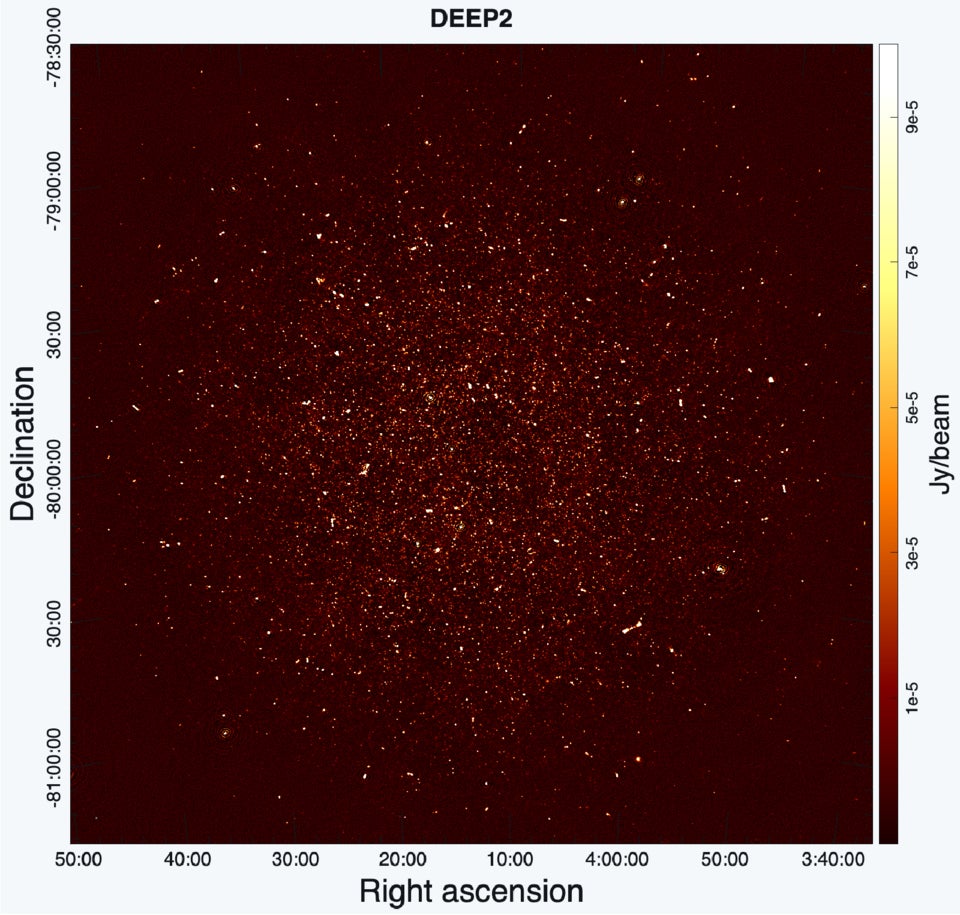
Detecting that combined glow is extraordinarily difficult.
Radio emission from the Milky Way, distant radio galaxies and other astrophysical sources can overwhelm the hydrogen signal. Human-generated radio-frequency interference, or RFI, adds another complication, while tiny calibration errors can produce patterns that resemble cosmological signals.
The observations used in the study were gathered during MeerKAT’s commissioning period in 2018. The telescope’s 64 dishes provide many short baselines, making the instrument especially sensitive to the spatial scales targeted by hydrogen intensity mapping.
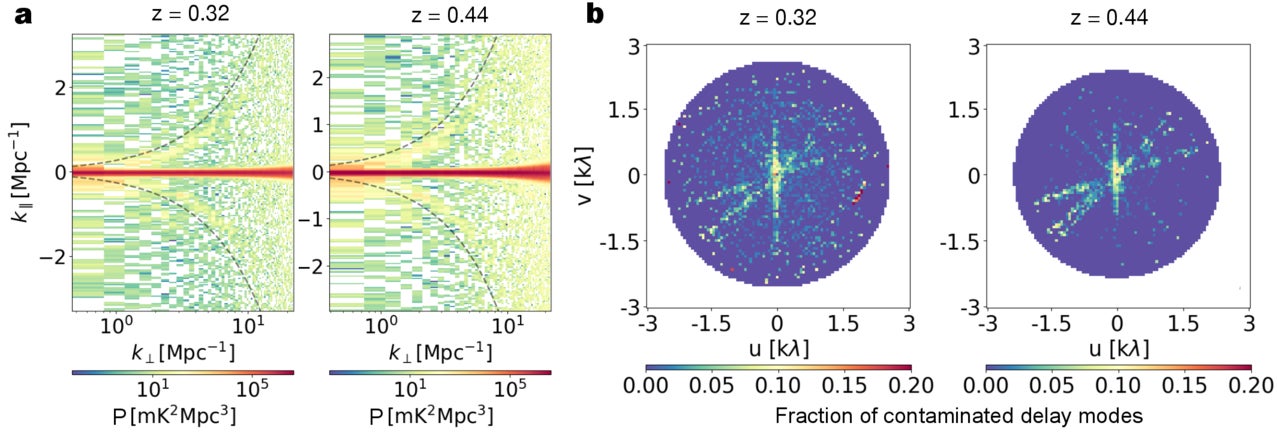
Researchers divided the data into two frequency ranges centered near 986 and 1,077.5 megahertz, corresponding to redshifts of approximately 0.44 and 0.32.
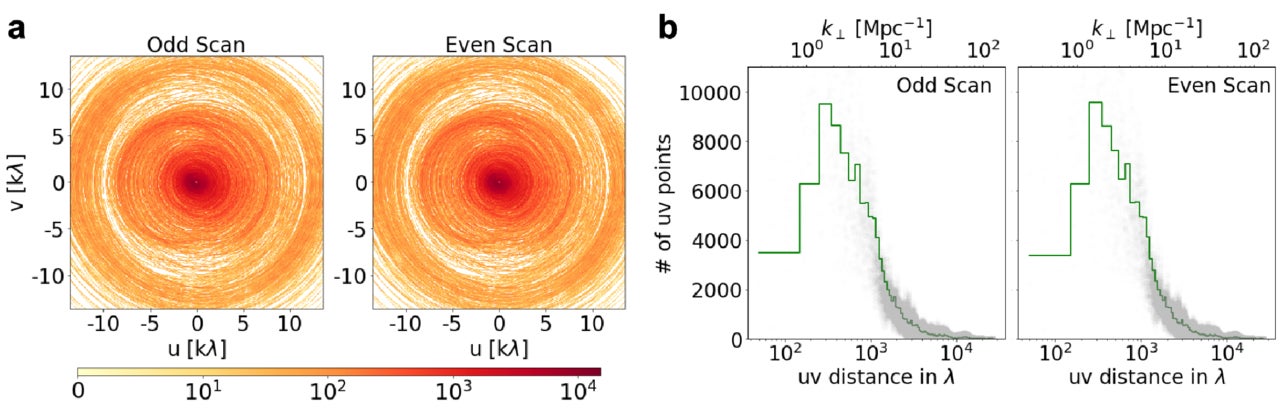
They also separated observations into independent time samples and cross-correlated them. That strategy helped remove noise bias and reduce the effect of systematics that changed with time.
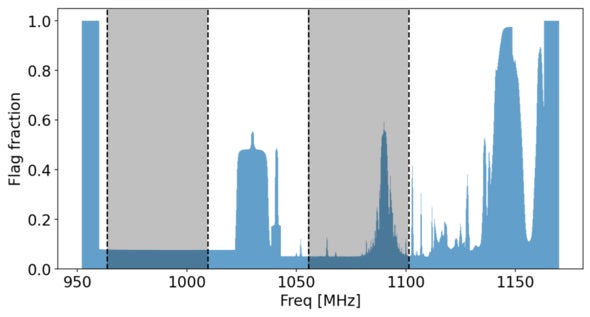
One persistent problem remained: weak broadband RFI that survived the initial cleaning.
The researchers therefore developed two different strategies for removing contaminated data. One identified problematic antenna pairs before calculating the power spectrum. The other searched the transformed data for unusually strong contaminated modes and removed those specific measurements.
Both approaches recovered consistent hydrogen power spectra, strengthening confidence that the detected signal was not simply an artifact of one cleaning technique.
The strength of the detection depended on which interference-removal method was used.
With the more conservative baseline-flagging procedure, the hydrogen power spectrum reached statistical significances of about 3.2 sigma at redshift 0.32 and 3.5 sigma at redshift 0.44.
The more selective method produced considerably stronger measurements. After excluding two bins considered more vulnerable to systematic contamination, the significances reached about 5.9 sigma and 9.18 sigma at the two redshifts.
The researchers carried out additional tests involving simulated calibration errors, signal loss, data gridding and null comparisons designed to reveal unwanted contamination.
They nevertheless acknowledge that radio-frequency interference is unavoidable at some level. The strength of the work lies partly in showing that the hydrogen signal remains measurable after different treatments of those effects.
“This was a challenging data analysis process, requiring a detailed understanding of the many sources of contamination that can affect such a faint measurement,” said Mario Santos. “It is particularly remarkable that the data used in this study were taken in 2018, when MeerKAT had only just started science operations.”
The measurements are especially sensitive to hydrogen fluctuations on scales of roughly one megaparsec, or about 3.26 million light-years.
At that scale, the team estimated the root-mean-square hydrogen brightness fluctuations at about 0.44 millikelvin at redshift 0.32 and 0.63 millikelvin at redshift 0.44.
The power spectrum contains more than a simple detection of hydrogen. Its shape can provide information about how neutral hydrogen occupies galaxies and dark-matter halos.
The researchers were already able to place preliminary constraints on hydrogen velocity dispersion, shot noise and properties of the hydrogen mass function. Larger datasets could eventually make those measurements substantially more precise.
That possibility makes intensity mapping attractive because it trades detailed images of individual galaxies for something different: rapid statistical mapping across huge cosmic volumes.
The achievement also carries importance for the Square Kilometre Array Observatory, or SKAO, for which MeerKAT serves as a precursor telescope.
Future surveys could observe much larger areas of sky and integrate for far longer, improving sensitivity while providing more opportunities to understand and remove instrumental contamination.
“MeerKAT continues to open new windows for cosmology,” said Laura Wolz of The University of Manchester. “The fact that this signal can be extracted from observations that were not originally designed for hydrogen intensity mapping is very encouraging.”
As those measurements improve, neutral hydrogen could help astronomers follow the distribution of matter across cosmic time, study how galaxies acquire and lose gas, and investigate how dark matter organizes the vast filamentary structures of the Universe.
For now, the significance is more fundamental. Astronomers have demonstrated that an exceptionally faint collective hydrogen signal can be extracted directly from radio observations alone.
A technique long discussed as a future method for cosmology is beginning to behave like a working one.
These resources explore how 21-centimetre intensity mapping can trace cosmic structure and the technical challenges that must be solved before it becomes a precision cosmology tool.
Revealing cosmological fluctuations in 21 cm intensity maps with MeerKLASS: from maps to power spectra: Reviews the scientific potential of MeerKLASS and explains how wide-area neutral-hydrogen surveys could turn MeerKAT into a major cosmology instrument. (Astrophysics and Space Science, 2026)
H I intensity mapping with MeerKAT: power spectrum detection in cross-correlation with WiggleZ galaxies: Reports an earlier MeerKAT detection obtained by cross-correlating radio intensity maps with an optical galaxy survey, providing an important predecessor to radio-only measurements. (Monthly Notices of the Royal Astronomical Society, 2023)
H I intensity mapping with MeerKAT: forecast for delay power spectrum measurement using interferometer mode: Models how MeerKAT interferometric observations and delay-spectrum techniques can recover the neutral-hydrogen power spectrum while separating foreground contamination. (Monthly Notices of the Royal Astronomical Society, 2023)
Research findings are available online in The Astrophysical Journal Letters.
The original story “MeerKAT detects a faint hydrogen signal from billions of years ago” is published in The Brighter Side of News.
Like these kind of feel good stories? Get The Brighter Side of News’ newsletter.
The post MeerKAT detects a faint hydrogen signal from billions of years ago appeared first on The Brighter Side of News.


Leave a comment
You must be logged in to post a comment.