For decades, cosmologists have had an awkward number sitting at the center of their equations.
The universe is expanding, and that expansion began speeding up in the recent cosmological past. The usual way to describe that behavior is with a positive cosmological constant, often written as Λ. But when physicists try to calculate that value using quantum field theory, the answer comes out wildly wrong, up to 120 orders of magnitude larger than what astronomers actually observe.
That mismatch is one of the biggest unresolved problems in modern physics. A new paper in Physical Review D does not claim to solve it outright. But researchers from the University of Thessaly in Greece argue that a strange ingredient from quantum gravity, microscopic wormholes flickering through spacetime foam, could generate an effective cosmological constant of the right kind, and possibly behave like a dark energy sector as well.
The paper starts from a familiar tension in cosmology. One route is to keep general relativity and treat dark energy as something dynamical, rather than a fixed constant. Another is to modify gravity itself so that it behaves differently on cosmic scales.
The new work tries to combine those paths.
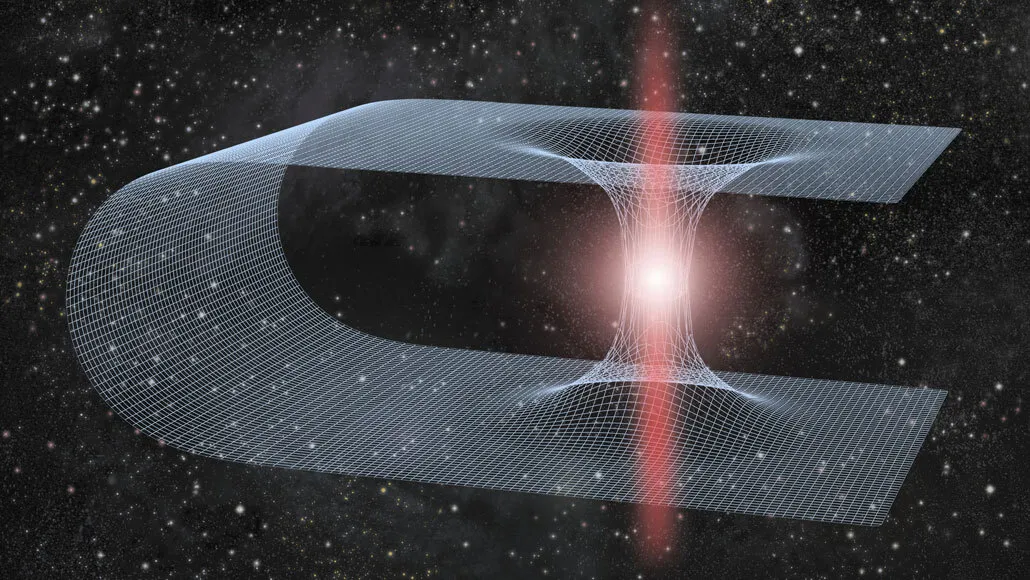
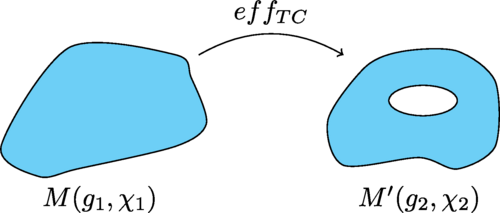
Instead of treating spacetime as a perfectly smooth background, the authors consider a more unruly picture. In Euclidean quantum gravity, they note, tiny objects such as instantons and wormholes can appear at the level of spacetime foam. If enough of those objects form, even briefly, they can change the topology of the underlying manifold, the deep mathematical structure used to describe spacetime.
That topological shift matters because it changes the Euler characteristic, a quantity tied to the shape of a manifold. In the paper, a Euclidean wormhole with topology S1×S3S^1 times S^3S1×S3 lowers the Euler characteristic by 2. A Nariai instanton with topology S2×S2S^2 times S^2S2×S2 raises it by 2.
The idea is abstract, but the payoff is concrete. If these microscopic topology changes are built into the variation of the gravitational action, the math produces an extra term in the field equations.
The researchers first show that this procedure does not do much to the standard Einstein-Hilbert action. In four dimensions, that part of the theory gives back the usual semiclassical Einstein equations.
The interesting result appears when they add the Gauss-Bonnet term.
In four dimensions, the Gauss-Bonnet term is usually treated as topological. At the classical level, it does not change the field equations in the usual way. But the authors argue that once the manifold itself changes topology because of microscopic wormholes, the variation is no longer trivial.
They write that “the variation of the Gauss-Bonnet term on a manifold that has topology changes due to the formation of wormholes is not zero.”
That nonzero variation leads to what they call an effective cosmological constant of topological origin. In their framework, the new term depends on two things: the Gauss-Bonnet coupling parameter and the density of wormholes per four-volume.
This is the core claim of the paper. Wormholes do not act as dark energy in a simple, direct sense. Instead, their topological effects alter the variation of the Gauss-Bonnet term, and that change produces an effective cosmological constant in the semiclassical field equations.
One sentence in the paper carries the whole proposal: “As we observe, we have obtained an effective cosmological constant term of topological origin, induced by the Gauss-Bonnet correction term due to the topology change that microscopic wormholes brought about.”
The framework becomes more tangible when the authors estimate numbers.
They tie the Gauss-Bonnet coupling, α, to the string scale and use a first estimate of α=lp2alpha = l_p^2α=lp2, where lpl_plp is the Planck length. With that choice, matching the observed cosmological constant, 10−52 m−210^{-52},mathrm{m}^{-2}10−52m−2, would require a microscopic wormhole density of 101610^{16}1016 wormholes per cubic meter per second.
That is 10 quadrillion wormholes per cubic meter per second.
The authors say that figure is “quite reasonable” when compared with earlier spacetime-foam estimates from Hawking and Schulz. They also note an upper bound of roughly one wormhole per Planck volume, which would produce a much larger effective cosmological constant, about 1072 m−210^{72},mathrm{m}^{-2}1072m−2, or roughly 1012410^{124}10124 times the observed value.
That huge range is part of the point. In their picture, the wormhole density need not stay fixed. They stress that “the wormhole density in a dynamical spacetime is not expected to be constant, therefore the obtained effective cosmological constant also acquires a dynamical nature, i.e., it corresponds to an effective dark energy sector.”
So the proposal is not just about getting a number. It is also about turning dark energy into something that could vary with time.
That may sound speculative, and it is. The authors frame it as a mathematical possibility worth exploring, not a tested cosmological model.
The paper stays firmly on the theoretical side. It does not present observational evidence for microscopic wormholes. It does not prove that spacetime foam really behaves this way. And it does not settle the cosmological constant problem.
The authors openly note deeper mathematical issues. They point out that four-dimensional topologies remain unclassifiable, that the path-integral approach is still not fully well defined mathematically, and that singularities and topology change can make the variational calculus ambiguous. They also assume a compromise in which quantum fluctuations are large enough to induce topology change at small scales, but still small enough for perturbation theory to hold.
Those are not small caveats.
Still, the paper offers a fresh angle on a very old problem. Instead of asking only whether dark energy is a new substance or whether gravity needs rewriting on large scales, it asks whether tiny topological changes in the quantum structure of spacetime could feed upward into cosmic expansion.
That is an unusual route, but not an arbitrary one. The argument leans on existing ingredients already familiar in high-energy theory: Euclidean quantum gravity, spacetime foam, Gauss-Bonnet terms, string-inspired couplings, and the idea that wormholes and instantons can alter topology.
Right now, the practical impact is conceptual rather than observational. The paper offers a framework that could let cosmologists model dark energy as an effect tied to microscopic topology change, rather than as a fixed constant inserted by hand.
If that approach is developed further, it could be tested against supernova data, baryon acoustic oscillations, the cosmic microwave background, cosmic chronometers, and the growth of matter perturbations, all possibilities the authors mention for future work. They also suggest the same mechanism might matter in the early universe and could even play a role in inflation.
For now, the main value of the study is narrower and still important. It shows one way a term long thought inert in four dimensions, the Gauss-Bonnet correction, might become active again if spacetime itself keeps changing shape at microscopic scales.
Research findings are available online in the journal Physical Review D.
The original story “Microscopic wormholes may be warping reality all around us” is published in The Brighter Side of News.
Like these kind of feel good stories? Get The Brighter Side of News’ newsletter.
The post Microscopic wormholes may be warping reality all around us appeared first on The Brighter Side of News.

