A trapped cloud of ultracold atoms, colder than almost anything found in nature, has become the setting for a deceptively simple question: if a universe has no built-in clock, how could anything inside it tell what comes first and what comes next?
That puzzle sits at the heart of a new experiment led by Professor Giovanni Barontini of the University of Birmingham. Working with about 24,000 rubidium atoms cooled to just a few billionths of a degree above absolute zero, Barontini built what he calls a “miniuniverse,” a closed quantum system designed to mimic a stripped-down version of the cosmos.
The point was not to build a literal model of space itself. It was to test, in the lab, an idea that usually lives in the most abstract parts of theoretical physics: that time may not be a basic ingredient of the universe at all, but something that emerges from relationships and changes within it.
“In some theories of the universe, especially quantum gravity, time doesn’t appear as a built-in feature. Yet in everyday life, time flows from past to future, why is this so, when most basic laws of physics work the same way forwards and backwards?” Barontini said.
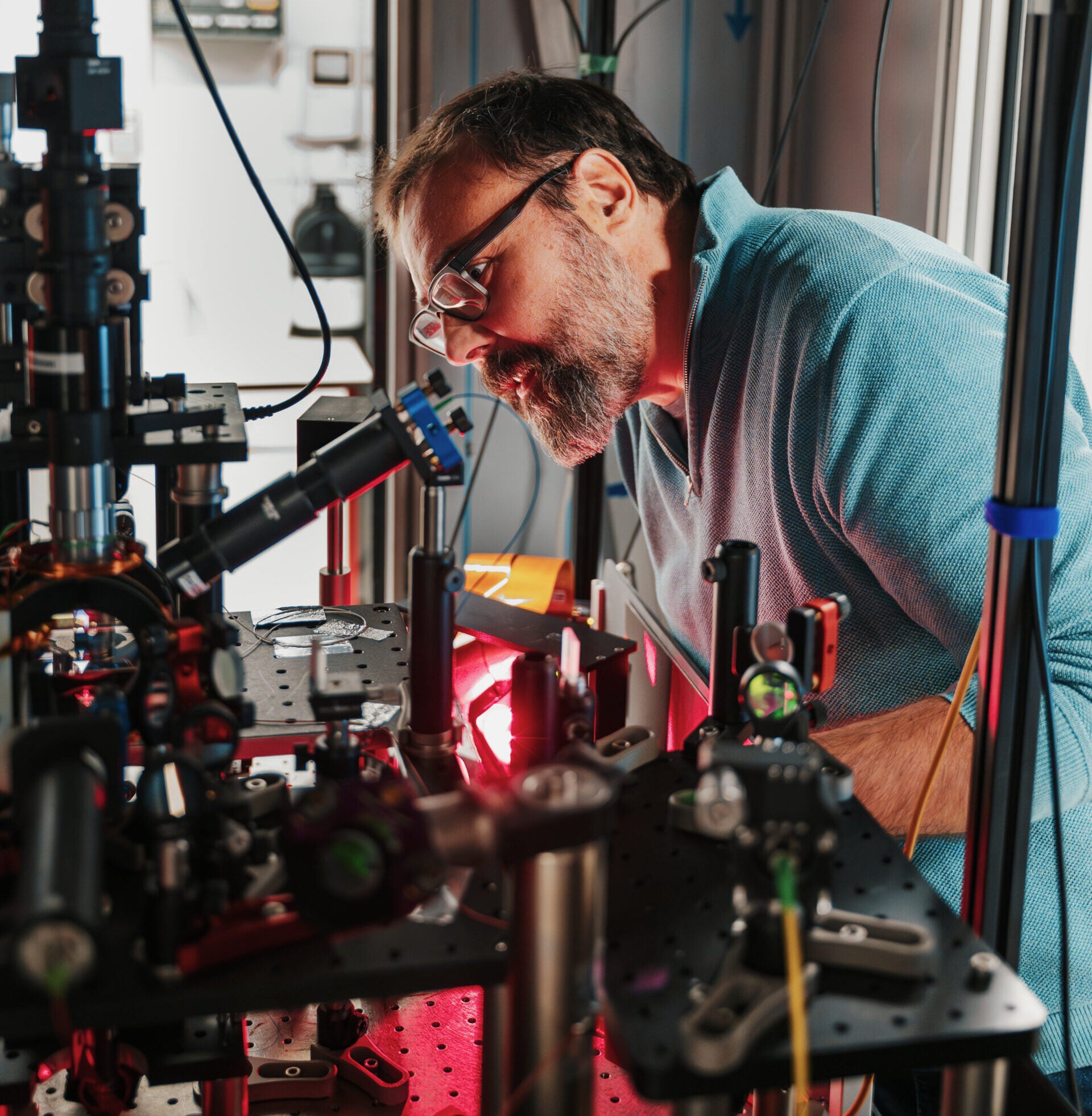
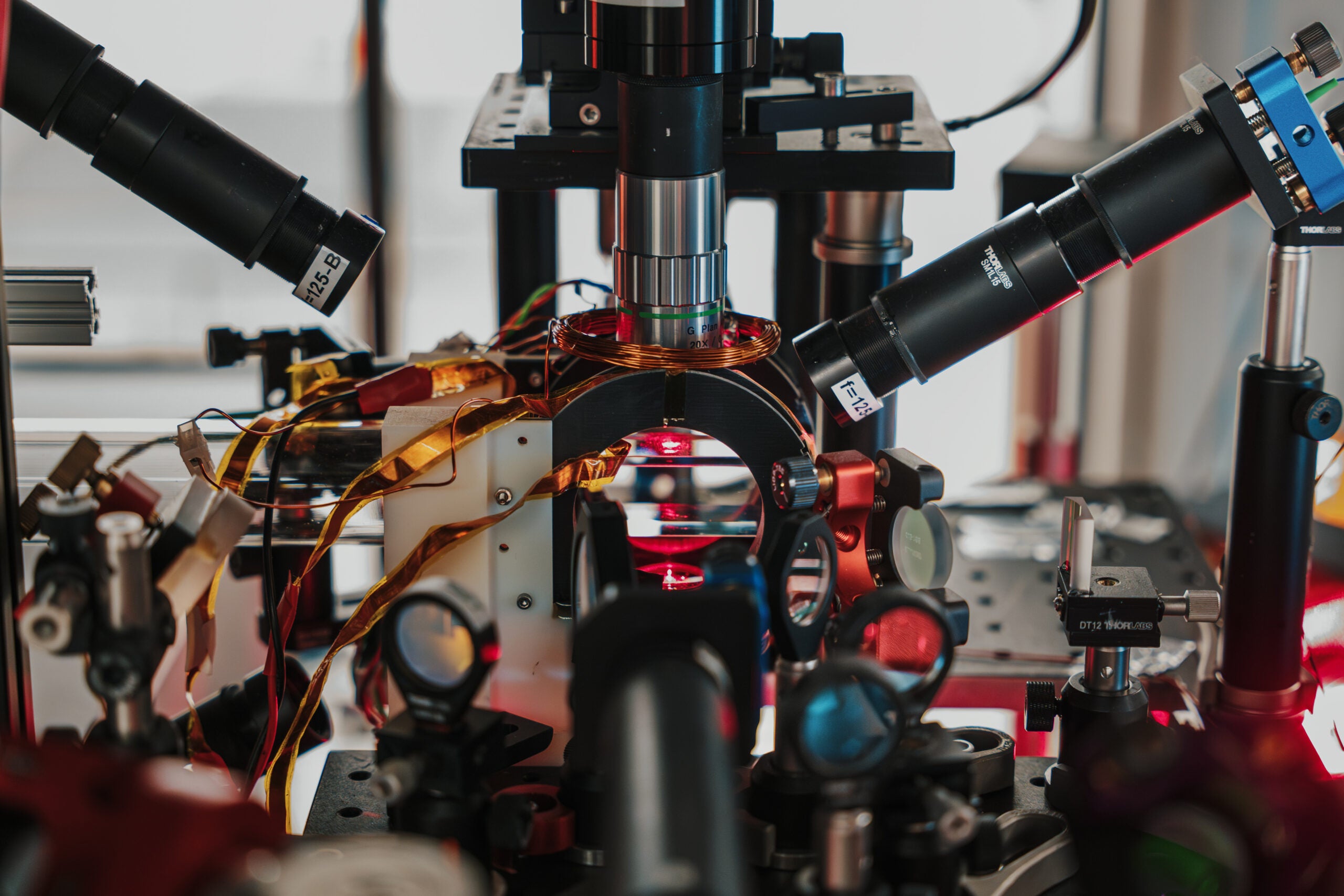
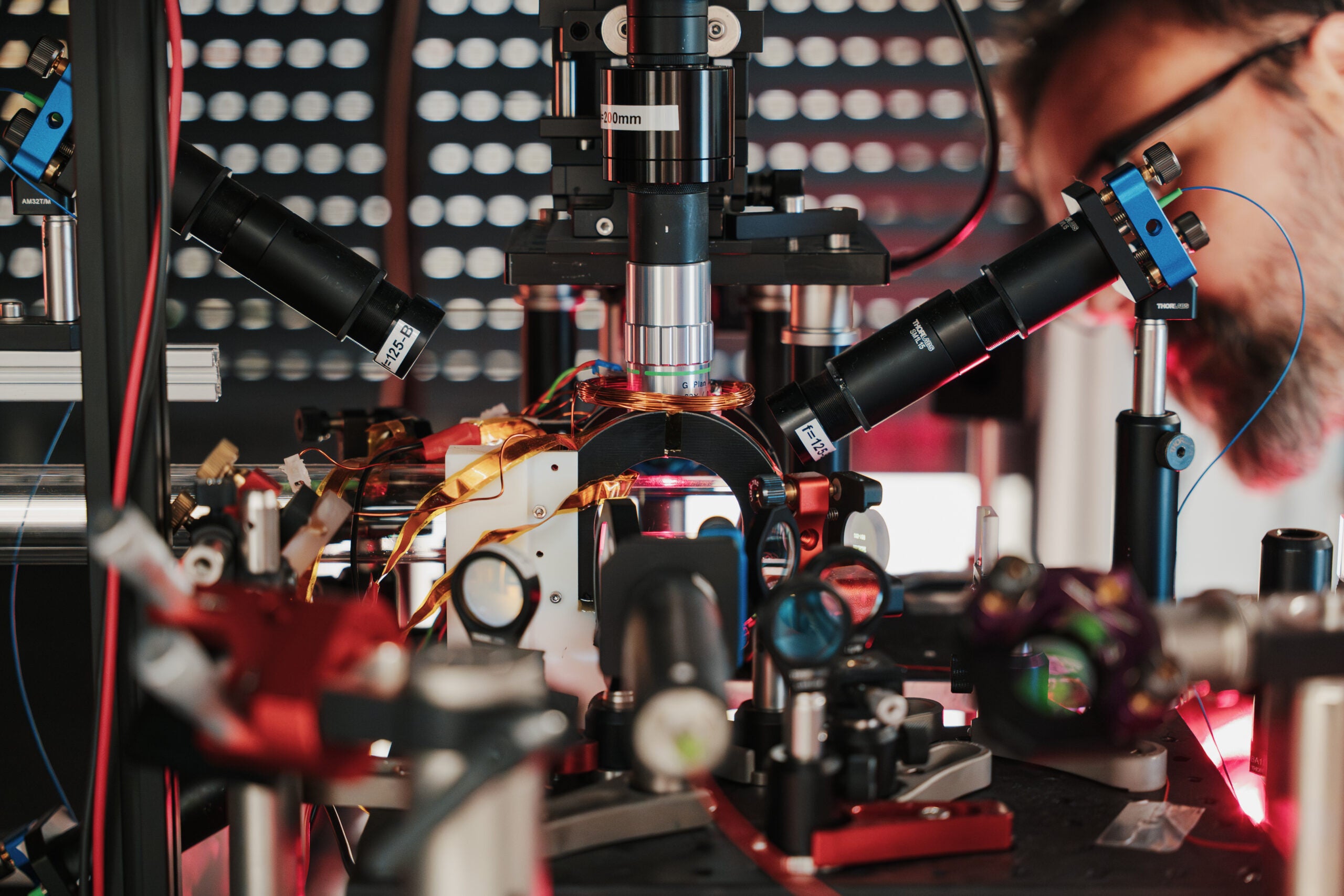
The experiment began with a Bose-Einstein condensate, a state of matter in which atoms behave collectively under quantum rules. The team trapped the atoms in an optical dipole trap and added a thin barrier made with light, separating the system into two parts: a “bright” sector that could be observed and a “dark” sector that was left unobserved.
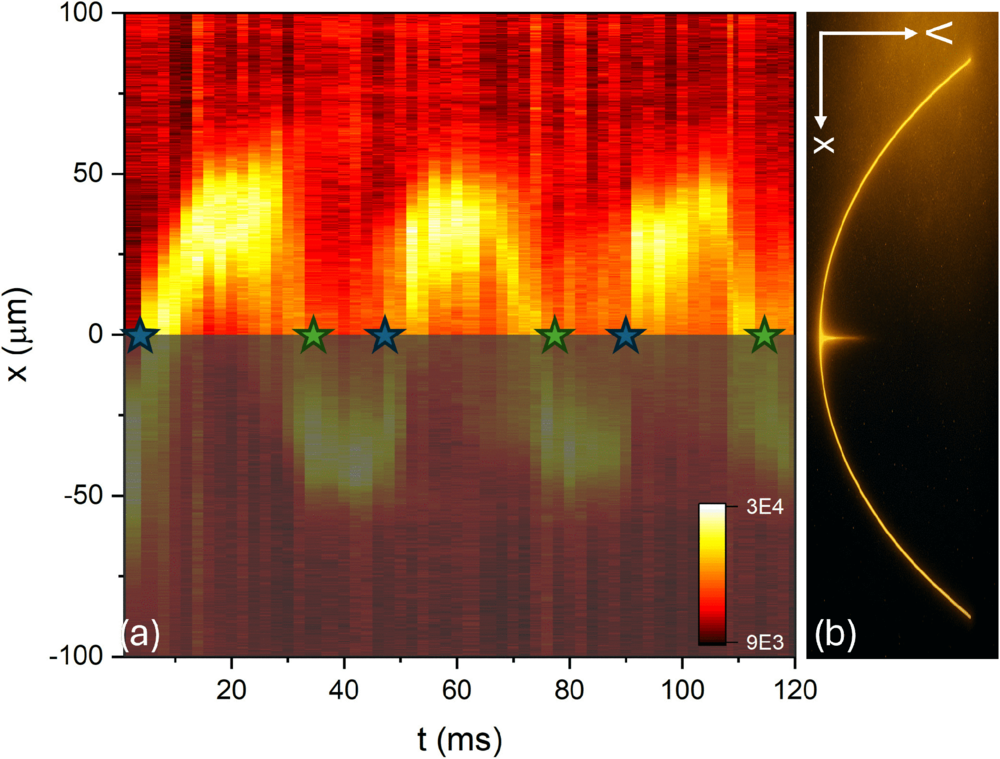
Atoms could cross between the two regions, but the system as a whole stayed well isolated from the outside world. Over roughly 100 milliseconds, the bright sector repeatedly grew and shrank as atoms moved in and out. In the paper’s language, it passed through something like a “big bang,” expanded, and then collapsed toward a “big crunch.”
That recurring motion mattered because it created a problem for any ordinary clock-like variable inside the system. One candidate variable, tied to the center of mass of the atoms in the bright region, did not move in a single direction forever. It reversed as the bright sector recollapsed. That made it a poor universal timekeeper.
So Barontini took a different approach.
Instead of treating time as something external that ticks steadily in the background, he defined it through entropy, the spread or disorder of atoms in the bright sector as they exchanged with the dark one. When the entropy in the bright sector changed, time advanced. When the distribution stopped changing, time effectively stopped as well.
That internal measure, which Barontini calls “entropic time,” did several jobs at once. It moved in one direction, giving the system an arrow of time. It ordered events correctly even as the bright sector expanded and contracted. And it did not flow at a fixed rate. It sped up when entropy moved quickly and slowed when the exchange died down.
In the experiment, the team imaged the system every 2 milliseconds for 120 milliseconds, repeating the run with different barrier heights. Those changes altered how easily atoms and entropy could move between the bright and dark sectors.
The results showed that entropic time grew monotonically almost everywhere. Its slope against ordinary laboratory time depended on how much entropy was flowing. In settings where exchange was strong, entropic time moved faster. In moments where no entropy passed between sectors, it stalled.
That gave the experiment a curious feature. By the lab clock, the system kept evolving continuously. By the internal entropic clock, however, some intervals contained no passage of time at all.
For low barrier heights, the bright sector cycled from a big bang-like beginning to a big crunch-like end and back again. But between one crunch and the next bang, no entropic time elapsed because no entropy was exchanged there. For higher barriers, the entropy exchange weakened and the entropic clock ran more slowly. At the highest settings, the bright sector stopped cycling and drifted toward a stationary state, a kind of “heat death,” where entropic time came to a halt.
The work goes further than offering a new metaphor for time. Barontini also showed that a version of the Schrödinger equation, the central equation of quantum mechanics, can be rewritten using entropic time instead of ordinary laboratory time.
That matters because it means the system could still be described predictively. The team derived an entropic-time Schrödinger equation for the bright sector and then solved it numerically. Those simulations closely matched the measured behavior of the condensate, including the changing width of the bright sector as the miniuniverse expanded and contracted.
“This study provides the first controlled experimental evidence that ‘time’ can be defined by changes within a system rather than as the external ‘ticking clock’ we think of as time. It offers new insight into the nature of time in quantum gravity that could be used to describe dynamics just as effectively as conventional time,” Barontini said.
The result does not claim to solve the problem of time in physics. It does, however, turn a famously philosophical issue into something more concrete. Theories based on the Wheeler-DeWitt equation describe the universe without an external time parameter, leaving open the question of how any internal observer could recover sequence, direction, or change. This experiment shows one way that could happen in a controlled many-body system.
It also speaks to another longstanding puzzle, the arrow of time. Most basic equations in physics do not care which direction time runs. Thermodynamics does. Entropy tends to increase in one direction, and that asymmetry has long stood out as one of the few robust signs of temporal order. Barontini’s system uses that fact directly.
Cold-atom experiments have already been used to imitate black hole horizons, false vacuum decay, and other exotic scenarios. This study adds a new use: testing ideas from quantum cosmology and gravity that would otherwise remain almost entirely theoretical.
Because the system is tunable, future experiments could push further. The paper points to possibilities including laboratory analogs of black holes, tests of reversibility, studies of singularities and bouncing cosmologies, and comparisons between competing internal clocks.
None of that means a tabletop condensate is the universe in miniature in any literal sense. But it may be enough to ask whether some of the deepest ideas about time, change, and cosmic history can survive contact with experiment.
The immediate value of the work is not a new device or technology, but a new experimental platform for a very old problem.
By showing that an internal, entropy-based time variable can order events and support quantum predictions, the study gives physicists a way to test concepts from quantum gravity and cosmology in the laboratory rather than only on paper.
That could help researchers compare different models of emergent time, probe how arrows of time arise in isolated quantum systems, and build more complex analog systems to study scenarios linked to the early universe, recollapse, or black hole physics.
Research findings are available online in the journal Physical Review Research.
The original story “‘Mini Universe’ built from ultracold atoms measures time without a clock” is published in The Brighter Side of News.
Like these kind of feel good stories? Get The Brighter Side of News’ newsletter.
The post ‘Mini Universe’ built from ultracold atoms measures time without a clock appeared first on The Brighter Side of News.

