Finding another Earth is not simply a matter of building a bigger telescope. An Earth-like planet orbiting a Sun-like star is so faint that its host star can overwhelm its reflected light by a factor of billions.
A NASA-led team wants to solve that problem by putting the light blocker in space while leaving the telescope on the ground.
The proposed Hybrid Observatory for Earth-like Exoplanets, or HOEE, would pair an enormous orbiting starshade with the next generation of extremely large optical telescopes. The starshade would create an artificial eclipse, preventing most of a target star’s light from reaching the telescope while allowing reflected light from surrounding planets to pass.
The concept is described in the 2026 Nature Astronomy paper, The observation of Earth-like exoplanets with ground-based telescopes and a shared orbiting starshade. The work includes researchers from NASA’s Jet Propulsion Laboratory, Goddard Space Flight Center and other institutions.
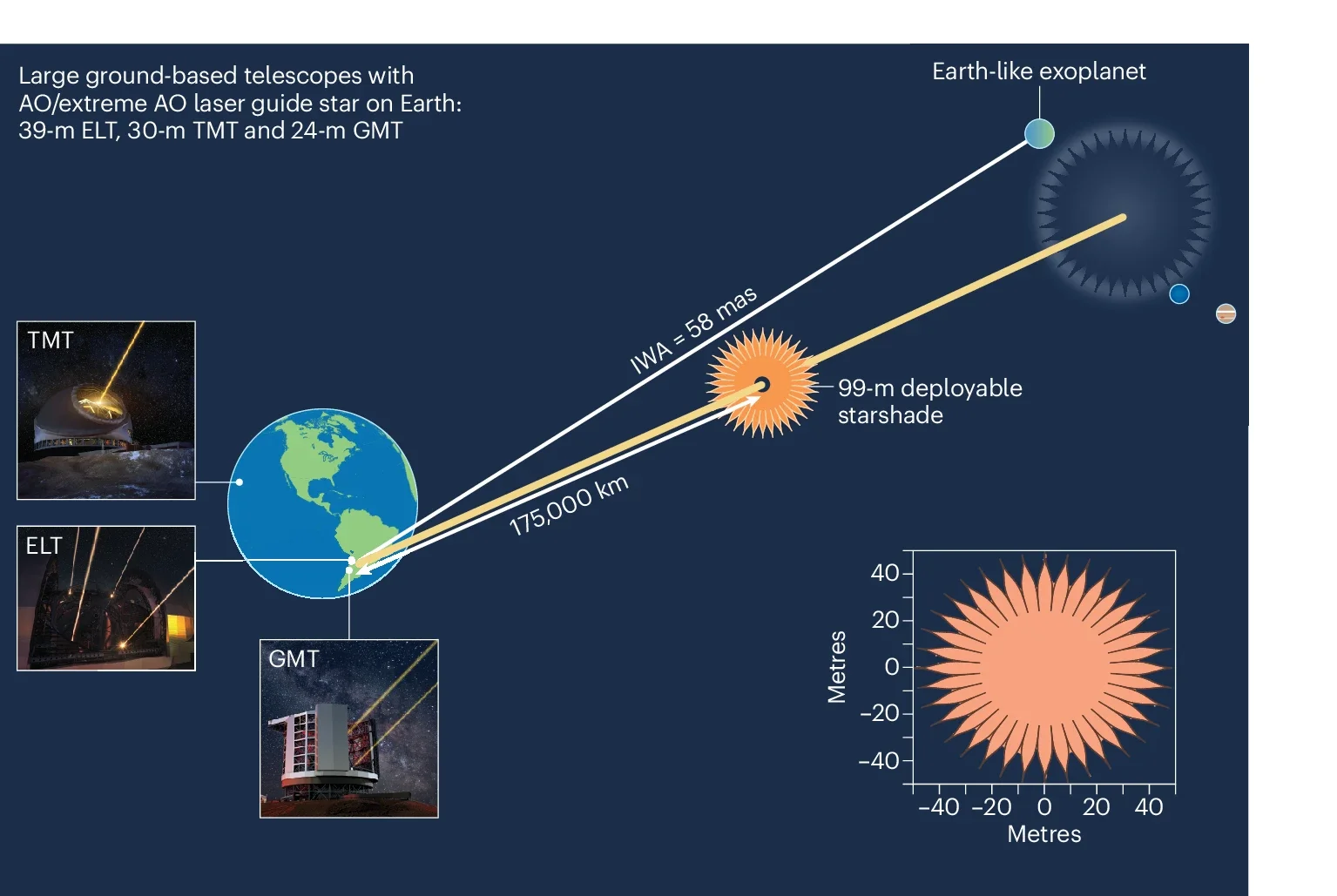
The proposed starshade would orbit roughly 175,000 kilometers from Earth and move into alignment with a telescope and its target star.
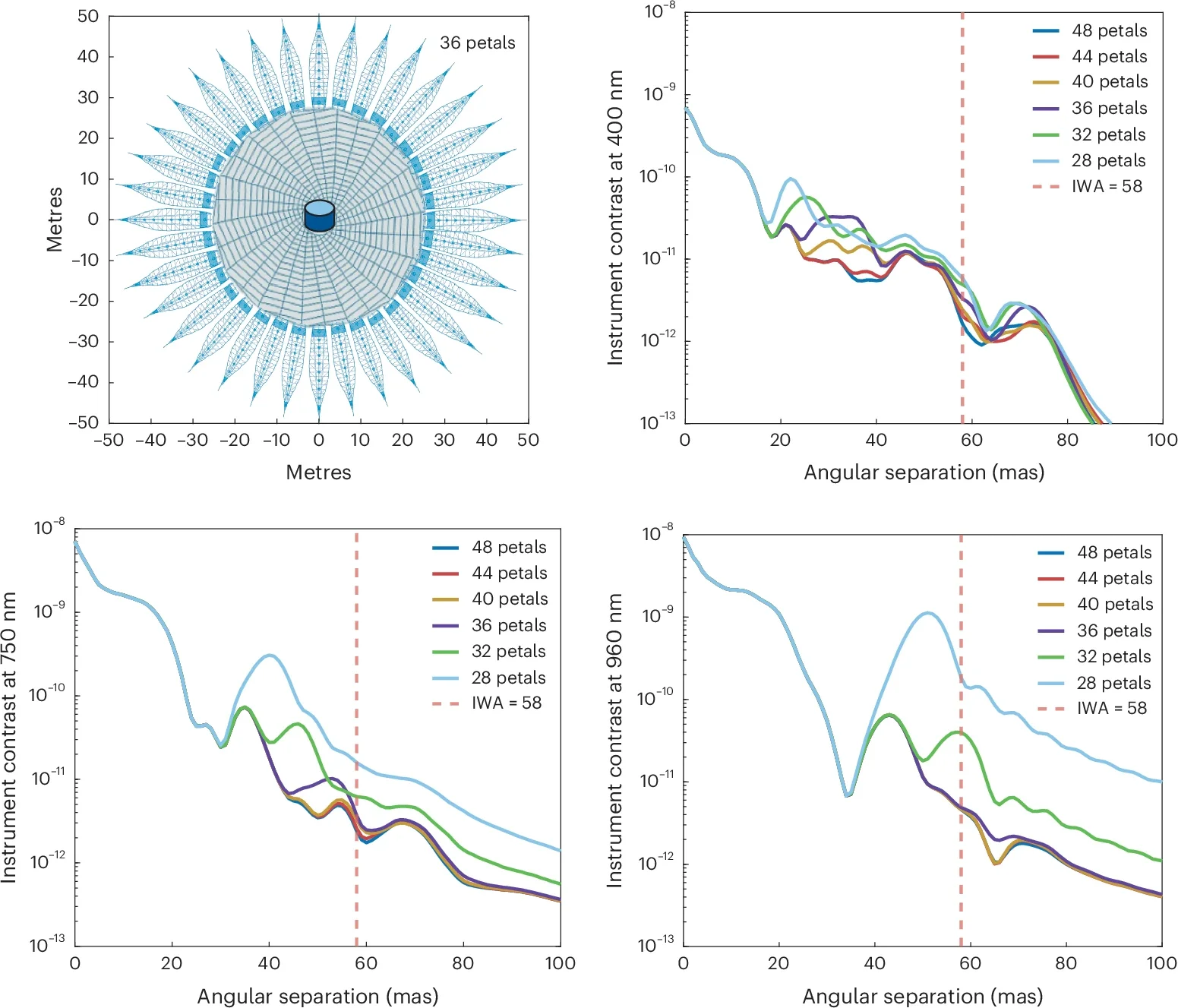
The design modeled in the research measures 99 meters across. It includes a 50-meter central disk surrounded by 48 petals, each 24.5 meters long.
Rather than trying to remove a star’s glare after it reaches the telescope, the starshade would suppress the light before it enters Earth’s atmosphere.
“Our team proves that by deploying a starshade to cast a “perfect shadow” over Earth’s largest telescopes, HOEE can suppress stellar glare before it ever enters the atmosphere,” Vladimir Airapetian, a senior astrophysicist at NASA Goddard Space Flight Center and HOEE team member, said.
The system would need extraordinary control. The starshade would remain directly along the line of sight between the telescope and star while continuously correcting its position.
The concept uses a long elliptical astro-stationary orbit designed to follow Earth’s rotation. Chemical propulsion could handle station-keeping, while solar electric propulsion could reposition the starshade between targets.
The first major partner could be the European Southern Observatory’s 39-meter Extremely Large Telescope in Chile. The concept could also work with the Giant Magellan Telescope and Thirty Meter Telescope.
These observatories have an advantage that is difficult to reproduce in space: enormous mirrors.
Current instruments can directly image some large and bright exoplanets, but rocky Earth-like planets around Sun-like stars remain beyond their reach. JWST’s Near Infrared Camera and the Nancy Grace Roman Space Telescope’s Coronagraph Instrument are also not designed to directly observe true Earth analogues around nearby Sun-like stars.
“We need to go for something that is more efficient and available now; a hybrid observatory that can observe the exoplanetary system in optical light,” Airapetian said.
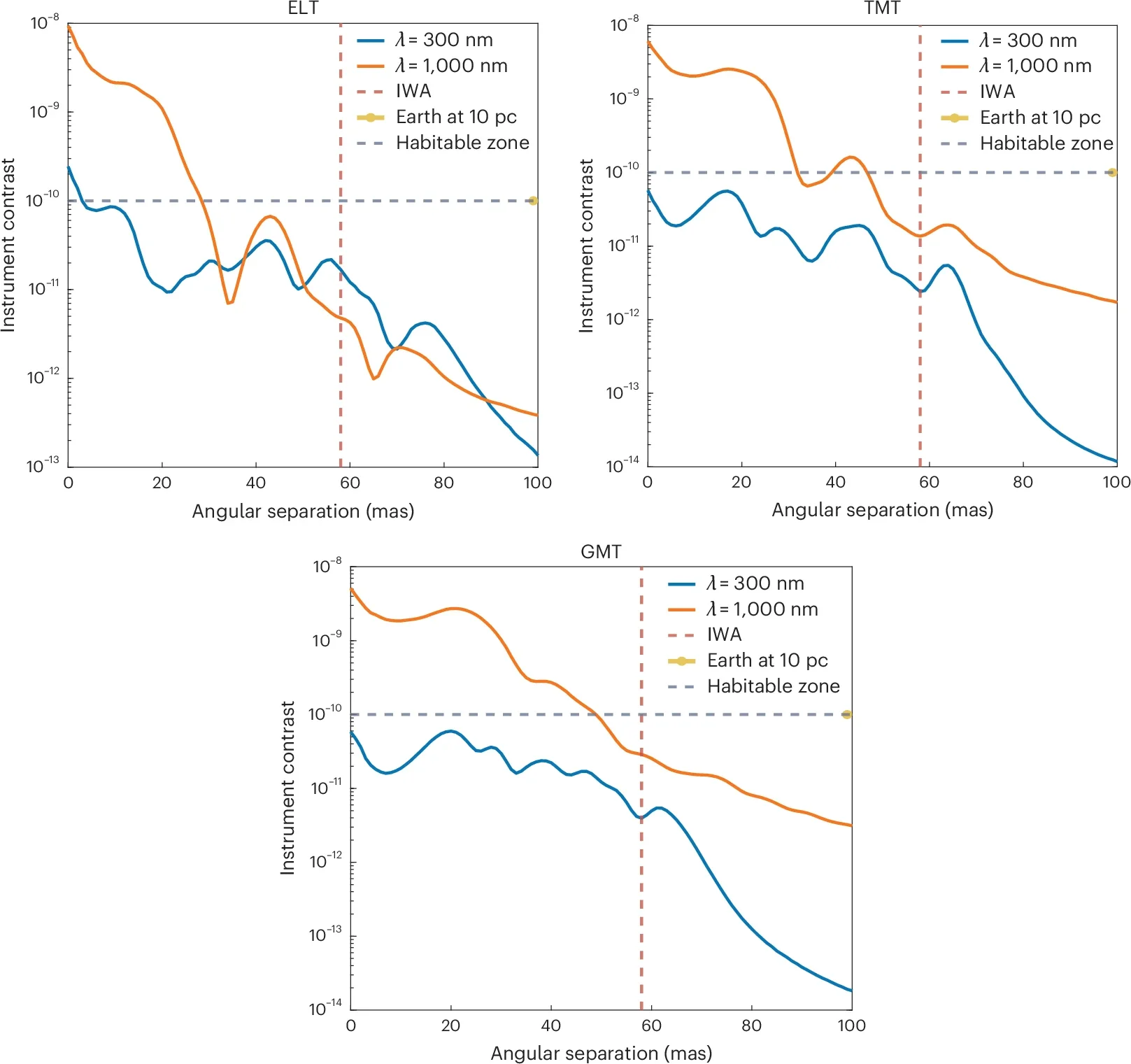
The team’s simulations examined how a 99-meter starshade could work with the ELT, Thirty Meter Telescope and Giant Magellan Telescope.
The researchers predict contrasts below roughly one part in 10 billion across wavelengths from 300 to 1,000 nanometers beyond the system’s inner working angle.
That level of suppression could make a rocky planet visible beside a star billions of times brighter.
The telescope’s large aperture would also produce unusually sharp images.
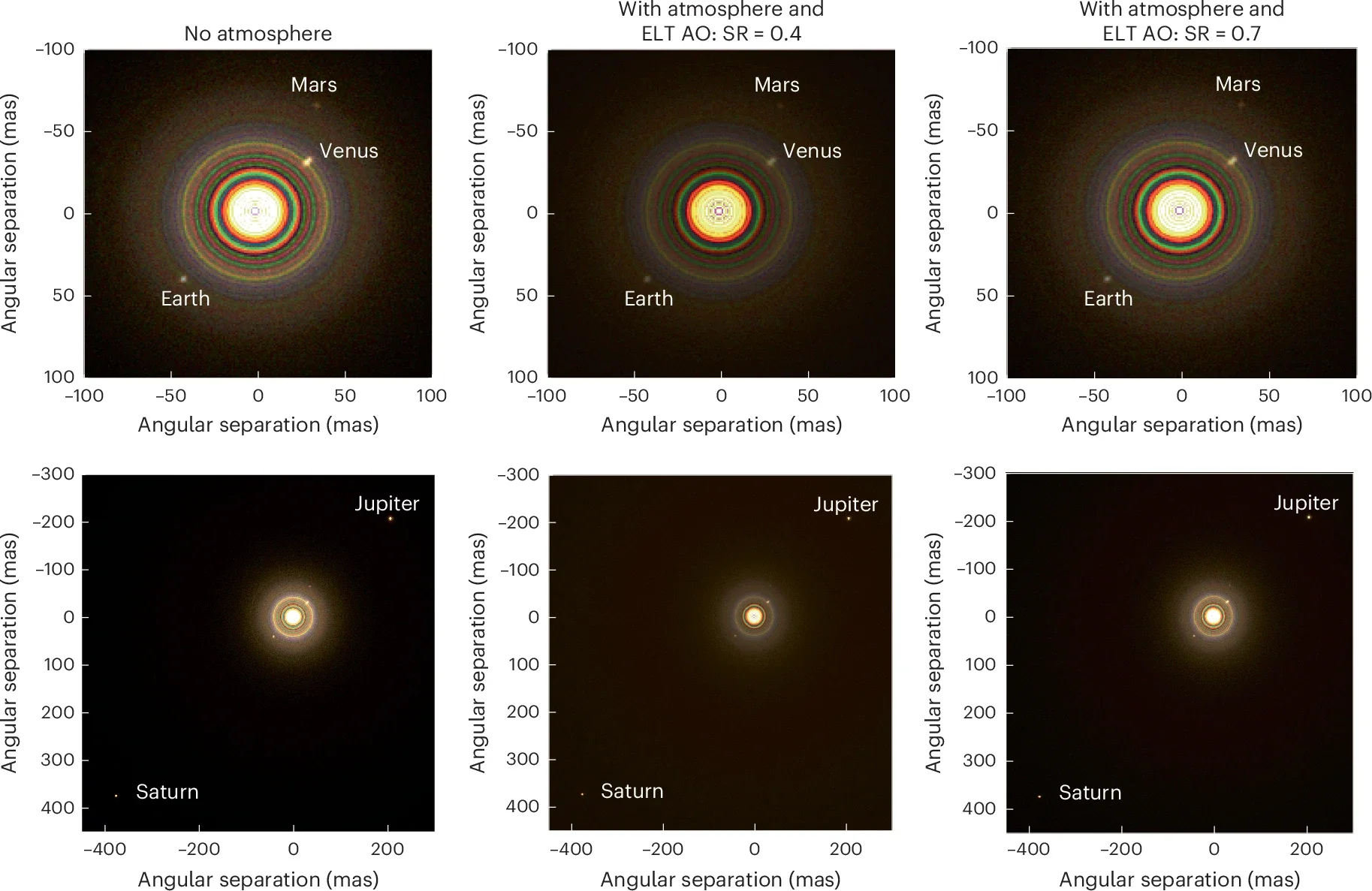
The ELT has a predicted angular diffraction limit of about three milliarcseconds. At a distance of 10 parsecs, the researchers say that is enough to distinguish structures separated by about one-tenth of the distance between Earth and the Sun.
To test the idea, the team simulated a Solar System analogue 17 parsecs away, or about 55 light-years.
In a simulated 20-minute exposure, the hybrid system could distinguish planets from Venus through Saturn under modeled atmospheric conditions. Earth sat near the system’s inner working angle, while Venus remained visible even inside it.
The concept could therefore do more than identify a single bright point. Its resolution could reveal the architecture of nearby planetary systems and separate multiple planets orbiting the same star.
Earlier HOEE work also projected that an Earth-like planet five parsecs away could potentially be imaged within about a minute.
Finding a rocky planet would only be the beginning.
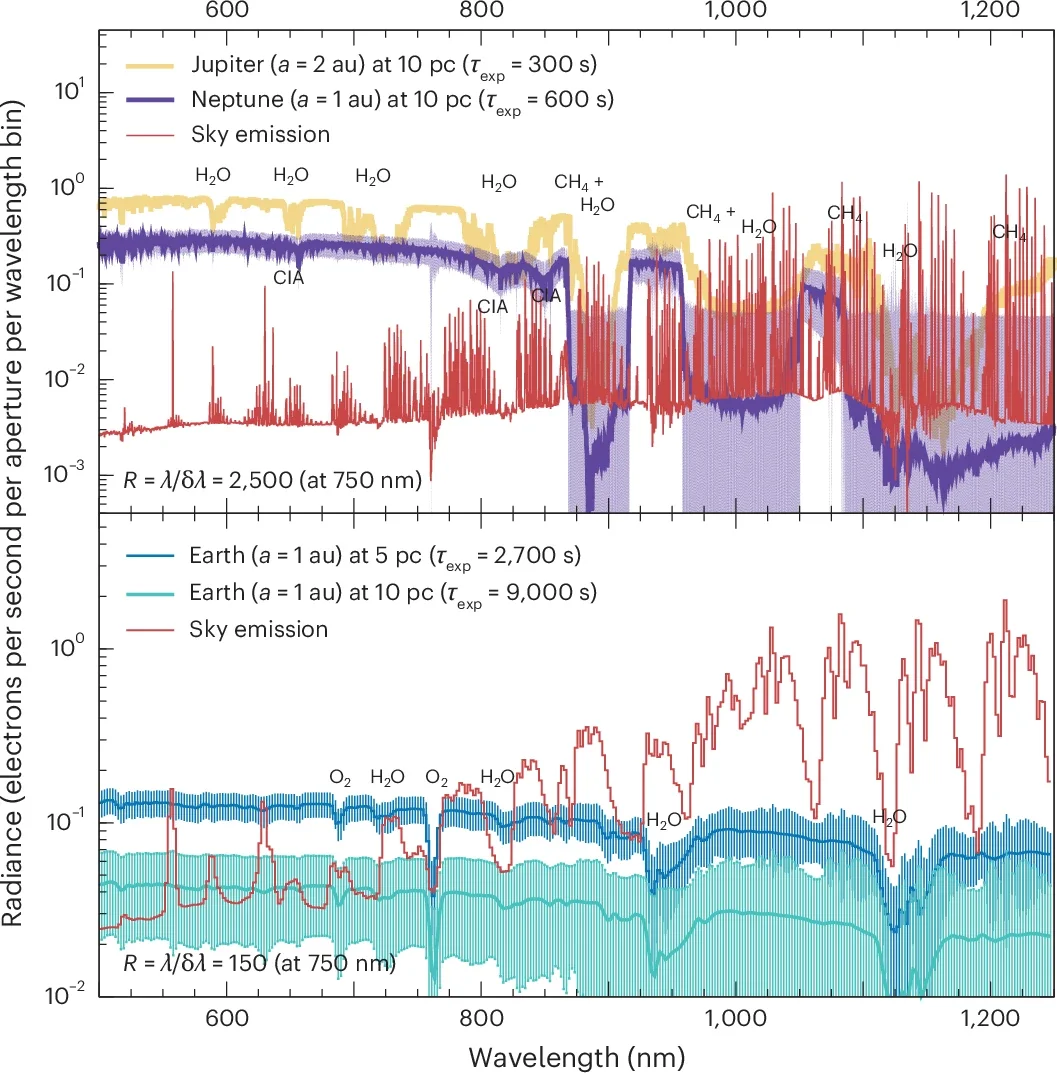
The larger goal is spectroscopy, splitting reflected planetary light into wavelengths that reveal molecules in an atmosphere.
The team simulated spectra for Earth-like planets at five and 10 parsecs. At five parsecs, molecular features from water, oxygen and methane remained visible at wavelengths below 850 nanometers.
Those measurements could provide clues about whether a planet has conditions associated with habitability.
Airapetian is particularly interested in young rocky planets orbiting F-, G- and K-type stars. Active stars can produce frequent flares that may generate auroras in planetary atmospheres.
“We’re going for the spectral lines from red and green auroras that would signal that the atmospheres of these planets can support nitrogen and oxygen,” Airapetian said.
Such observations could help researchers study worlds with atmospheric conditions relevant to the development of primitive life or its chemical precursors.
Putting the starshade in space does not eliminate every problem.
After passing around the shade, planetary light still travels through Earth’s atmosphere. Turbulence can blur images before they reach a ground telescope.
HOEE would depend heavily on adaptive optics, technology that rapidly corrects atmospheric distortion.
The researchers modeled realistic atmospheric turbulence and different levels of adaptive-optics performance for the ELT. Their simulations found that the telescope could maintain the contrast needed for Earth-like planet observations across the proposed wavelength range under moderate weather conditions.
Other sources of unwanted light include earthshine, sunlight reflecting from the starshade and exozodiacal dust surrounding distant planetary systems.
The team argues that adaptive optics, careful design and image processing could reduce those effects enough to recover planetary signals.
The largest obstacle may be getting an object nearly 100 meters wide into space and deploying it with enough precision.
NASA-backed starshade experiments have already demonstrated starlight suppression exceeding one part in 10 billion at smaller scales. Engineers have also tested folding and deployment methods for petal-shaped structures.
HOEE would require an extremely lightweight design. Airapetian said the final system could use inflatable components to keep launch mass below about 1,500 kilograms and allow the structure to fit inside a conventional launch vehicle.
He estimated the overall concept could fall in roughly the billion-dollar range.
The project remains a concept rather than an approved observatory, and its final engineering design has not been settled. Deployment accuracy, propulsion, atmospheric correction and the mechanical stability of the huge shade all require further development.
The potential payoff is direct light from worlds that until now have largely remained hidden beside their stars.
“For decades, the starshade was a beautiful but “impossible” dream,” Airapetian said. “Today, through NASA funding, that dream is becoming a buildable reality.”
These resources explore the technologies behind direct exoplanet imaging, the capabilities of extremely large telescopes and competing approaches for finding and characterizing nearby Earth-like worlds.
Optical performance of Hybrid Observatory for Earth-like Exoplanets: This 2025 analysis modeled a 99-meter orbiting starshade working with the 39-meter Extremely Large Telescope and examined sensitivity, optical tolerances and major background-light challenges. It provides much of the technical groundwork for evaluating whether a hybrid ground-space observatory could detect Earth-like planets. (Journal of Astronomical Telescopes, Instruments, and Systems, 2025)
Habitable Worlds Observatory: NASA’s Habitable Worlds Observatory concept offers the major space-based alternative for directly imaging nearby potentially habitable worlds. Its central goal is to directly image at least 25 potentially habitable planets and use spectroscopy to search their atmospheres for gases such as oxygen and methane. (NASA Science, 2026)
PCS — A Roadmap for Exoearth Imaging with the ELT: This ESO resource describes the Planetary Camera and Spectrograph proposed for the Extremely Large Telescope. The instrument combines extreme adaptive optics, coronagraphy and spectroscopy with the goal of detecting nearby planets down to Earth size and searching their atmospheres for signatures including molecular oxygen. (The Messenger, 2021)
Exoplanet imaging performance envelopes for starshade-based missions: NASA researchers used detailed optical simulations to examine how star type, planet properties, exozodiacal dust, starshade positioning and other factors affect the ability of starshade missions to image temperate planets. The work helps define both the capabilities and practical limits of external occulters. (Journal of Astronomical Telescopes, Instruments, and Systems, 2021)
Starshade Rendezvous Probe Study Report: This NASA mission study examines how an independently launched starshade could work with a space telescope to directly image and characterize planets around nearby stars. It provides a detailed engineering and scientific foundation for external starshade concepts that preceded HOEE. (NASA, 2019)
Research findings are available online in the journal Nature Astronomy.
The original story “NASA’s giant space ‘starshade’ could help ground telescopes photograph another Earth” is published in The Brighter Side of News.
Like these kind of feel good stories? Get The Brighter Side of News’ newsletter.
The post NASA’s giant space ‘starshade’ could help ground telescopes photograph another Earth appeared first on The Brighter Side of News.


Leave a comment
You must be logged in to post a comment.