A blood sample may contain more than the amount of beta-amyloid circulating through the body. It may also reveal whether abnormal amyloid particles can trigger more protein clumping, a process closely tied to Alzheimer’s disease.
Researchers at Xuanwu Hospital of Capital Medical University developed a blood-based assay that measures this “seeding” activity. In a two-stage study of 549 participants, the test distinguished Alzheimer’s disease and mild cognitive impairment caused by Alzheimer’s from comparison groups with strong accuracy.
The method uses real-time ultrasonic protein misfolding cyclic amplification, or PMCA. Instead of measuring only how much beta-amyloid is present, it amplifies the ability of misfolded amyloid particles to make normal Aβ42 proteins aggregate.
In an independent validation group of 429 people, the test produced area-under-the-curve values from 0.90 to 0.93 across four diagnostic comparisons.
Beta-amyloid, or Aβ, can misfold and assemble into oligomers and larger aggregates. These abnormal structures can act as seeds, encouraging other Aβ molecules to adopt similar forms.
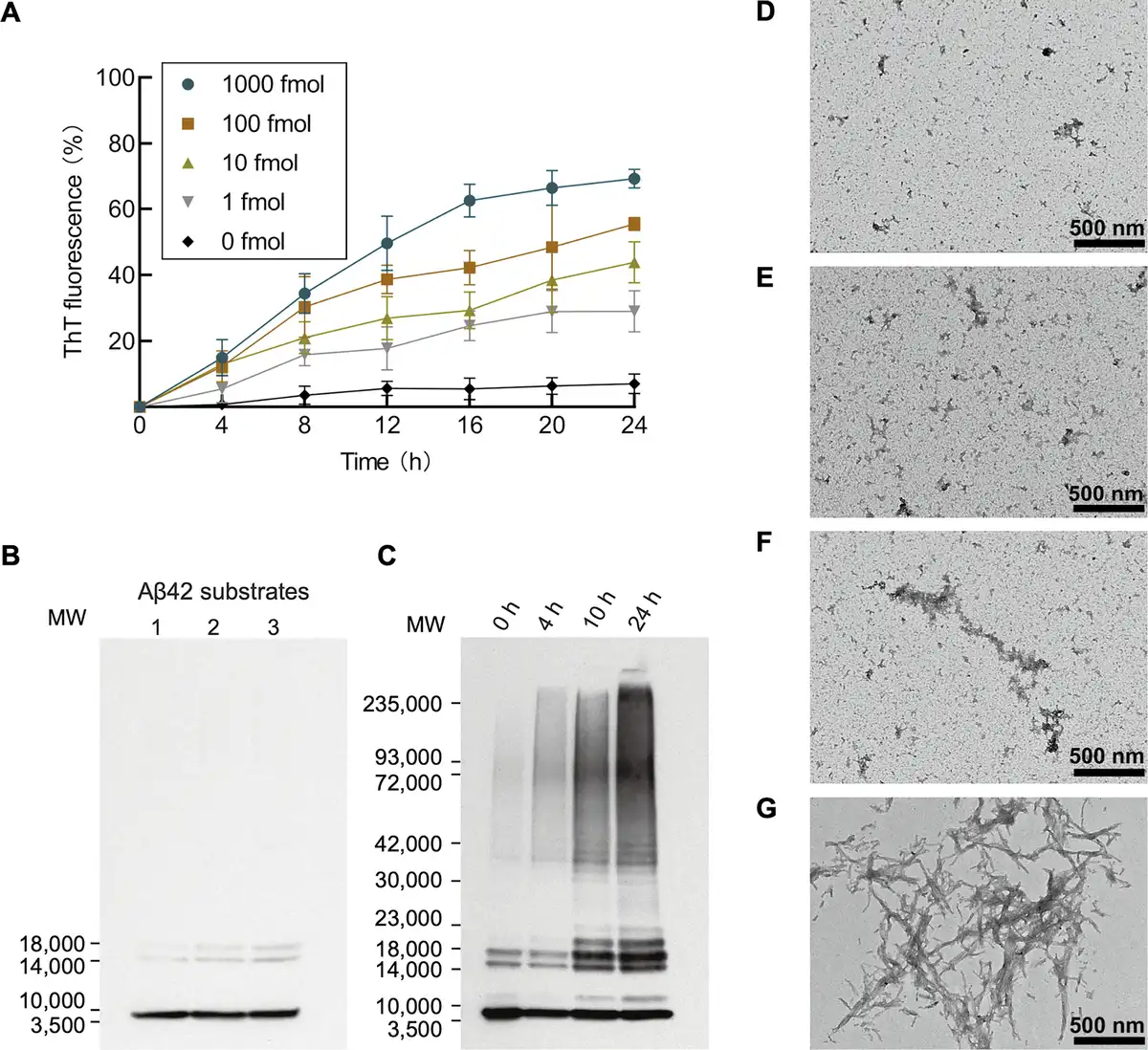
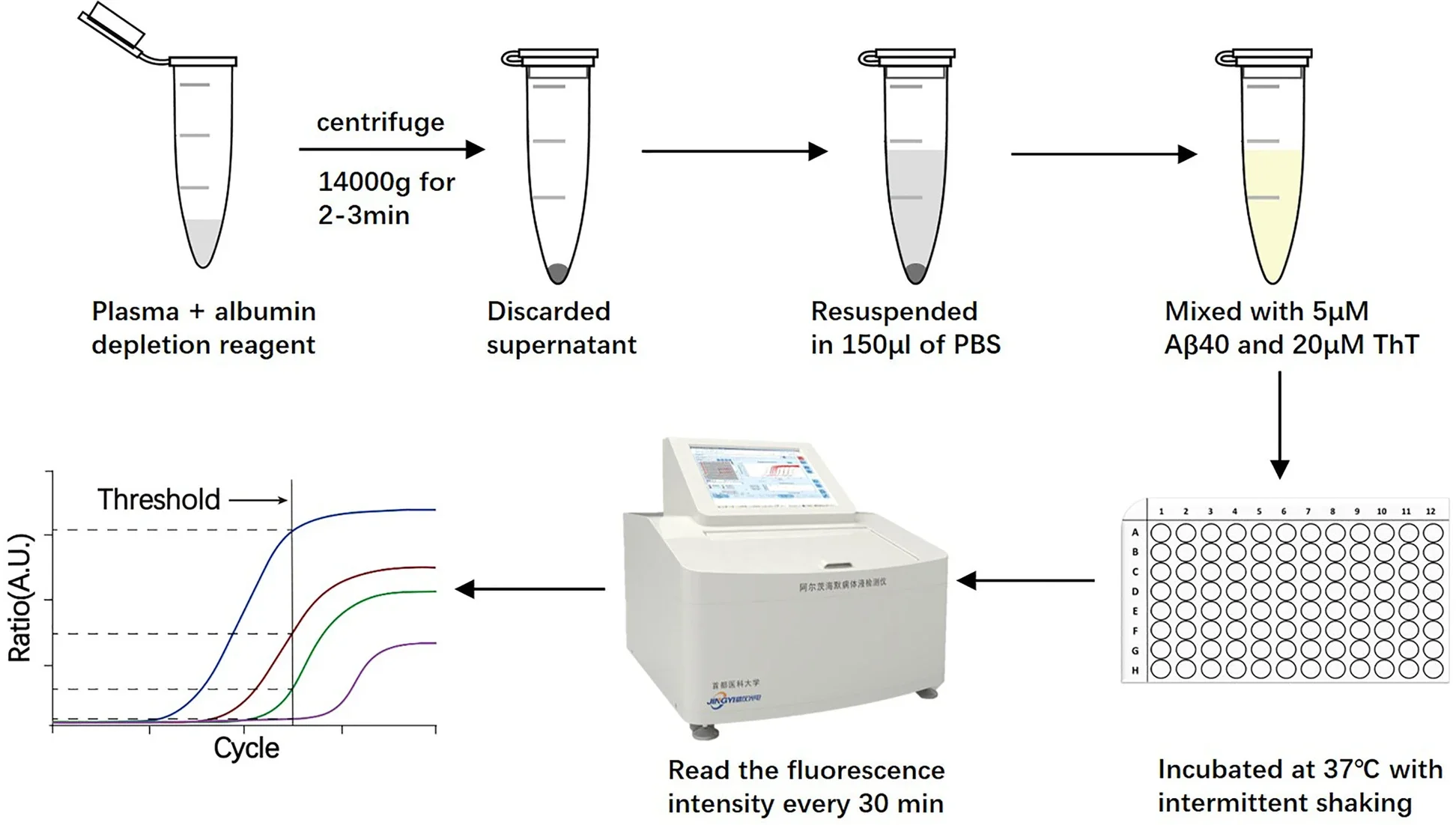
The assay mixes plasma with seed-free Aβ42 and Thioflavin T, a fluorescent dye that becomes brighter as amyloid aggregates form. Samples undergo repeated cycles of one minute of ultrasound followed by four minutes without ultrasound at 37 degrees Celsius. Fluorescence is measured every five minutes.
Ultrasound helps drive the amplification. Cavitation creates small interfaces and energy that promote fibril formation, while local heat and shear forces can encourage protein misfolding. The assay finishes within 24 hours.
“Compared to traditional quaking-based methods, this ultrasonic technology can detect Aβ oligomers at concentrations as low as 1 femtomole,” said Jianping Jia, who led the research.
Before studying patient plasma, the team tested laboratory-produced Aβ oligomers. The system clearly separated samples containing 1 femtomole of synthetic Aβ seeds from samples without seeds.
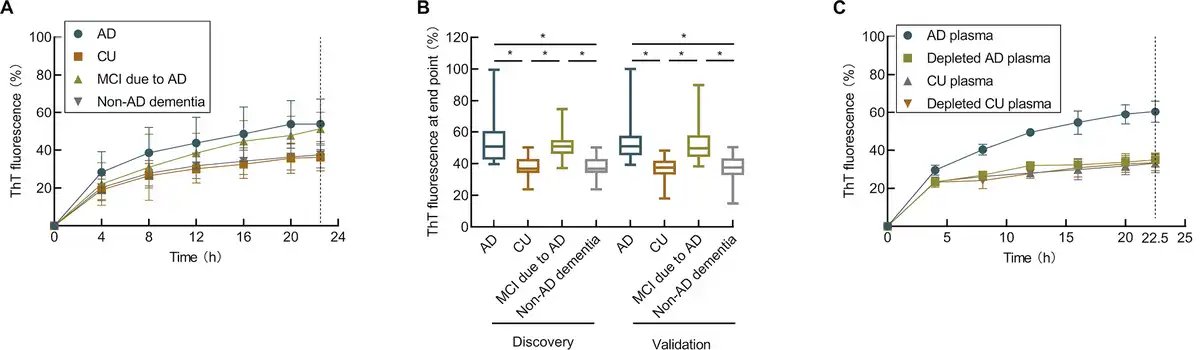
The discovery phase included 120 participants divided evenly among four groups: cognitively unimpaired adults, people with mild cognitive impairment due to Alzheimer’s, people with Alzheimer’s dementia and people with non-Alzheimer’s dementia.
Researchers then tested the method in an independent validation cohort of 429 participants. That group included 118 cognitively unimpaired people, 46 with MCI due to Alzheimer’s, 141 with Alzheimer’s dementia and 124 with non-Alzheimer’s dementia.
In the validation cohort, people with Alzheimer’s dementia had an average endpoint fluorescence of 53.31%. Cognitively unimpaired participants averaged 36.91%, while the non-Alzheimer’s dementia group averaged 37.06%.
The MCI due to Alzheimer’s group averaged 52.61%, close to the Alzheimer’s dementia group. That result showed that elevated seeding activity was also present at the MCI stage.
Immunodepletion experiments provided an additional check. When the team removed Aβ aggregates from Alzheimer’s plasma with antibodies, the seeding signal dropped significantly. Removing them from cognitively unimpaired samples made little difference.
Receiver operating characteristic analysis measured how well the assay separated the groups.
For Alzheimer’s dementia versus cognitively unimpaired participants, the validation AUC reached 0.93, with a 95% confidence interval from 0.91 to 0.96. Alzheimer’s versus non-Alzheimer’s dementia produced an AUC of 0.91.
The test also distinguished MCI due to Alzheimer’s from cognitively unimpaired people with an AUC of 0.92. MCI due to Alzheimer’s versus non-Alzheimer’s dementia reached 0.90.
Those results broadly matched the discovery phase, where AUC values ranged from 0.89 to 0.92.
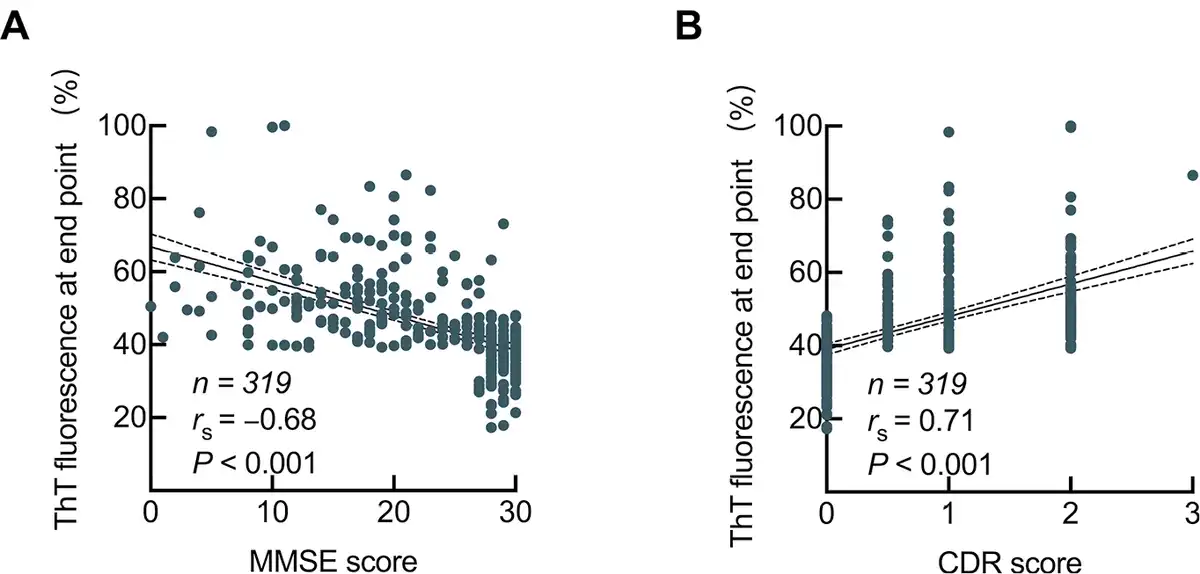
Among 319 participants with Alzheimer’s disease or normal cognition, higher plasma seeding activity also tracked with worse clinical status. It correlated with lower Mini-Mental State Examination scores at -0.68 and higher Clinical Dementia Rating scores at 0.71.
“The most important significance of this study lies in providing clinicians with a minimally invasive, efficient, and accurate AD diagnostic tool,” Jia said.
A subset of participants also had cerebrospinal fluid biomarker measurements.
For distinguishing Alzheimer’s from non-Alzheimer’s dementia, plasma seeding activity produced an AUC of 0.90. The CSF Aβ42/40 ratio reached 0.73, while total tau divided by Aβ42 reached 0.81.
The plasma assay was statistically comparable with the CSF phosphorylated tau181-to-Aβ42 ratio, which produced an AUC of 0.86.
Even so, the study did not directly compare seeding activity with several other blood biomarkers, including plasma Aβ42/40 and phosphorylated tau217. That leaves an important question about whether the new measurement adds diagnostic information beyond other available blood tests.
The study also used clinical diagnoses rather than confirmation from brain pathology. CSF data were unavailable for many participants, and every participant was of Chinese ethnicity.
The investigation was cross-sectional, so it cannot show whether rising seeding activity predicts future decline or progression from MCI to Alzheimer’s dementia.
The team plans larger clinical validation studies and longer follow-up to test that possibility.
Those studies will also be needed before the assay could support the broad community screening proposed by the researchers. Performance must hold across larger and more diverse populations and against other established blood biomarkers.
The test adds a different type of measurement to the expanding field of Alzheimer’s blood biomarkers. Instead of focusing only on protein concentration, it measures a functional property of abnormal Aβ: its ability to seed further aggregation.
That distinction could eventually help researchers determine whether seeding activity offers information about disease stage, progression or response to treatment that other biomarkers do not capture.
The assay may also provide an objective measure for selecting participants or tracking biological changes in Alzheimer’s clinical trials, if future studies confirm those uses.
For now, the strongest evidence is diagnostic. In an independent cohort, plasma Aβ seeding activity separated Alzheimer’s-related groups from cognitively normal and non-Alzheimer’s dementia groups with AUC values of 0.90 or higher.
The next step is proving that those results remain reliable over time, across populations and alongside the blood tests already moving into clinical practice.
These studies and guidelines place amyloid-seeding assays alongside the rapidly developing field of blood-based Alzheimer’s diagnostics.
Detection of plasma Aβ seeding activity by a newly developed analyzer for diagnosis of Alzheimer’s disease: This study developed an earlier approach for amplifying and detecting Aβ seeding activity in blood, helping establish the feasibility of plasma-based seed measurements for Alzheimer’s diagnosis. (Alzheimer’s Research & Therapy, 2022)
Detection of Misfolded Aβ Oligomers for Sensitive Biochemical Diagnosis of Alzheimer’s Disease: This foundational work used Aβ protein misfolding cyclic amplification to detect very small amounts of seeding-competent amyloid oligomers in cerebrospinal fluid. (Cell Reports, 2014)
Alzheimer’s Association Clinical Practice Guideline on the use of blood-based biomarkers in the diagnostic workup of suspected Alzheimer’s disease within specialized care settings: The guideline sets performance thresholds for using Alzheimer’s blood biomarkers as triage or confirmatory tests and stresses that results must remain part of a full clinical evaluation. (Alzheimer’s & Dementia, 2025)
Plasma phospho-tau217 for Alzheimer’s disease diagnosis in primary and secondary care using a fully automated platform: This multicenter study evaluated an automated plasma p-tau217 test across primary and secondary care, providing an important comparison for emerging blood-based Alzheimer’s assays. (Nature Medicine, 2025)
Blood Biomarkers to Detect Alzheimer Disease in Primary Care and Secondary Care: In 1,213 patients with cognitive symptoms, blood biomarkers based on p-tau217 and Aβ42/Aβ40 achieved high diagnostic accuracy and outperformed standard clinical evaluation alone. (JAMA, 2024)
Research findings are available online in the journal Chinese Medical Journal.
The original story “New blood test measures beta-amyloid seeding to identify Alzheimer’s disease” is published in The Brighter Side of News.
Like these kind of feel good stories? Get The Brighter Side of News’ newsletter.
The post New blood test measures beta-amyloid seeding to identify Alzheimer’s disease appeared first on The Brighter Side of News.


Leave a comment
You must be logged in to post a comment.