Water does not always freeze in the orderly way its familiar behavior might suggest. Squeeze liquid water hard enough, fast enough, and its molecules can take several routes into solid form, including one that produces a previously unknown ice.
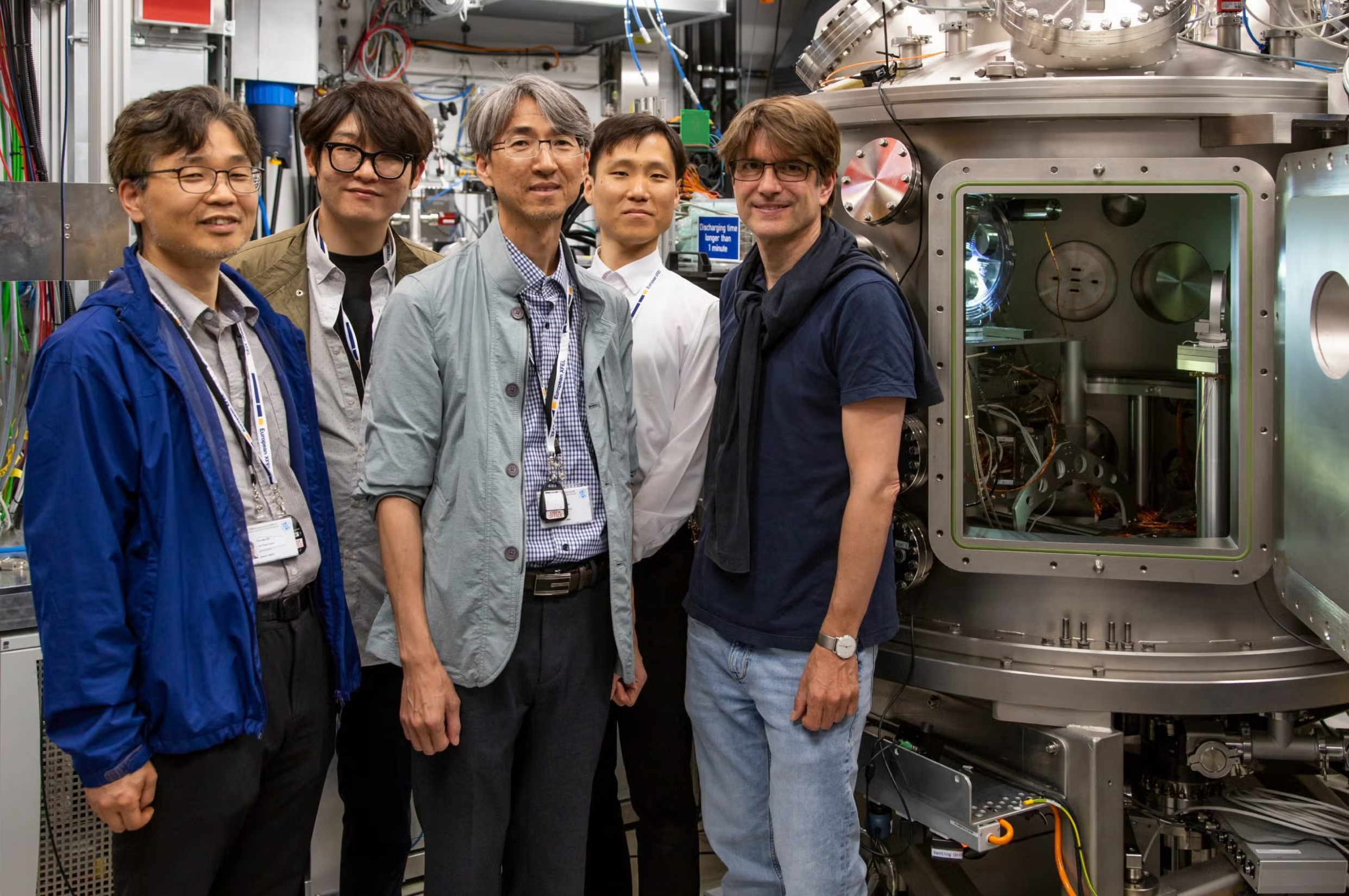
An international team working with the Korea Research Institute of Standards and Science, or KRISS, and European XFEL in Germany has identified at least five freezing and melting pathways at room temperature. The experiments also revealed a metastable crystal called ice XXI.
The finding expands an already crowded family of water ice structures. Water can form numerous crystalline phases, from ice Ih to ice XX, along with four amorphous forms. Their differences arise largely from how water molecules arrange their hydrogen-bond networks under changing pressure and temperature.
Ice XXI now adds another structure to that list.
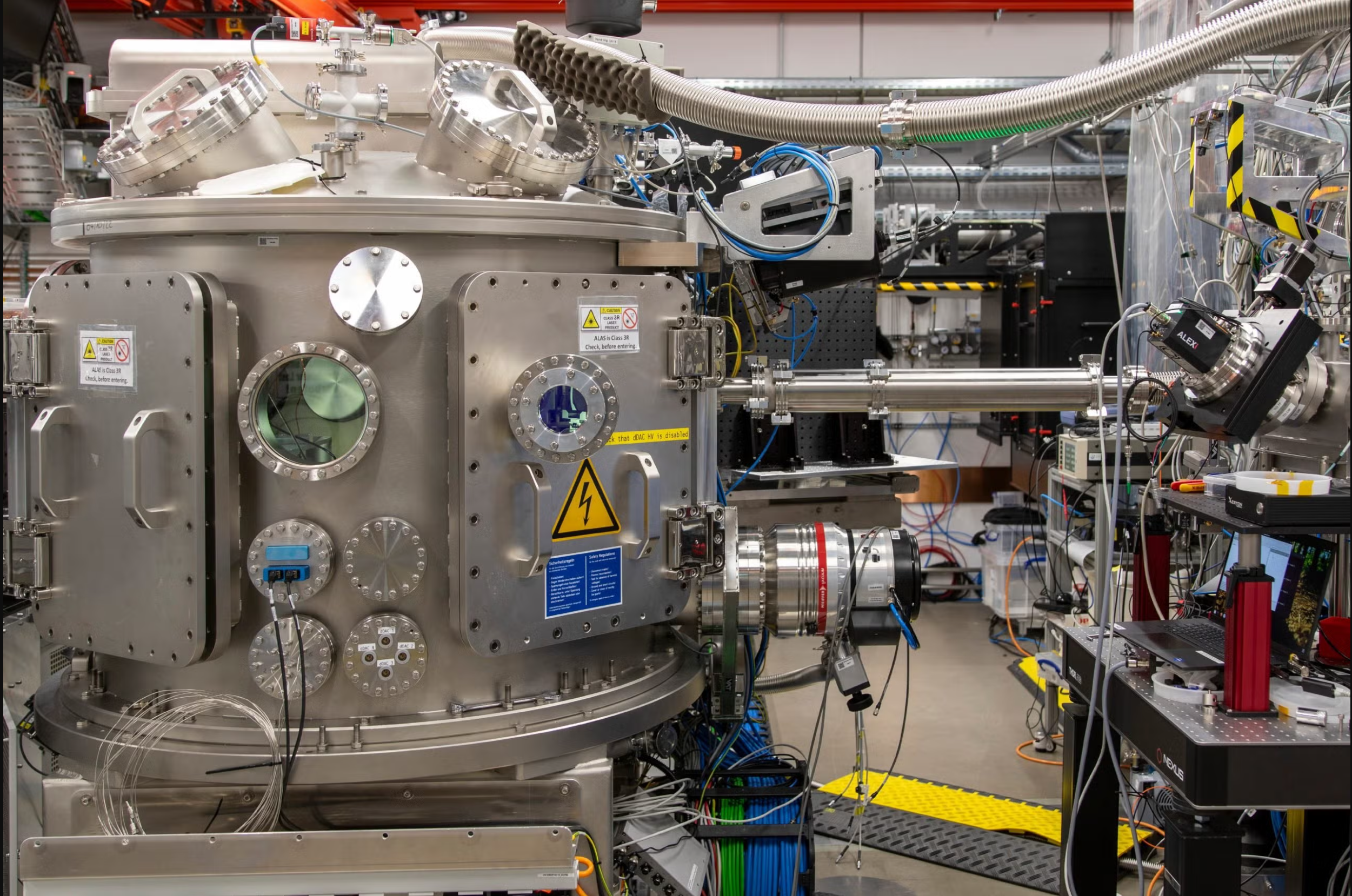
The researchers repeatedly squeezed and released liquid water inside a dynamic diamond anvil cell. The instrument traps a tiny sample between diamond tips and allows pressure to change at tightly controlled speeds.
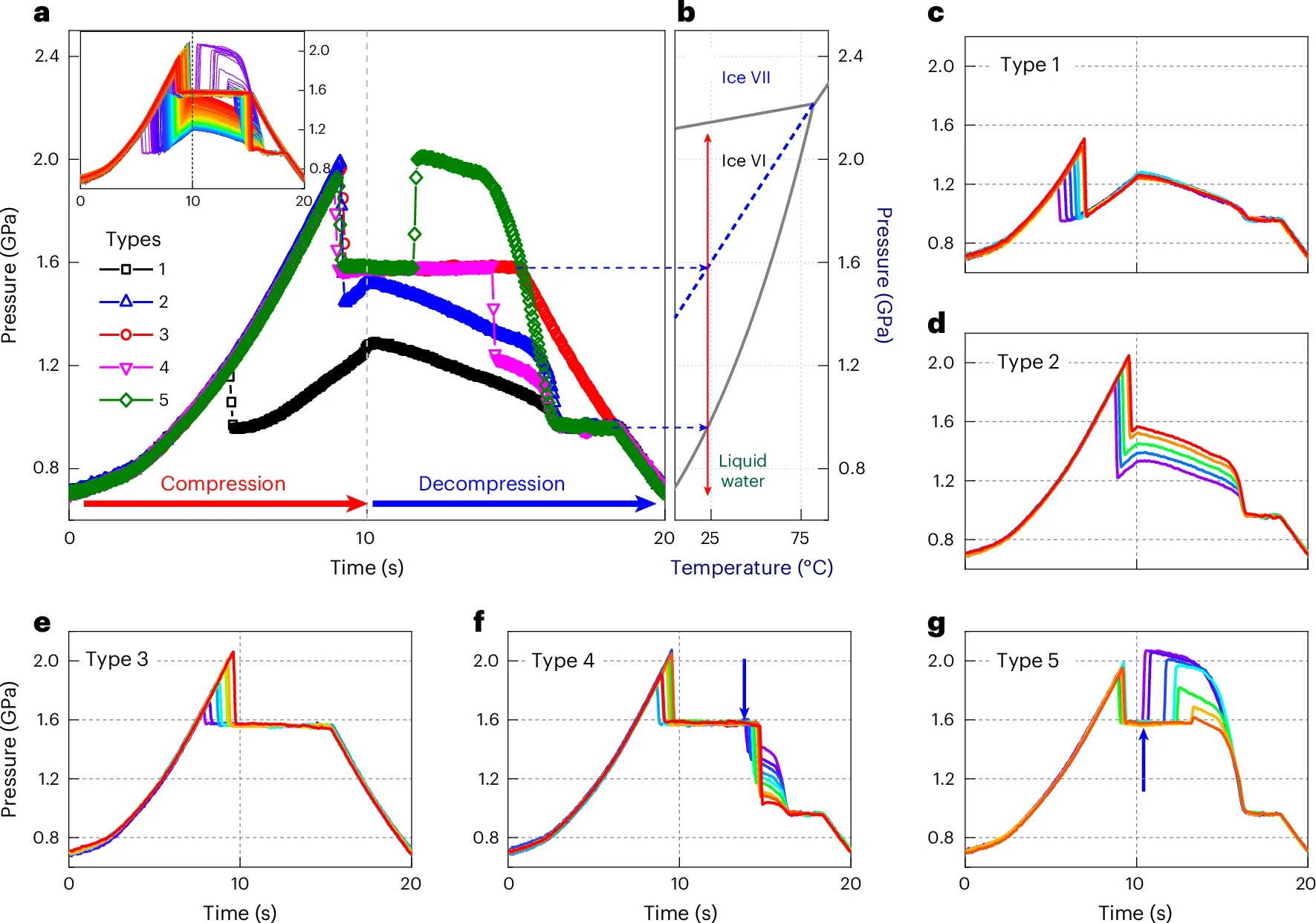
Compression and decompression rates ranged from 0.001 to 120 gigapascals per second. The team performed between 100 and 1,000 cycles at room temperature.
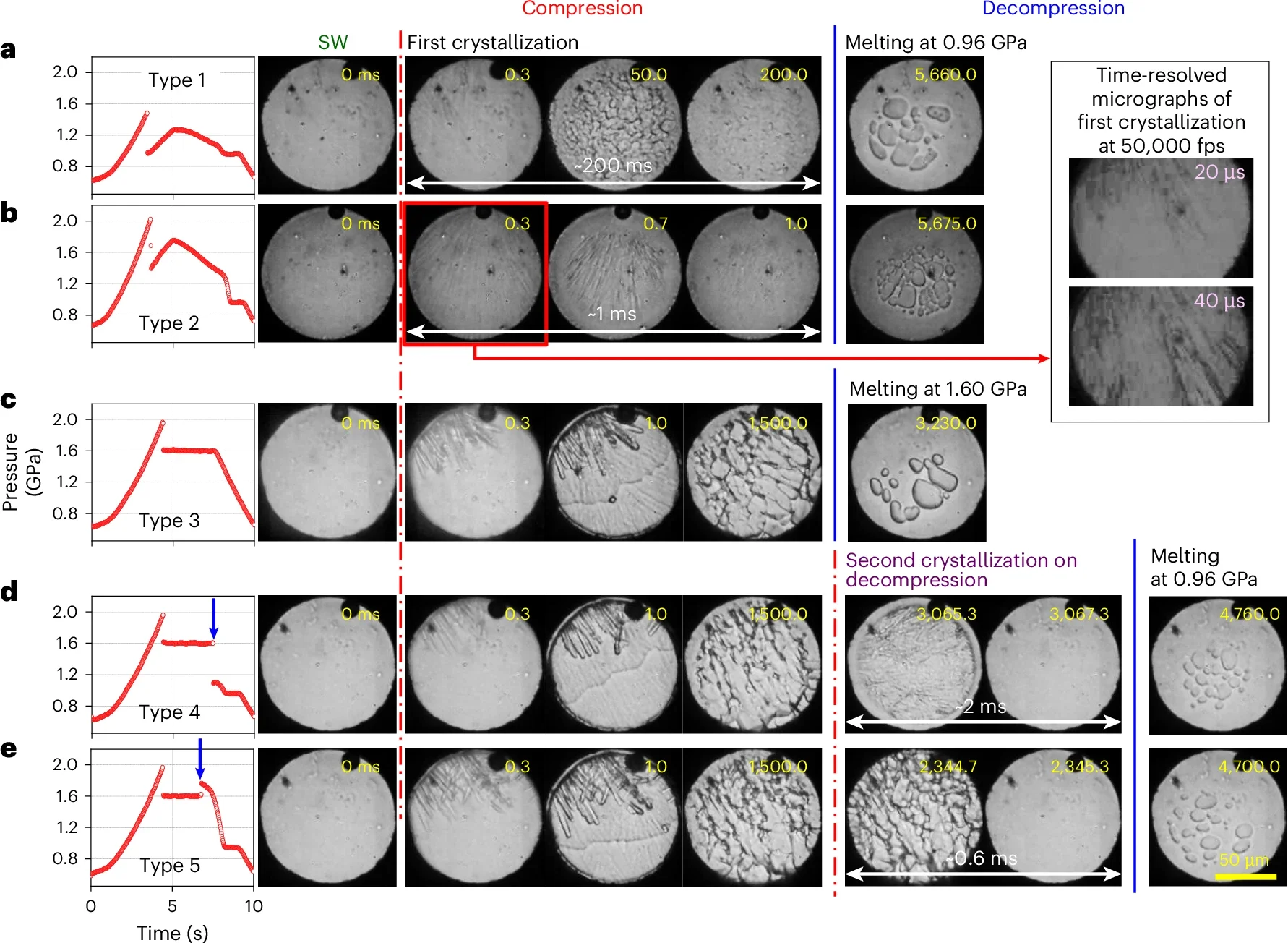
During those cycles, pressure measurements revealed five recurring patterns. Instead of simply becoming ice VI, the stable form expected across much of the tested pressure range, the water sometimes entered less stable intermediate states first.
One route followed supercompressed water to ice VI and then back to liquid water.
Another produced metastable ice VII before melting. A third moved from metastable ice VII into ice VI before returning to liquid.
The two remaining pathways involved ice XXI.
In one, supercompressed water formed ice XXI before converting into ice VI. In the most complex sequence, water became ice XXI, then metastable ice VII, then ice VI, before finally melting.
The transitions could happen extraordinarily quickly.
High-speed optical imaging showed an initial crystal growing from supercompressed water within about 20 to 40 microseconds. A second growth event followed within roughly one millisecond.
Ordinary synchrotron X-ray diffraction and Raman measurements could identify water, ice VI and metastable ice VII. But they were not fast enough to resolve the rapid two-step crystallization seen in some cycles.
The team turned to the High Energy Density beamline at European XFEL, where extremely rapid X-ray pulses could be synchronized with the pressure changes.
Those measurements captured crystal formation while the water was being compressed over about 10 milliseconds to pressures approaching 2 gigapascals.
The diffraction patterns revealed a phase that did not match any known ice from ice Ih through ice XX, including previously reported metastable structures in the ice VI pressure range.
Its crystal lattice had a body-centred tetragonal structure. Near 1.6 gigapascals, its unit cell measured about 20.2 angstroms across two axes and 7.9 angstroms along the third.
Each repeating unit contains 152 water molecules. Its calculated density at about 1.6 gigapascals is 1.413 grams per cubic centimeter.
The team named it ice XXI.
Unlike a stable phase, ice XXI does not represent the lowest-energy arrangement available under those conditions. It is metastable, meaning it can form and persist briefly before changing into a more stable structure.
The experiments showed ice XXI transforming directly into ice VI in some runs and into metastable ice VII in others.
The reverse transition from metastable ice VII back into ice XXI was not observed.
That one-way behavior indicates that ice XXI has a higher Gibbs free energy than metastable ice VII at room temperature, although the researchers concluded the two values may be fairly close.
The unusual pathways appear to depend partly on what happens inside the liquid before crystallization begins.
Rapid compression can push water beyond the pressure where it would normally freeze. In that temporary state, called supercompressed water, the liquid survives long enough for alternative crystal arrangements to compete.
Molecular-dynamics simulations showed that this liquid also changes internally as pressure rises.
The simulations used two water models, SPCfw and TIP4P/Ice. Results indicated that supercompressed water evolves from high-density water toward a very-high-density state as its hydrogen-bond network becomes distorted and rearranged.
Changes appeared in both the potential energy and density of the simulated water. The arrangement of neighboring oxygen atoms also shifted with pressure.
Between roughly 1 and 2 gigapascals, molecular patterns moved from arrangements resembling ice VI toward ones more like ice VII. Other structural changes suggested that very-high-density water could favor ice XXI instead.
That matters because crystallization does not depend only on which solid phase has the lowest energy.
A metastable crystal can appear first if its structure resembles the surrounding liquid closely enough to lower the barrier needed for nucleation. The process fits with Ostwald’s step rule, in which a material can pass through intermediate states before reaching its most stable form.
The experiments suggest ice XXI has a particularly low nucleation barrier above about 1.6 gigapascals, allowing it to compete with metastable ice VII and stable ice VI.
That competition turns what might appear to be a simple freezing process into a network of possible transitions.
The findings give scientists a more detailed picture of how water behaves when pressure changes rapidly. They also show that room-temperature water can access metastable structures that remain invisible when experiments focus only on equilibrium conditions.
That could help researchers build more precise atomistic models of water and water-containing substances. The authors specifically point to salty water and protein solutions as systems that could benefit from better high-pressure models.
The work may also guide searches for additional metastable phases at high pressures and temperatures.
Understanding how water selects among competing crystal structures could offer clues about complex high-pressure environments, including conditions relevant to icy moons and other planetary bodies.
More broadly, the results show that controlling the pathway of a phase transition can reveal structures that would otherwise be missed.
Even for a molecule as familiar as H2O, the route from liquid to solid can matter almost as much as the final destination.
These resources explore how water crystallizes under extreme pressure, why unusual ice phases can appear, and what those structures reveal about water inside planets and other high-pressure environments.
Origin of metastable ice VII and its crystal growth kinetics
Researchers experimentally verified metastable ice VII forming within the pressure range normally associated with ice VI and measured its rapid crystal-growth behavior using time-resolved X-ray diffraction and dynamic diamond-anvil compression. The work provides important context for why rapidly compressed water can follow unexpected crystallization pathways. (Physical Review B, 2025)
Metastable water at several compression rates and its freezing into ice VII
This study used time-resolved X-ray diffraction and programmable dynamic compression to examine how over-compressed liquid water remains metastable before suddenly freezing into ice VII. It directly addresses the role compression speed plays in determining what happens to water far beyond its normal freezing boundary. (Nature Communications, 2024)
Observation of plastic ice VII by quasi-elastic neutron scattering
Neutron-scattering experiments revealed a plastic form of ice VII in which the oxygen atoms retain a crystalline structure while water molecules continue rotating on extremely short timescales. The finding illustrates how high-pressure ice can combine solid-like order with molecular mobility. (Nature, 2025)
Observation of a mixed close-packed structure in superionic water ice
Using ultrafast X-ray diffraction on water compressed to pressures approaching 180 gigapascals, researchers found evidence for a more complicated superionic ice structure than a single conventional crystal phase. The results extend the study of water far beyond the ice VI and VII regime into conditions relevant to planetary interiors. (Nature Communications, 2025)
Deep potential-driven structure exploration of ice polymorphs
Computational structure searches reproduced known ice phases while identifying dozens of additional candidate structures across high-pressure conditions. The work shows why water’s phase diagram may still contain undiscovered or metastable arrangements beyond the ice forms confirmed experimentally so far. (Materials Today Physics, 2025)
Research findings are available online in the journal Nature Materials.
The original story “New form of ice can freeze at room temperature, study finds” is published in The Brighter Side of News.
Like these kind of feel good stories? Get The Brighter Side of News’ newsletter.
The post New form of ice can freeze at room temperature, study finds appeared first on The Brighter Side of News.


Leave a comment
You must be logged in to post a comment.