For more than half a century, astronomers have relied on a basic rule to estimate the stars they cannot see. New evidence from Milky Way star clusters suggests that rule is not universal, with consequences for how distant galaxies are weighed.
The rule is called the initial mass function, or IMF. It describes how many stars of different masses are born together. Because faint, low-mass stars are difficult to detect in distant galaxies, astronomers infer their numbers from brighter, heavier stars.
University of Missouri researchers found that the balance between low- and high-mass stars can change from one stellar environment to another. Their analysis used open star clusters mapped by the European Space Agency’s Gaia mission, which has cataloged nearly 2 billion stars.
“One of astronomy’s basic assumptions may be oversimplified,” Charles Steinhardt, an astronomy professor and co-author of the study, said. “Other galaxies weren’t breaking the laws of physics — we were measuring them with the wrong yardstick.”
A galaxy’s light is dominated by rare, massive stars even though they represent only a small share of its stellar mass. The study notes that these bright stars account for between 10−3 and 10−6 of the full mass of a galaxy’s dark matter halo.
That leaves most of an unresolved galaxy effectively invisible. Astronomers must estimate its total stellar mass and star formation rate from the luminous stars they can observe. Those calculations depend heavily on the assumed IMF.
Standard galaxy-analysis methods generally treat the chosen Galactic IMF as universal.
The Missouri team tested that assumption using open clusters, groups of stars that formed together under similar conditions. The Gaia catalog contains 7,167 detected clusters, including 3,530 considered highly reliable. After strict quality and completeness cuts, the final sample contained 110 clusters.
Only 417 of the 3,530 high-quality clusters contained enough low-mass stars to detect a key feature called the break mass, and fewer also contained enough rare high-mass stars.
Astronomers observe clusters as they exist today, not as they formed. Massive stars die first, while gravitational interactions and tidal stripping can gradually remove lower-mass stars.
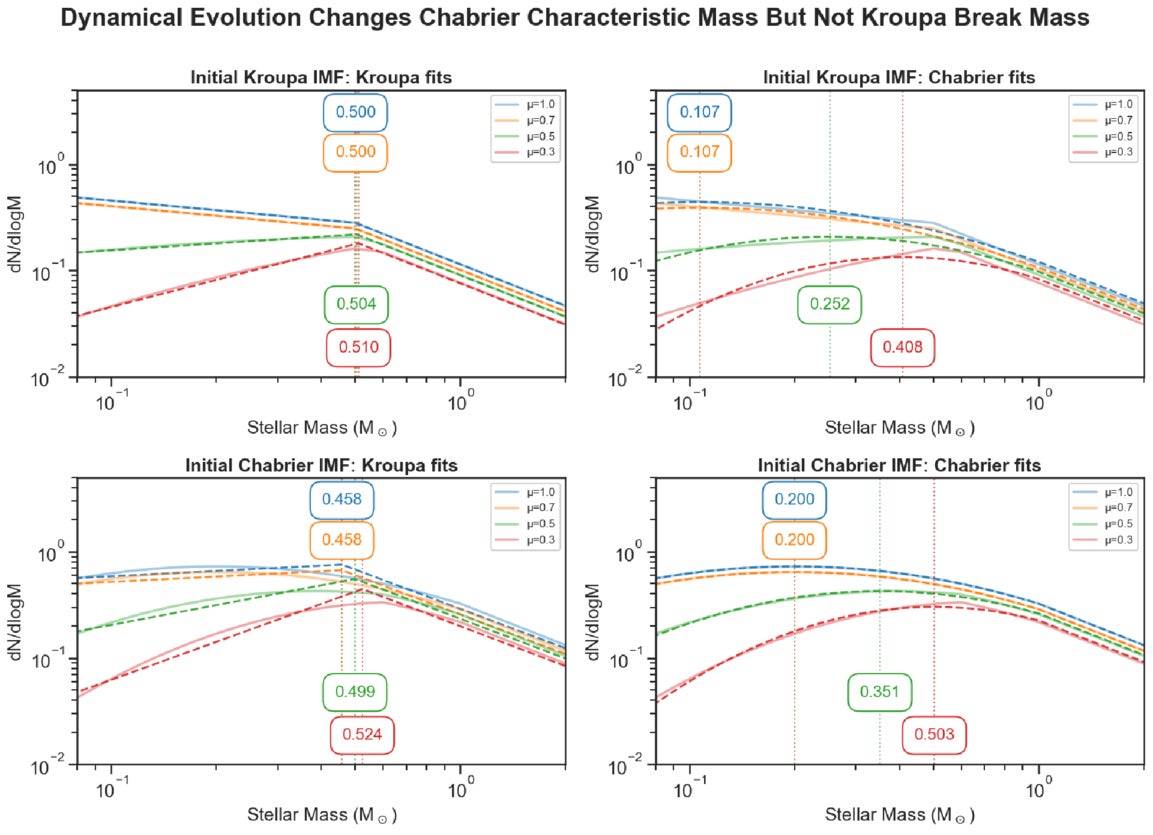
The researchers used a Kroupa-style IMF, which divides the stellar mass distribution into power-law sections separated by a break. In this framework, later dynamical evolution changes the slopes but leaves the break mass nearly unchanged.
That distinction allowed the team to separate changes caused after a cluster formed from differences present at birth. If clusters show different break masses, the authors argue, ordinary stellar aging and dynamical disruption cannot explain them.
Different clusters displayed different break masses, while the intermediate- and high-mass slopes showed no statistically significant relationship with cluster age.
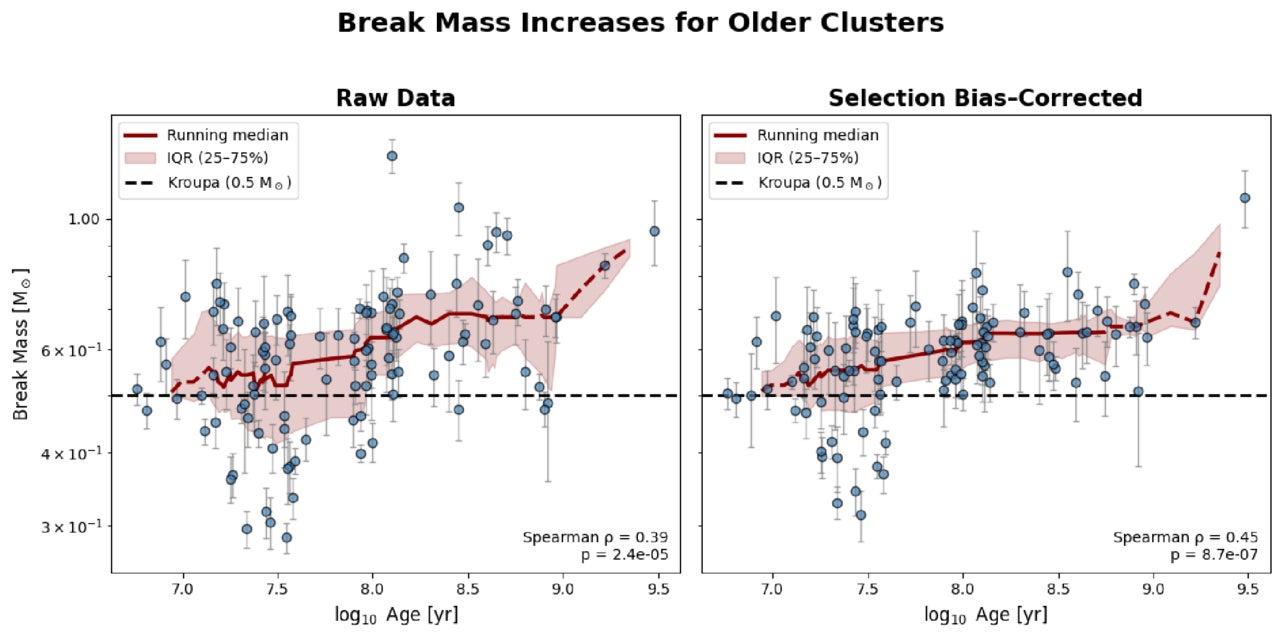
Break mass, however, rose strongly with age. Before correcting for a distance-related selection effect, the correlation had a Spearman coefficient of 0.391 and a probability value of 2.4 × 10⁻⁵. After correction, the correlation strengthened to 0.449, with a probability value of 8.7 × 10⁻⁷.
“The pattern we found is surprisingly clean,” Carter Meyerhoff, an undergraduate researcher and co-author of the study, said. “Instead of applying the same model to every galaxy, astronomers could account for the conditions under which stars formed and select the IMF that best matches that environment.”
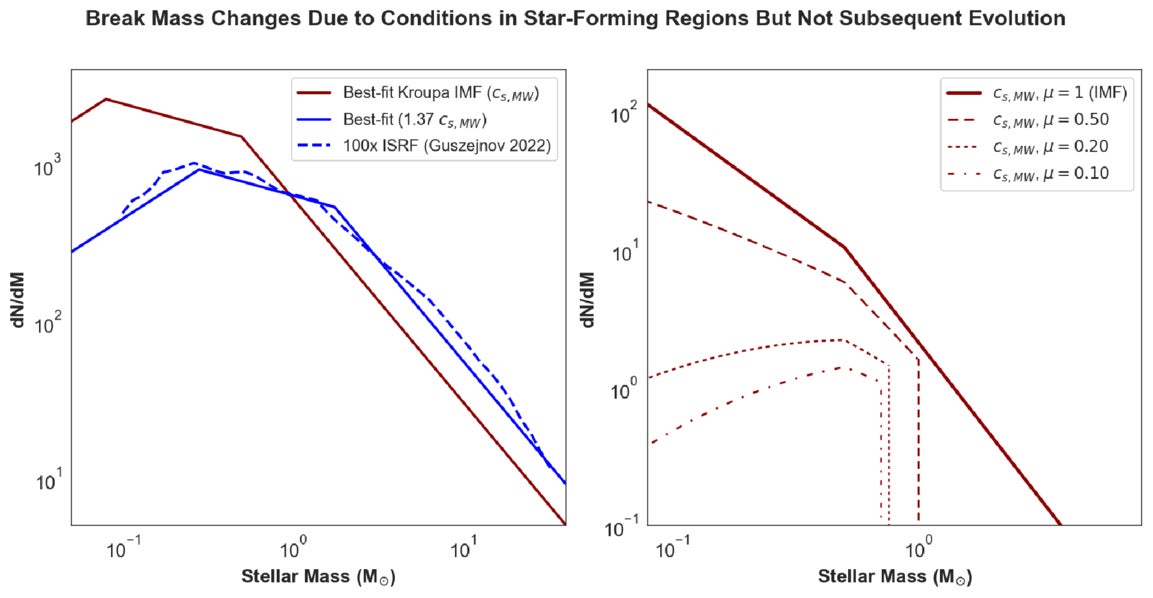
The result fits physical models in which the IMF depends partly on conditions inside molecular clouds, the gas clouds where stars form. One important factor is the speed of sound in the gas, which changes with conditions such as temperature.
Models predict that changing sound speed shifts the IMF break mass without necessarily changing its slopes. Older clusters may therefore preserve evidence of different star-forming environments in the Milky Way’s past.
The rate at which gas conditions change can differ among galaxies, and the Milky Way may have had an unusual star formation history. Better modeling will be needed to test the trend quantitatively.
Clusters of the same age also show a substantial range of break masses. That scatter is consistent with a galaxy containing many star-forming regions with different conditions at the same time.
The analysis carries other uncertainties. Correcting for unresolved binary stars remains unsettled, and different treatments can affect inferred mass functions, especially at low stellar masses. The study also cannot yet establish whether the IMF’s power-law slopes vary similarly because dynamical evolution affects those slopes more strongly.
Most techniques used to analyze unresolved galaxies assume a fixed IMF when converting observed light into stellar mass and star formation rates.
If the IMF changes with environment, those estimates can become systematically biased. The effect should be strongest for very distant galaxies, where star-forming conditions differ most from those in the Milky Way today.
That issue is especially relevant to galaxies observed by NASA’s James Webb Space Telescope. Some extremely distant systems have appeared surprisingly massive. A bottom-lighter IMF, containing relatively fewer low-mass stars, would mean their stellar masses and star formation rates have been overestimated.
The authors argue that this could make some apparently extreme JWST measurements easier to reconcile with standard astrophysical and cosmological models, without requiring those galaxies to violate established physics.
“We’ve found that the universe is more complicated than we assumed,” Steinhardt said. “But we’re also getting closer to measuring it correctly.”
The work suggests astronomers should no longer treat a universal IMF as the automatic starting point for every stellar population. Future galaxy models may need to account for the conditions under which different generations of stars formed.
That will be challenging because a galaxy contains stars produced across many environments and periods. Its combined IMF may not match any single simple IMF used for an individual star-forming region.
A next step is to develop flexible descriptions for these combined stellar populations and test them against simulations and different star formation histories. Better models could improve estimates of galaxy mass, star formation and evolution across cosmic time.
These recent studies explore how the stellar initial mass function can change with environment, metallicity and cosmic time, and what those changes could mean for galaxies observed by JWST. They also show where evidence for a universal stellar birth pattern is weakening and where important uncertainties remain.
Research findings are available online in The Astrophysical Journal Letters.
The original story “New Gaia data is challenging a 50-year-old assumption about how stars and galaxies form” is published in The Brighter Side of News.
Like these kind of feel good stories? Get The Brighter Side of News’ newsletter.
The post New Gaia data is challenging a 50-year-old assumption about how stars and galaxies form appeared first on The Brighter Side of News.


Leave a comment
You must be logged in to post a comment.