Dark lines cut across the pale northern edge of Pluto’s largest glacier, tracing boundaries between vast cells of nitrogen ice. Their shape now points to a surprising possibility: liquid nitrogen may have recently risen from below and flowed across the frozen surface.
The proposed flows would be the first evidence of liquid reaching Pluto’s surface during its modern geological era. The conclusion comes from a Southwest Research Institute-led analysis of images collected by NASA’s New Horizons spacecraft.
The peer-reviewed research, published in The Planetary Science Journal, focuses on Sputnik Planitia. This enormous glacier forms the western side of Pluto’s heart-shaped region and is larger than Texas and Oklahoma combined.
“Pluto never stops surprising us,” lead author Dr. Alan Stern said, “and this new result certainly does that. In addition to suggesting that liquids have recently expressed themselves on Pluto’s surface, it also suggests a new kind of time-variable feature on Pluto.”
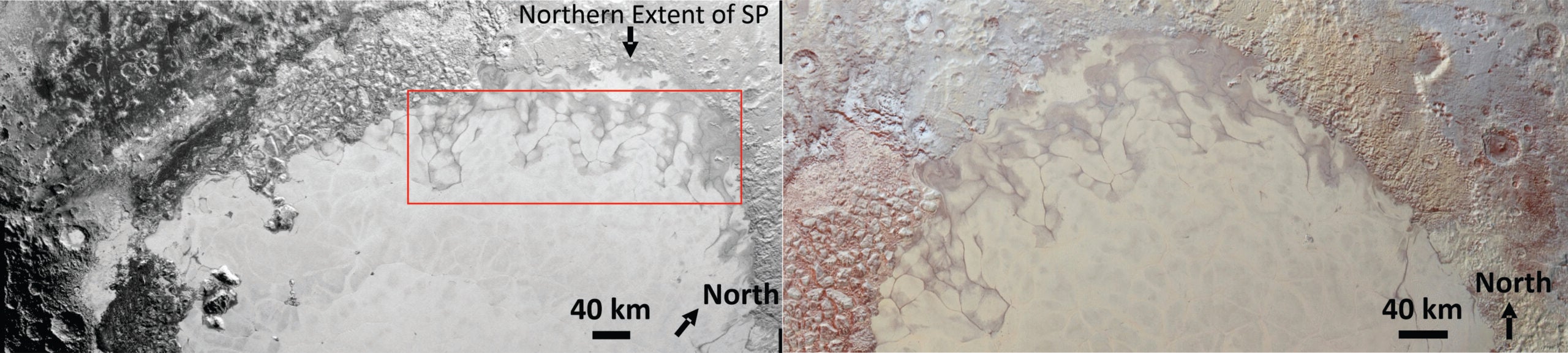
Sputnik Planitia stretches about 850 kilometers from east to west and roughly 1,500 kilometers from north to south. The glacier fills much of an ancient impact basin and contains nitrogen-rich ice mixed with smaller amounts of carbon monoxide and methane.
Its surface sits between 2.5 and 3.5 kilometers below the mountains surrounding the basin. Temperatures hover near 37 kelvins, or about minus 236 degrees Celsius.
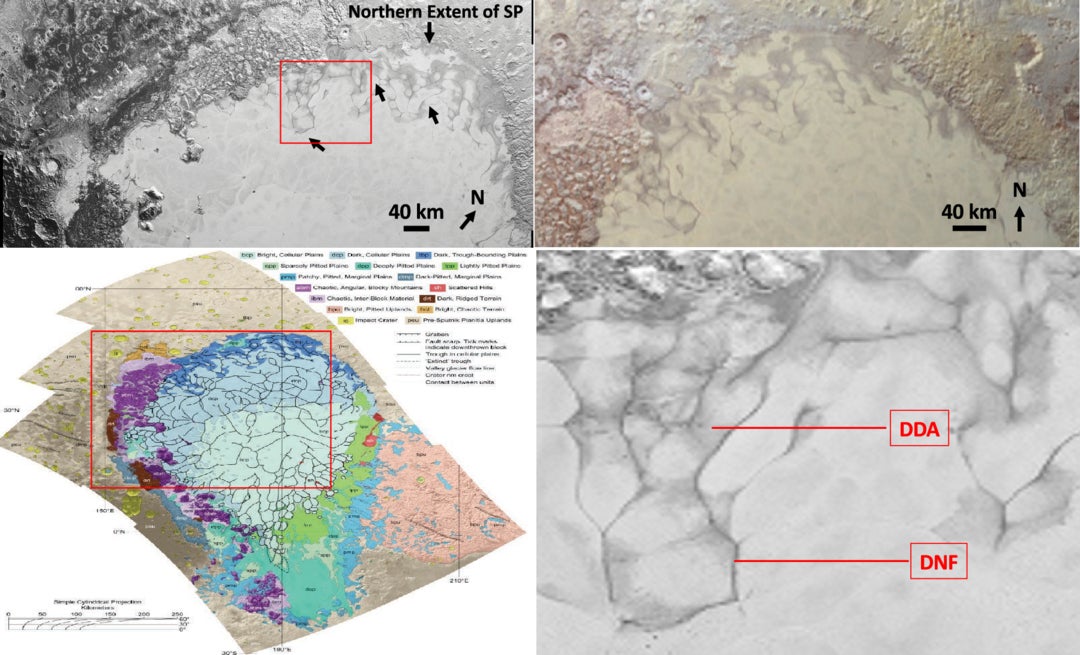
Much of the glacier consists of polygon-shaped convection cells. These city-sized regions form as solid nitrogen ice slowly circulates, bringing warmer material upward and carrying colder material downward.
Individual cells usually measure 20 to 35 kilometers across. Their centers rise modestly, while narrow troughs separate their edges.
New Horizons photographed dark, narrow features along many of those boundaries. Some stretch tens of kilometers. Broader, more diffuse dark aprons surround them, sometimes extending up to 20 times farther than the narrow cores.
The markings appear softer and muddier than nearby terrain. They also follow slopes and low areas in ways that resemble the movement of a fluid.
Pluto’s atmospheric pressure and surface temperature rule out liquid nitrogen rain. Any liquid would therefore need to come from beneath the glacier.
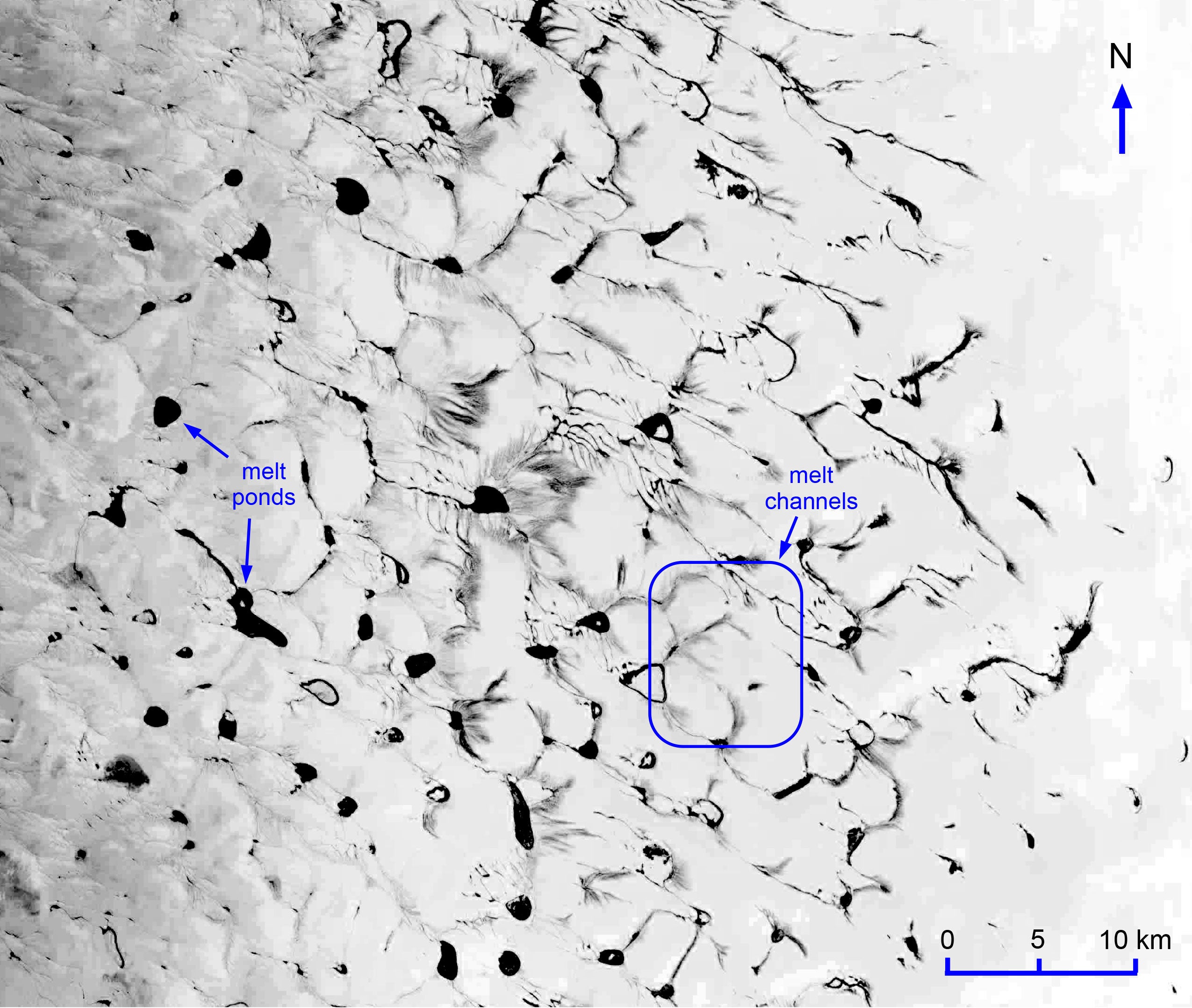
The team compared the New Horizons images with Landsat 9 views of Greenland’s ice sheet. On Earth, water flowing through channels and collecting in ponds darkens snow and ice.
Liquid water changes how light moves through the frozen surface. It can also enlarge ice grains, reducing the amount of light reflected back into space. Some channels remain darker even after the water freezes.
The Greenland patterns resemble the dark lines and aprons seen on Sputnik Planitia. Both appear concentrated in depressions and along routes controlled by local topography.
Other processes can darken ice. Larger grains, dust or carbon-rich particles can all reduce surface brightness. Pluto’s atmosphere also deposits dark hydrocarbon haze particles across the landscape.
However, those processes would likely create more diffuse patterns. They do not easily explain the sharp boundaries, long narrow lines and darkened low areas seen along the glacier’s northern edge.
The dark aprons are about 0.10 lower in reflectivity than most of Sputnik Planitia. The narrow central features are roughly 0.15 darker.
A liquid passing through the ice could enlarge its grains quickly. Flowing nitrogen might also carry dark material from below, leaving deposits where the liquid pooled or froze.
Computer modeling led by Dr. Orkan Umurhan of the SETI Institute examined whether nitrogen could melt beneath the glacier and reach the surface before freezing.
Liquid nitrogen is less dense than solid nitrogen ice. That difference would cause melt to rise, much as molten rock rises through denser crust on Earth.
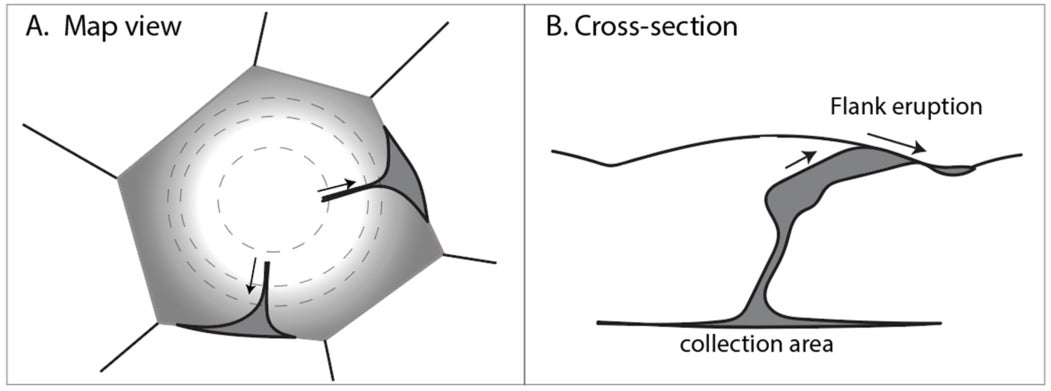
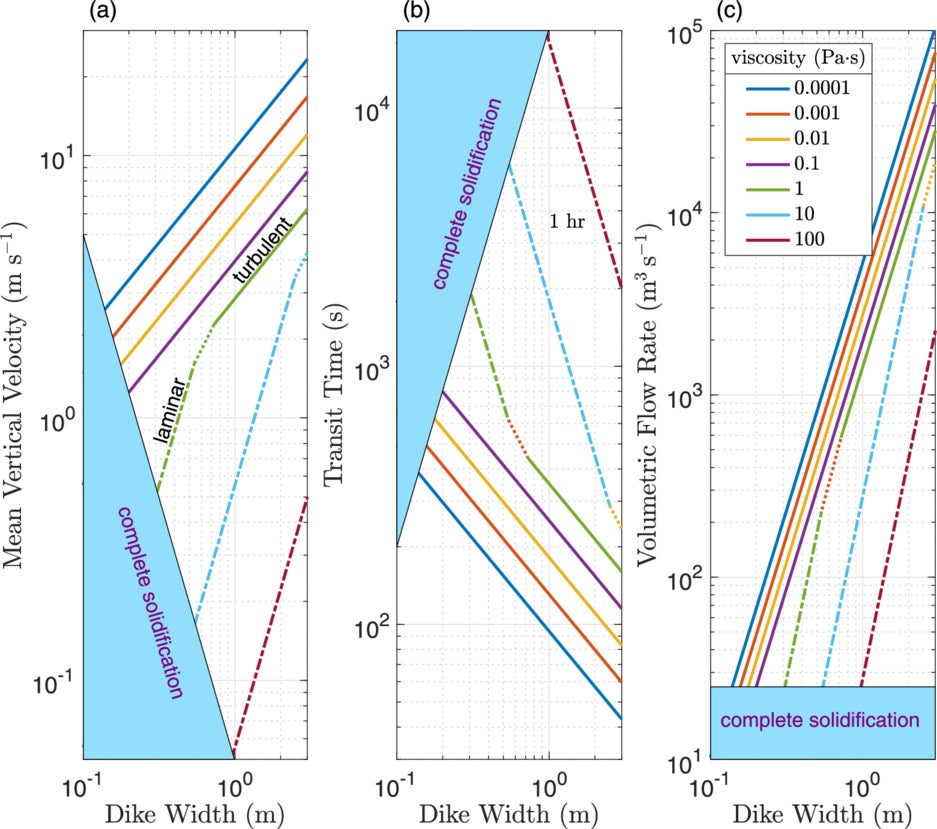
The models suggest liquid nitrogen could move through narrow conduits or cracks. These passages may measure from about 15 centimeters to roughly one meter across, depending on the liquid’s thickness and composition.
Such cracks would be far too small for New Horizons to see. The spacecraft’s sharpest images of Sputnik Planitia resolve features about 70 to 75 meters wide.
The glacier may be deep enough for pressure and internal heat to create liquid nitrogen near its base. Depending on Pluto’s geothermal heat, melting conditions could occur between about 300 meters and 1.4 kilometers below the surface.
The exact melting process remains uncertain. Heat generated by the glacier’s movement appears too weak to produce enough liquid.
One possibility involves nitrogen trapped within pores in the water-ice bedrock. A pressure change or deep fracture could allow that nitrogen to melt and rise.
Another proposed mechanism begins as northern Sputnik Planitia slowly loses ice through sublimation. As the layer thins, convection could weaken. The less active ice would carry away less internal heat, allowing temperatures near the base to rise toward the melting point.
The estimated steady production of liquid nitrogen is too low to maintain a continuous flow to the surface. The models place that rate below one cubic meter per second.
At least 25 cubic meters per second may be needed to keep liquid moving upward without freezing inside a crack. Surface flows extending one kilometer could require discharge rates of at least seven cubic meters per second.
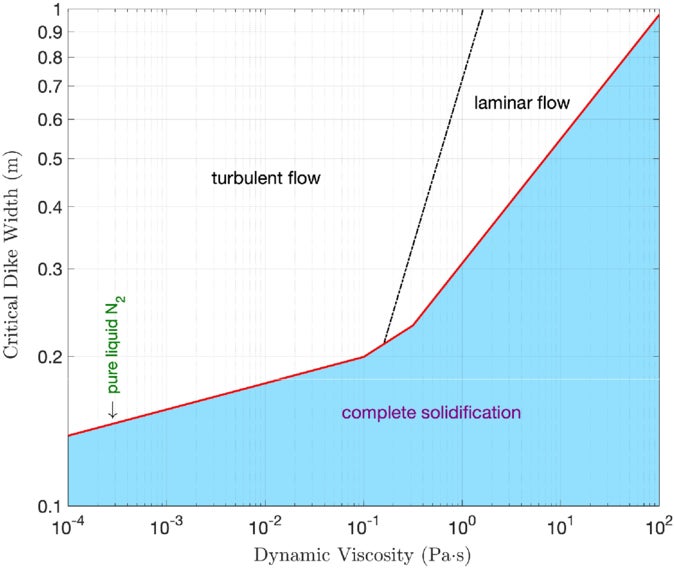
That mismatch suggests liquid would gather in underground reservoirs.
As more melt entered a reservoir, pressure could rise until the overlying ice fractured. Nitrogen might then surge upward during an eruption lasting hours or days.
Once at the surface, the liquid could move downhill toward the edges of convection cells. It might fill troughs and other depressions before freezing.
Depending on its viscosity and flow rate, the nitrogen could remain mobile for minutes, hours or longer. Some modeled flows could continue for about 20 hours and release between 100,000 and one million cubic meters of liquid.
“The surface of Sputnik Planitia is quite young, probably less than one million years based on modeling of the surface overturn, and thus these features that we are looking at must have formed since then,” said SwRI Principal Scientist Dr. Kelsi Singer, a study co-author.
No impact craters have been found on the glacier, supporting the idea that convection renews its surface every 500,000 to one million years.
That does not prove liquid nitrogen created the markings. The interpretation rests on surface shapes, brightness patterns, comparisons with Earth and computer models.
The findings give planetary scientists a new way to investigate how extremely cold glaciers behave. Nitrogen ice under pressure may melt, fracture and erupt through processes that laboratories have barely explored.
“I think the great significance of these findings, and the tantalizing picture that it promotes, is a great motivation and reason to further examine solid state nitrogen physics at very low temperatures,” Umurhan said. “Specifically, it’s important to examine the physics taking place in solid nitrogen materials under stress and strain, which can cause them to melt. These processes have never been studied in real detail in the laboratory.”
More than half of Pluto has not been mapped at high resolution. Future spacecraft images could reveal whether similar dark flows appear elsewhere on the dwarf planet.
The same mechanism could also help explain nitrogen-driven activity on other distant worlds. Possible targets include Neptune’s moon Triton, where Voyager 2 observed geysers, and the dwarf planet Eris, whose bright surface contains nitrogen ice.
For now, Sputnik Planitia offers the strongest available evidence. Beneath its smooth frozen plains, Pluto may still be storing liquid and occasionally forcing it into the open.
Research findings are available online in The Planetary Science Journal.
The original story “New Horizons images reveal signs of flowing liquid nitrogen on Pluto” is published in The Brighter Side of News.
Like these kind of feel good stories? Get The Brighter Side of News’ newsletter.
The post New Horizons images reveal signs of flowing liquid nitrogen on Pluto appeared first on The Brighter Side of News.


Leave a comment
You must be logged in to post a comment.