Every text message, photograph, and saved file still comes down to a simple bargain: information is stored as either 0 or 1. That binary system built modern computing, and for decades engineers kept improving it by shrinking the transistors that carry and store those bits.
That long run is getting harder to sustain.
As components approach physical limits, researchers are looking for other ways to handle information, including methods that do not rely only on electric charge. One of the most closely watched alternatives is spintronics, a field that uses another property of electrons, their magnetism, to store and process data.
A new study from researchers at Institut Laue-Langevin pushes that idea in an unusual direction. Instead of building memory around two stable magnetic states, the work shows that a single crystal can hold four. In principle, that could let one memory unit represent four values rather than just 0 and 1, opening a path toward denser forms of digital storage.
The material at the center of the work is a magnetoelectric crystal called LiNi0.8Fe0.2PO4, made from lithium, nickel, iron, and phosphate. Inside it, atomic-scale magnets line up in an antiferromagnetic pattern, meaning neighboring moments point in opposite directions. That matters because antiferromagnets produce no overall magnetic field, making them less vulnerable to outside disturbances and attractive for tightly packed devices.
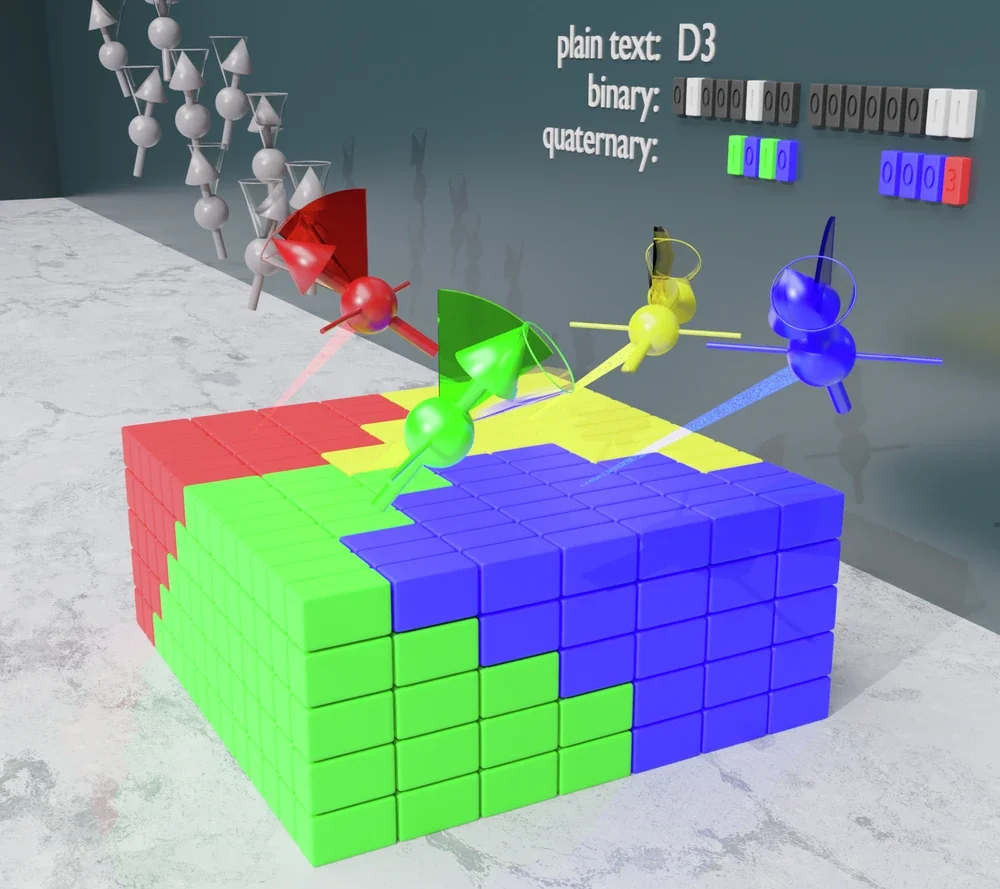
At very low temperatures, below 21 kelvin, or about minus 252 degrees Celsius, the crystal enters a state where its atomic magnets can settle into four distinct arrangements. Those configurations emerge because the moments rotate away from a higher-symmetry direction and stabilize in four separate magnetic domains.
That is what makes the system interesting as a model for quaternary memory, a storage concept that goes beyond binary logic. If each memory unit can reliably occupy four states instead of two, storage density rises sharply. The study illustrates that idea with a simple comparison: eight binary units can encode 256 combinations, while eight quaternary units can encode 65,536.
This is not a practical memory chip. The material only works at extremely low temperatures, far below what any consumer device could tolerate. Still, the findings matter because they show that a purely antiferromagnetic bulk material, without ferromagnetic or ferroelectric order, can be driven into four stable and distinguishable magnetic states.
That is a rare result.
Most earlier examples of four-state memory systems relied on composite materials and included at least one ferro- or ferrimagnetic component, both of which are sensitive to stray magnetic fields. LiNi0.8Fe0.2PO4 avoids that problem because its opposite moments cancel one another out.
The crystal also has two less familiar traits that give researchers ways to control it. It is magnetoelectric, meaning its magnetic state can be influenced by an electric field. And it carries what is known as toroidic order, in which the magnetic moments form a circulating, vortex-like pattern that creates a toroidic moment.
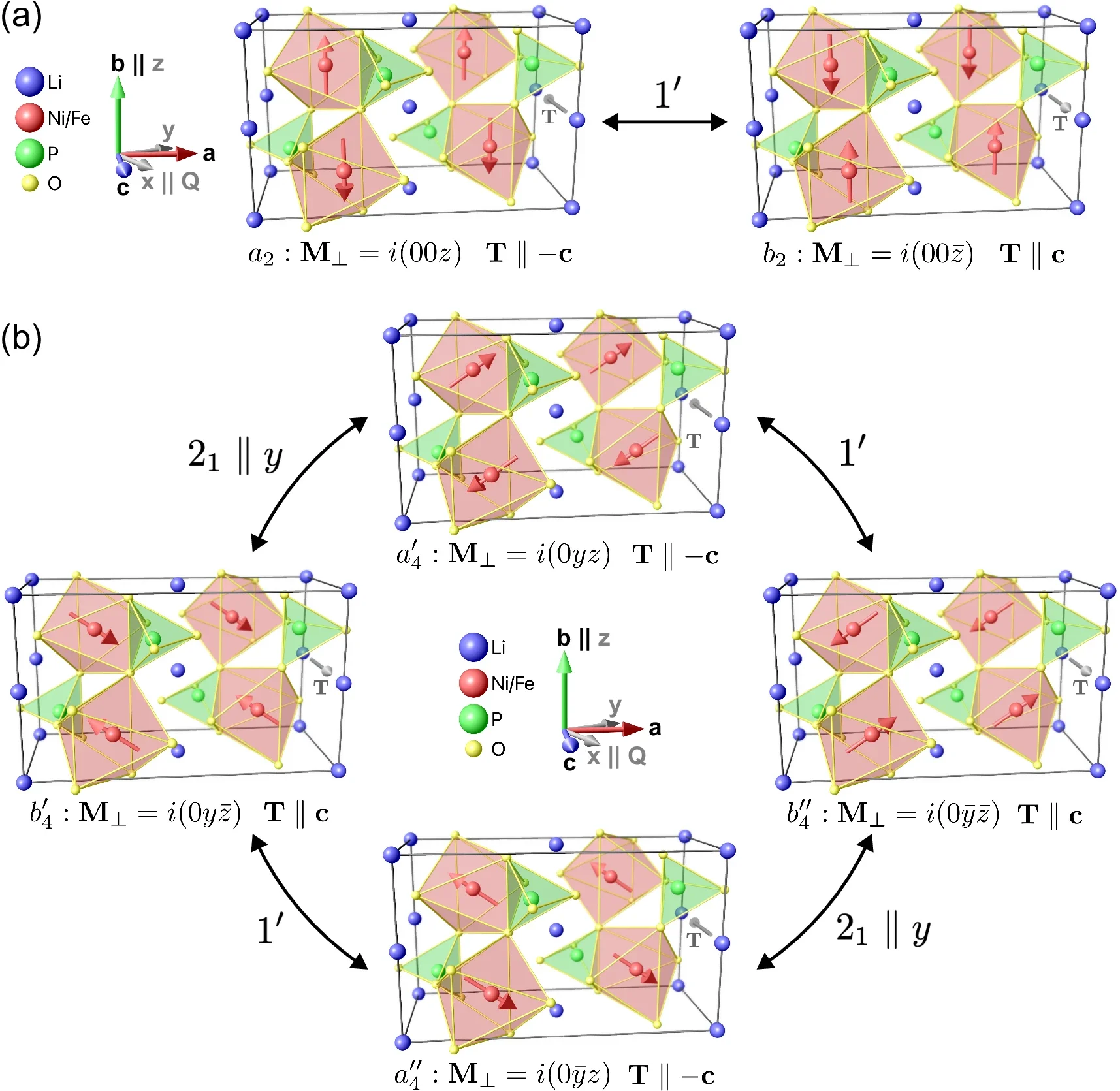
That toroidic character turns out to be central. The team found that the material’s magnetic domains can be selected by cooling the crystal under applied electric and magnetic fields. In the higher-temperature ordered phase, below the Néel temperature of 25 kelvin but above 21 kelvin, the crystal has two magnetic domains. Below 21 kelvin, after the spin rotation sets in, those two expand into four.
The key point is that the researchers could use two independent controls. The combination of electric and magnetic fields, through the quantity E × H, selected the toroidal domain. The magnetic field itself then helped select the orientation domain. Together, those handles allowed the sample to be steered toward each of the four possible states.
The magnetic structure remained in place after the fields were removed.
That non-volatile behavior is essential for memory. Stored information has little practical value if it vanishes as soon as power or control fields disappear. In this case, the domain distribution stayed stable at constant temperature even though all spherical neutron polarimetry measurements were performed afterward with both electric and magnetic fields set to zero.
To prove which magnetic state the crystal had adopted, the team used polarized neutron scattering, specifically spherical neutron polarimetry, or SNP. Neutrons are especially useful for this kind of work because they carry a magnetic moment even though they have no electric charge. That lets them act as tiny magnetic probes inside a crystal.
When a polarized neutron beam passes through a magnetic material, the neutron spins rotate in ways that depend on how the atomic moments are arranged. In LiNi0.8Fe0.2PO4, the sign and direction of that rotation provided a fingerprint for each domain. Standard methods cannot fully identify the absolute spin configuration, but SNP can do so by measuring off-diagonal elements in the polarization matrix that reveal the sign of the magnetic interaction vector.
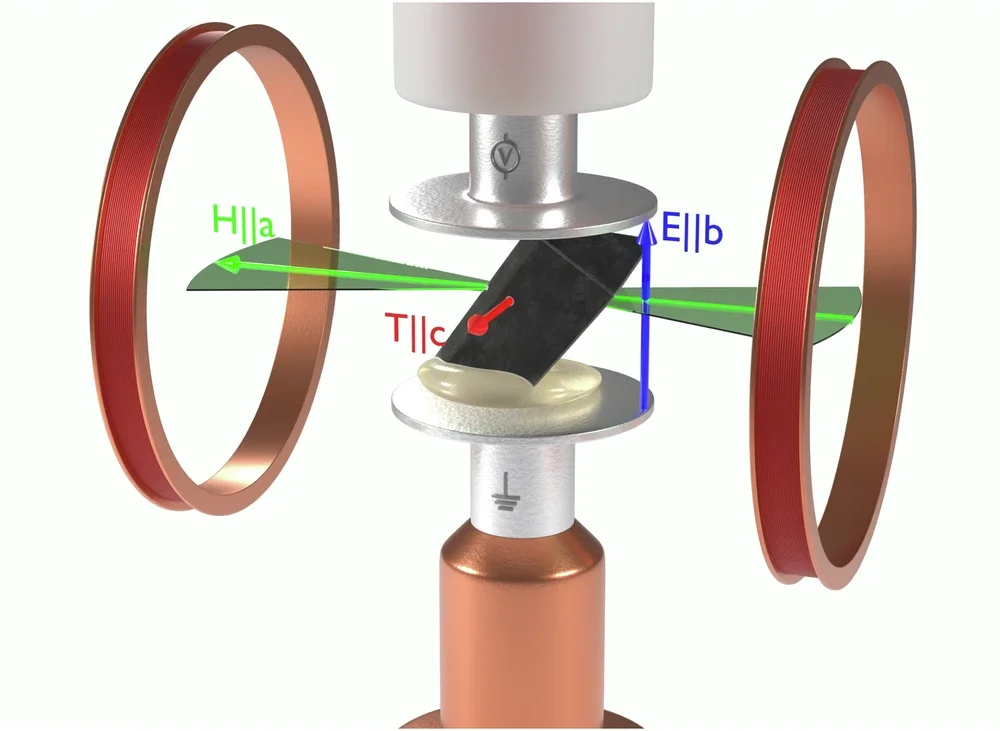
Using that approach, the team showed that four different field-cooling protocols produced four different signatures at 2 kelvin. Those signatures corresponded to four separate magnetic domains, effectively demonstrating a four-state memory in the crystal.
The control was not perfect. At 22 kelvin, cooling under crossed electric and magnetic fields produced a majority domain occupying more than 90 percent of the sample volume. At 2 kelvin, the four-state selection was weaker, with majority domain populations ranging from 55 percent to 66 percent. The authors traced that less efficient selection to the relative strengths of internal interactions tied to the Dzyaloshinskii-Moriya vector, a feature that influences how spins cant and how domains are favored.
They also tried switching domains at constant temperature near 19 kelvin and did not succeed, even with a conjugate field of about 13 tesla-kilovolt per centimeter. The study suggests that impurities or local fluctuations in the nickel-iron distribution may pin the domains and make switching harder.
The immediate impact is not a new commercial memory device. The crystal orders only at very low temperature, and the work remains a proof of concept rather than a product blueprint.
Its value lies elsewhere. The findings establish a clean example of quaternary logic in an antiferromagnetic material, one that is robust against stray magnetic fields and known for very fast magnetic dynamics. That combination fits well with long-term efforts to build spintronic devices that move beyond the charge-based limits of conventional silicon electronics.
The research also gives scientists a clearer map for what to look for next. Better control of the four domains, successful in-situ switching, and materials that operate much closer to room temperature are the major next steps. Thin films may help because they could allow stronger conjugate fields, and the symmetry-based mechanism seen here may apply to other magnetoelectrics with more useful operating temperatures.
For now, LiNi0.8Fe0.2PO4 serves as a sharply resolved model system. It shows that four stable magnetic states can be written, read, and retained in a single antiferromagnetic crystal. In a field searching for memory beyond binary, that alone is a meaningful step.
Research findings are available online in the journal Nature Communications.
The original story “New material stores four magnetic states per cell – exponentially increasing memory storage” is published in The Brighter Side of News.
Like these kind of feel good stories? Get The Brighter Side of News’ newsletter.
The post New material stores four magnetic states per cell – exponentially increasing memory storage appeared first on The Brighter Side of News.

