Tiny robots built from biomolecules and nanoparticles have long promised a more precise way to deliver drugs, run chemical reactions, or work in places larger machines cannot reach. The challenge has been flexibility. Many nanorobots are built for one task, then stop there.
A team at the University of Basel now reports a design that breaks that pattern by splitting the machine into reusable parts. Instead of packing every function into one rigid structure, the researchers built a nanorobot with a magnetic propulsion module and a separate payload module, then linked them through complementary DNA strands that act like a molecular fastener.
“Previous nanorobots are often designed for a specific task only,” says Cornelia Palivan of the University of Basel. “Our modular system, on the other hand, can be adapted to different applications.”
The work, published in Advanced Functional Materials, points to a system that could be tuned for medicine, catalysis, and environmental technology, all by changing what the payload carries.
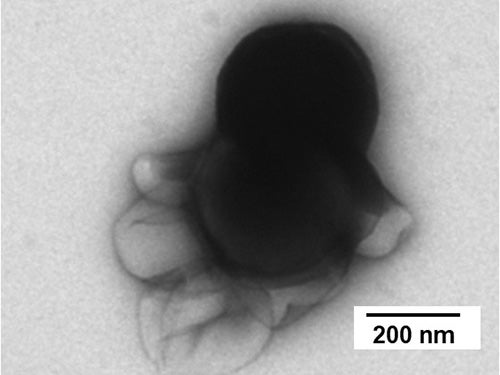
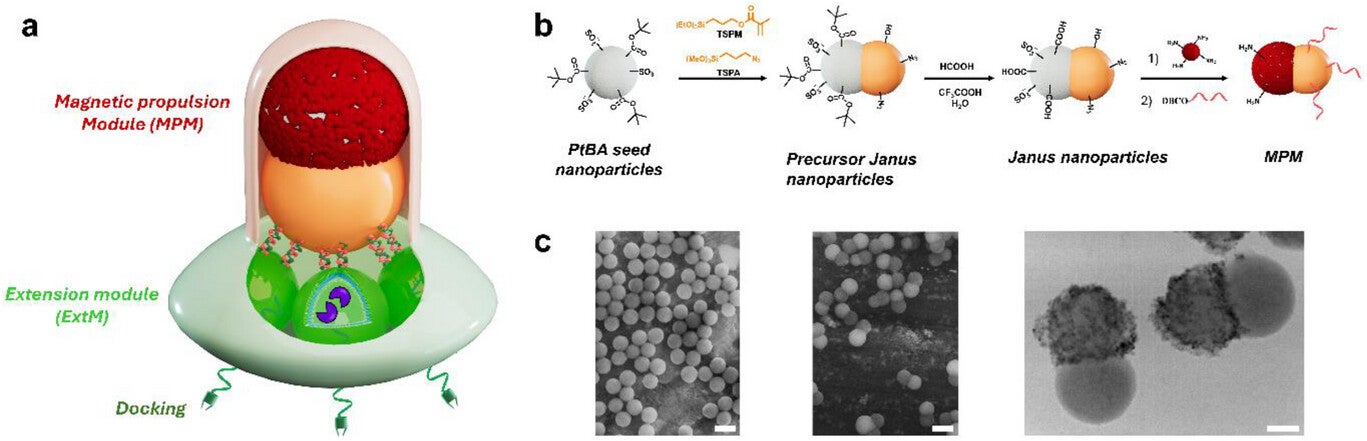
The design resembles a miniature multistage craft. One part, called the magnetic propulsion module, is based on Janus nanoparticles, structures with two different sides. On one side, the team attached magnetic iron oxide nanoparticles, allowing the system to respond to external magnetic fields. On the other, they added single-stranded DNA to create a programmable attachment site.
The second part, the extension module, carries the functional cargo. In the Basel design, that cargo sat inside polymersomes, polymer-based vesicles that can protect delicate enzymes. Molecules can pass through pores in the vesicles, interact with enzymes inside, and then release the products back into the surroundings.
When the complementary DNA strands on the two modules met, the pieces self-assembled into a dual-module nanorobot. Under optimized conditions, assembly reached a yield of 92 percent. The resulting extension module usually contained four polymersomes attached to the non-magnetic side of the propulsion unit.
That split matters. By keeping the magnetic portion separate from the biochemical portion, the team aimed to reduce interference between functions. The Janus structure also helped keep the DNA interface away from the magnetic domain, lowering the risk of nonspecific adsorption and poor DNA hybridization.
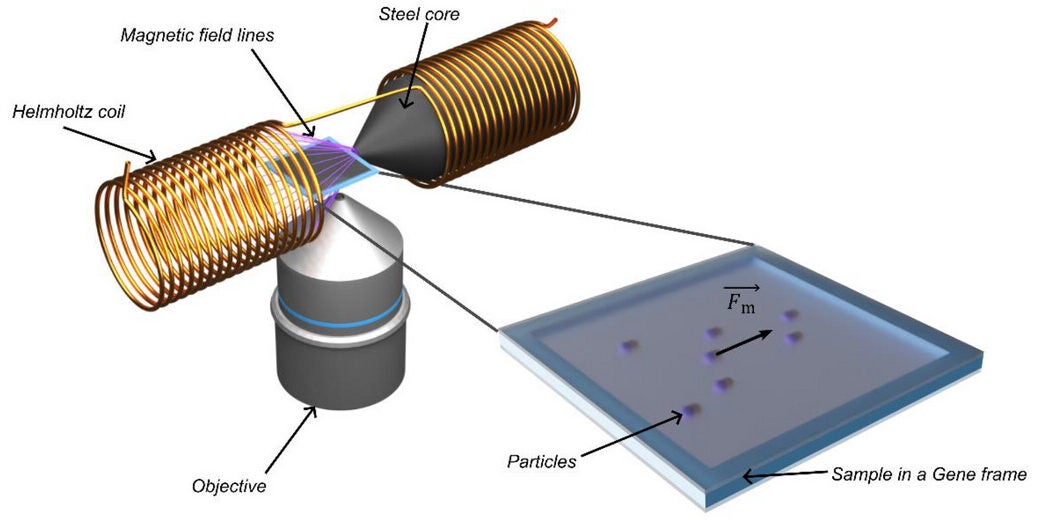
In tests, the researchers first built a basic version that paired the magnetic unit with a fluorescent payload. This let them watch the nanorobots move while applying a magnetic field gradient.
Even though magnetic material covered only one lobe of each propulsion module, it was enough to pull the nanorobots through the test setup. The basic nanorobots showed a mean velocity of 3.5 ± 1.0 micrometers per second under field exposure. The magnetic propulsion modules alone moved more slowly, with a mean of 1.4 ± 1.4 micrometers per second.
That result may seem backwards, since the full nanorobot is larger. The team says the likely reason is transient clustering under the magnetic field. Small groups of nanorobots can carry more magnetic material together, increasing the overall magnetic moment and helping them move faster. The clustering was treated as reversible, appearing during magnetic actuation and dispersing after the field was removed.
The researchers also used fluorescence and microscopy to check whether the payload stayed intact during guided motion. In these tests, the polymersomes held together, with no background fluorescence indicating leakage.
The medical potential came into focus when the team turned the platform into a theranostic nanorobot, one that combines therapeutic activity with imaging. For this version, the propulsion module was labeled with a fluorescent dye, while the payload module carried polymersomes loaded with the enzyme L-asparaginase.
L-asparaginase is a chemotherapy agent that depletes extracellular L-asparagine, a molecule some cancer cells rely on for survival. Its clinical use can be limited by immunogenicity and a short half-life. Encapsulating it inside the polymersome-based extension module was meant to protect the enzyme while preserving activity.
The payload module also carried extra DNA strands that could act as docking arms. In experiments with HeLa cells, a human cancer cell line, the nanorobots accumulated on the cell surface after five hours of incubation. When the researchers added poly(inosinic acid), an inhibitor of scavenger receptors, that attachment disappeared, pointing to receptor-mediated docking.
“The drug can have a concentrated local effect if we use our nanorobot to specifically target it to the cancer cells,” explains first author Voichita Mihali.
Cell viability tests showed the strongest effect after 72 hours. HeLa cell viability fell to 16 ± 7 percent after treatment with active theranostic nanorobots, compared with 72 ± 6 percent at 24 hours. Versions lacking permeabilizing pores in the payload capsule did not show the same effect, and non-enzymatic components alone did not reduce viability.
The same modular logic also let the team swap in a different enzyme and create a catalytic nanorobot. In that version, the payload carried alkaline phosphatase, while the fluorescent magnetic propulsion unit stayed the same.
Using a disc-shaped neodymium magnet, the researchers guided these catalytic nanorobots into ring-shaped assemblies within 30 minutes. When a fluorogenic substrate was added, the fluorescent product appeared in the same regions, showing that catalysis remained spatially confined to where the nanorobots had been gathered.
The system could also be recovered and reused. After each catalytic cycle, the nanorobots were pulled out magnetically, placed into fresh substrate solution, and used again. The team reported maintained enzymatic activity and structural integrity over three cycles, with only a minor drop in reaction rate.
That reusability may be especially important outside medicine. In catalysis or industrial processing, a recoverable nanosystem could help reduce waste and improve sustainability. The researchers also showed that they could separate the propulsion and payload modules, refill the payload capsules, and recombine the parts.
This work moves nanorobotics toward something more adaptable than a single-purpose particle.
In medicine, the design offers a way to combine targeting, imaging, and treatment in one small construct while protecting sensitive enzymes. In industrial or environmental settings, the ability to magnetically retrieve and reuse the system could make nanoscale catalysis more practical.
The most immediate value may be the platform itself: by changing the payload capsule rather than rebuilding the whole machine, researchers can tailor the nanorobot for different jobs.
Research findings are available online in the journal Advanced Functional Materials.
The original story “New modular nanorobot can move, dock to cancer cells, deliver therapy, and be reused” is published in The Brighter Side of News.
Like these kind of feel good stories? Get The Brighter Side of News’ newsletter.
The post New modular nanorobot can move, dock to cancer cells, deliver therapy, and be reused appeared first on The Brighter Side of News.

