Dry battery electrodes promise a cleaner way to build the lithium-ion cells that power electric vehicles and grid storage. However, one stubborn material has sat at the center of that promise: PTFE, the fluorinated binder better known as the polymer behind Teflon. It helps hold dry electrodes together. Yet, in battery anodes it can also become part of the problem.
A team in South Korea says it has found a way around that tradeoff by changing not just the binder. In addition, they changed the shape of the graphite itself.
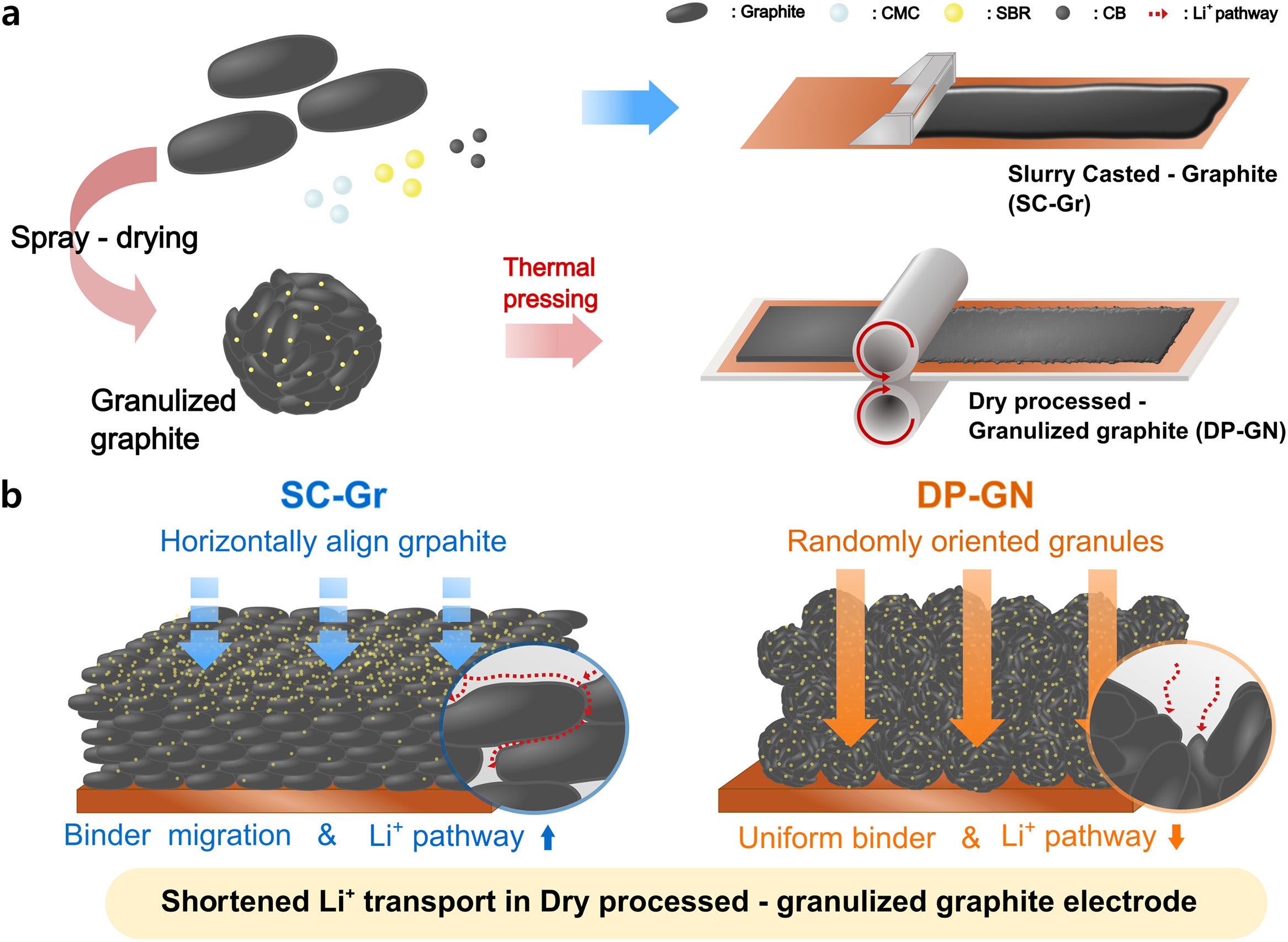
Researchers at the Korea Institute of Materials Science, working with the Korea Electrotechnology Research Institute, developed a PTFE-free dry anode built from spray-dried graphite granules. Instead of relying on PTFE fibrillation, the method uses the CMC-SBR binder system already common in commercial wet-electrode production. Then, it restructures the graphite into rounded secondary particles designed to improve lithium-ion movement through thick electrodes.
“This technology presents a new approach capable of overcoming the limitations of conventional PTFE-based dry-electrode processes,” said Jihee Yoon, senior researcher at Korea Institute of Materials Science. “We expect it to be highly applicable to next-generation EV batteries that require both high energy density and fast-charging performance.”
Dry-electrode manufacturing has drawn growing attention because it cuts back on organic solvents and energy-intensive drying steps. That can lower production costs and carbon emissions. Additionally, it helps manufacturers build thicker electrodes that store more energy in the same footprint.
The catch is that most dry-electrode approaches have depended heavily on PTFE. In cathodes, that chemistry has advanced far enough to look commercially practical. Meanwhile, anodes are different. They operate at much lower voltages. Under those conditions PTFE is known to decompose, causing irreversible capacity loss and weakening the binder’s function.
The South Korean group took a different route. They mixed flake graphite, styrene-butadiene rubber, carboxymethyl cellulose, and carbon black, then spray-dried the slurry into granules. That process turned the graphite into spherical secondary particles with a more random internal arrangement.
That internal geometry mattered.
Conventional graphite particles tend to align in ways that make lithium ions move less efficiently through the thickness of an electrode. In the new granules, the graphite flakes were reoriented into a more isotropic structure, exposing more edge planes and creating multidirectional transport pathways. As a result, the team said that helped reduce the transport bottlenecks that usually show up as electrodes get thicker.
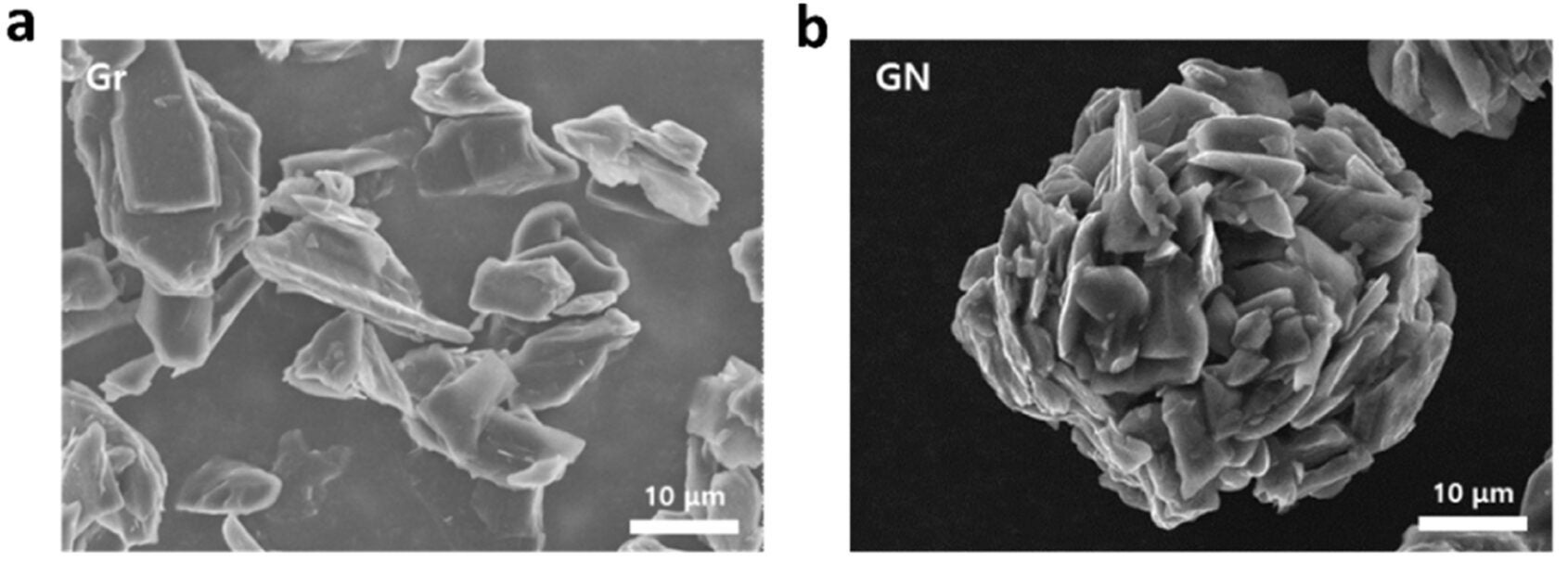
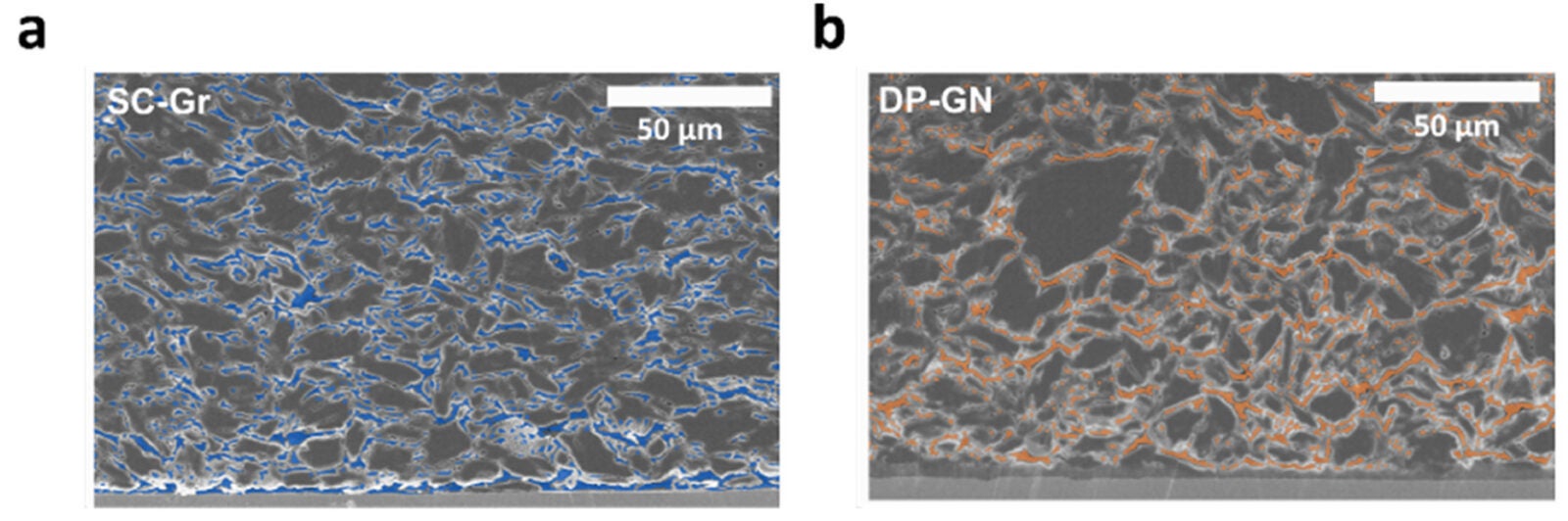
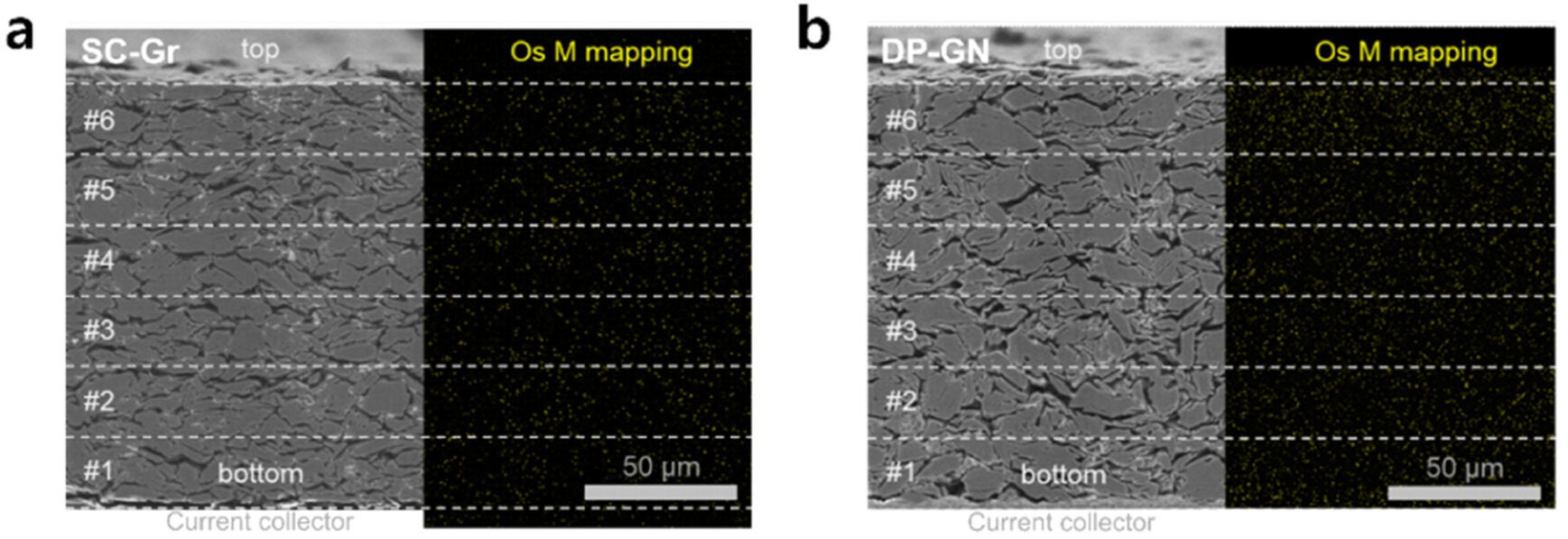
Microscopy and structural analyses pointed to clear differences between ordinary slurry-cast graphite electrodes and the granule-based dry anodes.
The slurry-cast version showed a strong porosity gradient through the electrode thickness, along with weaker contact near the copper current collector. In contrast, the dry granule electrode showed more uniform porosity and more continuous contact with the collector. Larger pores were also more common in the dry granule electrode. However, researchers linked this feature to improved lithium-ion transport under high-current conditions.
Graphite alignment changed too. In the slurry-cast electrode, flakes tended to lie more horizontally. In the granule-based dry electrode, their orientation was broader and more random.
That came with a tradeoff. Surface conductance was lower in the dry granule electrode, because randomly oriented graphite exposes more edge planes, and graphite conducts electricity far better along some directions than others. But for graphite anodes, the limiting factor in fast charging is often lithium-ion transport rather than electron flow. The researchers argued that giving up some electrical conductance was worthwhile if ion movement improved enough.
They also found a more even binder distribution. In slurry-cast electrodes, the SBR binder migrated upward during solvent evaporation, building up near the top surface. In the dry granule electrode, that migration was largely suppressed, leaving a more uniform structure across the full thickness.
The performance gap widened as the electrodes were pushed to higher areal capacities.
At 5.5 mAh cm−2, the first lithiation capacities of the two anodes were close. At 6.9 mAh cm−2, the dry granule anode largely held its capacity, reaching 353.5 mAh g−1. Meanwhile, the slurry-cast anode dropped to 344.2 mAh g−1. The granule-based electrode also kept clearer voltage plateaus tied to graphite’s staging behavior. This is a sign of more uniform lithiation through a thick electrode.
A related measure told a similar story. As areal capacity increased to 6.9 mAh cm−2, the constant-voltage contribution in the slurry-cast anode rose sharply to 13.5 percent. In the dry granule anode, it stayed lower at 8.5 percent, indicating less severe transport limitation during charging.
The dry granule electrode also showed slightly higher lithium-ion diffusion coefficients across the lithiation range. In a specially designed reaction dynamics analysis cell, current repeatedly favored the granule-based electrode over the slurry-cast one. That advantage became much stronger at higher charging rates.
In half-cell testing at 6.9 mAh cm−2, the dry granule anode delivered 353.5 mAh g−1 in the formation cycle with an initial Coulombic efficiency of 92.6 percent. The slurry-cast anode reached 344.2 mAh g−1 and 90.3 percent. At 2C, the dry granule electrode delivered 109.5 mAh g−1. In comparison, the slurry-cast version delivered 81.1 mAh g−1.
During cycling at 0.5C, the dry granule electrode started higher and stayed higher. It retained 76.3 percent of its initial capacity after 40 cycles. That compared with 69.6 percent for the slurry-cast electrode.
The team also compared the new anode directly with a PTFE-based dry electrode.
Here the contrast was sharp. The PTFE electrode showed an abnormally high initial charge capacity of 470.8 mAh g−1 and a much lower initial Coulombic efficiency of 70.0 percent, compared with 92.6 percent for the PTFE-free dry granule anode. Additionally, differential capacity plots pointed to extra reduction reactions in the PTFE system before the main graphite lithiation process, consistent with PTFE decomposition.
XPS measurements reinforced that picture. After lithiation, the PTFE electrode showed signs of decomposed fluorinated species and LiF formation. The PTFE-free system instead formed what the team described as more typical and stable interfacial species.
First-principles calculations supported the experimental results. PTFE had a lower LUMO energy than CMC or SBR, meaning it was more easily reduced under anode operating conditions. Its electronic structure also suggested that incoming electrons could directly weaken carbon-fluorine bonds. Therefore, this offered a mechanistic reason for the instability seen in testing.
In full cells, the differences remained. At 1C, the dry granule cell delivered 172.1 mAh g−1. The slurry-cast full cell delivered 155.6 mAh g−1. At 2C, the gap widened to 109.5 versus 90.3 mAh g−1. After 200 cycles at 1C, the dry granule full cell retained 151.1 mAh g−1, or 81.8 percent of its initial capacity. The slurry-cast cell retained 114.4 mAh g−1, or 71.5 percent.
This work points to a cleaner route for making thick, high-energy battery anodes without relying on PTFE. By pairing an industry-standard CMC-SBR binder with spray-dried graphite granules, the process may be easier to scale than a completely new binder system.
The results suggest manufacturers could build dry electrodes with better fast-charging behavior, more stable cycling, and more uniform internal structure. Additionally, that would reduce solvent use, drying steps, manufacturing energy demand, and fluorinated-material concerns.
For electric vehicles and energy storage systems, that combination could help support longer driving range, faster charging, and lower-emission battery production.
Research findings are available online in the journal Energy Storage Materials.
The original story “New PTFE-free battery anode cuts charging time and extends EV range” is published in The Brighter Side of News.
Like these kind of feel good stories? Get The Brighter Side of News’ newsletter.
The post New PTFE-free battery anode cuts charging time and extends EV range appeared first on The Brighter Side of News.

