A semiconductor chilled to nearly −270 °C can host tiny spin oscillators that refuse to drift apart. In a new experiment, many of these continuous time crystals locked onto one rhythm, even when separated by tens of micrometers.
The work comes from Prof. Alex Greilich and his team at TU Dortmund University, building on their January 2024 demonstration of long-lived continuous time-crystal oscillations in a semiconductor. Their latest results, published in Nature Communications, show that multiple time crystals can synchronize through the movement of spin-polarized electrons.
Time crystals are systems whose internal motion repeats in time without a periodic external signal forcing the rhythm. In this experiment, the crystals emerge from coupled electron and nuclear spins inside indium gallium arsenide, or InGaAs.
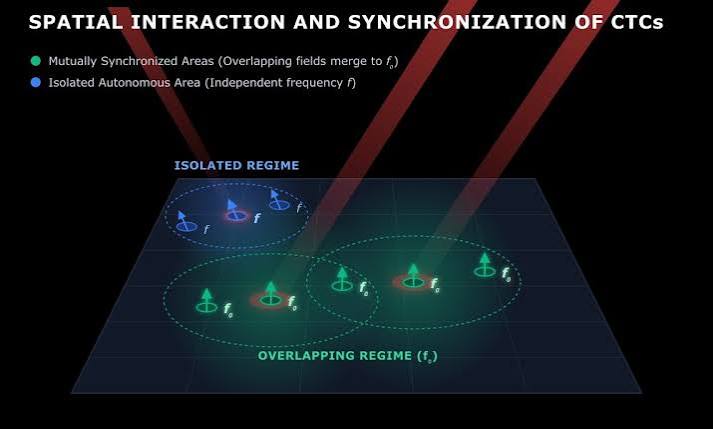
The researchers used a 10-micrometer-thick InGaAs layer containing 3% indium and doped with silicon. Electrons localized around silicon donors interact strongly with nearby nuclei through the hyperfine interaction.
Each localized electron couples to about one million nuclear spins inside a region set by an 11-nanometer Bohr radius. Circularly polarized pump light aligns the electron spins, which then transfer polarization to the surrounding nuclei.
That nuclear polarization creates an Overhauser field, a magnetic field produced by the polarized nuclei. The field feeds back on the electrons, creating a loop between the two spin systems. A linearly polarized probe laser tracks the resulting motion through Faraday rotation.
The nuclear system loses energy because it is open to its environment. Continuous optical pumping compensates for that loss. Under the right conditions, the feedback produces persistent electron-nuclear spin oscillations, forming a continuous time crystal.
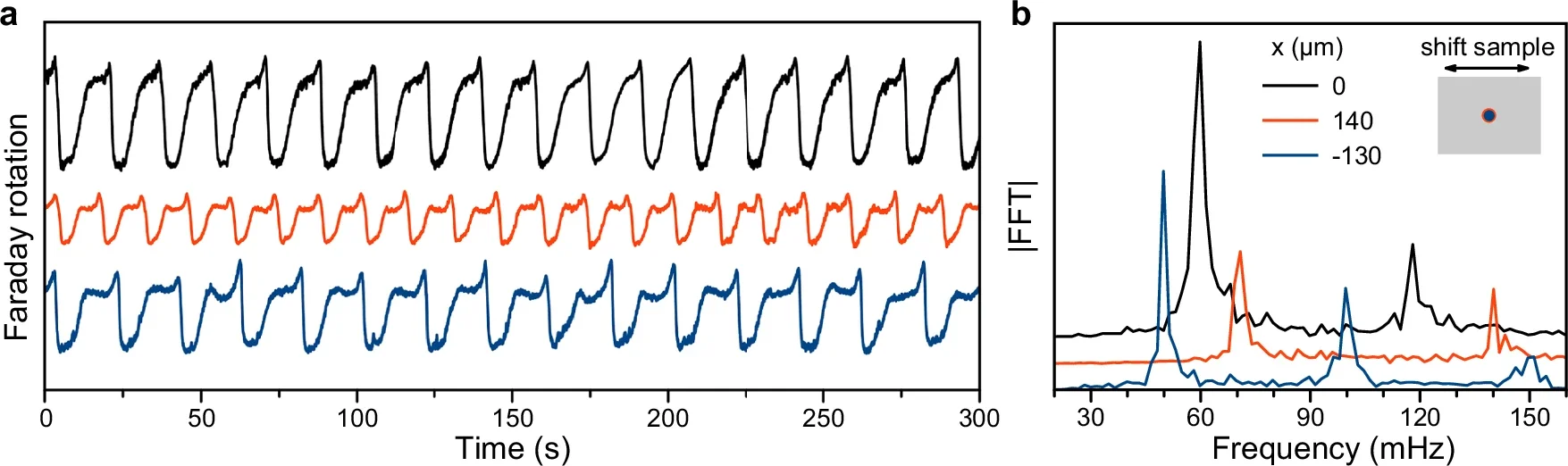
The semiconductor is not perfectly uniform. Changes in donor density and indium distribution cause different locations to oscillate at different natural frequencies. With a tightly focused pump and probe, the team measured clear frequency differences across positions separated by hundreds of micrometers.
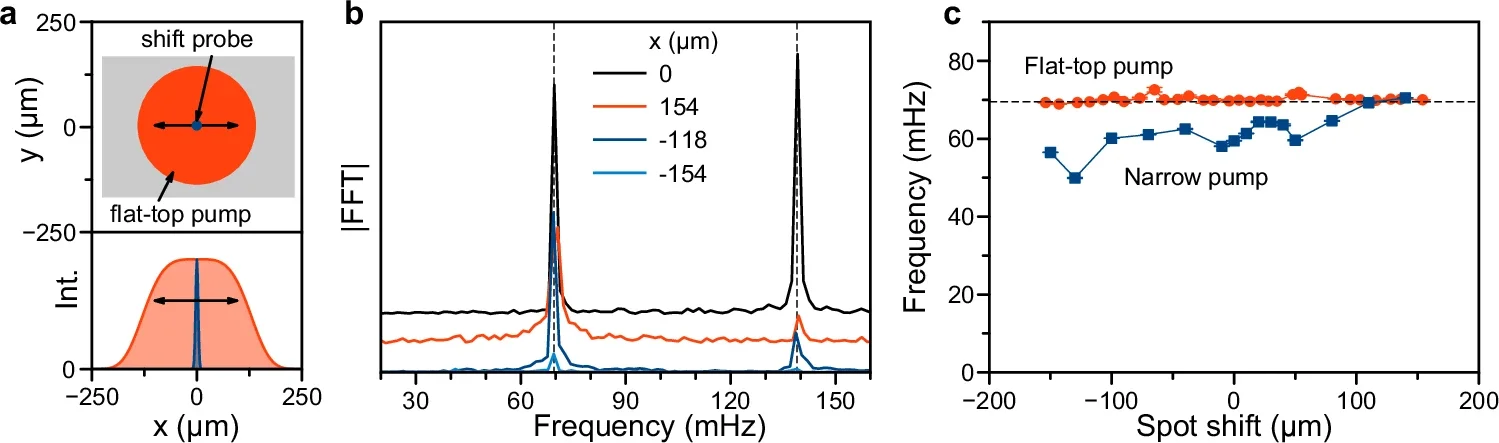
The picture changed when the researchers widened the pump beam to about 200 micrometers while moving a much smaller probe spot across the illuminated region.
Instead of different frequencies, every measured location oscillated at the same frequency. The synchronization held even when the natural frequencies differed by as much as 40%.
The behavior resembles Christiaan Huygens’ 1665 observation of two pendulum clocks mounted on the same support. Weak mechanical coupling caused the clocks to settle into a shared rhythm. Here, the coupling happens through spins rather than a moving beam.
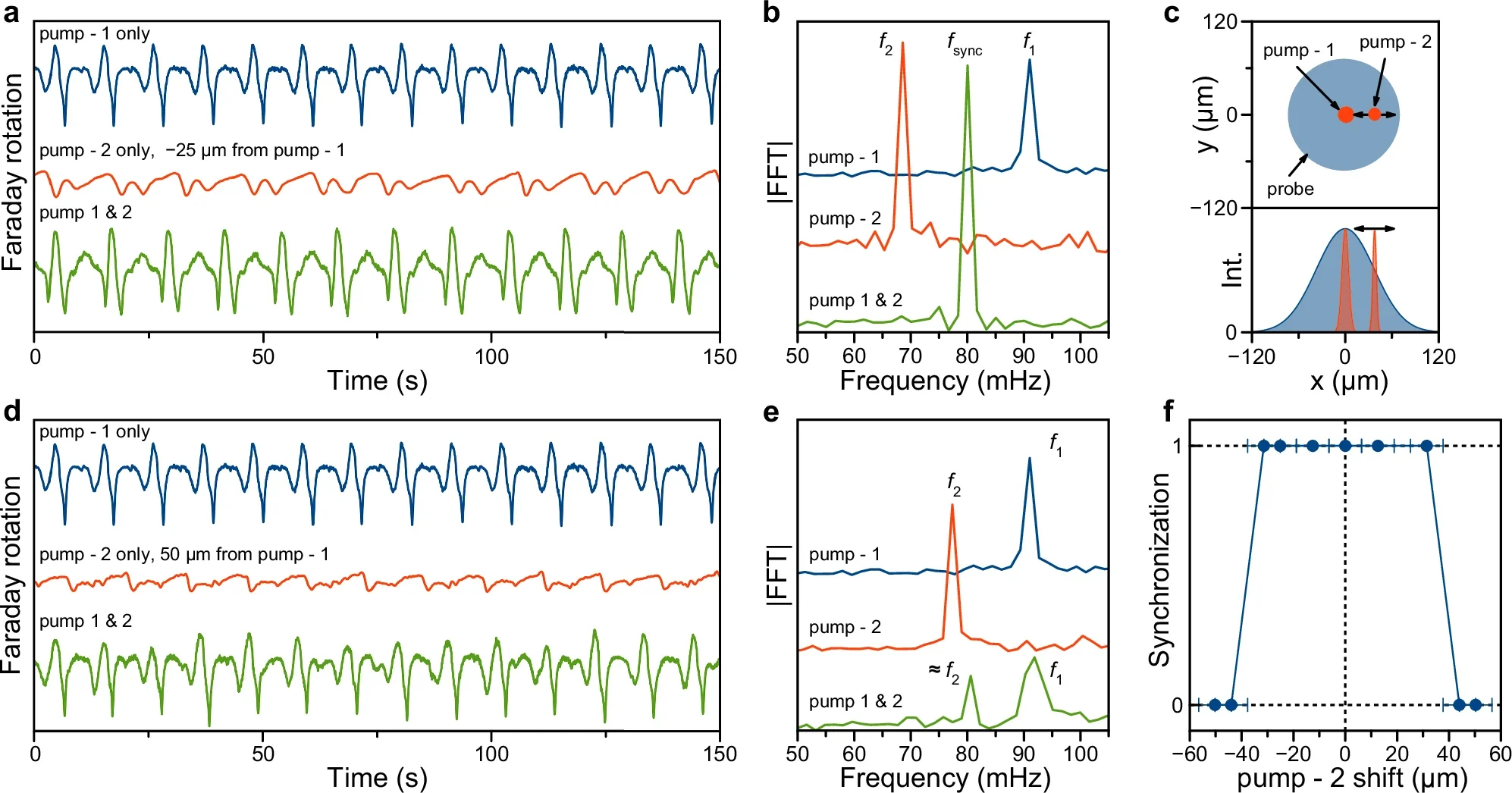
To test how far the effect could reach, the team used two separate pump lasers. Each excited an independent region of the semiconductor, while a broad probe beam monitored both at once.
At one example spacing of 25 micrometers, the first region oscillated at 91 millihertz and the second at 69 millihertz. When both pumps operated together, the two peaks collapsed into one at 80 millihertz. That single intermediate frequency marked mutual synchronization.
At a 50-micrometer separation, synchronization disappeared. Both original frequencies remained visible.
Across repeated measurements, the synchronization range reached 38 ± 3 micrometers between the centers of the two pump spots. Accounting for beam size gave a separation of 25 ± 3 micrometers between the points where each beam’s intensity fell to 1/e² of its maximum.
The team considered several possible ways the distant oscillators could communicate.
Scattered pump light was ruled out by the two-beam experiments. Nuclear spin diffusion was far too slow and short-ranged, with a diffusion constant near 10−13 square centimeters per second. Electron hopping also produced an estimated length of only about 3.5 micrometers.
Electron spin diffusion fit the observations much better. Free spin-polarized carriers created in one illuminated region can diffuse outward and interact with donor-bound electrons through spin exchange. That changes the nuclear polarization and Overhauser field, allowing one oscillator’s phase to influence another.
Using a spin diffusion constant of 24 square centimeters per second and an electron spin relaxation time of 120 nanoseconds, the researchers estimated a spin-diffusion length of about 17 micrometers.
A second semiconductor sample strengthened that interpretation. Its electron concentration was roughly two orders of magnitude lower, and synchronization occurred only when the pump spots overlapped. Its shorter 30-nanosecond spin relaxation time corresponded to an estimated diffusion length of about 8.5 micrometers.
The team also modeled the system by extending equations for electron-spin precession and nuclear-spin feedback to include spatial spin diffusion. The simulations reproduced the key pattern: nearby oscillators locked to an intermediate frequency, while more distant ones continued at separate frequencies.
Synchronization persisted in the model up to about 1.5 spin-diffusion lengths. Simulations using a broad, flat-top pump also showed a common frequency emerging across an inhomogeneous sample.
An independent measurement using time-resolved magneto-optical Kerr rotation microscopy produced a spin diffusion constant of 28 ± 1 square centimeters per second. That value corresponds to a diffusion length of 18.3 ± 0.3 micrometers and closely matched the earlier estimate.
The experiments show that continuous time crystals in a semiconductor do not have to behave as isolated oscillators. Electron spin diffusion can connect spatially separated regions and pull large ensembles into one collective rhythm.
That synchronization also helps explain why the earlier time-crystal oscillations remained so stable. A many-body synchronized state can resist local disorder and fluctuations that would otherwise disrupt phase-stable motion.
The researchers suggest that electrically controlled gating or lateral drift could eventually make the coupling tunable rather than passive. Such control could help create networks of spin oscillators for spintronic systems or analog neuromorphic architectures, where information is processed through collective phase dynamics instead of discrete logic states.
For now, the central advance is more fundamental. The work identifies a mechanism that lets separate electron-nuclear spin systems coordinate across mesoscopic distances, turning many microscopic oscillators into a coherent macroscopic state.
Here are five expert resources to help you dig deeper into quantum spin and time crystals.
Research findings are available online in the journal Nature Communications.
The original story “New semiconductor turns billions of spin oscillators into a shared time crystal” is published in The Brighter Side of News.
Like these kind of feel good stories? Get The Brighter Side of News’ newsletter.
The post New semiconductor turns billions of spin oscillators into a shared time crystal appeared first on The Brighter Side of News.


Leave a comment
You must be logged in to post a comment.