A disk of electrically charged atoms only about 200 micrometers wide has demonstrated how one of quantum mechanics’ strangest effects can become a powerful measuring tool.
Physicists at the National Institute of Standards and Technology created the sensor from roughly 150 beryllium ions held inside a strong magnetic field. Repulsion between the charged particles caused them to arrange themselves naturally into a flat, two-dimensional crystal.
The researchers then entangled two very different properties of that crystal: its collective mechanical motion and the electronic spins of its ions.
The result was a sensor capable of detecting weak electric fields with sensitivity beyond the standard quantum limit, the noise boundary faced by comparable measurements using uncorrelated quantum states. The work appeared in Science under the title “Quantum-enhanced sensing of displacements and electric fields with two-dimensional trapped-ion crystals.” NIST continues to develop trapped-ion crystals for quantum sensing and simulation.
The experiment also opened an intriguing possibility. Sensors operating on the same principles could eventually search for electric fields associated with some forms of ultralight dark matter.
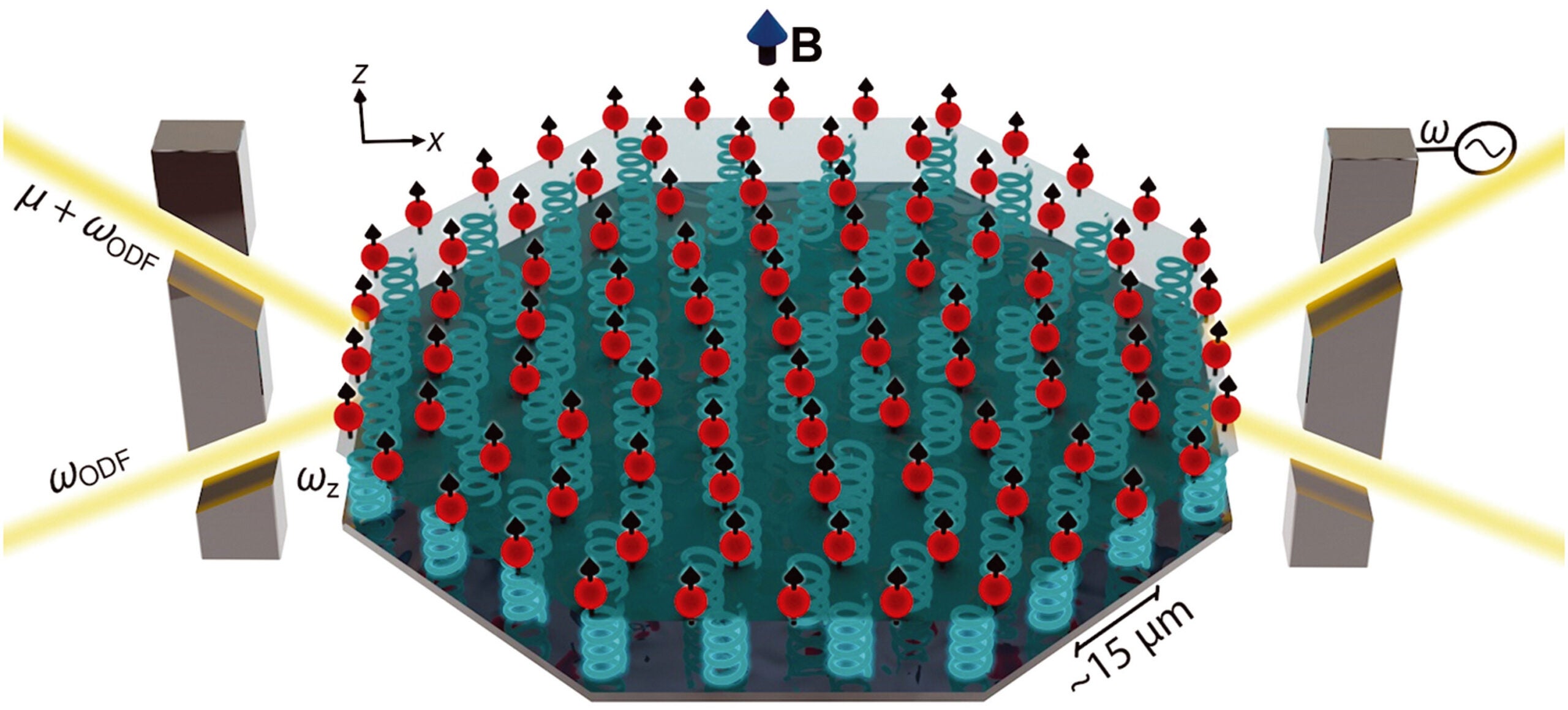
The crystal behaves partly like an extraordinarily small mechanical oscillator.
Its ions can move collectively perpendicular to the flat plane, creating a center-of-mass vibration that researchers compare to a drumhead moving up and down. In the experiment, that mode oscillated at about 1.59 megahertz.
The scientists needed a way to measure movements so small that ordinary quantum fluctuations would normally obscure them.
They used the electronic spin of each beryllium ion as the readout system. Spin is an intrinsic quantum property that can be controlled with microwaves and measured by observing fluorescence from the ions.
Crossed laser beams generated a force that depended on the ions’ spins. Applying that force near the frequency of the crystal’s mechanical oscillation created strong correlations between its collective motion and collective spin.
In other words, the researchers entangled the mechanical oscillator with the system used to measure it.
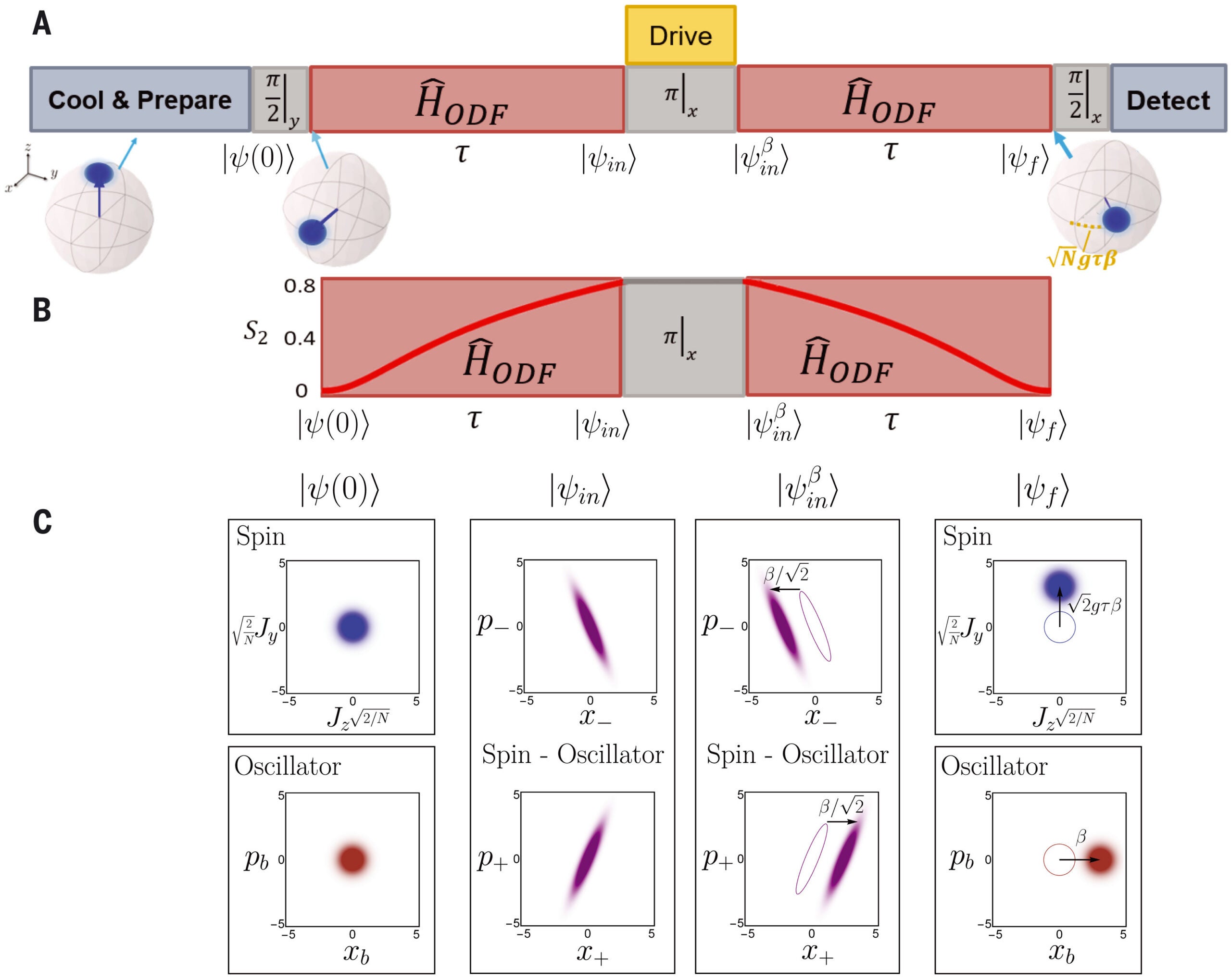
That matters because an ordinary coherent quantum state faces a fundamental level of uncertainty known as the standard quantum limit. Entanglement redistributes those uncertainties, allowing carefully designed measurements to distinguish smaller displacements than an uncorrelated sensor could reliably resolve.
Creating entanglement alone presented another problem.
Information about a tiny displacement became distributed across the combined state of the crystal’s motion and spins. Measuring one component directly could therefore lose some of the advantage created by entanglement.
The researchers solved that problem with a many-body echo, essentially reversing the quantum dynamics after applying the weak signal they wanted to detect.
First, laser light entangled the spin and motion. An electric field then drove a tiny displacement of the crystal. The researchers subsequently reversed the spin-motion interaction, disentangling the two systems while leaving information about the movement encoded in a collective rotation of the ions’ spins.
They could then read the answer through fluorescence.
“To avoid this issue, John is able to reverse the dynamics and disentangle the spin and the motion after the displacement is applied,” NIST and JILA theorist Ana Maria Rey said. “This time reversal decouples the spin and the motion, and now the collective spin itself has the displacement information stored on it.”
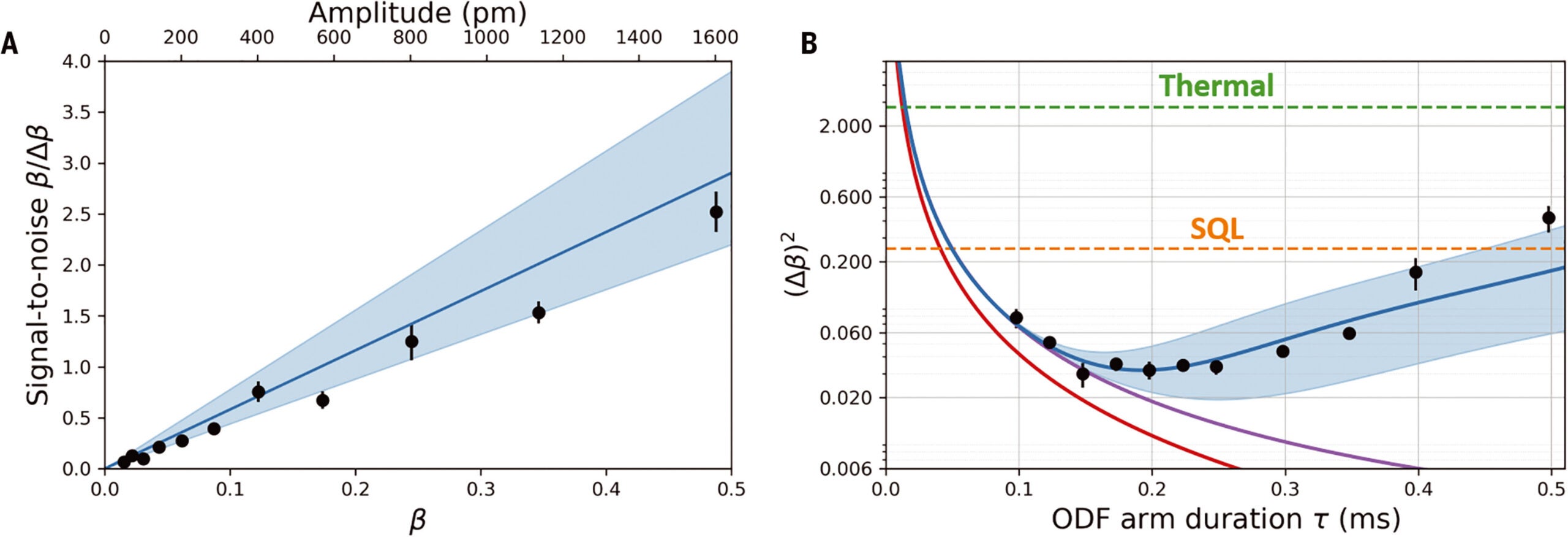
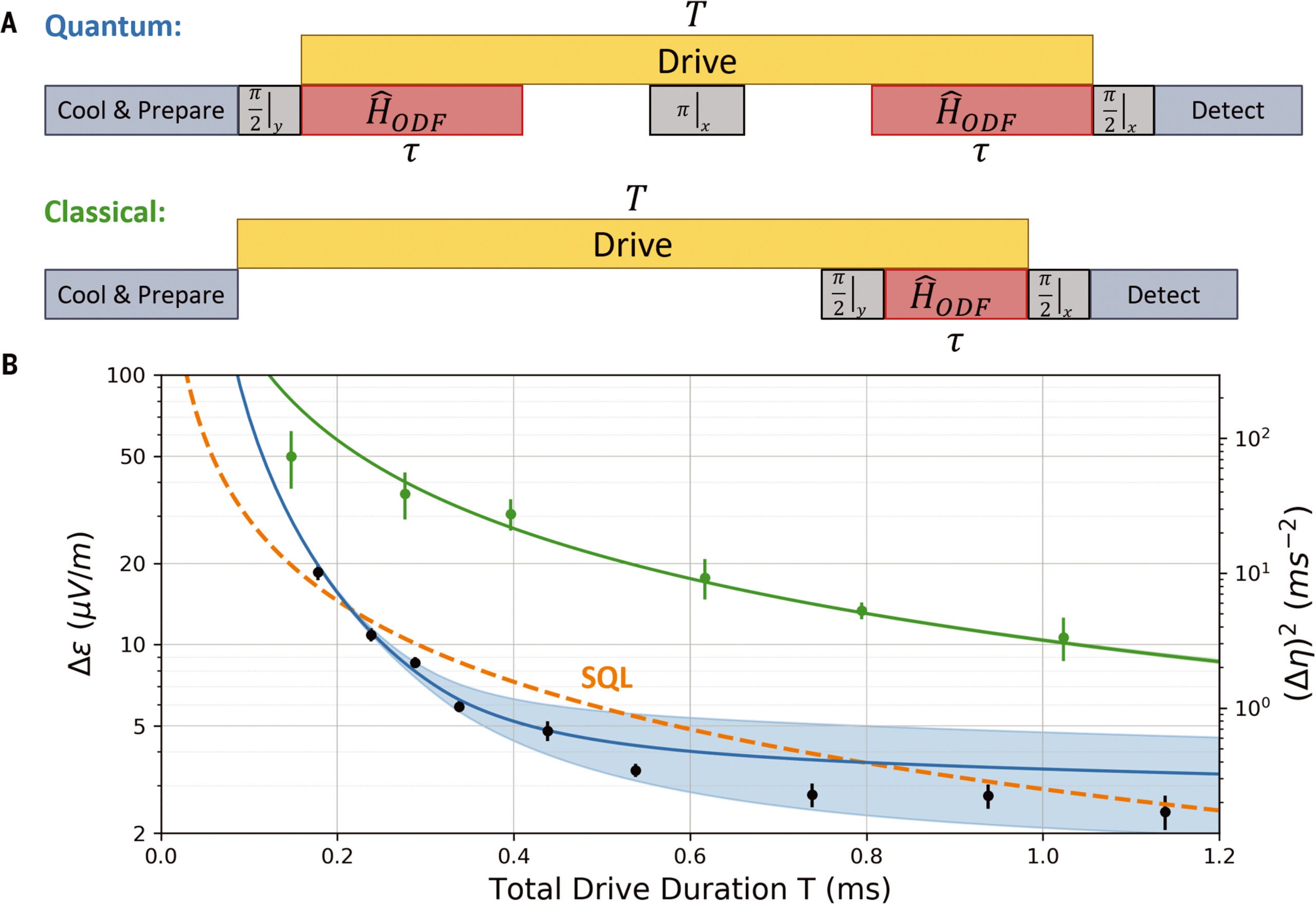
The experiment achieved displacement sensitivity 8.8 ± 0.4 decibels below the standard quantum limit. For electric fields, the quantum protocol reached roughly 4.0 ± 0.5 decibels below that limit and provided up to a 14-decibel improvement over the comparable classical protocol.
Translated into practical terms, the sensor reached an electric-field sensitivity of about 240 ± 10 nanovolts per meter per square root hertz near 1.6 megahertz.
At the time, that was more than an order of magnitude better than state-of-the-art electrometers based on Rydberg atoms and roughly 300 times better than earlier off-resonant trapped-ion methods.
The device remains limited by several technical effects. Small fluctuations in the frequency of the crystal’s center-of-mass motion interfere with the precision of the time reversal, while thermal motion contributes additional noise.
Neither limitation is fundamental.
Later work from the same broader research effort has explored parametric amplification, improved cooling and larger ion structures. In March 2026, researchers including Rey and John Bollinger published theoretical work on parametric amplification of spin-motion coupling in three-dimensional trapped-ion crystals, one possible route toward scaling these systems to much larger numbers of ions.
Dark matter is where the sensor’s unusual capabilities become particularly interesting.
Some ultralight dark matter candidates, including hidden photons and axion-like particles, could behave more like oscillating fields than individual heavy particles striking a detector.
Their interactions with ordinary matter might generate extraordinarily weak electromagnetic signals at frequencies related to the particles’ masses. A sufficiently sensitive ion crystal could respond to such a field by developing a tiny collective oscillation.
The NIST experiment did not search for or detect dark matter. Instead, it demonstrated a sensing platform that could potentially be adapted for such searches.
The researchers calculated that improved trapped-ion crystals could probe dark matter over center-of-mass frequencies between roughly 10 kilohertz and 10 megahertz. The system also contains a strong magnetic field, an advantage for some proposed axion searches.
The idea has since moved beyond this single experiment. A 2026 Physical Review D study proposed using spin-motion entanglement in a trapped-ion interferometer to probe previously unexplored dark-photon parameter space.
A crystal small enough to disappear behind the point of a pencil therefore offers something much larger than its dimensions suggest: a way to turn controlled quantum entanglement into a probe for electric fields that ordinary sensors may never hear.
These studies explore how larger ion crystals, stronger spin-motion coupling and quantum interferometry could extend trapped-ion sensors toward increasingly faint forces and possible ultralight dark matter signals.
Parametric amplification of spin-motion coupling in three-dimensional trapped-ion crystals: This work examines how parametric amplification could strengthen spin-motion interactions in large three-dimensional ion crystals, addressing an important challenge in scaling trapped-ion systems for quantum sensing and simulation. (Physical Review Applied, 2026)
Ultralight dark matter detection with trapped-ion interferometry: The study proposes using an ion prepared with entangled spin and motion as a matter-wave interferometer capable of searching unexplored regions of dark-photon parameter space while also probing axion-like dark matter. (Physical Review D, 2026)
Ion Coulomb crystals: an exotic form of condensed matter: This broad review examines the physics of laser-cooled ion crystals in one, two and three dimensions and explains why their highly controllable collective motion makes them useful for quantum simulation, sensing and information processing. (Reviews of Modern Physics, 2026)
Bilayer Crystals of Trapped Ions for Quantum Information Processing: Researchers demonstrate theoretically how Penning traps can support clean bilayer crystals containing hundreds of ions, establishing a route toward multilayer and three-dimensional trapped-ion architectures. (Physical Review X, 2024)
Toward improved quantum simulations and sensing with trapped two-dimensional ion crystals via parametric amplification: Experiments with roughly 100 beryllium ions demonstrate motional squeezing and parametric amplification that could substantially improve the sensitivity of displacement measurements in trapped-ion crystals. (Physical Review A, 2023)
Research findings are available online in the journal Science.
The original story “NIST scientists invent a quantum crystal detector to hunt for dark matter” is published in The Brighter Side of News.
Like these kind of feel good stories? Get The Brighter Side of News’ newsletter.
The post NIST scientists invent a quantum crystal detector to hunt for dark matter appeared first on The Brighter Side of News.


Leave a comment
You must be logged in to post a comment.