The ozone layer’s most famous wound opened over Antarctica, but the damage may have started much earlier, and somewhere else entirely.
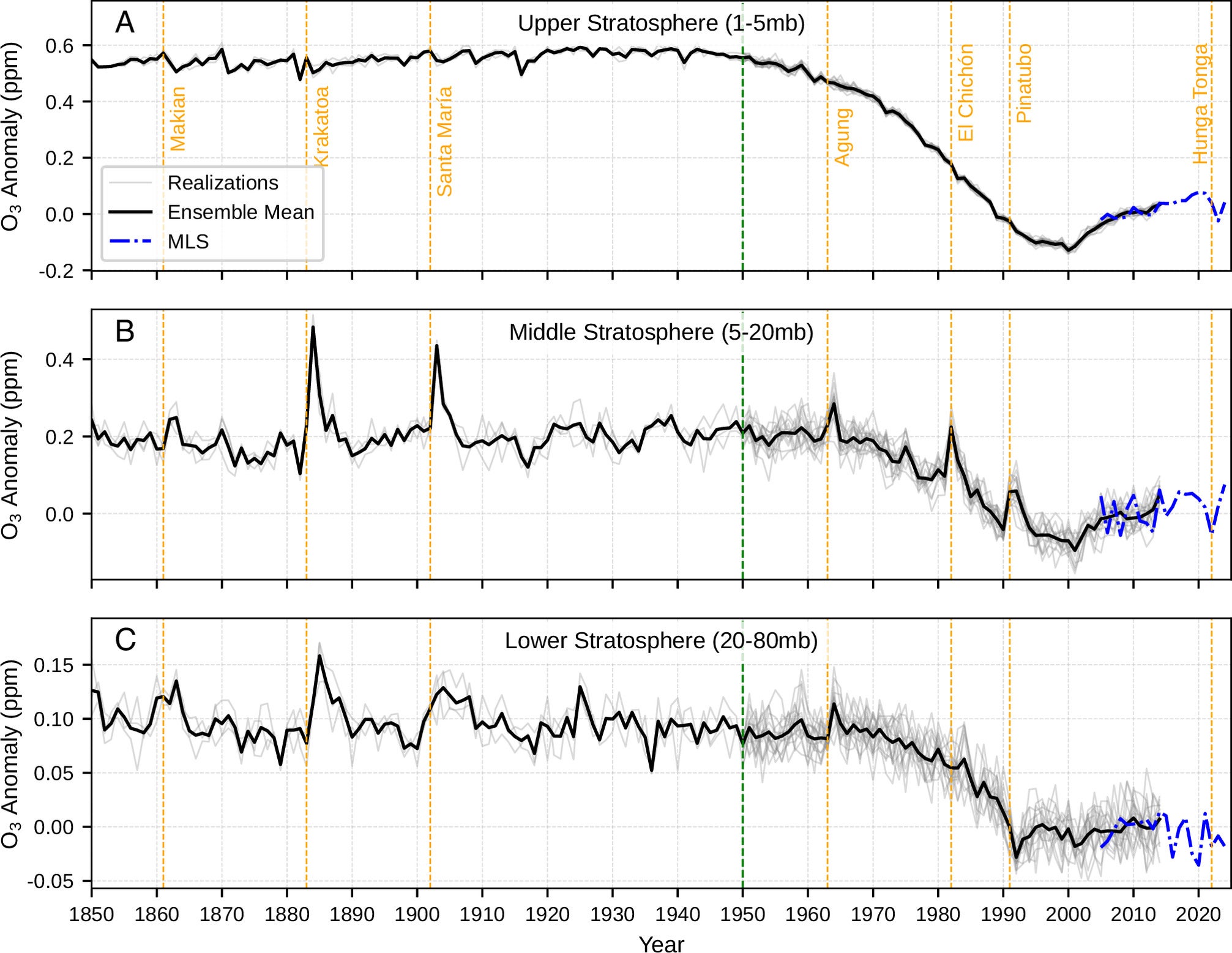
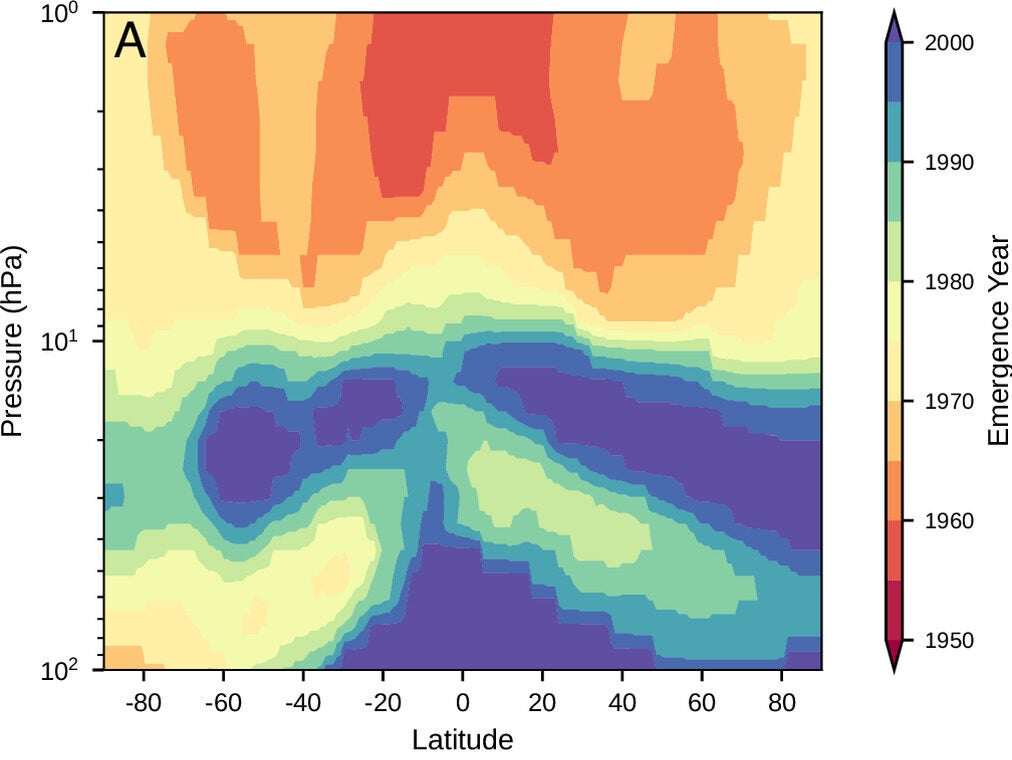
A new modeling study suggests the first detectable sign of human-caused ozone loss appeared in 1957, nearly three decades before the Antarctic ozone hole was reported. The earliest signal did not show up near the poles. It emerged in the tropical upper stratosphere, in a part of the atmosphere where natural variability is relatively quiet and small changes are easier to spot.
That result surprised even Susan Solomon, the MIT atmospheric chemist whose work helped explain why chlorine from industrial chemicals was destroying ozone over Antarctica.
“The fact that ozone depletion would have happened as early as the late 1950s, which is much earlier than I would have thought, just absolutely blew my mind,” Solomon said.
The study, published in the Proceedings of the National Academy of Sciences, asked a counterfactual question: If scientists had possessed today’s monitoring tools and modeling techniques in the middle of the 20th century, when would the first human fingerprint on ozone have become visible?
The answer, according to the team’s simulations, is 1957.
That date matters because the Antarctic ozone hole was not discovered until 1985, and because public discussion of ozone depletion has long centered on chlorofluorocarbons, or CFCs. Those compounds were widely used in refrigeration, air conditioning, aerosol propellants, solvents, and foam production before they were phased out under the 1987 Montreal Protocol.
The new work points to a different chemical as the earliest driver: carbon tetrachloride, an industrial solvent that entered widespread use earlier than the best-known CFCs.
“What we’ve learned from textbooks is that CFCs result in ozone depletion,” said first author Jian Guan, a graduate student in MIT’s Department of Earth, Atmospheric and Planetary Sciences. “It turns out there was another compound that caused ozone depletion much earlier than CFCs. This was a big surprise.”
Ozone, a molecule made of three oxygen atoms, forms naturally in the stratosphere and absorbs harmful ultraviolet radiation. Without that shield, more of the sun’s UV light reaches Earth’s surface.
By the time Solomon led expeditions to Antarctica in the late 1980s, the chemistry behind the ozone hole was becoming clear. Measurements showed unexpectedly high levels of chlorine dioxide in the stratosphere there, helping confirm that chlorine released from CFCs was breaking ozone apart.
That work, together with Mario Molina’s earlier proposal that sunlight could split CFCs and free chlorine atoms in the upper atmosphere, helped establish the chemical case that led to international action. Molina later shared the 1995 Nobel Prize in Chemistry.
The new study does not overturn that history. It pushes the timeline back.
To do that, the researchers carried out what Solomon called a “what-if” experiment. They used ensembles of chemistry-climate model runs to reconstruct atmospheric behavior from 1950 to 2014 under historical levels of ozone-depleting substances, greenhouse gases, solar forcing, and volcanic eruptions.
The model they relied on, CESM-WACCM6, included 16 simulations for 1950 to 2014, plus three earlier runs extending back to 1850. The team also compared its behavior with ozone measurements from the Microwave Limb Sounder for the years when observations overlap. According to the authors, the model reproduced both the magnitude of observed ozone changes and the pattern of year-to-year variability.
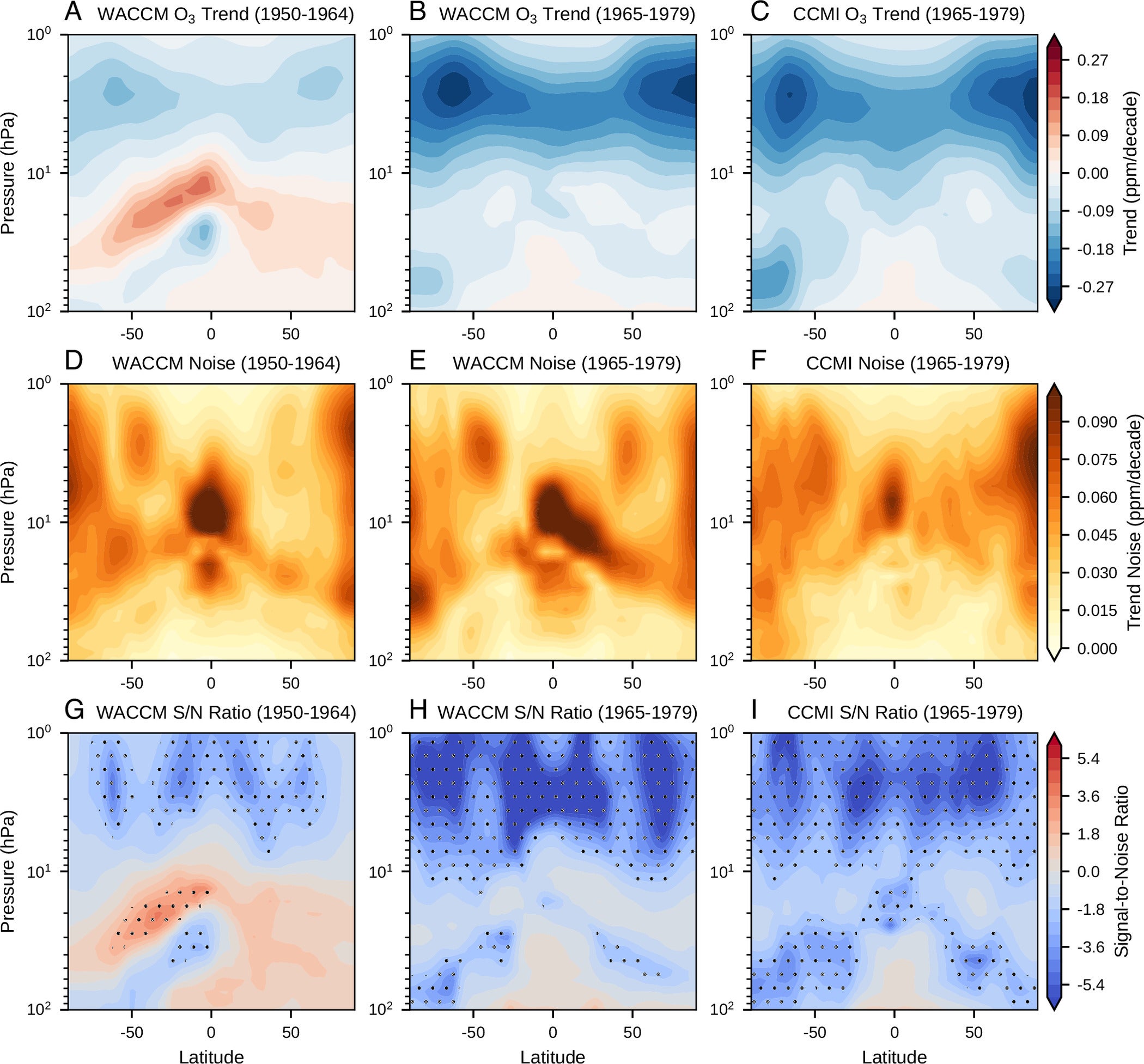
That mattered because the question was not simply whether ozone was declining. It was whether the decline rose clearly enough above the atmospheric “noise” of volcanoes, weather swings, and natural variability to count as a detectable human signal.
The strongest early signal did not appear where ozone losses were largest. It appeared where variability was smallest.
In the tropical upper stratosphere, especially between about 20 degrees south and 20 degrees north, the models showed unusually low internal variability. That made the region a better place to detect an early human fingerprint. By the authors’ estimate, if modern height-resolved observations had existed at the time, a statistically significant signal would have emerged there in 1957.
In the Northern Hemisphere mid-latitudes, where some of the first stratospheric ozone measurements were historically made, the study suggests detection would have come a few years later, around 1963.
The culprit, in the team’s analysis, was carbon tetrachloride, or CCl4.
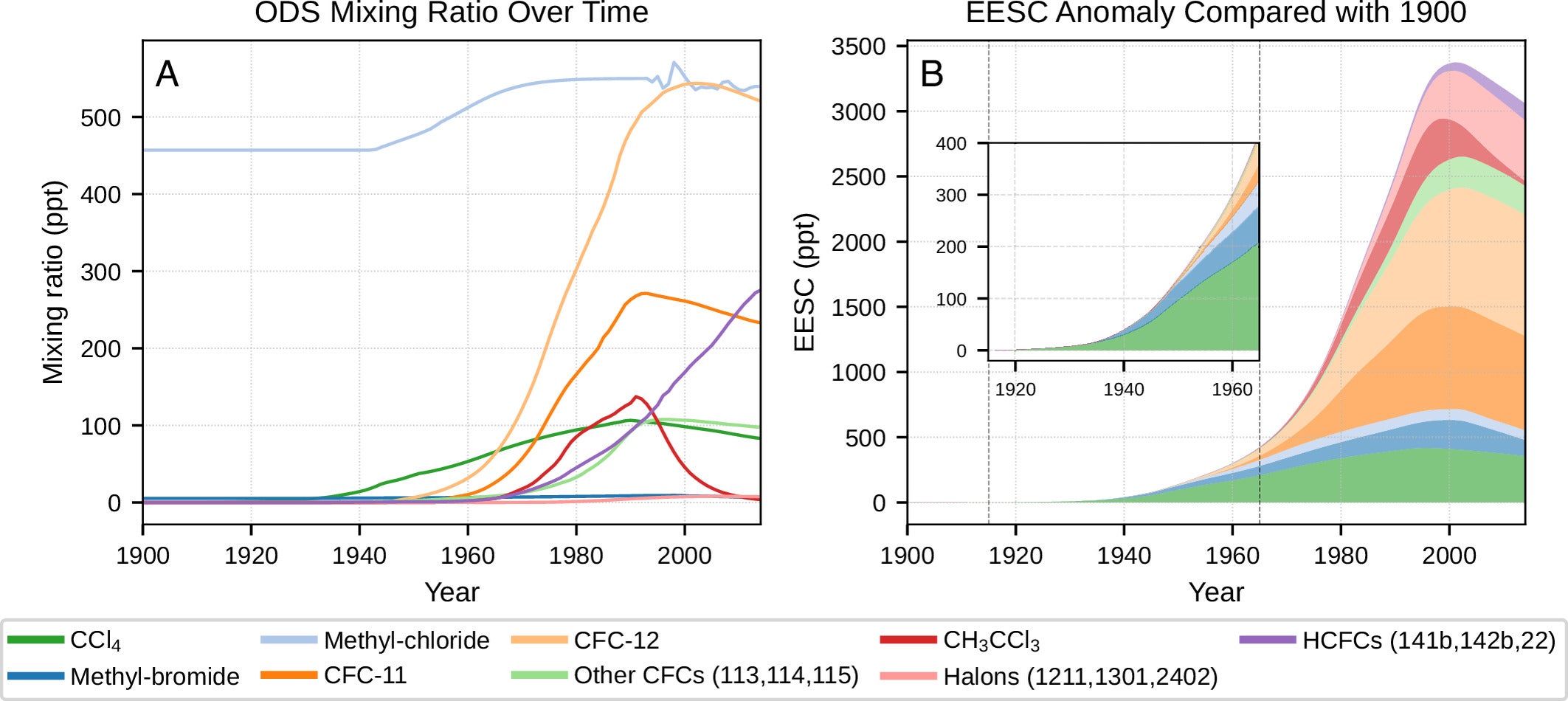
Before 1960, CFC-11 and CFC-12 were still relatively scarce. Carbon tetrachloride had a head start. It had been used as an industrial solvent in the United States as early as 1914 and was in widespread use by the 1930s.
The researchers combined historical production estimates with ice core and firn air evidence showing that atmospheric concentrations of carbon tetrachloride were already climbing by the 1940s. By 1950, the paper notes, surface concentrations of the compound were already around 30 to 40 parts per trillion, while the total concentration of CFCs remained below 10 parts per trillion.
In terms of equivalent effective stratospheric chlorine, a measure used to estimate the ozone-damaging power of chlorine- and bromine-containing compounds, carbon tetrachloride dominated the anthropogenic contribution from 1920 to 1960. The study reports that it accounted for about 69 percent of that contribution in 1950 and 56 percent in 1960.
“That’s the only ozone-depleting substance that was increasing that early,” Solomon said. “We started using carbon tetrachloride in the 1930s as a dry-cleaning agent, and as a degreasing solvent. We didn’t start using CFCs until quite a bit later.”
Carbon tetrachloride was later phased out in much of the world, first because of health risks and then under tighter controls linked to ozone protection.
The findings also sharpen the contrast between early upper-atmosphere damage and the slower emergence of changes elsewhere. In the middle stratosphere, the model did not show significant depletion in the 1950 to 1964 period, but did show detectable negative trends by 1965 to 1979. In the lower stratosphere, including over Antarctica, detectable depletion emerged still later.
That delay helps explain why the first unmistakable observational shock came from the Antarctic ozone hole rather than from a global or tropical warning. Total column ozone, the broad measure often used in policy and public debate, can mask altitude-specific losses because different atmospheric layers respond in different ways.
The study also found clear signs of recovery in the upper stratosphere during the early 21st century, matching the long-running picture that ozone is beginning to rebound after the Montreal Protocol’s restrictions on ozone-depleting substances.
Solomon said that recovery makes continued monitoring even more important.
“We’ve gone through a big effort to get rid of these chemicals,” she said. “Don’t we have an obligation to keep monitoring to make sure the atmosphere responds the way we think it should?”
The study suggests the ozone story began earlier than most people think, and that early warning depends as much on careful monitoring as on the size of the damage itself.
It also shows that altitude-resolved measurements can reveal changes that total ozone values may hide.
As older ozone-depleting chemicals continue to linger in the atmosphere for decades, the findings strengthen the case for sustained satellite and atmospheric monitoring, both to track recovery and to catch any unexpected changes before they grow into a larger problem.
Research findings are available online in the journal PNAS.
The original story “Ozone depletion actually began decades before holes in the ozone layer were first discovered” is published in The Brighter Side of News.
Like these kind of feel good stories? Get The Brighter Side of News’ newsletter.
The post Ozone depletion actually began decades before holes in the ozone layer were first discovered appeared first on The Brighter Side of News.

