Two laser pulses meeting at an angle gave physicists access to electron states that conventional planar light fields cannot generate. By shaping the pulses, the team changed how electrons escaped potassium atoms, producing previously unobserved patterns in their momentum distributions.
The experiment, led by Matthias Wollenhaupt at the University of Oldenburg in Germany, appears in Physical Review Research. The study combines controlled light fields with measurements of emitted electrons. It also demonstrates a method for following rapid changes in excited atomic states.
The findings provide an experimental foundation for proposals involving chiral light and molecular sensing. Those applications concern distinguishing structures with different handedness, but the reported tests used potassium atoms rather than chiral molecules.
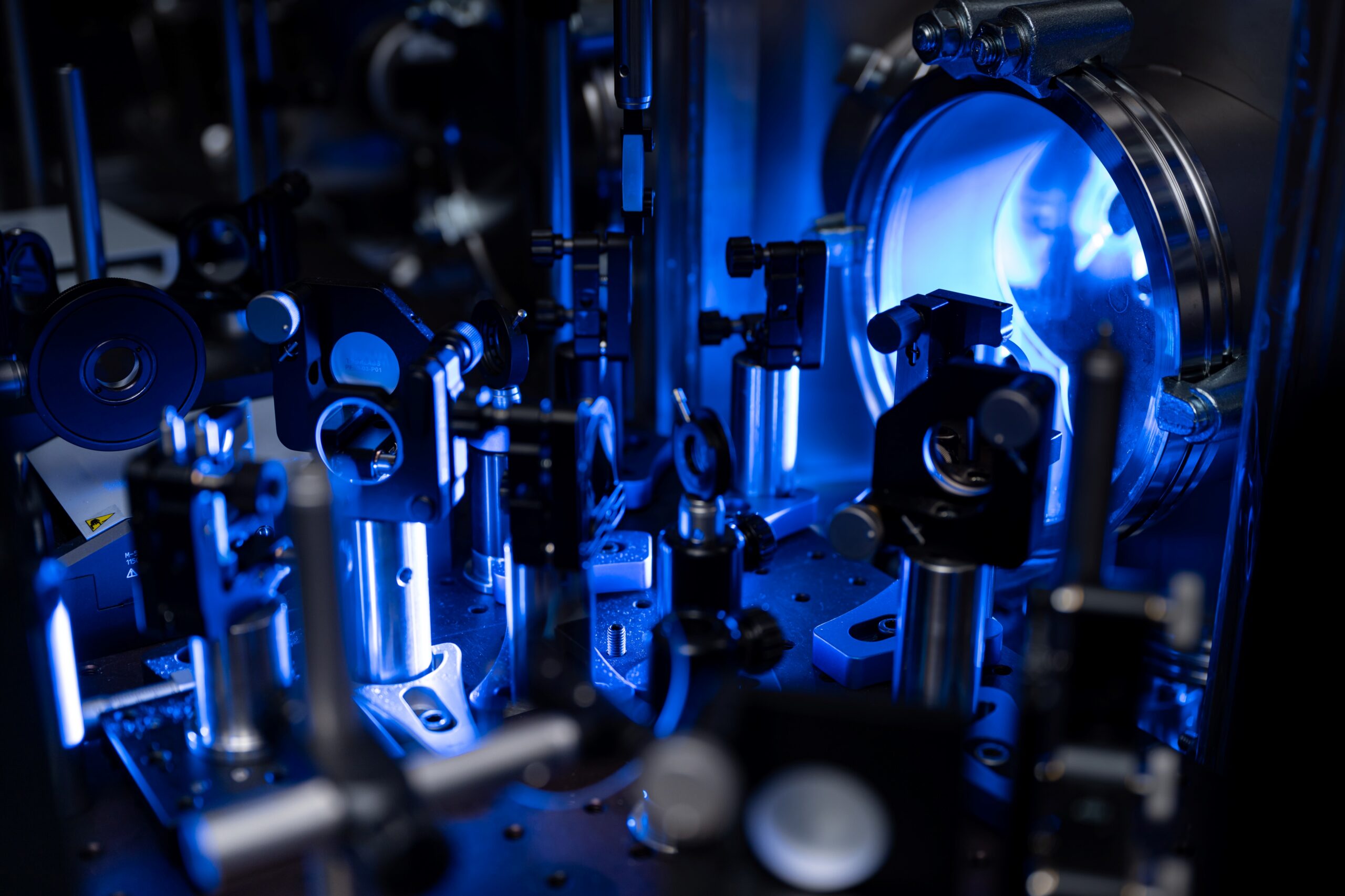
In many pulse-shaping experiments, the electric field oscillates within a plane perpendicular to the beam’s direction. Scientists can alter its polarization and timing, yet that planar arrangement constrains which atomic transitions they can drive together.
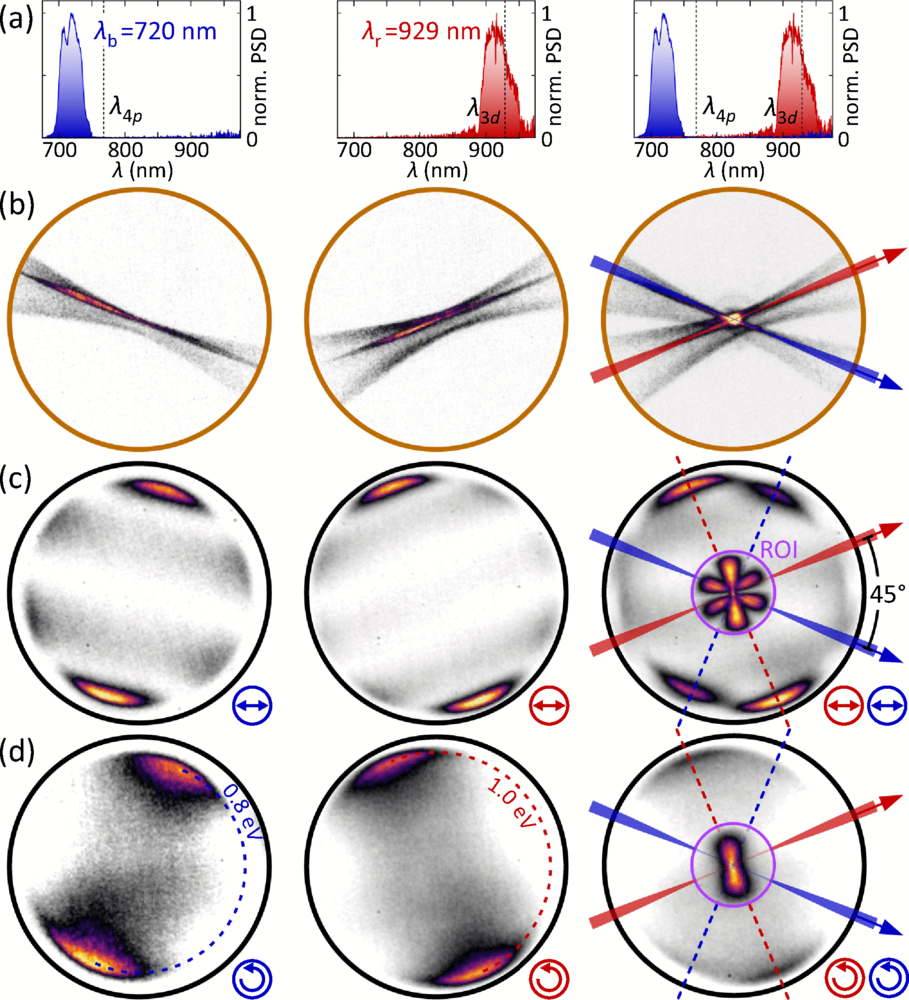
The Oldenburg team used two pulses approaching from different directions. Their electric fields combined in the overlap region, allowing the resulting field to oscillate along all three spatial axes.
“The fields oscillate in all three spatial directions, opening up new possibilities for investigating and controlling specific light-matter interactions,” said Darius Köhnke. He and Hans-Christian Ahlswede contributed equally as the study’s lead authors, working with Tim Bayer and Wollenhaupt.
Three-dimensional fields have been explored through theory and other optical methods, including tight focusing. The advance here is their use in polarization-shaped, two-color multiphoton ionization. That process uses several photons to excite an electron and remove it from an atom.
The setup began with pulses from an amplified femtosecond laser system. Passing them through a neon-filled hollow-core fiber produced a broad spectrum, from which a custom pulse shaper selected two bands.
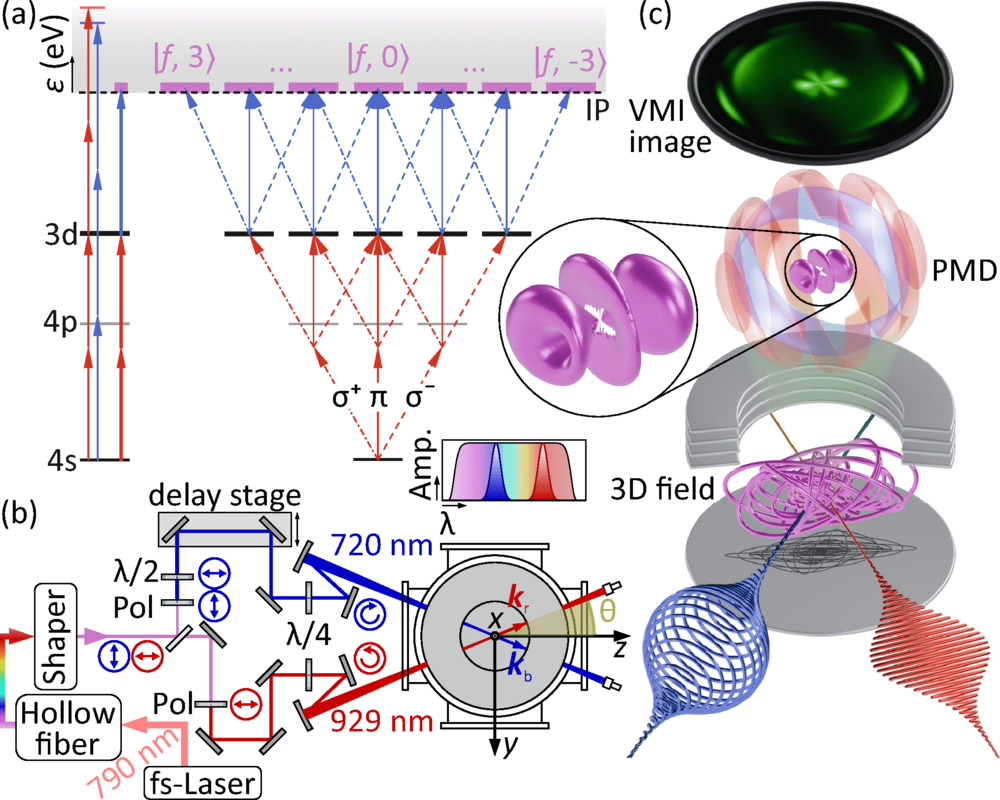
The bands were centered at wavelengths of 929 and 720 nanometers. The paper calls them red and blue to distinguish their relative wavelengths. Both lie beyond the wavelengths usually associated with those everyday color names.
Optical components separated the bands into two paths and adjusted their polarization. Mirrors then focused them into the interaction region, where they crossed at 45 degrees.
Each shaped pulse lasted about 30 femtoseconds, or 30 millionths of a billionth of a second. Precise control of their arrival times ensured that the pulses overlapped where the potassium atoms interacted with the light.
Polarization adjustments changed the combined field’s shape. The researchers investigated five configurations, including combinations of linear and circular polarization. One provided a planar comparison, while other arrangements generated more complex three-dimensional fields.
The wavelengths were selected to emphasize a particular excitation route. Two photons from the longer-wavelength pulse excited potassium through its 3d state, and a photon from the shorter-wavelength pulse released the electron.
This two-plus-one process produced electrons with a characteristic kinetic energy near 0.05 electron volts. Electrons released by either pulse acting alone had higher characteristic energies, near 1.0 and 0.8 electron volts.
That separation helped isolate the signal caused by the pulses working together. In this context, the paper’s description of background-free detection refers to separating those energy signals, rather than eliminating every possible experimental background.
The three field components also opened combinations of transitions unavailable with planar excitation. In quantum terms, they allowed changes in the magnetic quantum number of zero, plus one or minus one simultaneously.
The resulting free-electron wave packets combined angular-momentum components through quantum interference. Changing the light’s polarization altered that combination and the directions in which electrons emerged. These wave packets are quantum states described by wave functions, rather than electrons following sharply defined classical paths.
A velocity-map imaging instrument recorded the electrons with energy and angular resolution. Their momentum distributions changed with the chosen polarization configuration, providing evidence of control over the ionization process.
The researchers compared those measurements with simulated projections. Close agreement across the five configurations supported their interpretation of the contributing excitation pathways and angular-momentum components.
The patterns included tilted, ring-like and more intricate distributions. They revealed how the combined light field affected the emitted electrons, rather than merely showing that ionization occurred.
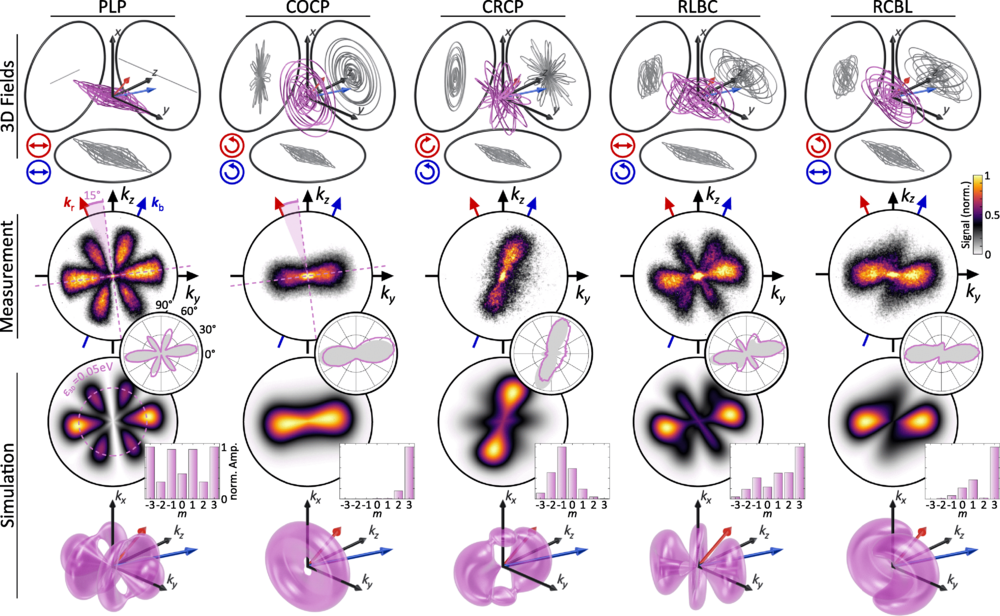
However, the detector images were projections of the momentum distributions. The complete three-dimensional distributions shown in the analysis came from simulations. The authors note that full experimental access to those unusually structured distributions will require emerging reconstruction methods combining electron imaging with high-resolution time-of-flight detection.
That distinction defines both the strength and the limit of the evidence. The measured patterns support the proposed quantum states, while the complete spatial interpretation depends on a model checked against those measurements.
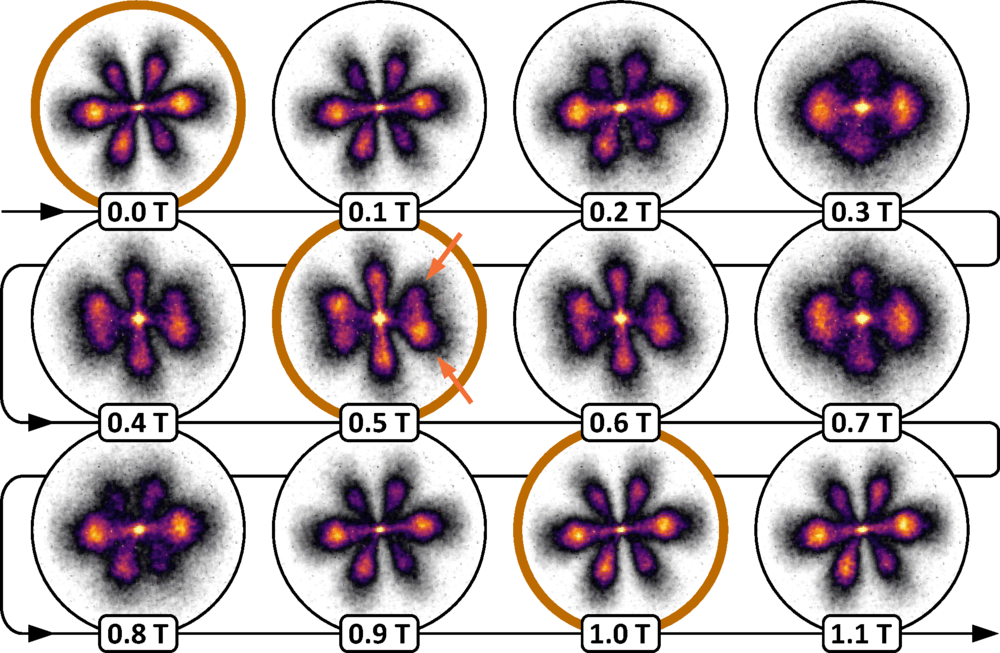
The team also separated excitation and observation in time. The longer-wavelength pulse launched a superposition of two potassium 3d states, and the delayed shorter-wavelength pulse probed its evolution.
These states differ through spin-orbit coupling, the interaction between an electron’s spin and orbital angular momentum. Their energy separation produces a repeating evolution with a period of approximately 14.45 picoseconds, or trillionths of a second.
Researchers varied the delay in steps of one-tenth of that period. They recorded ten momentum distributions per cycle, revealing changes in the electron-emission pattern as the excited state evolved.
The approach resembles stroboscopic imaging, sampling successive stages of a repeating process. It does not continuously film a single electron. Instead, measurements at different delays map the quantum dynamics into detectable outgoing-electron patterns.
The distributions changed during the cycle and returned to their initial form after a full period. Their directional asymmetries also showed how the angled-beam arrangement added sensitivity to the dynamics.
Chiral molecules exist as mirror-image forms that cannot be superimposed, like left and right hands. Many biologically important molecules have this property, and their forms can interact differently with other matter.
Theory predicts that appropriately structured three-dimensional light can itself possess chirality. Such fields could provide sensitive ways to distinguish molecular handedness or control chiral light-matter interactions.
“Theoretical studies show that three-dimensional light fields can also possess chiral properties,” Wollenhaupt said. The potassium experiment establishes control needed to investigate such proposals, rather than demonstrating molecular identification or separation.
The work therefore expands an experimental capability with a defined result: shaping ultrashort fields to access new electron-state combinations. Whether that capability becomes an effective molecular sensing method remains a question for subsequent experiments.
These resources explore light-field shaping, molecular handedness and the experimental and theoretical foundations of chiral sensing.
A new age of molecular chirality: Discusses emerging opportunities for studying and controlling molecular chirality with advanced optical approaches. (Science, 2025)
Synthetic chiral light for efficient control of chiral light–matter interaction: Develops the theoretical approach to locally chiral electric fields and their interactions with chiral molecules. (Nature Photonics, 2019)
Capturing electron-driven chiral dynamics in UV-excited molecules: Reports experimental work linking electronic excitation with ultrafast changes in molecular chirality. (Nature, 2024)
Structured light: Reviews methods for controlling light’s spatial, temporal and polarization properties across multiple dimensions. (Nature Photonics, 2021)
Towards higher-dimensional structured light: Examines strategies for extending structured light beyond conventional two-dimensional fields. (Light: Science & Applications, 2022)
Research findings are available online in the journal Physical Review Research.
The original story “Physicists use 3D light pulses to unlock new electron quantum states” is published in The Brighter Side of News.
Like these kind of feel good stories? Get The Brighter Side of News’ newsletter.
The post Physicists use 3D light pulses to unlock new electron quantum states appeared first on The Brighter Side of News.


Leave a comment
You must be logged in to post a comment.