A clock built from thorium-229 has crossed an important line, from a long-discussed concept to a working device. The shift matters because this clock does more than keep time. It can also watch for tiny changes in the forces that shape the universe.
The work was led by researchers at TU Wien in Vienna, PTB and the Max Born Institute in Germany, Leibniz University Hannover, and the Czech Academy of Sciences’ Institute of Scientific Instruments in Brno.
The new system uses a nuclear transition in thorium-229 rather than the electron-shell transitions used in conventional atomic clocks. That distinction has made the isotope one of physics’ most closely watched candidates for next-generation timekeeping. The transition sits at 148 nanometers, making it accessible to lasers, and its unusual origin gives it an added role as a probe of fundamental physics.
For years, thorium-229 was valued for its potential. Now the device has been demonstrated as a stand-alone nuclear clock, with a continuous-wave laser stabilized directly to the isotope’s nuclear transition inside a calcium fluoride crystal at room temperature.
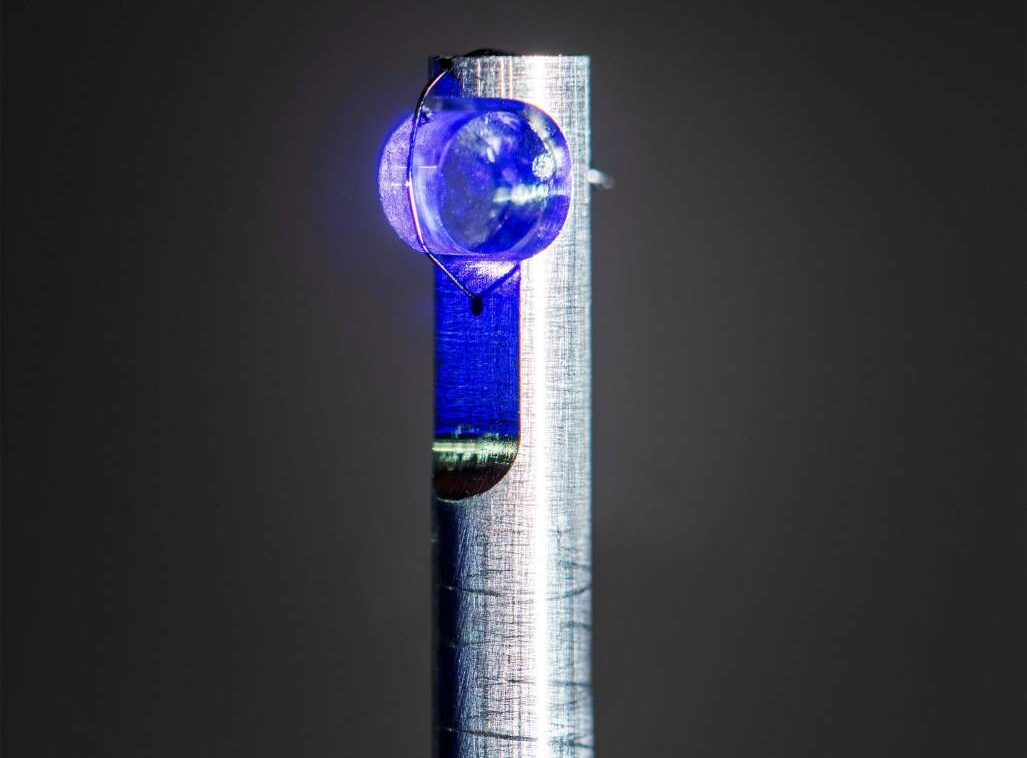
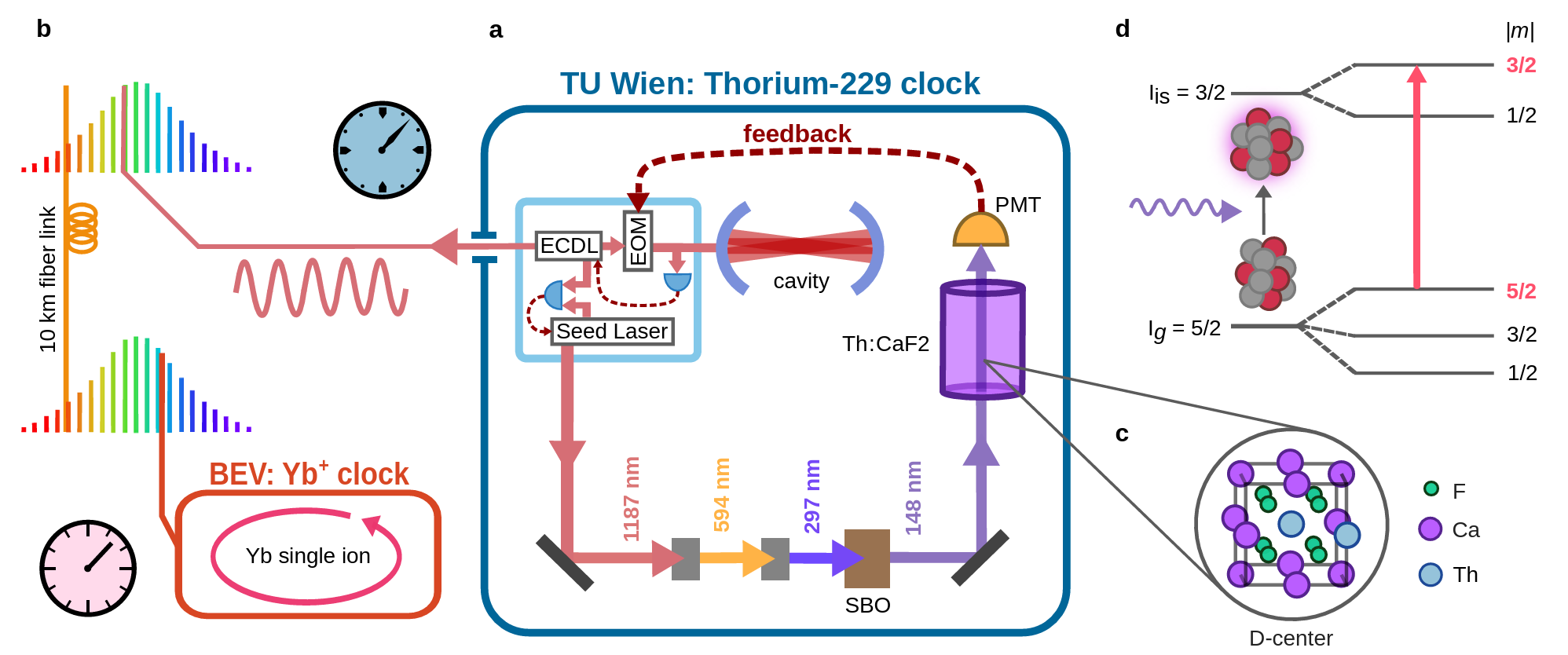
The setup embeds thorium-229 nuclei in a millimeter-sized calcium fluoride crystal and uses continuous absorption spectroscopy to keep the laser locked to the nuclear resonance. That makes the system different from earlier demonstrations, which showed that the transition could be excited but did not yet let the nuclei themselves steer the clock laser.
The clock compares a subharmonic of the 148 nm radiation with a ytterbium ion clock, giving the team a way to measure performance and track any drift. In this arrangement, the thorium transition becomes the long-term reference, while a cavity-stabilized laser supplies short-term stability.
That matters because clock building is really a problem of noise control. Short measurements are limited by counting noise. Long ones let drift creep in. The researchers balanced those effects by adjusting how often the laser was corrected back onto the thorium resonance.
Using continuous absorption also solved another practical problem. Because the thorium isomer has a long lifetime, fluorescence methods can be slow. Absorption spectroscopy allowed continuous probing without waiting for that lifetime to run its course, and it produced three orders of magnitude more signal photons per second than fluorescence.
In operation, the nuclear clock showed shot-noise-limited fractional frequency instability of 3 × 10^-12/√(τ/s), where τ is averaging time. Over one day of continuous operation, it approached instabilities of 10^-15.

The team ran the clock in two modes, one with 20-second correction steps and one with 30-minute steps. The shorter cycle gave faster locking to the thorium transition and broadened the range of dark-matter signals the system could test. The longer cycle preserved more of the cavity’s short-term stability.
The present version can operate for a day without intervention. The researchers reported no observable effect from crystal temperature fluctuations of about 0.1 K during those runs, consistent with previous measurements of the transition’s weak temperature dependence near room temperature.
That room-temperature performance is one reason nuclear clocks have attracted so much interest. The nucleus couples more weakly than electron shells to many outside disturbances, raising hopes for a clock that could be both robust and extremely precise.
The most striking limitation did not come from the laser or the transition itself. It came from the crystal.
Within a single run, the clock reached fractional frequency instabilities in the low 10^-14 range. But reproducibility between runs on different days was limited to about 5 × 10^-13. The likely reason was that realigning the laser changed the exact path through the thorium-doped crystal, causing the system to probe slightly different local regions each time.
Tests at five crystal positions supported that explanation. Line centers differed by as much as 1.7 kHz between positions, far beyond the spread expected from statistical fluctuations alone. When the same position was measured again, the line center was reproducible.
The team suspects local strain from structural inhomogeneity inside the crystal. That points to one of the next practical challenges for the field: making the optical path more repeatable, improving doping homogeneity, and reducing strain during crystal growth.
This is where the clock’s broader importance comes into focus. The thorium-229 transition is unusually sensitive because its low energy comes from a near-cancellation of much larger electromagnetic and nuclear contributions. That makes it especially responsive to any fluctuations in the fundamental constants tied to those interactions.
Some theories predict that ultralight scalar dark matter could cause periodic oscillations or slow drifts in constants such as the fine-structure constant, the quantum chromodynamics scale, or quark masses. Because atomic and nuclear transition energies depend on those constants, clocks can be used as detectors.
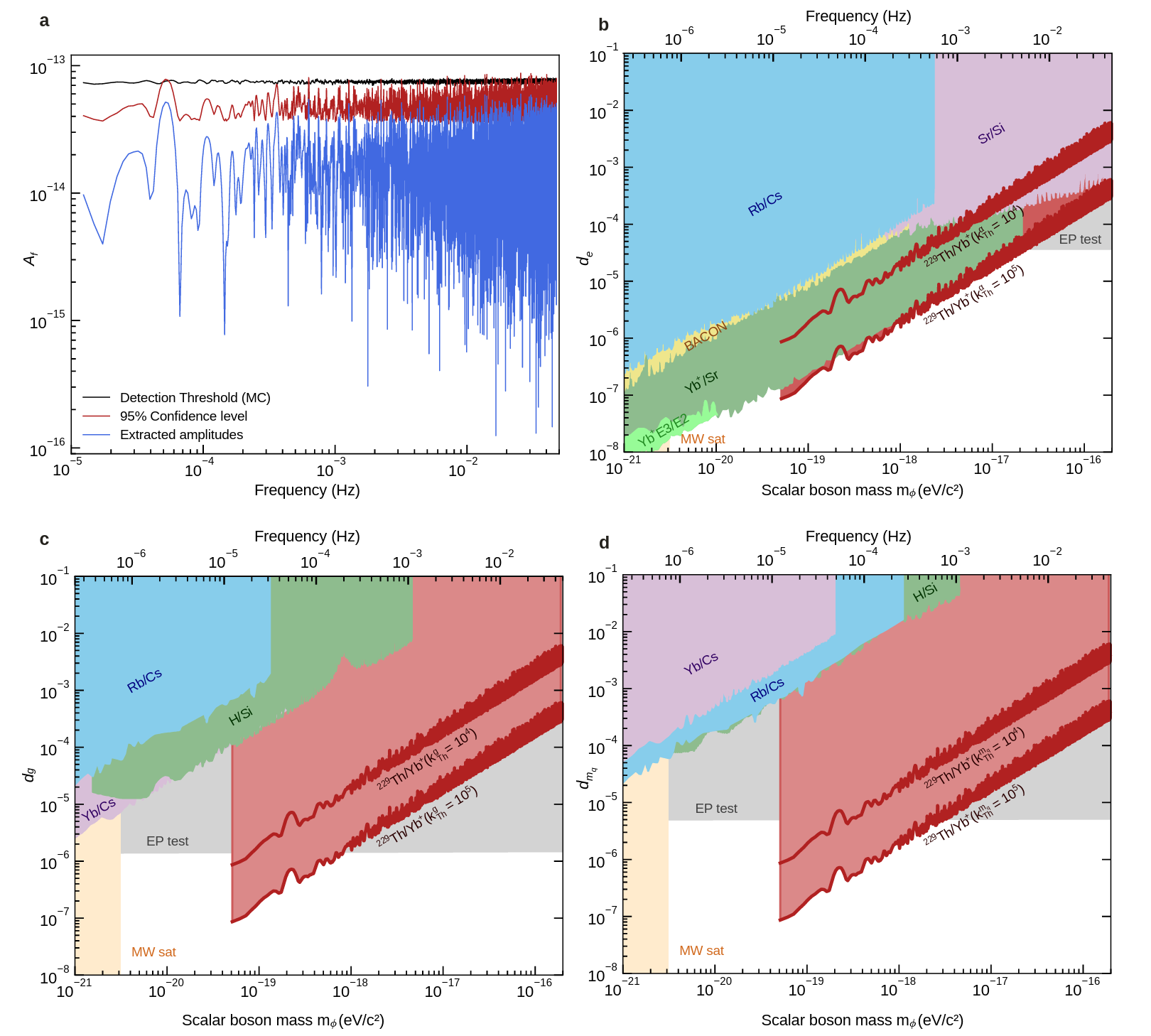
Using about 23 hours of data from the 20-second operating mode, the researchers searched for periodic signals between 20 seconds and 1 day. They found no statistically significant oscillations above threshold, allowing them to place new upper limits on possible dark-matter couplings.
For coupling to photons, the thorium clock already produced constraints that compete with the best atomic-clock comparisons. For couplings tied to the strong force and to up and down quark masses, it pushed about 100 to 1000 times deeper into parameter space than earlier atomic-clock experiments.
The team also looked for slow drifts. A linear fit gave a slope of (2 ± 4) × 10^-14 per day in the frequency ratio between the thorium and ytterbium clocks, consistent with zero.
The researchers see several straightforward ways to improve performance. More vacuum-ultraviolet laser power would raise signal-to-noise. Longer crystals and VUV cavities could lengthen the optical path and further boost absorption. Other crystal hosts, including ones where thorium is built into the stoichiometric structure rather than added as a dopant, may reduce linewidth and improve reproducibility.
They also point to spinless solids as a way to suppress magnetic broadening from neighboring fluorine nuclei. With a narrower linewidth around 1 kHz and modest laser power, they project that a future solid-state thorium clock could reach fractional frequency instability near 10^-16/√(τ/s).
That would place it in the range of state-of-the-art optical atomic clocks, while keeping the compact form and relative simplicity of a solid-state device.
This result changes the thorium-229 story from a promising sensitivity estimate into an operating clock platform. In the near term, that gives precision physicists a new instrument for testing whether nature’s constants remain fixed and for searching for ultralight dark matter over timescales from seconds to a day.
Longer term, the work sketches a path toward solid-state nuclear clocks that could rival the best optical atomic clocks while being less vulnerable to outside disturbances.
If those improvements arrive, thorium-229 may become not just a remarkable clock, but one of the sharpest tools available for probing physics beyond the standard model.
Research findings are available online in the journal arXiv.
The original story “Physicists use thorium-229 to power the world’s first working nuclear clock” is published in The Brighter Side of News.
Like these kind of feel good stories? Get The Brighter Side of News’ newsletter.
The post Physicists use thorium-229 to power the world’s first working nuclear clock appeared first on The Brighter Side of News.

