A string stretched between two confined charges can store so much energy that breaking it becomes cheaper than stretching it farther. When that happens in particle physics, energy can transform into new particle-antiparticle pairs.
Researchers have now watched an analogue of that process unfold inside a programmable quantum simulator.
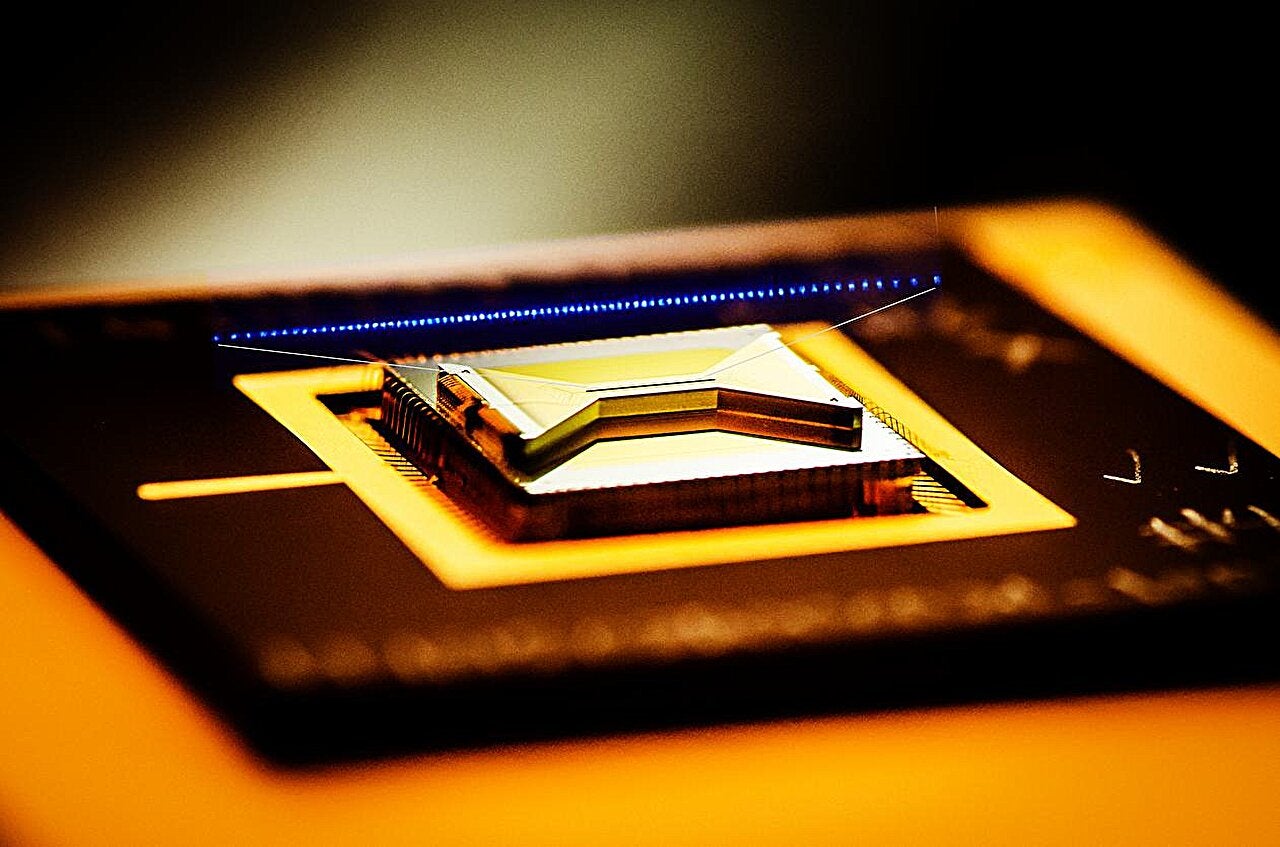
A Duke Quantum Center-led team encoded a simplified gauge theory into 13 trapped ions and followed its evolution in real time. The experiment reproduced charge confinement and string-breaking dynamics while revealing an unexpected way that simulated particle pairs can emerge from the string’s edges.
The work, published in Nature Physics, brings together researchers from Duke University, the University of Maryland, Oxford University, Caltech, Cornell University and KU Leuven.
It does not recreate actual quarks or the full theory of the strong nuclear force. Instead, the experiment demonstrates how controllable quantum systems can reproduce important features of physics that becomes exceptionally difficult to calculate as particles interact and become entangled.
Quarks are fundamental particles found inside hadrons such as protons and neutrons. Unlike electrically charged particles, isolated quarks have never been observed.
Quantum chromodynamics, or QCD, explains that behavior through color confinement.
One useful picture imagines a quark and antiquark connected by a string of gluonic energy. Pulling ordinary opposite electrical charges farther apart eventually weakens their interaction. Separating confined quarks instead adds energy to the field connecting them.
Eventually, stretching the string requires enough energy to create another quark-antiquark pair. The original connection effectively fragments, leaving new combinations of confined particles.
This process is thought to play an important role when energetic collisions produce sprays of hadrons. Related physics would also have mattered while the early universe cooled after the Big Bang.
Calculating those dynamics directly is extremely difficult. Standard computational techniques can handle some static properties of QCD, but real-time evolution creates mathematical challenges that quickly become expensive or impractical for classical machines.
“Quantum computer simulations provide the best platform to investigate complex questions like matter formation, short of having witnessed the Big Bang itself,” Duke physicist Christopher Monroe said.
The researchers did not try to construct QCD itself.
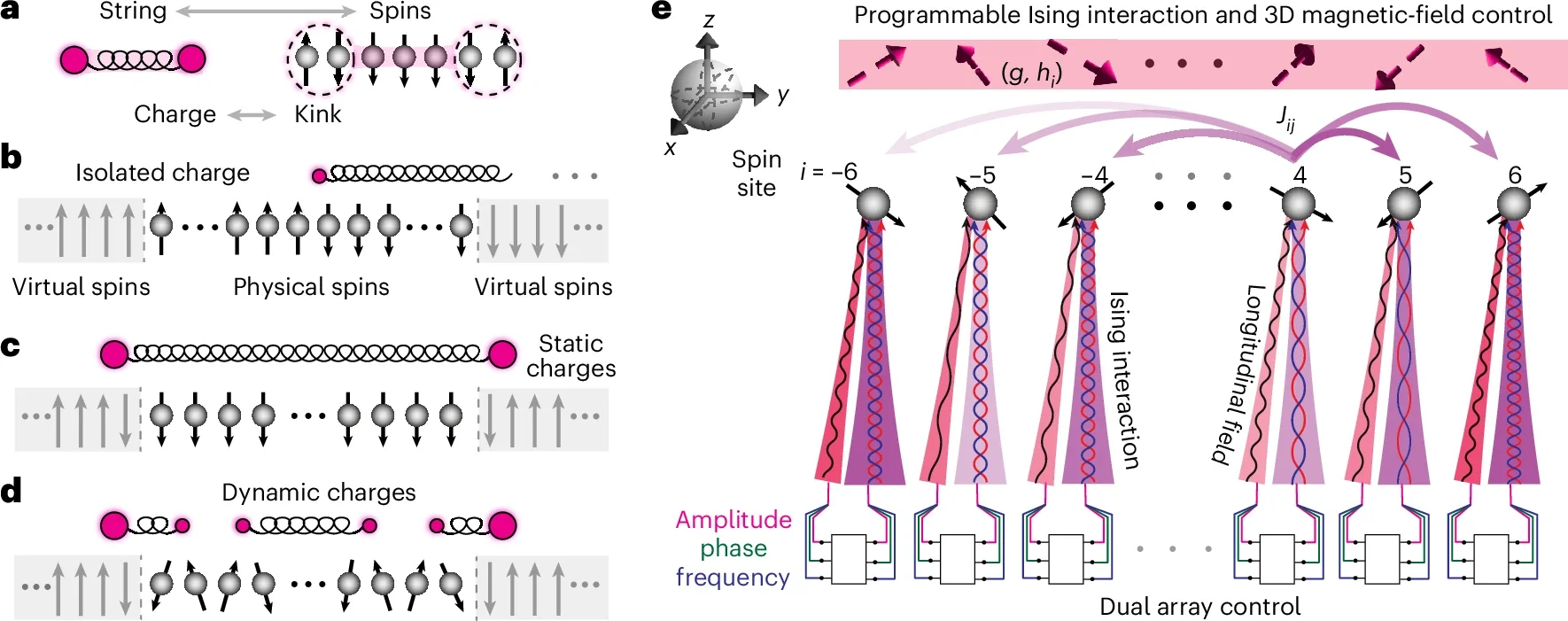
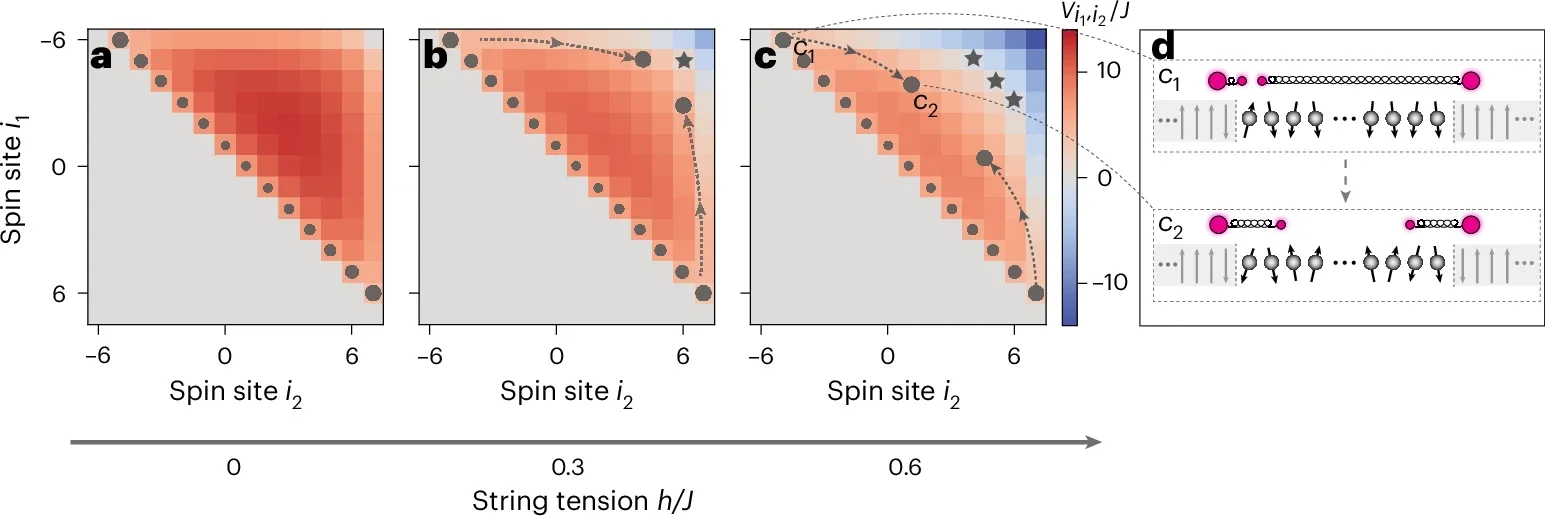
Instead, they mapped a one-dimensional lattice gauge theory onto a quantum Ising spin model. In that representation, charges correspond to boundaries between oppositely oriented spins, while a string corresponds to a domain of spins pointing in another direction.
The experiment used 13 ytterbium ions held in a trap. Two internal states of each ion represented quantum spins.
Arrays of precisely controlled laser beams allowed the researchers to modify interactions between ions and independently tune local effective magnetic fields. That degree of control let them emulate both the physical region being simulated and additional virtual environments beyond its boundaries.
Those virtual regions were important because a small quantum computer cannot represent an infinite physical system. By engineering how the edge ions behaved, the team could reproduce the influence of much larger surroundings without adding more physical ions.
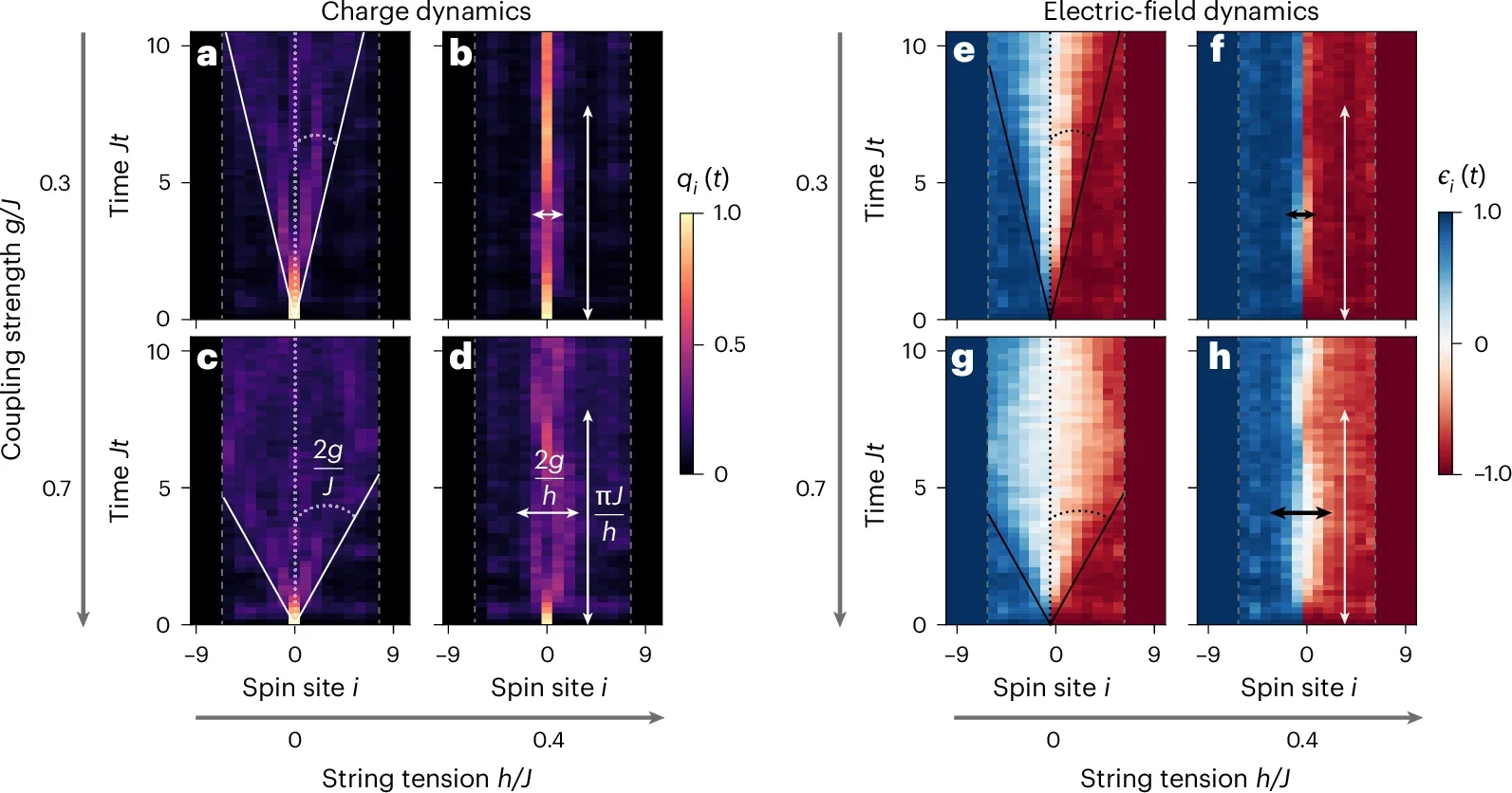
The researchers first tested how an individual confined charge moved. Without string tension, it spread through the simulated lattice. Increasing the tension instead caused the charge to remain localized and oscillate around its original position.
The measurements closely matched numerical calculations.
The team then placed effective static charges at opposite ends of a simulated string.
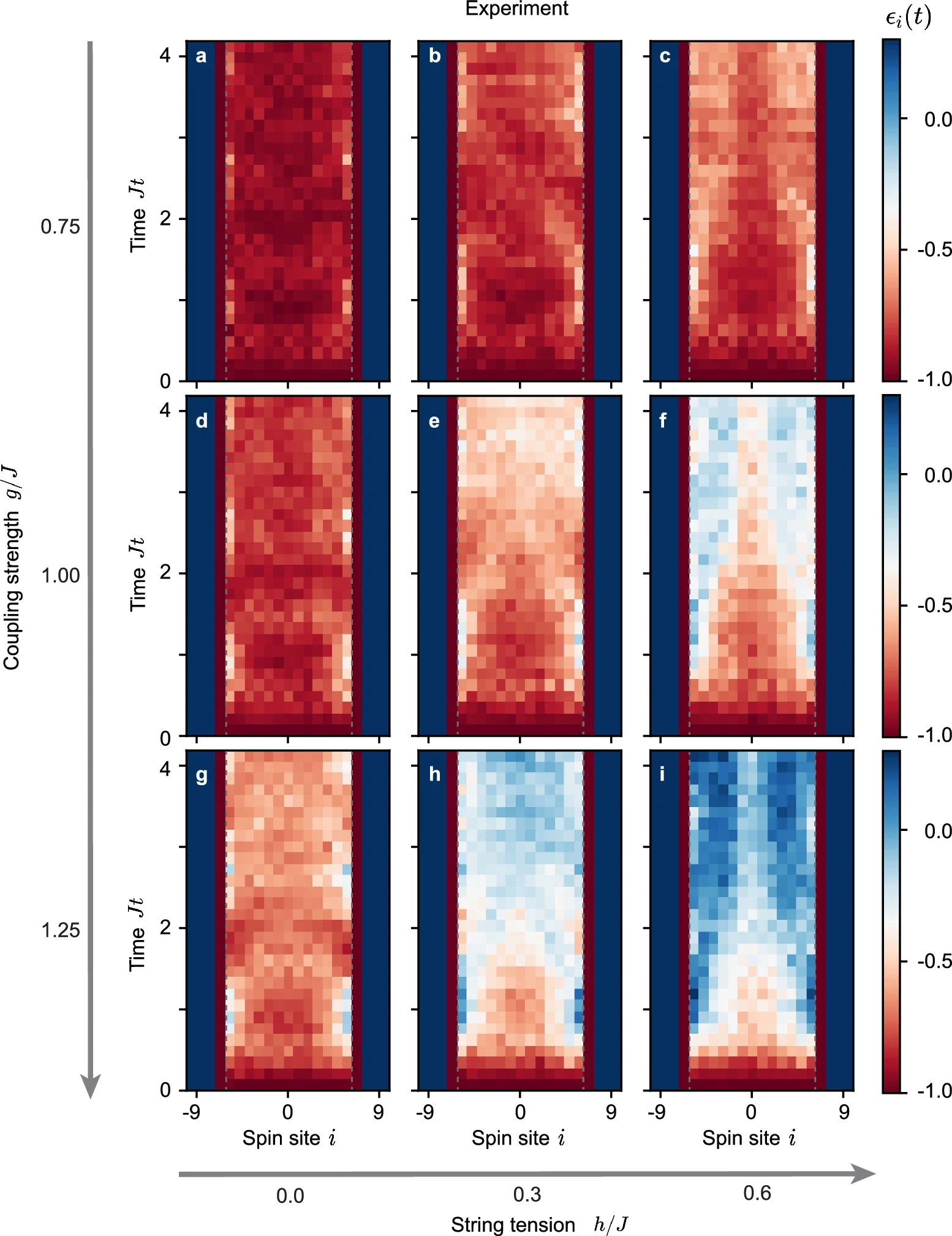
They abruptly changed the quantum system’s parameters, injecting energy and pushing it far from equilibrium. The researchers could then watch how the charge distribution and effective electric field changed over time.
New pairs of effective charges appeared, providing the signature of string breaking.
“As a physicist, it is incredibly exciting to investigate the conditions of the early universe in an atomic-level computing machine,” University of Maryland physicist Zohreh Davoudi said.
The experiment could resolve where and when those charges emerged, revealing more than the mere existence of string breaking.
What researchers saw was not exactly the behavior they originally expected.
A conventional picture called the Schwinger mechanism predicts spontaneous pair creation throughout a sufficiently strong field.
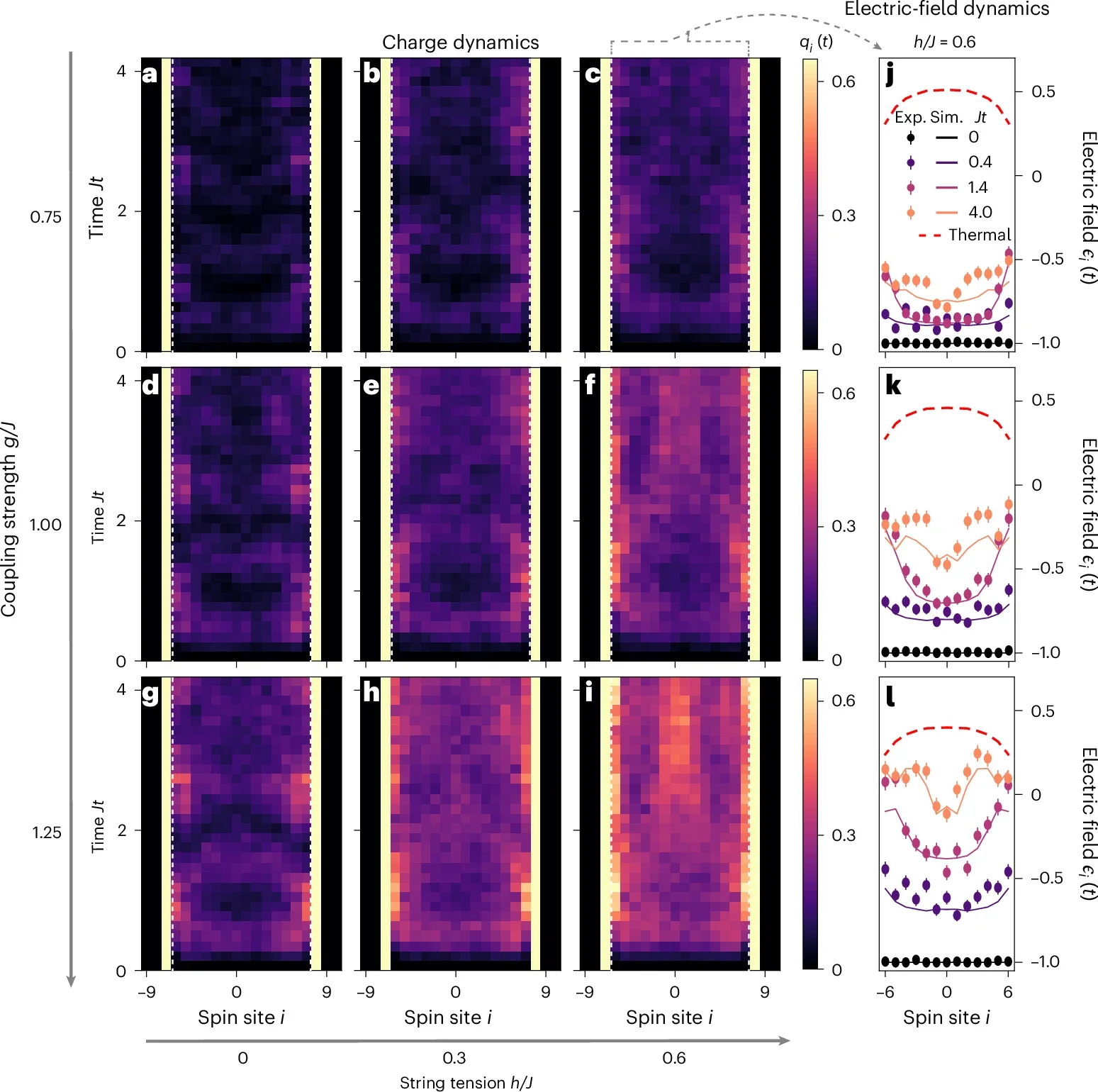
The trapped-ion experiment instead showed charge pairs repeatedly emerging near the two ends of the string.
Under weaker string tension, those new charges remained near the edges and underwent coherent oscillations. When researchers increased the tension, the pairs began spreading inward toward the center of the string.
The team developed a theoretical model explaining why.
Creating a pair near an edge initially costs less energy because of the surrounding vacuum conditions built into the simulation. Stronger tension then opens pathways that allow those charges to propagate farther into the system.
The onset of this behavior also changed relatively little as researchers varied some model parameters. Conventional Schwinger pair production should respond much more dramatically to such changes.
The researchers therefore describe the phenomenon as an edge-facilitated string-breaking mechanism distinct from the conventional Schwinger process.
Current classical computers could still reproduce the 13-ion experiment, allowing the researchers to check whether the quantum simulator behaved correctly.
That will not necessarily remain true as these experiments grow.
Quantum systems become increasingly difficult to model classically as their size, evolution time and entanglement increase. Quantum simulators operate according to quantum mechanics themselves, potentially allowing their required resources to grow far more manageably for certain problems.
Other groups have already demonstrated related string physics with different technologies. Google researchers have used superconducting qubits to visualize charge and string dynamics, while a QuEra-led experiment used neutral Rydberg atoms to observe string breaking in two dimensions.
“These are the three platforms leading the charge in quantum computing, so it’s a nice benchmark and comparison for the quantum community,” Monroe said.
The Duke experiment adds trapped ions to that growing toolbox while demonstrating detailed control over non-equilibrium string dynamics.
The experiment should not be interpreted as a quantum computer reproducing the complete behavior of quarks inside a proton.
Full QCD exists in three spatial dimensions, involves non-Abelian gauge fields and contains vastly more complexity than the simplified model implemented here. Building a first-principles quantum simulation of realistic high-energy collisions remains a major technological and theoretical challenge.
Still, researchers can use simplified models to develop the methods needed to move toward that goal.
Future experiments could simulate moving rather than static charges, larger lattices, particle collisions and more realistic surrounding quantum environments. They may eventually explore regimes where classical supercomputers can no longer follow the entire evolution.
For now, 13 ions have provided a controlled glimpse of one of particle physics’ most fundamental ideas: a quantum string storing enough energy to create new particles as it breaks.
These resources explore string breaking, gauge theories, confinement and the growing effort to simulate high-energy physics with quantum machines.
Quantum simulation of fundamental particles and forces: This perspective explains why quantum computers may eventually help simulate real-time dynamics of quantum fields, dense matter and fundamental particles that challenge classical methods. (Nature Reviews Physics, 2023)
Real-time dynamics of lattice gauge theories with a few-qubit quantum computer: An early trapped-ion experiment demonstrated that a small quantum computer could simulate real-time particle creation in a lattice gauge theory. (Nature, 2016)
Quantum simulations of hadron dynamics in the Schwinger model using 112 qubits: Researchers used a 112-qubit implementation to prepare and evolve hadron wave packets, illustrating how larger quantum processors could approach particle-scattering problems. (Physical Review D, 2024)
Visualizing dynamics of charges and strings in (2 + 1)D lattice gauge theories: A superconducting-qubit processor directly imaged confinement and string dynamics in a two-dimensional lattice gauge theory. (Nature, 2025)
Observation of string breaking on a (2 + 1)D Rydberg quantum simulator: A neutral-atom quantum simulator reproduced confinement and dynamical string breaking, providing a complementary platform for studying gauge-theory physics. (Nature, 2025)
Research findings are available online in the journal Nature Physics.
The original story “Quantum computer simulates how stored energy can become new particles” is published in The Brighter Side of News.
Like these kind of feel good stories? Get The Brighter Side of News’ newsletter.
The post Quantum computer simulates how stored energy can become new particles appeared first on The Brighter Side of News.


Leave a comment
You must be logged in to post a comment.