A clock normally needs a beginning. Set the starting point, count the ticks and calculate how much time has passed. A quantum system built from excited helium atoms could offer a different approach.
Researchers at Uppsala University have shown that complex interference patterns inside highly excited atoms can act as timestamps. Instead of counting regular oscillations from a known zero point, the method reads a distinctive quantum pattern and matches it to theory to determine how much time has elapsed.
The team calls the method a “quantum watch,” rather than a clock. Its key signal comes from quasiunique beat signatures, or QUBS, produced when many Rydberg states interfere. In experiments, those patterns allowed the researchers to determine elapsed time with femtosecond-scale accuracy and expose a small drift in equipment normally used to set timing.
Ordinary mechanical, quartz and atomic clocks rely on repeated oscillations. Time is determined by counting those cycles from an established reference point. The Uppsala approach works differently because the quantum interference pattern itself changes as time passes.
“You can compare it to how you can look at a measuring tape and see how far you are from the start. Regardless if it is 5 centimeters or 4000 meters, we could show that it is possible to look at the probability that these Rydberg states can be ionised by another light pulse. And by studying only a short time interval, we could by comparing with theoretical models, directly read off how much time had passed since the Rydberg states were created,” said Johan Söderström, who leads the research group in the Division of X-ray Photon Science at Uppsala University’s Department of Physics and Astronomy.
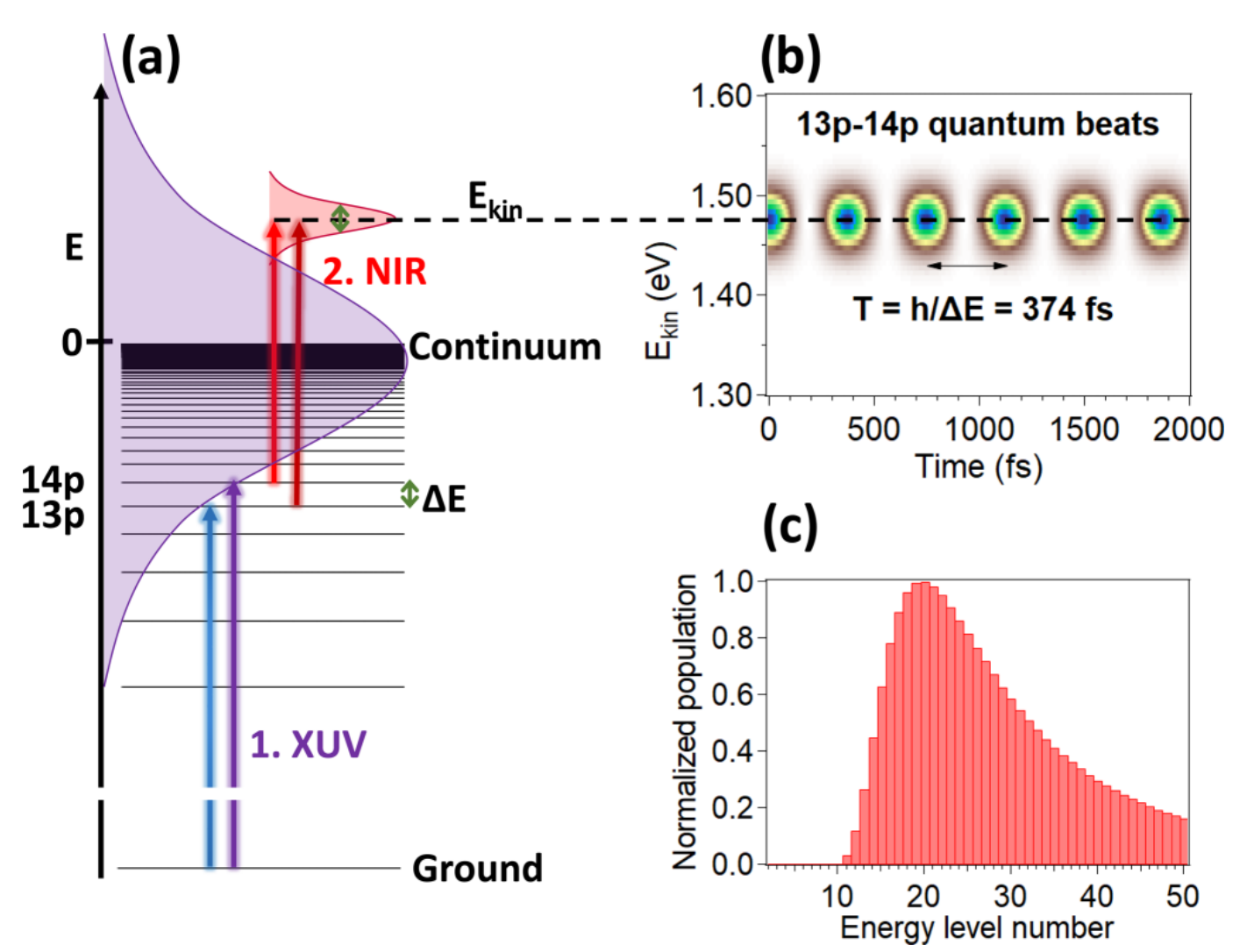
The idea depends on Rydberg wave packets, coherent mixtures of highly excited atomic states. A packet containing only two Rydberg states produces a simple oscillation. When many states are excited at once, their slightly different energies make their phases evolve at different rates, creating a far more complicated interference pattern.
The team created wave packets in helium containing Rydberg states ranging from principal quantum number 10 toward the ionization threshold. An ultrashort extreme-ultraviolet, or XUV, pulse excited the helium atoms. A delayed near-infrared pulse then ionized them, allowing the researchers to measure emitted electrons.
The experiment took place in the HELIOS laboratory at Uppsala’s Ångström Laboratory. Researchers controlled the arrival of the probe pulse with a motorized delay stage and recorded how the photoelectron signal changed as the delay increased.
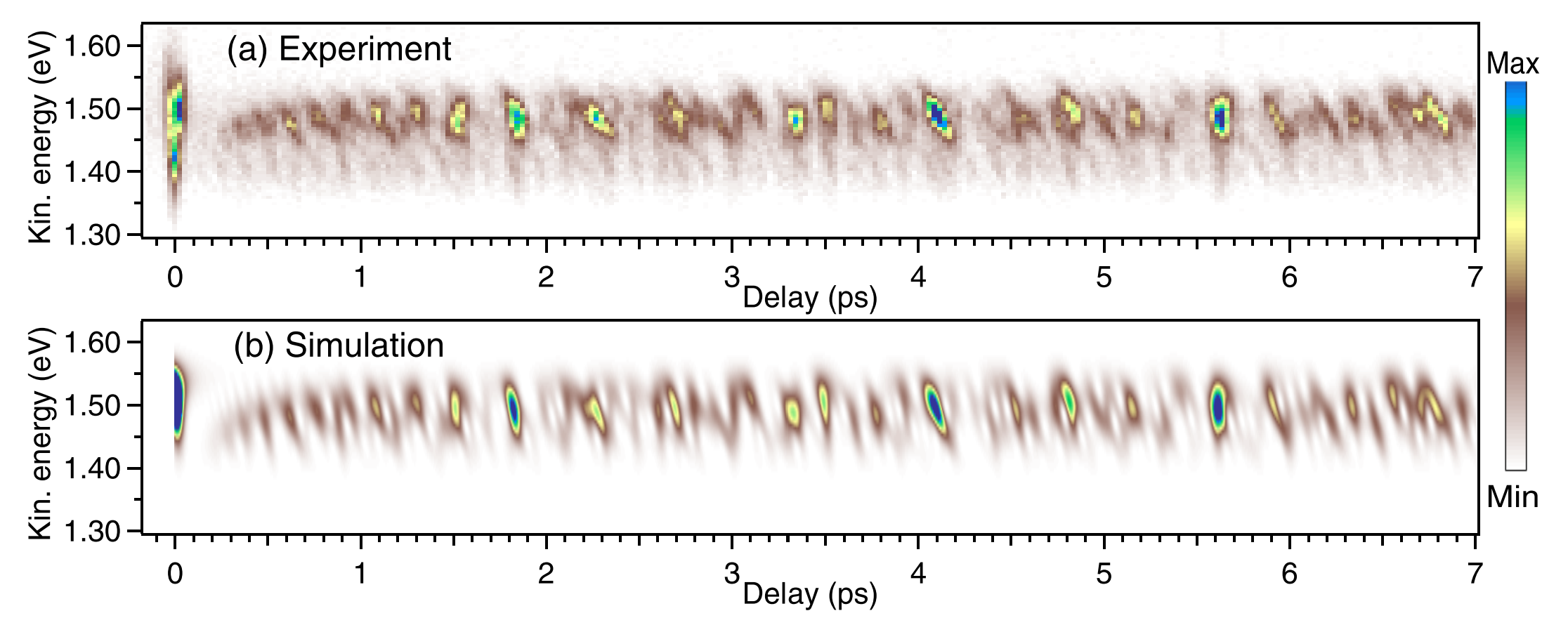
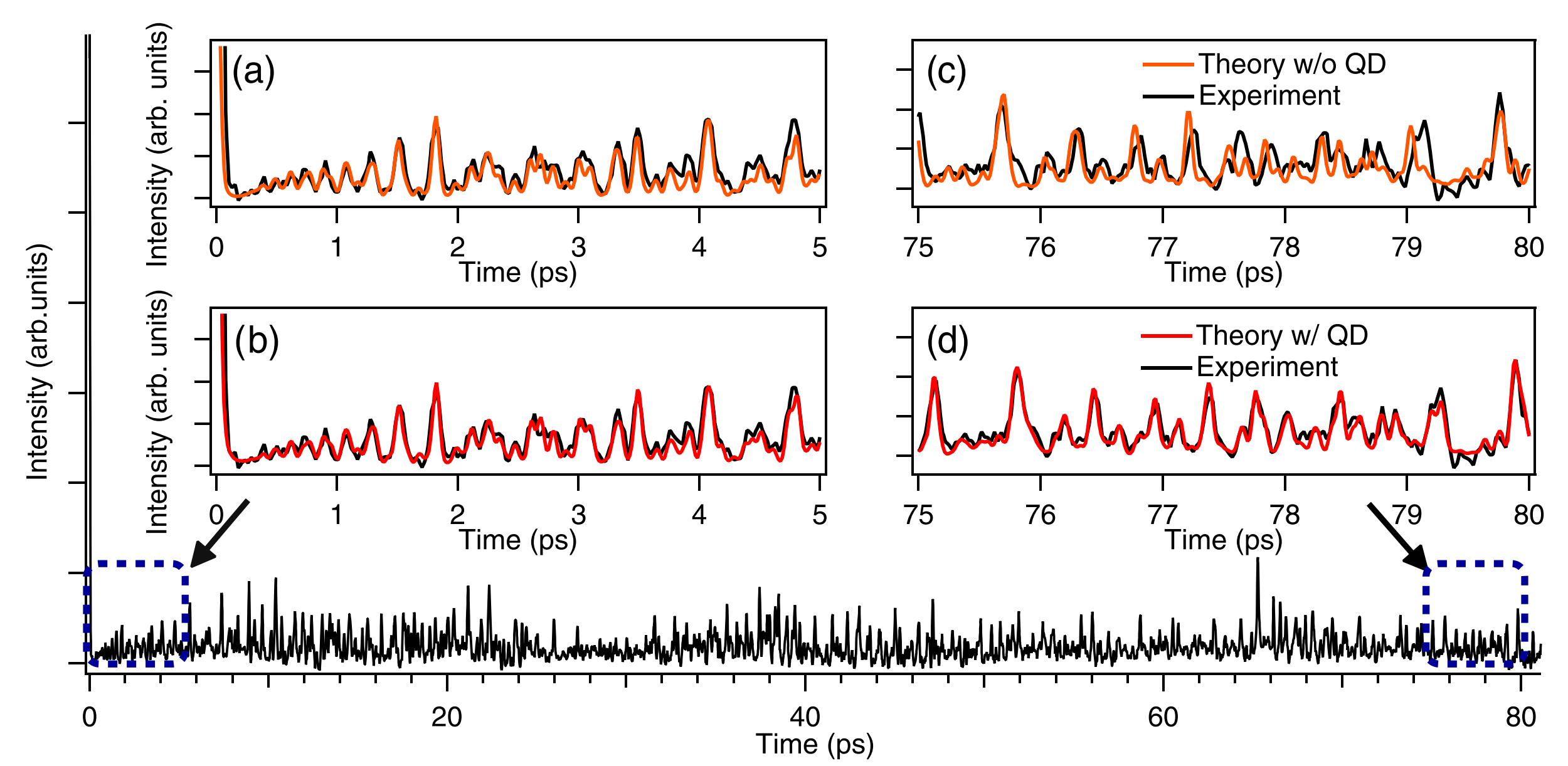
The variations looked complex and almost random, but theoretical calculations reproduced nearly all the observed features. The team also tested subtle differences in the energies of excited helium states known as quantum defects. During the first few picoseconds, calculations with and without those values matched the experiment. Near 80 picoseconds, only calculations that included the predicted quantum defects continued to reproduce the data. A fit gave a multiplication factor of 0.98 plus or minus 0.08 for the theoretical values.
The researchers then used the interference pattern itself as a timing tool. Instead of relying on the position of the mechanical delay stage, they compared short sections of experimental data with a much longer theoretical timeline. Each section could be assigned a time according to the theoretical pattern it matched.
That is the basis of QUBS. The pattern acts as a fingerprint for a particular elapsed time, so the system does not need to count every oscillation between preparation and measurement. It only needs to be initiated and later read.
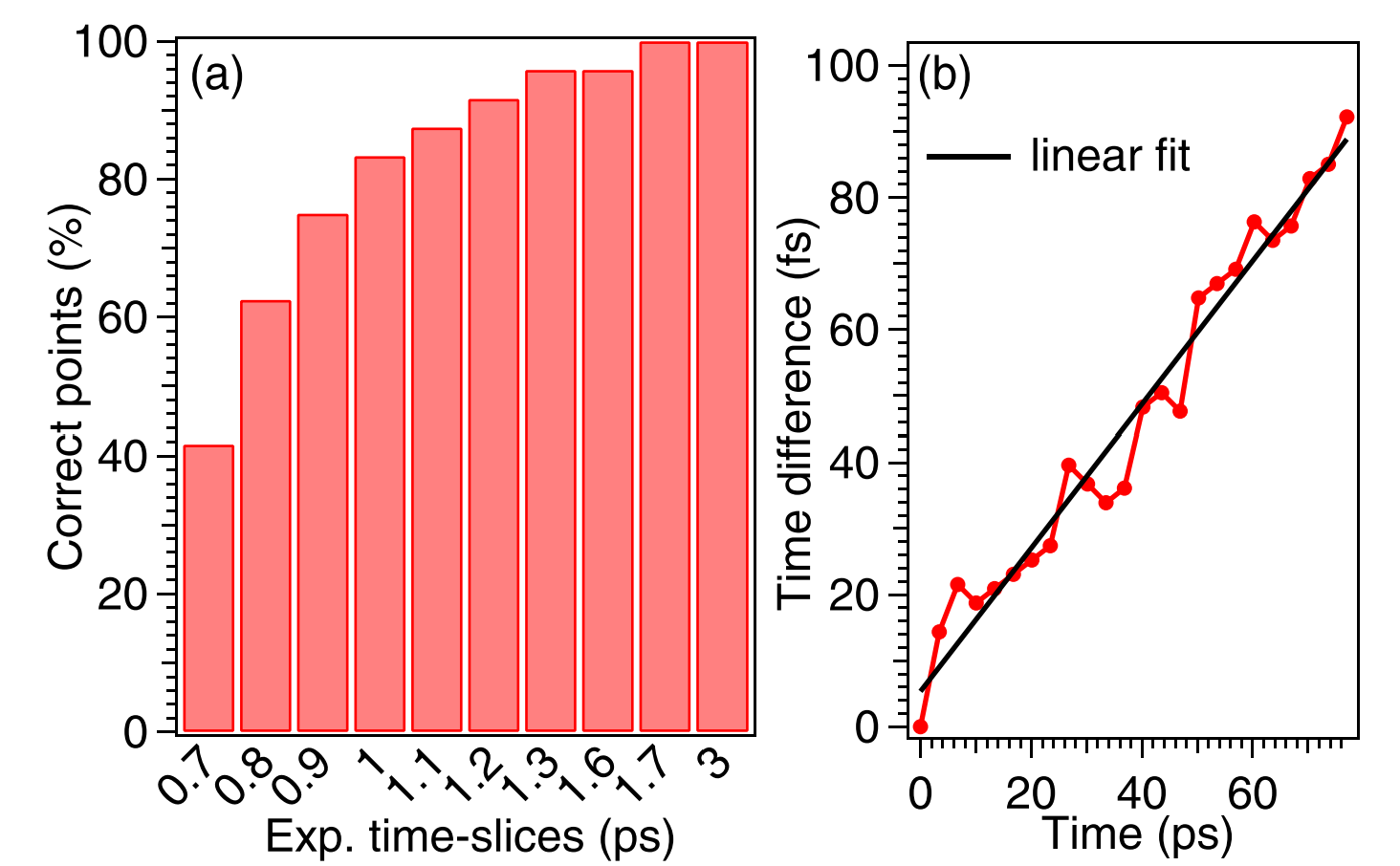
The observation window determines how far the system can measure without confusing one pattern for another. When researchers compared experimental slices with a calculated range extending to 10 nanoseconds, windows between 1.7 and 3 picoseconds identified the correct time in every tested case. A 0.7-picosecond window succeeded in only 41.7% of cases.
For measurements extending to 100 nanoseconds, the analysis indicated that a 3-picosecond window would be needed for a unique timestamp. High Rydberg states can survive well above a microsecond, giving the method the potential to work across a broad ultrafast time range.
The experiment also showed why the method could be useful. Pump-probe measurements typically determine delays by moving an optical component on a precision translation stage. The distance traveled is then converted into a time delay.
When the team compared this delay-stage time with QUBS-derived time, the two gradually separated. One measurement showed a difference of about 90 femtoseconds, while the overall drift was about 1 femtosecond for every picosecond of delay. The researchers attributed the discrepancy to a small misalignment in the delay stage.
Because the experimental interference patterns agreed quantitatively with theory, the team argues that QUBS provides an intrinsic check on its accuracy. Least-squares fitting could determine the experimental data within 1 femtosecond, while the researchers estimated overall QUBS timing accuracy at about 8 femtoseconds.
The quantum watch is not meant to replace ordinary clocks. Its potential lies in experiments where determining the exact moment called time zero is difficult, or where scientists need an independent way to check whether an ultrafast delay system has drifted.
The approach could also be adapted. The researchers describe neon, argon, krypton and xenon as alternatives to helium when lower-energy pump light is needed. Ions could extend the idea to higher excitation energies, while other excitation methods might create usable wave packets in different systems.
The team plans additional theoretical work and studies of molecules, including how molecular fragmentation could affect Rydberg states. Much of the experiment was carried out during the COVID-19 pandemic, when reduced university activity gave the researchers longer periods in the HELIOS lab.
For ultrafast physics, where a few femtoseconds can matter, the method offers a different answer to a familiar question. Instead of counting ticks from a known beginning, it reads a changing quantum pattern and uses that pattern to reveal how much time has passed.
These resources explore Rydberg wave packets, femtosecond and attosecond measurement techniques, and the broader physics behind using rapidly evolving quantum states to probe time and electron dynamics.
Wave-packet manipulation of He Rydberg states by a seeded free-electron laser: This experiment examines how coherent helium Rydberg wave packets can be created and manipulated with controlled light pulses, providing a closely related example of how interference among excited states can encode dynamical information. (Physical Review Research, 2024)
Experimental demonstration of attosecond pump-probe spectroscopy with an X-ray free-electron laser: Researchers demonstrated pump-probe measurements with control of pulse delays down to 270 attoseconds, showing why accurate knowledge of very short time delays is critical for observing electron dynamics. (Nature Photonics, 2024)
Entanglement in photoionisation reveals the effect of ionic coupling in attosecond time delays: This work uses attosecond photoelectron interferometry to examine timing information contained in photoionization, illustrating how quantum interference can reveal extremely short delays in electronic processes. (Nature Communications, 2025)
Technical review: Time-dependent density functional theory for attosecond physics ranging from gas-phase to solids: This review covers theoretical methods used to interpret ultrafast electron dynamics, including time-resolved photoelectron spectroscopy and pump-probe experiments in which the delay between light pulses carries crucial physical information. (npj Computational Materials, 2025)
Rydberg states of alkali atoms in atomic vapour as SI-traceable field probes and communications receivers: This technical review explains why highly excited Rydberg atoms are unusually sensitive quantum probes and surveys their growing role in precise, self-calibrated measurements, providing broader context for using Rydberg states as measurement tools. (Nature Reviews Physics, 2024)
Research findings are available online in the journal Physical Review Research.
The original story “Quantum interference offers a radically different way to measure time” is published in The Brighter Side of News.
Like these kind of feel good stories? Get The Brighter Side of News’ newsletter.
The post Quantum interference offers a radically different way to measure time appeared first on The Brighter Side of News.


Leave a comment
You must be logged in to post a comment.