A faint X-ray flash from a galaxy 500 million light-years away exposed a stellar death that looked familiar in visible light but behaved strangely at higher energies. The event may widen the known range of ways massive stars collapse.
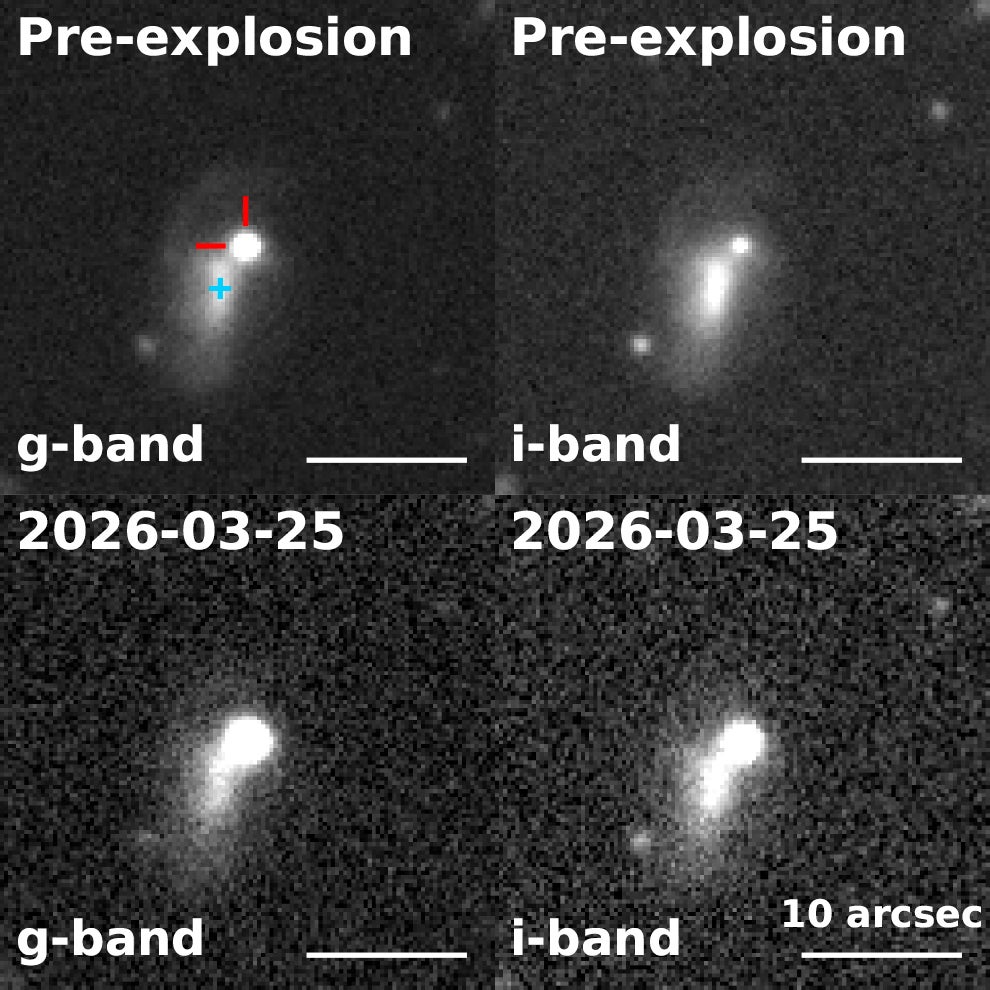
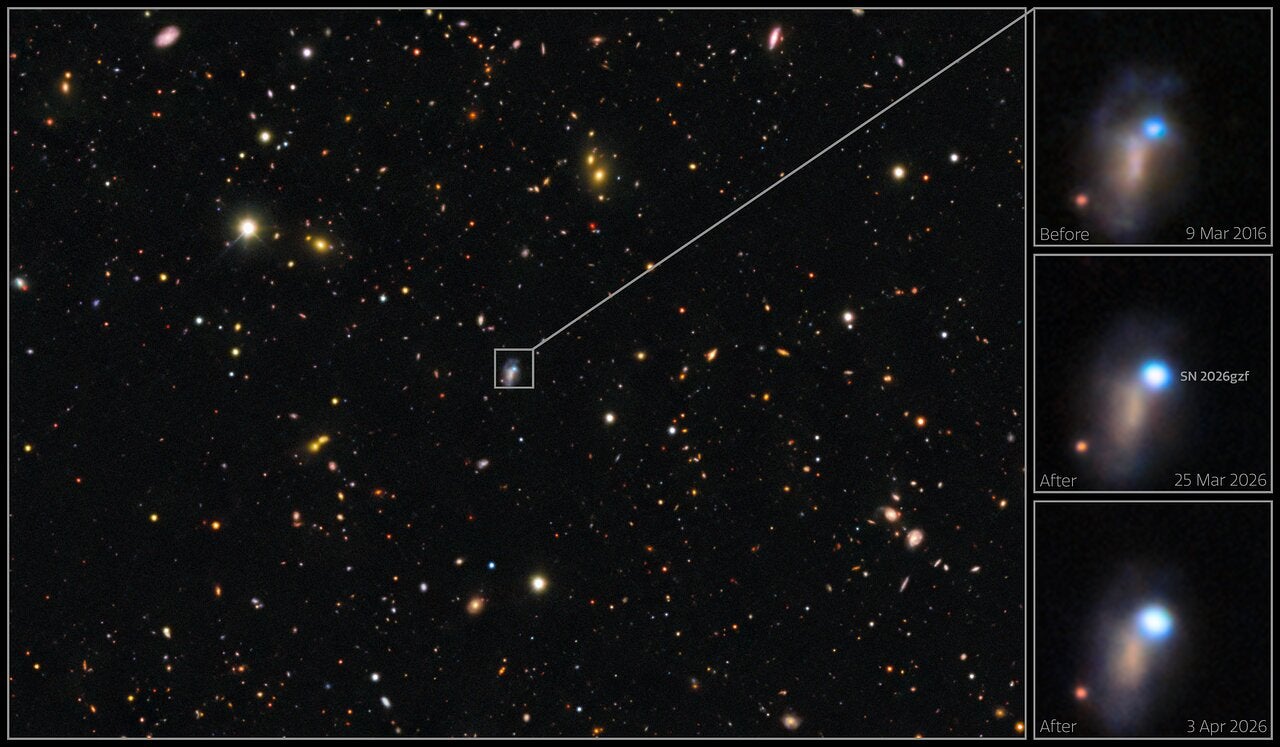
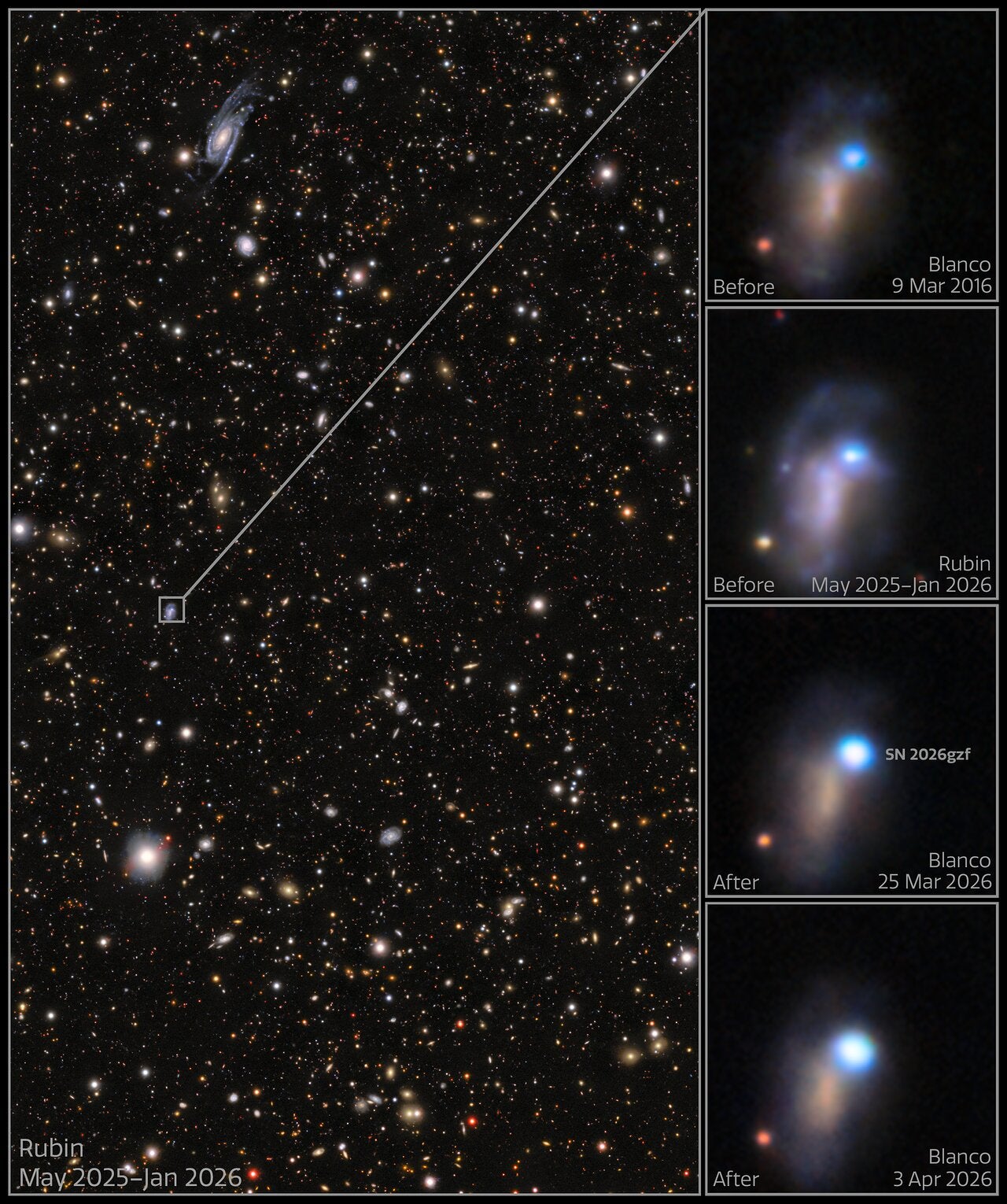
Einstein Probe detected the soft X-ray burst, named EP260321a, on March 21, 2026. Ground telescopes began watching within an hour and soon found a rapidly brightening supernova, later designated SN 2026gzf.
Two independent teams, led by Brendan O’Connor of Carnegie Mellon University and Jillian Rastinejad of the University of Maryland, College Park, traced the event with observatories worldwide.
Both teams identified the original signal as a shock breakout. This occurs when an explosion’s shock wave reaches the star’s surface, or nearby material, and releases the supernova’s first electromagnetic light.
Shock breakouts should accompany every supernova, but they are exceptionally hard to catch. They last from seconds to hours and often peak in soft X-rays or extreme ultraviolet light.
Astronomers had confidently identified only one other clear X-ray shock breakout during the previous two decades. That event, linked to SN 2008D, made EP260321a an unusually valuable detection.
Later observations showed that SN 2026gzf was a broad-lined Type Ic supernova. These explosions involve stars stripped of hydrogen and helium.
Such supernovae are often associated with relativistic jets and gamma-ray bursts. Yet no gamma-ray burst appeared after SN 2026gzf.
“SN 2026gzf looks remarkably similar to other energetic supernovae that have been previously linked to gamma-ray bursts. Yet multi-wavelength follow-up observations using the most sensitive facilities found no evidence for a relativistic jet or an afterglow, which are typically seen in those events,” O’Connor said. “One possibility is that the jet was ‘choked,’ either by the surface of the star or by circumstellar material surrounding the star.”
The mismatch became one of the event’s defining features. The supernova resembled energetic explosions tied to gamma-ray bursts, but its initial X-ray breakout was the faintest yet connected to a broad-lined Type Ic supernova.
Einstein Probe measured a peak X-ray luminosity near 1.0 × 10^45 ergs per second. That was about 10 times fainter than several nearby low-luminosity gamma-ray bursts and other recent breakout candidates.
The optical supernova was not comparably weak. It reached an absolute magnitude near minus 19 in the r band about 15 days after the trigger.
Early spectra showed ejecta moving near 30,000 kilometers per second. Iron features indicated speeds near 35,000 kilometers per second at 3.6 days, falling to about 20,000 by 11.3 days.
The teams found no lasting X-ray or radio afterglow. Chandra detected no source 15 or 39 days after the explosion. The Very Large Array found no radio source about 60 days after the trigger.
Those limits ruled out a luminous relativistic jet like those seen in known nearby gamma-ray burst supernovae. A weak jet, mildly relativistic outflow or jet trapped inside surrounding material remained possible.
The campaign combined data from major ground and space observatories.
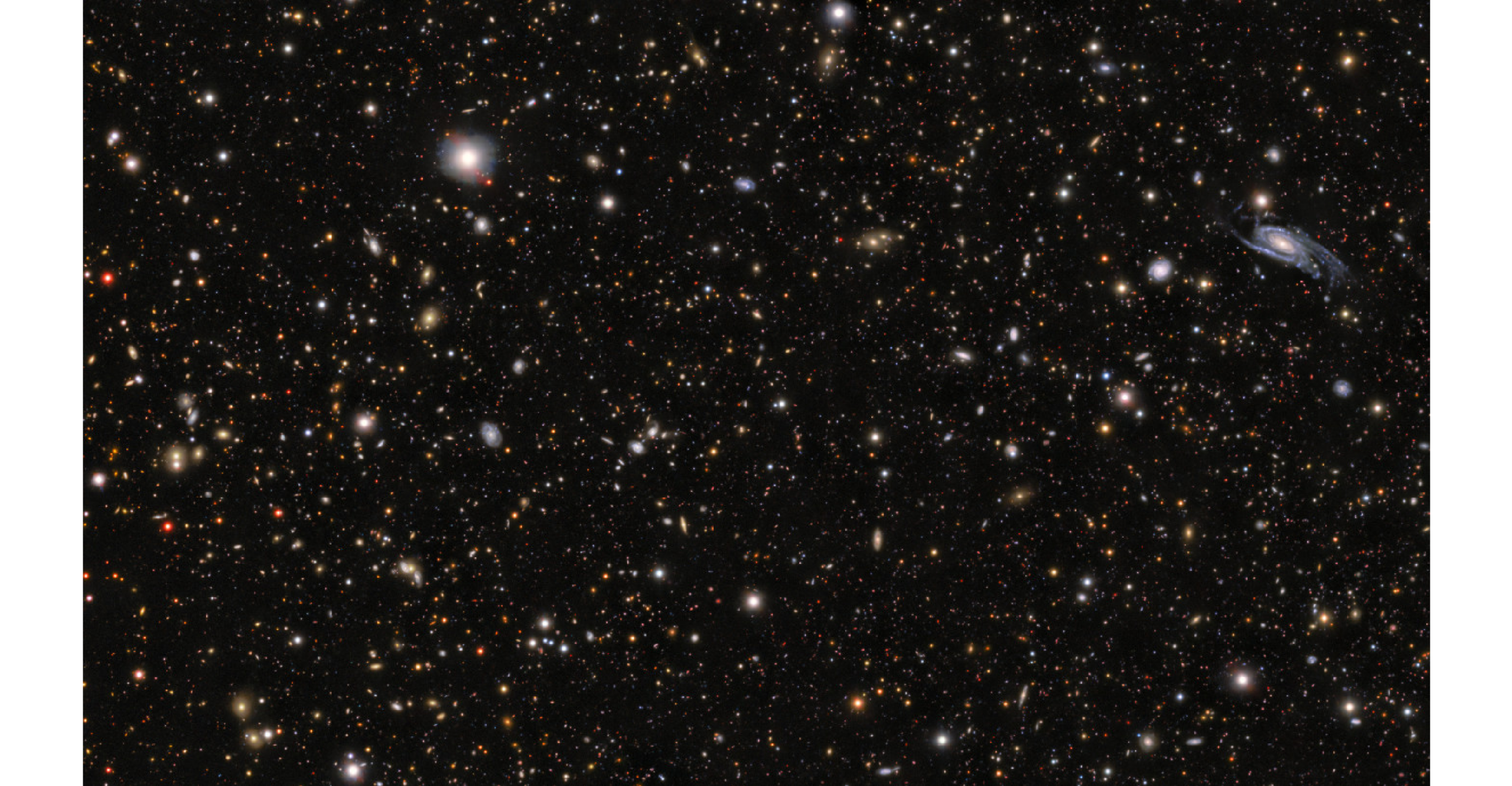
DECam images taken years before the explosion showed a blue source at the same location. Rubin commissioning data also indicated activity from the progenitor system shortly before the star died.
DESI’s spare-fiber program returned to the supernova several times. Its spectra confirmed the classification and tracked changes as the explosion expanded and cooled.
“DESI’s spare-fiber program gave us the opportunity to return to SN 2026gzf repeatedly and follow how its spectrum changed as the explosion evolved,” said Xander Hall of Carnegie Mellon University. “This sequence of observations demonstrates the power of using DESI’s spare fibers for rapid transient follow-up and classification as Rubin continues to ramp up its transient alert stream over the next decade.”
Rastinejad’s team concluded that the progenitor was a Wolf-Rayet star born with about 20 times the Sun’s mass. It had burned through its hydrogen early and later shed its remaining hydrogen and helium.
The mass loss left a star composed mostly of carbon and oxygen. It also built several shells, including a compact, low-mass shell linked to the first X-rays and a larger, uneven shell connected to the optical emission.
“Our observations allowed us to study the physics of three pieces of this explosion: the X-ray shock breakout, the accompanying supernova, and the interaction of the supernova with material previously cast out by the dying star,” Rastinejad said. “With this information we were able to map out the structure of the material surrounding the star and understand the star’s violent lifestyle before it collapsed.”
The supernova occurred about 2.5 kiloparsecs from the center of a blue dwarf galaxy. Measurements showed active star formation around the explosion site and extremely low metal abundance.
The local metallicity was estimated at roughly 15 to 20 percent of the Sun’s level, though the calibration carried important systematic uncertainty.
Low-metal environments often host broad-lined Type Ic supernovae and gamma-ray bursts. SN 2026gzf produced no detected gamma-ray burst, showing that metallicity alone cannot determine whether a relativistic jet escapes.
Modeling suggested about 0.45 solar masses of radioactive nickel, though shock heating or interaction with nearby material could have added light. The estimate may therefore be an upper limit.
EP260321a links ordinary supernova shock breakouts with more extreme explosions that produce low-luminosity gamma-ray bursts. Its bright optical supernova and faint thermal X-rays show that these signals do not rise and fall together.
The event demonstrates how wide-field X-ray monitoring can catch stellar explosions before optical surveys recognize them. Coordinated follow-up can then reconstruct the star, its surroundings and the weak or failed outflow it may have launched.
Future detections by Einstein Probe and planned ultraviolet missions could reveal whether stripped stars commonly undergo violent mass loss before collapse. A larger sample could show how often energetic supernovae produce successful jets, weak jets or no relativistic outflow.
Research findings are available online in The Astrophysical Journal Letters.
The original story “Rare x-ray flash reveals the first moments of a powerful supernova without a gamma-ray burst” is published in The Brighter Side of News.
Like these kind of feel good stories? Get The Brighter Side of News’ newsletter.
The post Rare x-ray flash reveals the first moments of a powerful supernova without a gamma-ray burst appeared first on The Brighter Side of News.

