Solar panels stop working when the sky goes dark. That simple fact has pushed energy researchers into a stubborn problem: how to hang on to the sun’s power once the light is gone.
At UC Santa Barbara, scientists say they have built a molecule that does exactly that, not by storing electricity, but by packing solar energy into chemical bonds and holding it there until heat is needed. The work, published in Science, centers on a modified organic compound called pyrimidone, which can absorb sunlight, shift into a high-energy form, and later snap back, releasing heat on demand.
The idea belongs to a field known as molecular solar thermal energy storage, or MOST. Instead of routing solar energy into large battery packs or the power grid, MOST systems store that energy directly inside a material.
“We typically describe it as a rechargeable solar battery,” said Han Nguyen, a doctoral student in the Han Group and the study’s lead author. “It stores sunlight, and it can be recharged.”
Nguyen said the team thinks of the process the way many people think about photochromic sunglasses. The lenses darken in sunlight, then turn clear again indoors. Here, the reversible change is not about color. It is about capturing energy, releasing it later, and using the same material again.
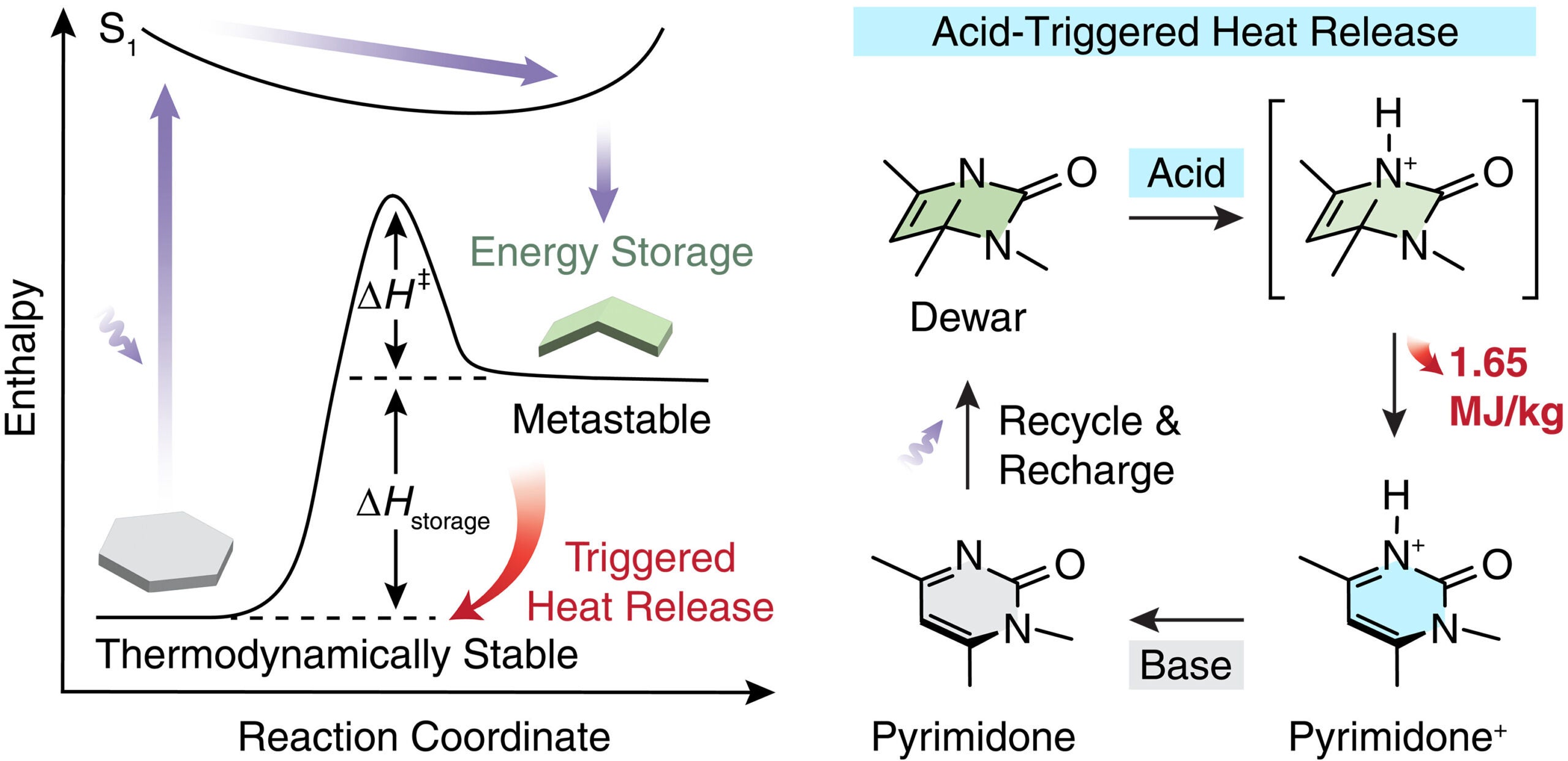
The molecule’s design came from an unusual place: DNA damage.
The researchers drew inspiration from a pyrimidone-like structure related to lesions that can form in DNA after ultraviolet exposure. Those lesions can reversibly change shape under light, and the team saw a chance to turn that chemistry into an energy-storage system. They built a synthetic version and tuned it so the molecule could repeatedly switch between two forms, one stable and one energy-rich.
To understand why the charged form could hang on to its energy for so long, the group worked with UCLA distinguished research professor Ken Houk. Computational modeling helped explain how the molecule remains stable for months or even years, depending on the version, before giving up its stored heat.
“We prioritized a lightweight, compact molecule design,” Nguyen said. “For this project, we cut everything we didn’t need. Anything that was unnecessary, we removed to make the molecule as compact as possible.”
That decision mattered. In MOST systems, adding bulky chemical groups can help shift light absorption into more useful regions of the solar spectrum, but the tradeoff is weight. More weight means less stored energy per kilogram.
The UC Santa Barbara team focused on getting the highest possible energy density from a small molecule. Their best performer, called compound 3, reached 1.648 megajoules per kilogram, or about 228 kilojoules per mole. The authors say that beats leading photoswitch-based MOST compounds by at least 65 percent.
For comparison, the study notes that lithium-ion batteries store about 0.9 megajoules per kilogram. Heating oil, by contrast, still contains far more energy, around 40 megajoules per kilogram, but it is burned once and gone. The appeal of MOST materials is that they can cycle through storage and release again and again.
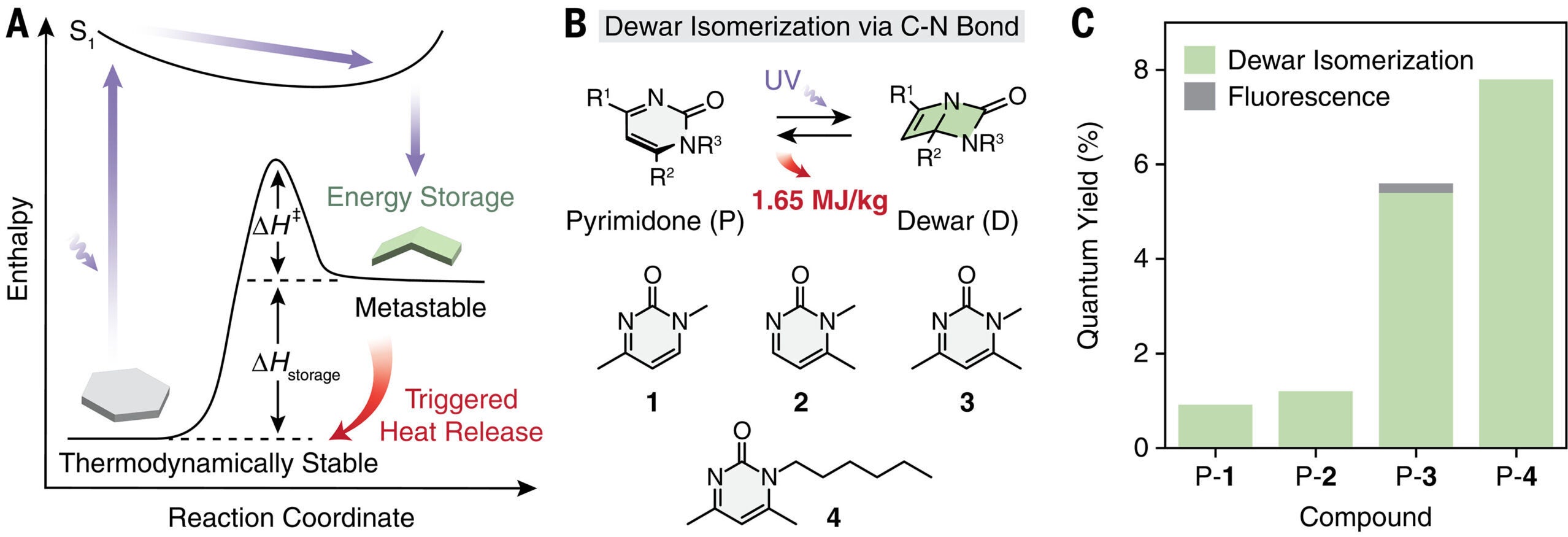
The pyrimidone system works a bit like a compressed spring.
When the molecule absorbs ultraviolet light, it rearranges into a strained Dewar isomer, a higher-energy form that traps solar energy in its bonds. That stored energy stays in place until the molecule gets a trigger, such as heat or a catalyst. Then it flips back to its original structure and releases heat.
In lab tests, the researchers found that several versions of the molecule showed strong thermal stability. Compound 3 had an extrapolated half-life of 481 days at room temperature. Compound 4, which was designed to work as a liquid under solvent-free conditions, reached an extrapolated half-life of 1,240 days.
The group also tested whether the material could survive repeated charge and discharge cycles. In dimethyl sulfoxide, compound 3 went through more than 20 light-driven storage and heat-release cycles with negligible degradation.
That durability matters because MOST systems only become practical if they can be reused many times. The authors argue that a material storing roughly 1.5 to 2 megajoules per kilogram per cycle could, over repeated use, deliver a cumulative heat output comparable to conventional heating fuels.
The work still comes with limits. Right now, the pyrimidones absorb mainly in the UV-A and UV-B range, which makes up only about 5 percent of the solar spectrum. Their photoisomerization quantum yields were also low, which means charging under sunlight would be slow. The team says future chemical modifications may red-shift absorption, though doing so could reduce energy density.
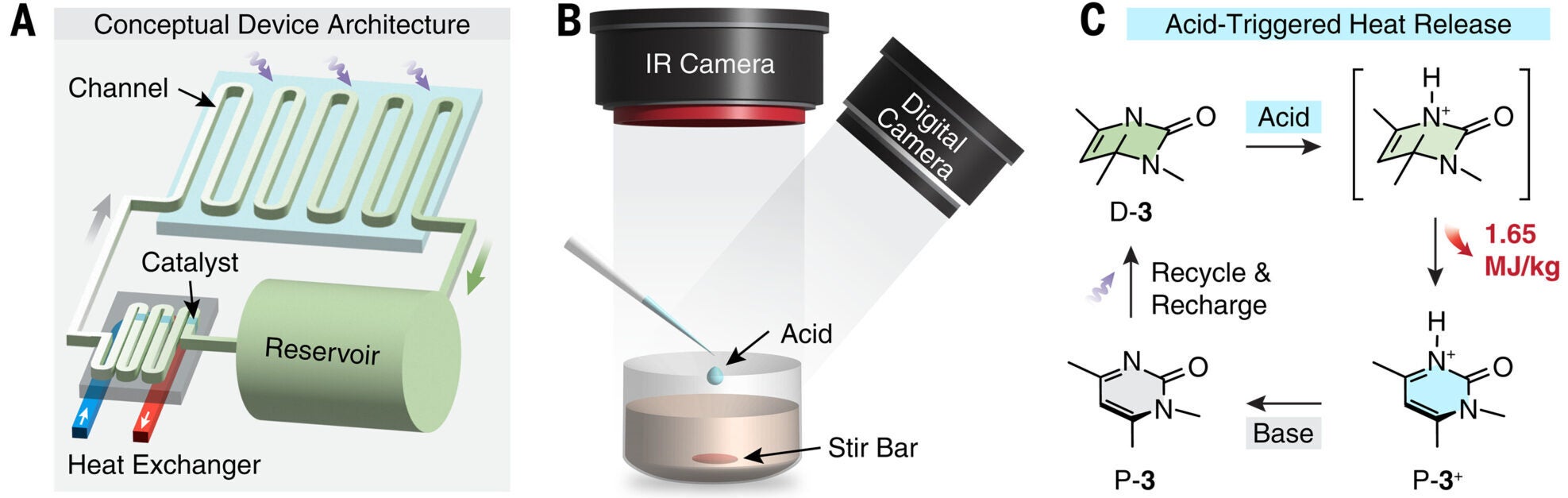
The clearest demonstration came when the researchers used the stored energy to heat water.
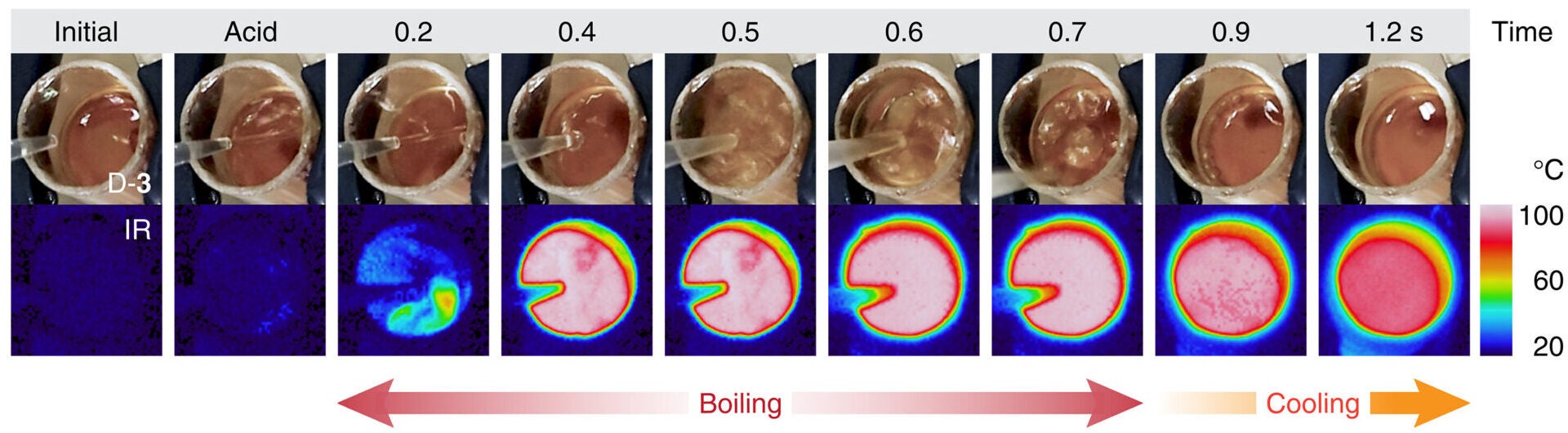
They dissolved the charged Dewar form of compound 3 in water, then triggered its return to the stable pyrimidone form with hydrochloric acid. In one test, 51 milligrams of the material in 0.50 milliliters of water produced a 40-degree Celsius temperature jump in 1.8 seconds.
Then they pushed the system further. Using 107 milligrams of the molecule in 0.46 milliliters of water, the team added acid under ambient conditions and saw the solution reach 100 degrees Celsius and begin boiling within one second.
“Boiling water is an energy-intensive process,” Nguyen said. “The fact that we can boil water under ambient conditions is a big achievement.”
Control experiments showed that the acid itself accounted for only a small part of the heating. Most of the temperature rise came from the molecule releasing the energy it had stored earlier.
The team also compared the pyrimidone system with other representative MOST materials, including diazetidine and cis-azobenzene. Under similar mass loadings, compound 3 transferred far more heat to the surrounding medium. The difference tracked with its higher gravimetric energy density.
Still, this was a proof of concept, not a finished product. The current setup used a homogeneous acid catalyst, which then required neutralization, producing salt buildup that would cut into the total energy density in a practical device. The authors say a better route would be a heterogeneous catalyst fixed inside a channel, allowing the fluid to release heat without that extra cleanup step.
Heating accounts for nearly half of global energy demand, and the study notes that almost two-thirds of that heating still comes from fossil fuels. That makes heat, not just electricity, a major climate problem.
This new MOST material points to a different way of thinking about solar energy storage. Instead of using sunlight to make electricity and then storing that electricity in batteries, the material stores solar energy directly as heat-ready chemical potential. That could make it useful for tasks where heat is the end goal, such as water heating, cooking, or surface defrosting.
The researchers suggest that water-compatible MOST materials could one day circulate through rooftop solar collectors during the day, then move into storage tanks and release heat later, including at night. They also point to possible off-grid uses, such as camping or home heating systems.
“With solar panels, you need an additional battery system to store the energy,” said co-author Benjamin Baker, a doctoral student in the Han Lab. “With molecular solar thermal energy storage, the material itself is able to store that energy from sunlight.”
The system is not ready to replace household infrastructure. It still needs better solar absorption, improved charging efficiency, and more practical catalytic release. But by showing a compact molecule that stores heat at record levels and can boil water on command, the research pushes MOST technology closer to something less abstract: a reusable fuel made from sunlight.
Note: Source material provided by the University of California, Santa Barbara. The original university release was written by Seren Snow and has been expanded and edited for content, style, clarity, and length.
Research findings are available online in the journal Science.
The original story “Rechargeable solar battery ‘bottles the Sun’ for a rainy day or a cold night” is published in The Brighter Side of News.
Like these kind of feel good stories? Get The Brighter Side of News’ newsletter.
The post Rechargeable solar battery ‘bottles the Sun’ for a rainy day or a cold night appeared first on The Brighter Side of News.

