A child raises their arms, turns slightly, and tries to match a movement on a screen. The action looks simple, almost routine. Yet for clinicians, moments like these can reveal important clues about development, learning, and social connection. A new artificial intelligence system now aims to capture those subtle differences with greater clarity, using nothing more than ordinary video.
Researchers at Kennedy Krieger Institute and Penn Engineering have developed a tool called CAMI-2DNet, short for Computerized Assessment of Motor Imitation. The system uses artificial intelligence to measure how closely a child copies basic body movements. It offers a new, scalable way to study imitation, a key behavioral marker linked to autism.
“Motor imitation is a critical building block for social development,” said Dr. Stewart H. Mostofsky, director of the Center for Neurodevelopmental and Imaging Research at Kennedy Krieger Institute and a co-author of the study. “Our long-term goal is to better understand individual differences in autism and help inform interventions that address those differences.”
Imitation plays a central role in how children learn. From early childhood, copying others helps build communication, coordination, and social understanding. It allows children to mirror gestures, recognize intent, and connect with those around them.
For children with autism, this process often looks different. They may imitate movements less accurately or with different timing. These differences can signal deeper variations in how the brain processes information and interacts with the environment.
Because of this, clinicians often include imitation tasks in developmental evaluations. Observing how a child copies simple movements can provide valuable insight into their cognitive and social growth.
For years, measuring imitation has relied on trained experts watching videos and assigning scores. This method, known as human observation coding, requires careful review and significant training.
While useful, it has clear limits. Human judgment can vary between observers. The process is also slow and difficult to scale, especially as the demand for autism evaluations continues to grow.
More advanced systems have been developed, including motion-capture setups that track body movement in three dimensions. These tools can produce detailed data, but they require expensive equipment and controlled environments.
“By replacing specialized hardware and manual analysis with intelligent computer vision, we can help make objective behavioral assessments more accessible to clinicians and families,” said René Vidal, a professor at Penn Engineering and senior author of the study.
CAMI-2DNet takes a different approach. Instead of relying on specialized cameras, it works with standard video recordings. This means it can be used in clinics, schools, or even at home.
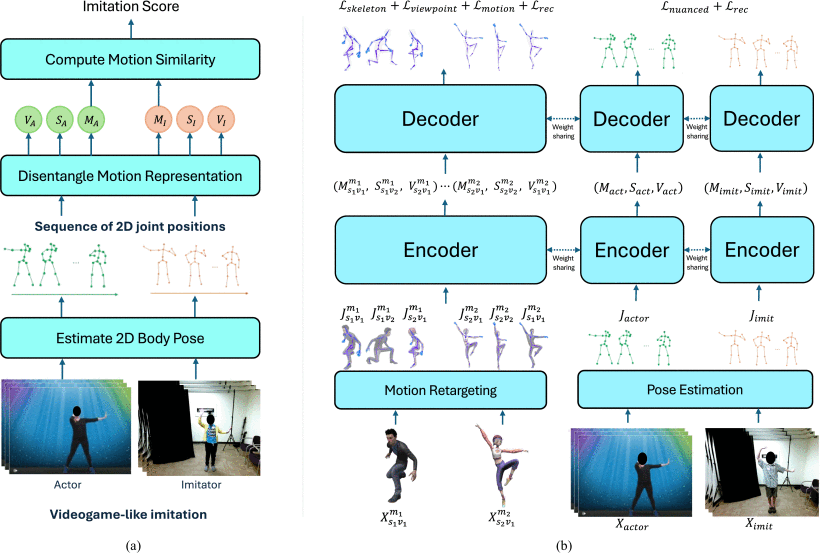
The system begins by analyzing video of a person performing a movement and a child attempting to copy it. It tracks key points on the body, such as shoulders, elbows, and knees, across each frame.
From there, the system focuses on the motion itself. It separates the movement from other factors like body shape or camera angle. This allows it to compare actions more fairly, even when individuals look different or are filmed from different perspectives.
At the core of CAMI-2DNet is a deep learning model designed to understand motion patterns. The system breaks down each movement into three components: motion, body shape, and viewpoint.
By isolating motion, it can focus on how the body moves rather than how it appears. This step reduces noise and improves accuracy when comparing two performances.
The system then aligns the movements in time. This is important because children may perform actions at different speeds. By adjusting for timing, the model ensures that slower or faster movements can still be evaluated correctly.
Finally, the system calculates a similarity score. This score reflects how closely the child’s movement matches the original. Higher scores indicate more accurate imitation.
To teach the model how to recognize motion, researchers used a mix of real and simulated data. They created a large dataset of virtual characters performing movements from different angles and with different body types.
This synthetic data allowed the system to learn a wide range of motion patterns. It included thousands of base actions and more than 100,000 variations.
The researchers also used real-world data from 185 children between the ages of six and twelve. Among them, 82 had autism and 103 were neurotypical. A smaller group had detailed scores from human observers, which allowed researchers to compare the system’s results with expert evaluations.
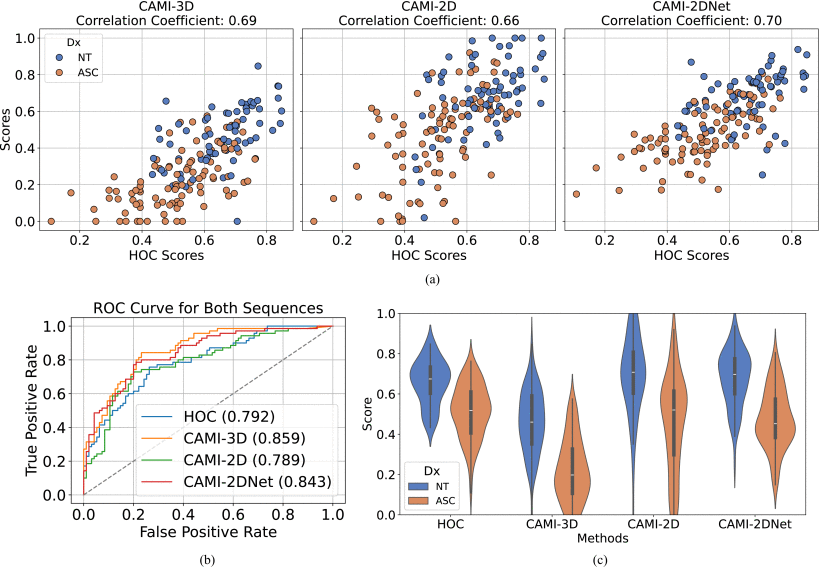
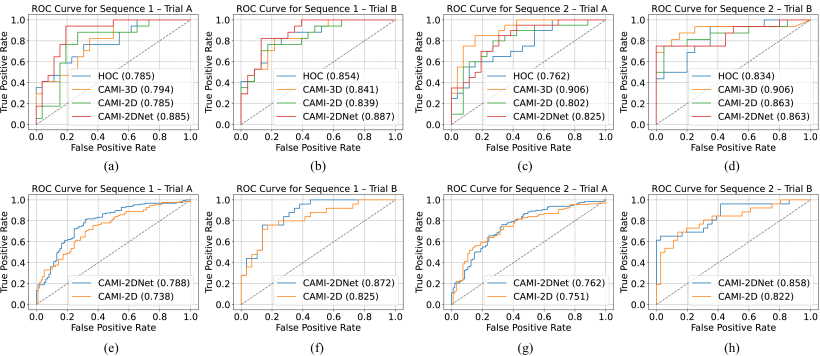
The system performed well across several key measures. Its scores closely matched those from human experts, showing a strong level of agreement.
In tests designed to distinguish between children with autism and neurotypical children, the system also showed high accuracy. Its performance was similar to more complex motion-capture systems and, in some cases, even stronger.
The results suggest that CAMI-2DNet can provide reliable and consistent measurements without the need for specialized equipment or manual scoring.
One of the most important advantages of this system is accessibility. Because it uses standard video, it can be applied in a wide range of settings. This opens the door to more frequent and widespread assessments.
It also reduces reliance on subjective judgment. By providing an objective score, the system helps clinicians make more informed decisions.
CAMI-2DNet is not meant to replace human expertise. Instead, it serves as a complementary tool. It adds a layer of precision that can support existing evaluation methods.
Despite its promise, the system still faces challenges. Real-world environments can vary widely, and factors like lighting, background, and camera quality may affect performance.
Researchers are working to improve the model’s ability to handle these variations. They also plan to expand the dataset to include more diverse populations, which can help improve fairness and accuracy.
Another important step involves making the system easier to use in everyday settings. Reducing the need for computing power and simplifying the interface could help bring the technology to more clinics and families.
The development of CAMI-2DNet reflects a broader shift in how scientists study behavior. By combining artificial intelligence with accessible tools, researchers can gather more data and uncover patterns that were previously difficult to measure.
This approach may lead to earlier detection of developmental differences. It could also help track changes over time, offering insight into how children respond to interventions.
The introduction of CAMI-2DNet has the potential to reshape how motor imitation is measured in clinical and research settings. By making assessments more accessible, the system could allow more children to be evaluated without the need for specialized equipment.
Clinicians may use the tool to complement traditional evaluations, adding objective data to support their observations. This can improve diagnostic accuracy and help tailor interventions to each child’s needs.
For researchers, the system provides a scalable way to study motor behavior across large populations. This could lead to new insights into autism and other developmental conditions.
Families may also benefit. With the ability to use standard video, assessments could take place in more familiar environments. This may reduce stress for children and make the process more convenient.
Overall, the technology moves the field toward more personalized and data-driven care. It offers a way to better understand individual differences and respond with targeted support.
Research findings are available online in the journal IEEE Transactions on Biomedical Engineering.
The original story “Researchers develop new video-based AI tool for autism assessment” is published in The Brighter Side of News.
Like these kind of feel good stories? Get The Brighter Side of News’ newsletter.
The post Researchers develop new video-based AI tool for autism assessment appeared first on The Brighter Side of News.


Leave a comment
You must be logged in to post a comment.