A crowded bacterial community can release cells through narrow outward-flowing channels without dissolving its entire protective structure. The force comes from a water-absorbing polymer made by the bacteria themselves.
That mechanism emerged as scientists watched Bacillus subtilis biofilms containing more than a million cells. Instead of seeing the whole community gradually disintegrate, they observed selected interior cells pushing through surrounding layers and escaping.
The findings, published in Nature Microbiology, come from the University of California San Diego and Universitat Pompeu Fabra in Barcelona. They reveal another way biofilms disperse and suggest that manipulating their physical structure could offer new approaches to controlling them.
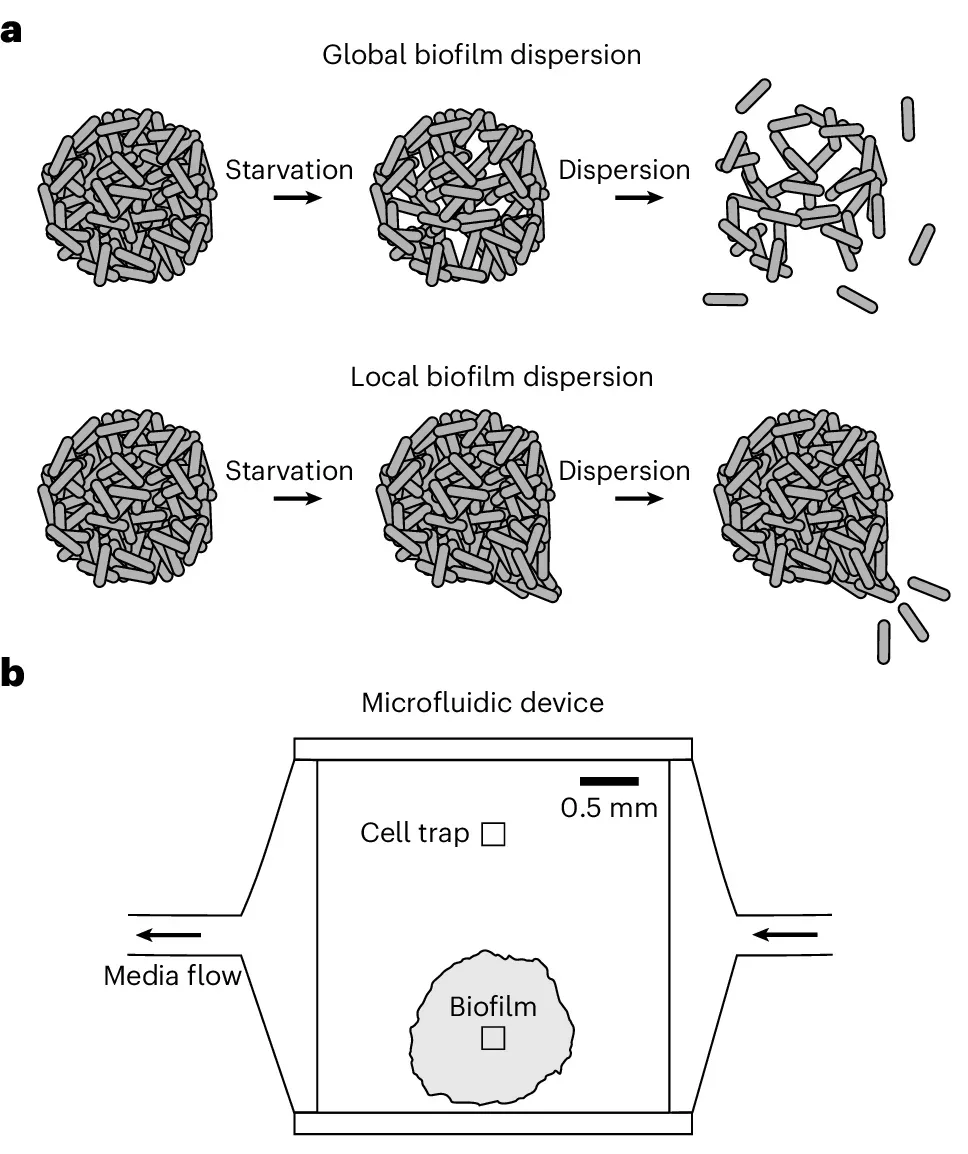
Biofilms are communities of bacteria embedded in a self-produced extracellular matrix. That surrounding network holds cells together and helps anchor them to surfaces. It can also protect bacteria against environmental threats and antimicrobial treatment.
Understanding how cells leave these communities matters because dispersal allows bacteria to move beyond an established biofilm. Much previous work has focused on enzymes that degrade the matrix. The new study examined whether the spatial arrangement of different cell types could produce more localized departures.
The team included graduate researchers Todd Kwang-Tao Chou and Alejandra Dau-Martinez in Gürol Süel’s laboratory at UC San Diego. Collaborators Júlia Vicens-Figueres and Jordi Garcia-Ojalvo at Universitat Pompeu Fabra contributed mathematical modeling.
Their microfluidic chambers allowed nutrient solutions to flow past growing biofilms while microscopes recorded their behavior. The chambers measured three millimeters across but only six micrometers high. That shallow geometry restricted vertical growth and created an effectively two-dimensional experimental system.
The researchers grew biofilms for approximately 30 hours, then removed carbon and nitrogen sources for 16 hours. When nutrients returned, cells began leaving from particular interior regions. Streams flowed toward the edge while much of the surrounding community remained connected.
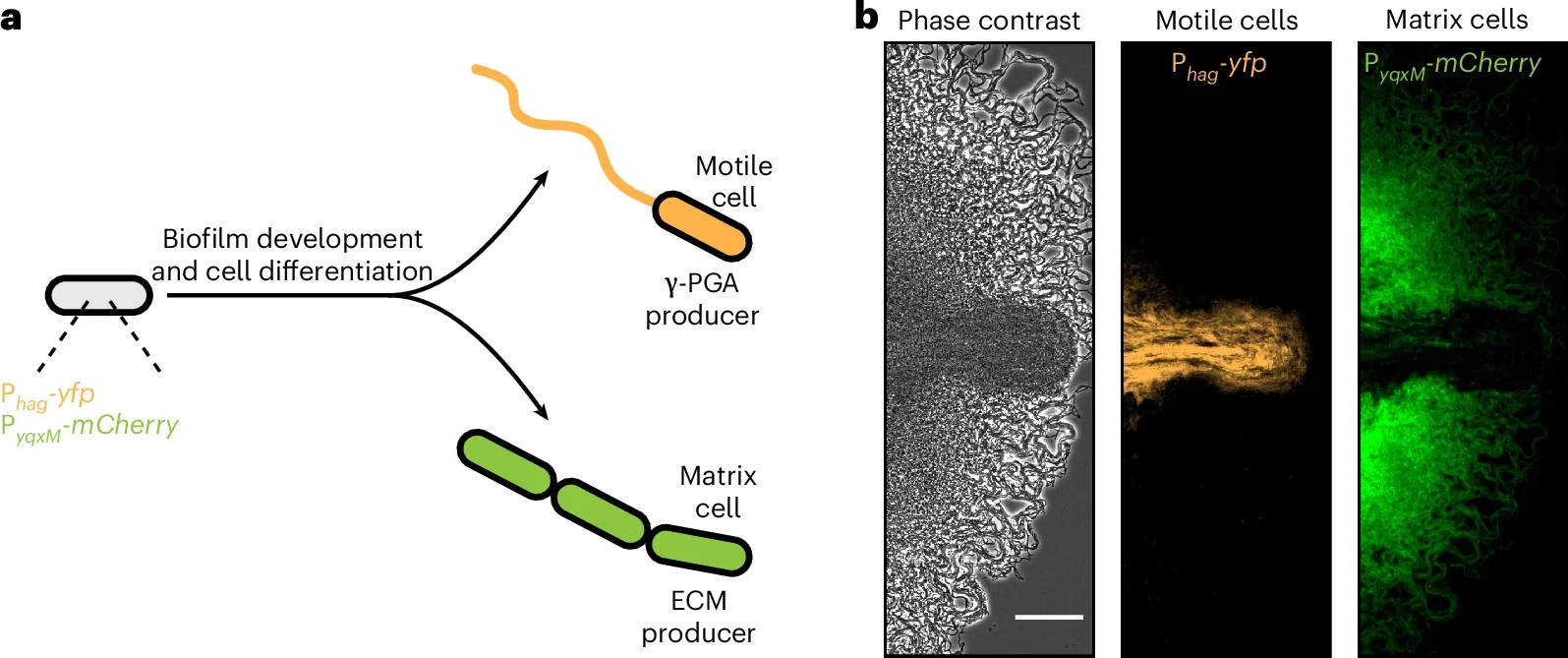
Fluorescent reporters helped identify the cells involved in those streams. The escaping regions consisted mainly of cells in a motile state, rather than cells producing the main structural matrix. That initially raised an obvious explanation: perhaps the bacteria were swimming out.
The team tested that possibility by deleting hag, a gene needed to build the flagella used for swimming. The altered cells still occupied the broader motile state, but lacked those swimming structures. Their biofilms nevertheless showed the same localized dispersal.
Being prepared for motility was therefore associated with escape, but active swimming was not required to leave the community. The distinction pointed toward another product associated with that cell state.
That product was poly-gamma-glutamic acid, abbreviated γ-PGA. It forms a hydrogel that absorbs water and swells. Within a crowded biofilm, its expansion can generate pressure that pushes neighboring cells apart.
“We found that at the end of their life cycles these bacterial biofilms forcefully ejected specific cells from the community,” said Süel, a professor of molecular biology.
To determine whether γ-PGA was necessary, the researchers deleted the genes responsible for making it. Those bacteria still formed full-size biofilms. However, they no longer displayed the localized dispersal seen in the unmodified strain.
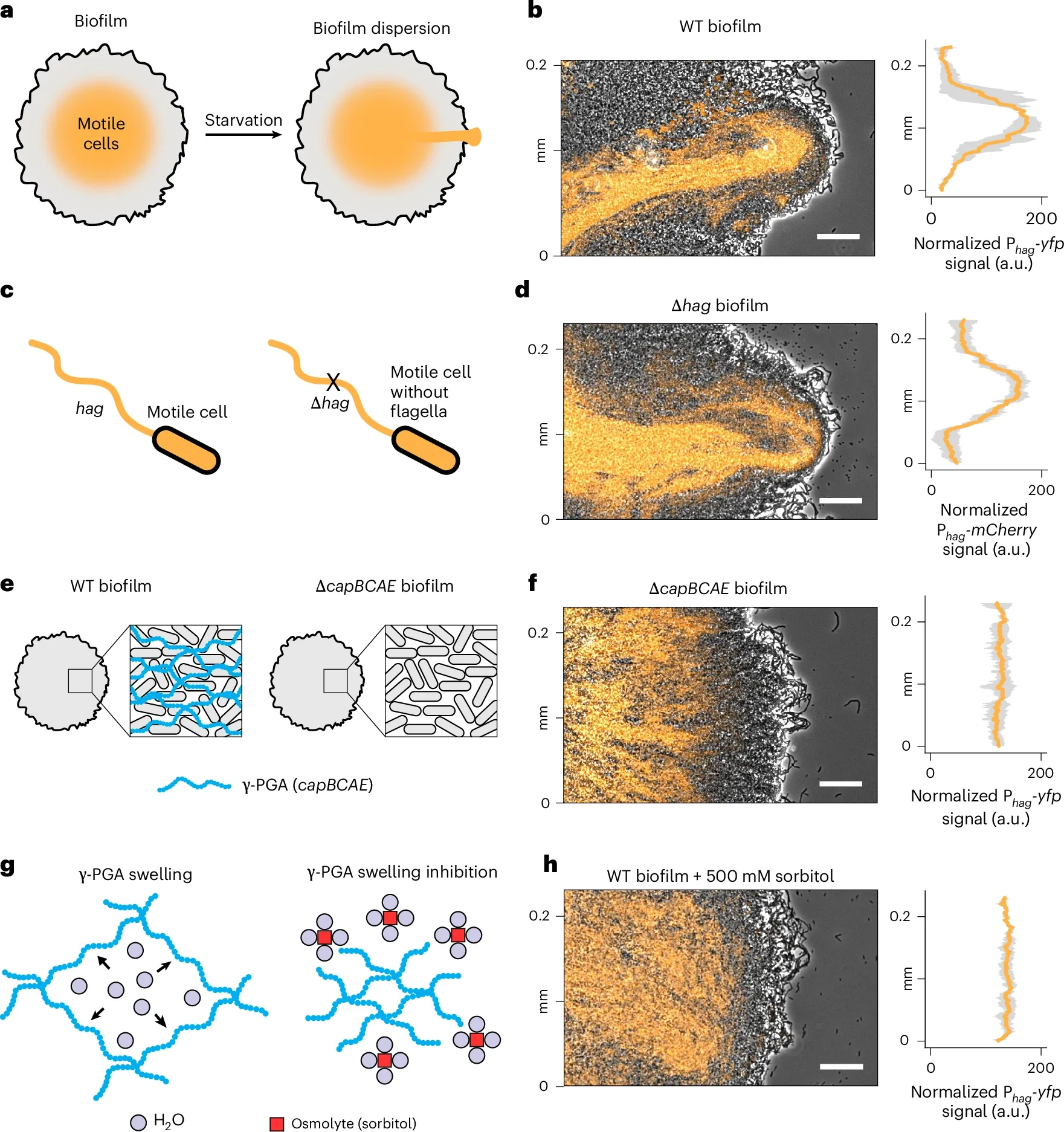
The result separated the polymer’s role in escape from the colony’s ability to build a biofilm. Fluorescent measurements also showed that the regions releasing cells expressed genes involved in γ-PGA production.
Another test targeted swelling itself. Adding sorbitol, which competes for water, inhibited dispersal. That supported the explanation that water entering the hydrogel creates the mechanical force, rather than the polymer merely marking cells already destined to leave.
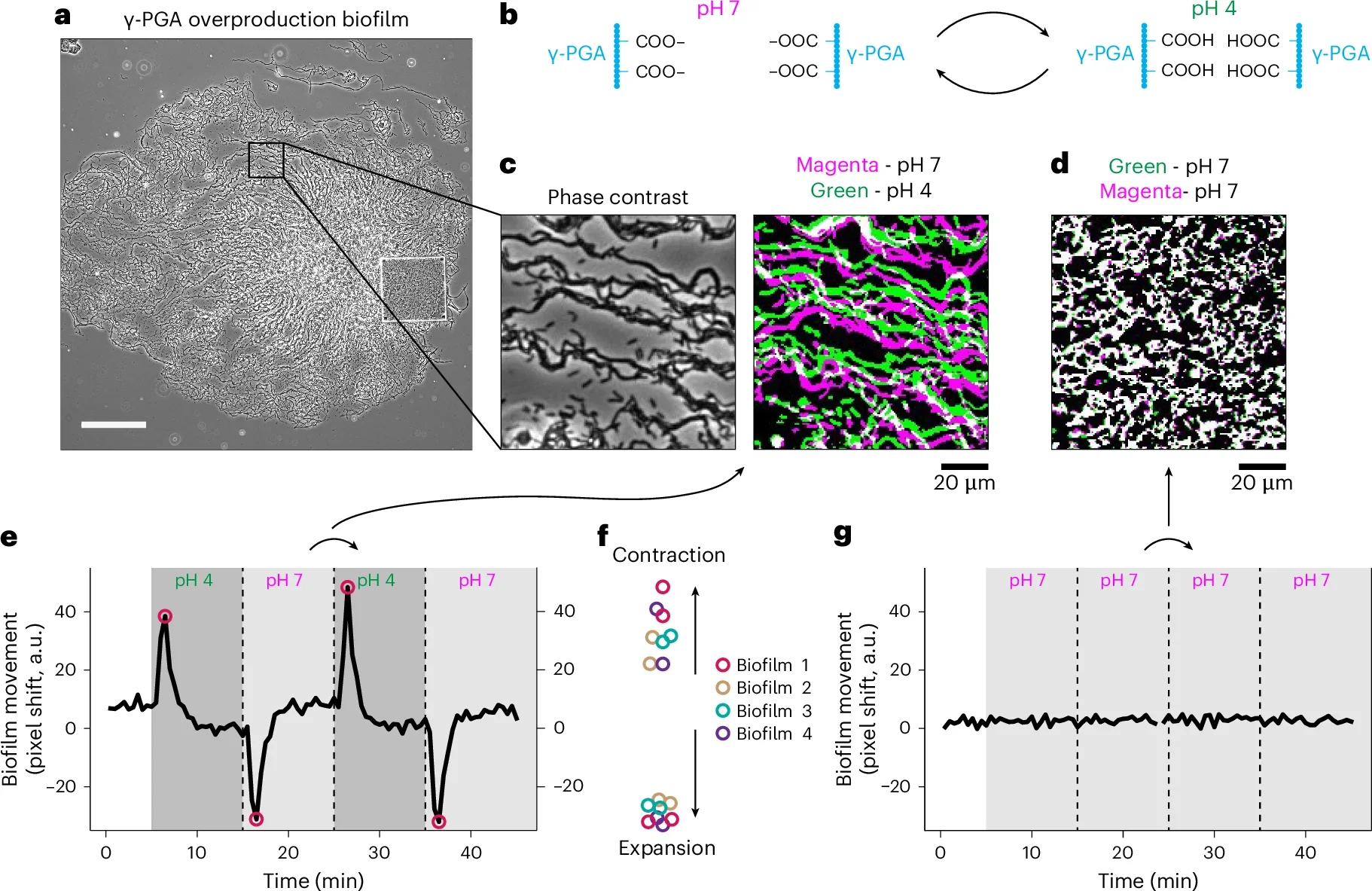
The team then engineered bacteria to produce almost four times the usual amount of γ-PGA. Their biofilms developed conspicuous gaps between cells. To investigate the polymer’s physical behavior, the scientists alternated the surrounding solution between pH 7 and pH 4.
At neutral pH, negatively charged groups on the polymer repel one another, encouraging expansion. Under acidic conditions, reduced charge allows tighter packing. The changing distances between cells followed those shifts, reinforcing the hydrogel explanation.
Together, the genetic, chemical and imaging experiments linked polymer production, water uptake and cell displacement. They identified a mechanical route for release that does not require broad degradation of the community’s supporting matrix.
The mathematical model represented motile cells, matrix-associated cells, γ-PGA and nutrients. It reproduced localized outward movement and predicted what could happen if polymer production became excessive. Instead of a narrow escape stream, the community could lose integrity more broadly.
The researchers tested that prediction without the starvation period used in their original observations. Both normal and engineered biofilms received additional glutamate, providing material for polymer production. Extra glutamate alone did not trigger breakup in the normal strain.
The overproducing strain behaved differently. Clusters separated from the main biofilm as it continued growing, and flowing medium eventually washed them from the chamber. An image analyzed at 31 hours contained 13 disconnected clusters.
Normal biofilms under the comparison conditions remained connected. The difference showed that enhanced polymer production could convert localized release into widespread structural disruption. It did not establish that the released bacteria had been killed.
That distinction is central to possible applications. Breaking apart a protective community could potentially make bacteria easier to reach with other treatments. Whether this approach improves infection outcomes would require separate experiments.
The mechanism has a striking parallel in cnidarians, including jellyfish and hydra. These animals use γ-PGA-associated osmotic forces in structures that discharge stinging threads. Bacteria employ the polymer outside their cells, across a community, rather than within a specialized cellular capsule.
The comparison concerns a shared material and physical principle. It does not mean bacteria possess jellyfish-like stinging machinery. Nor does localized release prove that a biofilm anticipates death or consciously organizes a rescue.
Selective dispersal could allow some bacteria to seek better conditions while preserving much of the original community. The study identifies the release mechanism; successful colonization elsewhere remains a potential consequence.
Medical translation also requires evidence beyond this model species and shallow chamber. Researchers must establish where comparable mechanisms occur, how to manipulate them in established biofilms and what happens to dispersed cells. The proposed connection to tumor-cell release is likewise a research possibility, not a demonstrated cancer mechanism.
For now, the study reveals how a bacterial polymer can both release selected cells and destabilize their collective shelter. Controlling that balance offers a concrete physical target for further biofilm research.
These resources explain how biofilms protect bacteria, how cells leave them and why dispersal presents both opportunities and challenges.
Biofilm dispersion: Reviews the signals and mechanisms that release bacteria from biofilms and considers their relevance to treatment. (Nature Reviews Microbiology, 2020)
Density and temperature controlled fluid extraction in a bacterial biofilm is determined by poly-γ-glutamic acid production: Investigates how γ-PGA influences water uptake and physical behavior in bacterial communities. (npj Biofilms and Microbiomes, 2022)
Mechanisms of antimicrobial resistance in biofilms: Explains the multiple processes that help biofilm-associated bacteria withstand antimicrobial treatment. (npj Antimicrobials and Resistance, 2024)
Biofilm dispersion: The key to biofilm eradication or opening Pandora’s box?: Examines the promise of inducing dispersal and the need to consider the fate of released bacteria. (Biofilm, 2020)
Biofilms: an emergent form of bacterial life: Describes how the extracellular matrix supports cooperation, resource capture and survival within biofilms. (Nature Reviews Microbiology, 2016)
Research findings are available online in the journal Nature Microbiology.
The original story “Scientists discover bacteria that sacrifice their own cells for survival” is published in The Brighter Side of News.
Like these kind of feel good stories? Get The Brighter Side of News’ newsletter.
The post Scientists discover bacteria that sacrifice their own cells for survival appeared first on The Brighter Side of News.


Leave a comment
You must be logged in to post a comment.