The Moon has been circling Earth for billions of years, but its orbit could also be functioning as something unexpected: an enormous detector for ripples traveling through spacetime.
Gravitational waves constantly passing through the solar system should produce extraordinarily small changes in the Moon’s orbit. Those movements are far too subtle to notice directly, but decades of precision laser measurements may make them detectable.
Physicists Diego Blas of the Universitat Autònoma de Barcelona and Institut de Física d’Altes Energies, and Alexander C. Jenkins of University College London, proposed using the Earth-Moon system and other astronomical binaries to search for gravitational waves in a largely unexplored part of the spectrum.
Their work, published in Physical Review Letters, targets frequencies between roughly 10^-7 and 10^-4 hertz. This microhertz region sits between frequency bands accessible to pulsar timing arrays and future space-based instruments such as the Laser Interferometer Space Antenna, or LISA.
Rather than constructing another detector, the researchers propose turning systems already moving through space into natural gravitational-wave observatories.
Gravitational waves are distortions in spacetime produced when massive objects accelerate. Albert Einstein predicted them through general relativity, and their first direct detection in 2015 opened an entirely new way of studying the universe.
Different gravitational-wave detectors respond to different frequencies, much as different radio receivers tune into different parts of the electromagnetic spectrum.
Ground-based observatories such as LIGO and Virgo are sensitive to relatively high frequencies produced by events including mergers of stellar-mass black holes. Pulsar timing arrays probe much lower frequencies by looking for changes in the arrival times of radio pulses from extraordinarily stable rotating neutron stars.
LISA will occupy another part of the spectrum from space.
Yet gaps remain. One lies around the microhertz region, where conventional detectors face a fundamental size problem. Detecting such long-period waves with a purpose-built interferometer would require enormous distances between its components.
Blas and Jenkins realized nature has already constructed systems on the required scale.
When a gravitational wave passes through a binary system, it slightly perturbs the distance and motion between the two objects. For Earth and the Moon, those disturbances would appear as tiny changes in orbital parameters.
Normally, the effect would be almost impossibly small. Lunar laser ranging provides an unusual advantage.
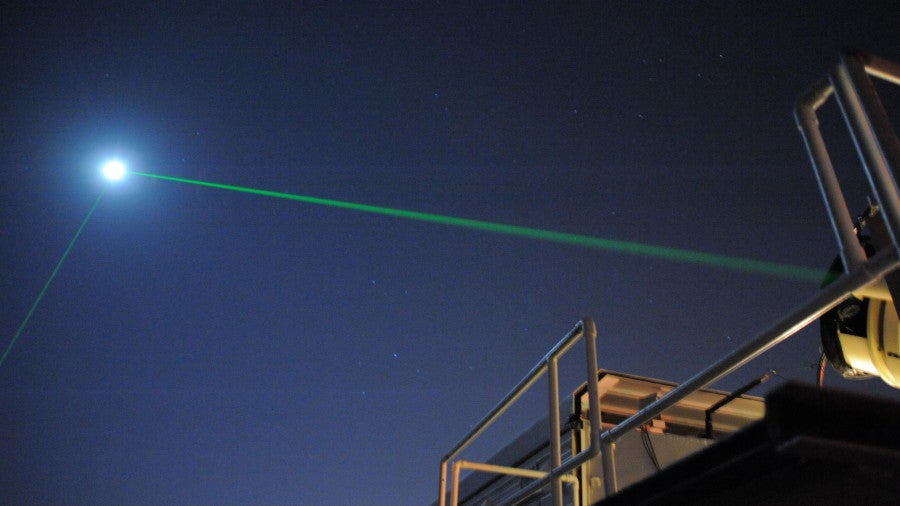
Reflectors placed on the Moon beginning with the Apollo missions allow observatories on Earth to fire laser pulses toward the lunar surface and measure their return. The travel time reveals the Earth-Moon distance with remarkable precision.
Individual lunar laser-ranging measurements can reach millimeter-scale precision. Researchers have also accumulated decades of observations, creating a long record of the Moon’s motion.
The Moon takes about 27 days to complete an orbit. That timescale makes the system particularly sensitive to gravitational waves at certain microhertz frequencies.
The response becomes especially powerful at resonances. If a gravitational-wave frequency corresponds to an integer multiple of the orbital frequency, its effects can accumulate rather than averaging away.
Instead of detecting a passing wave as a brief distortion, researchers would search for statistical changes slowly written into the Moon’s orbital motion.
The calculations focus largely on a stochastic gravitational-wave background, or SGWB. Rather than one individually detectable event, such a background would consist of countless unresolved gravitational waves arriving from different directions and sources.
Blas and Jenkins modeled how that background would alter all six parameters describing a binary orbit.
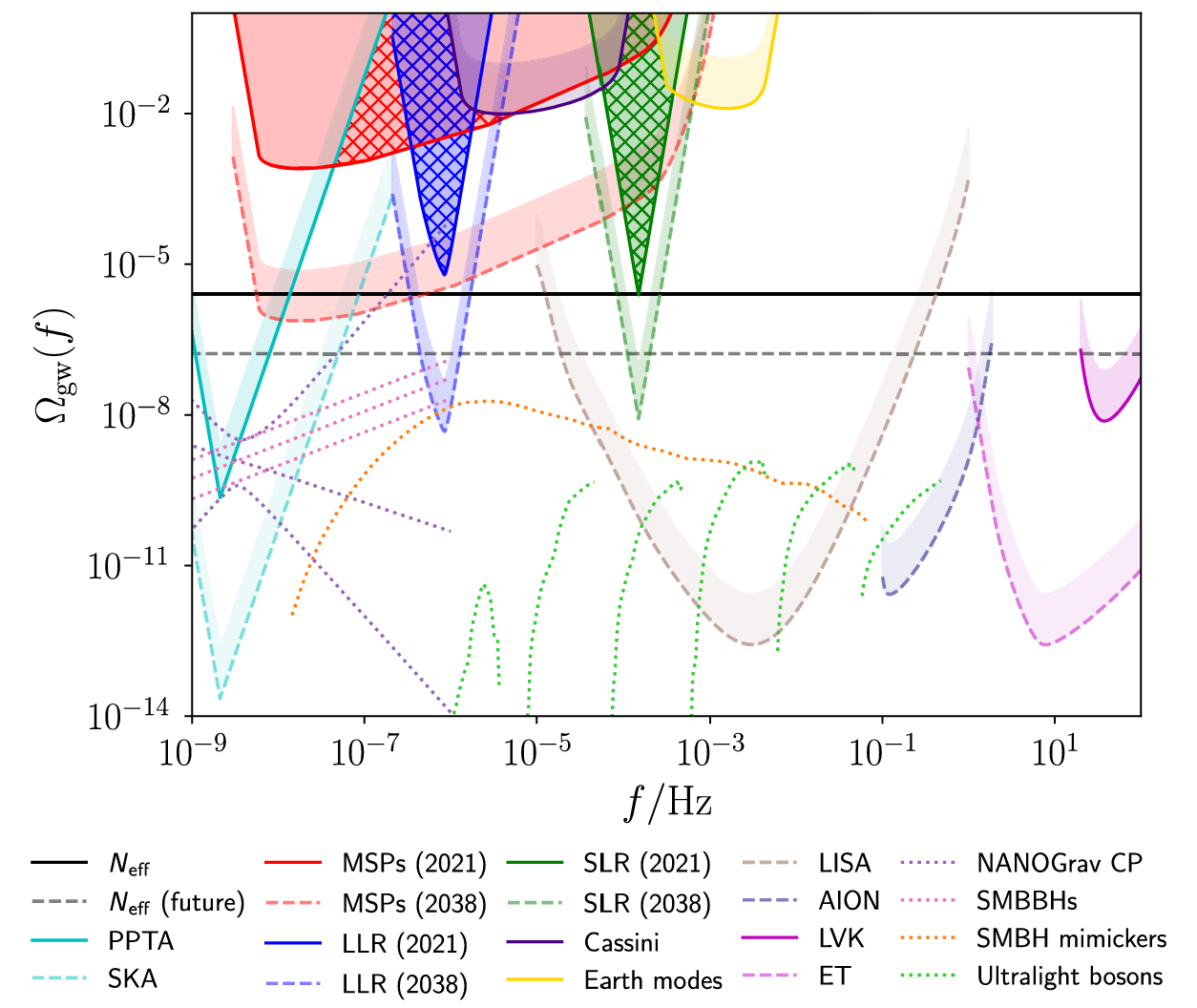
For lunar laser ranging, their forecasts found particularly strong sensitivity around 0.85 microhertz, corresponding to an important harmonic of the Moon’s orbit. Using data available around the time of the study, they estimated sensitivity to a gravitational-wave background intensity of about 6.2 × 10^-6 at that frequency.
Improved measurements over the following years could dramatically strengthen the constraint. Their forecast for 2038 reached about 4.8 × 10^-9.
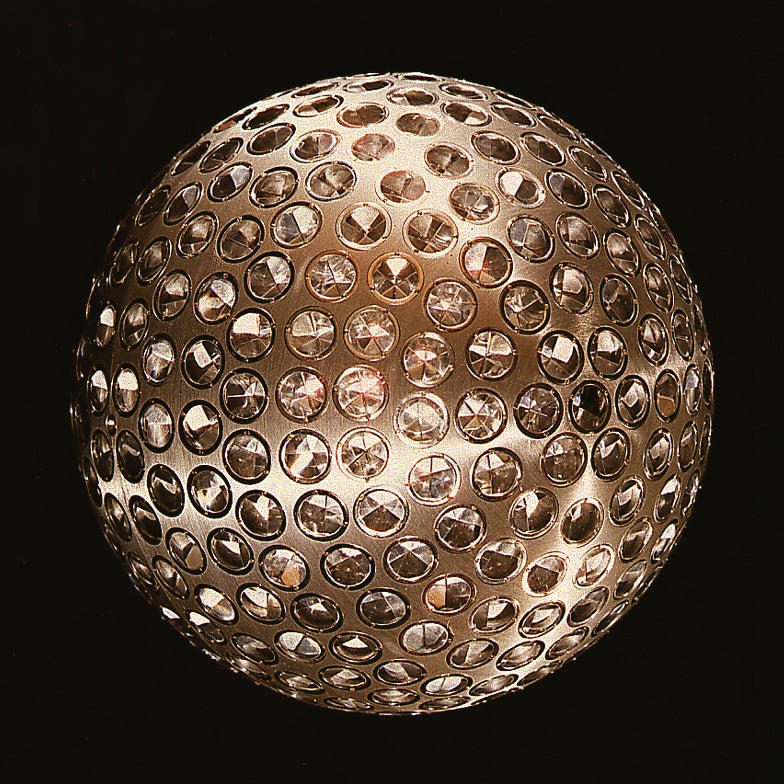
Artificial satellites offer another possibility. Laser ranging of LAGEOS-1, a satellite whose orbit has been monitored for decades, could probe higher frequencies around 0.15 millihertz.
The researchers estimated that existing satellite-ranging data could reach about 2.4 × 10^-6 in gravitational-wave background intensity at that frequency, potentially improving to roughly 8.3 × 10^-9 by 2038.
The same principle is not limited to objects orbiting Earth.
Binary pulsars contain at least one rapidly rotating neutron star whose radio pulses can be timed with extraordinary accuracy. Because astronomers can reconstruct their orbits so precisely, these systems can act as distant gravitational-wave sensors.
Their great advantage is variety. Different binary pulsars have different orbital periods and eccentricities, giving them access to different gravitational-wave frequencies and harmonics.
The researchers combined forecasts from 215 binary systems and found potential sensitivity spanning nearly five decades, from around 6 nanohertz to approximately 0.2 millihertz.
Lunar and satellite laser ranging can achieve higher sensitivity at particular frequencies, while the pulsar systems offer much broader coverage.
Together, these systems could begin filling an observational gap between pulsar timing arrays and LISA without launching a dedicated microhertz gravitational-wave observatory.
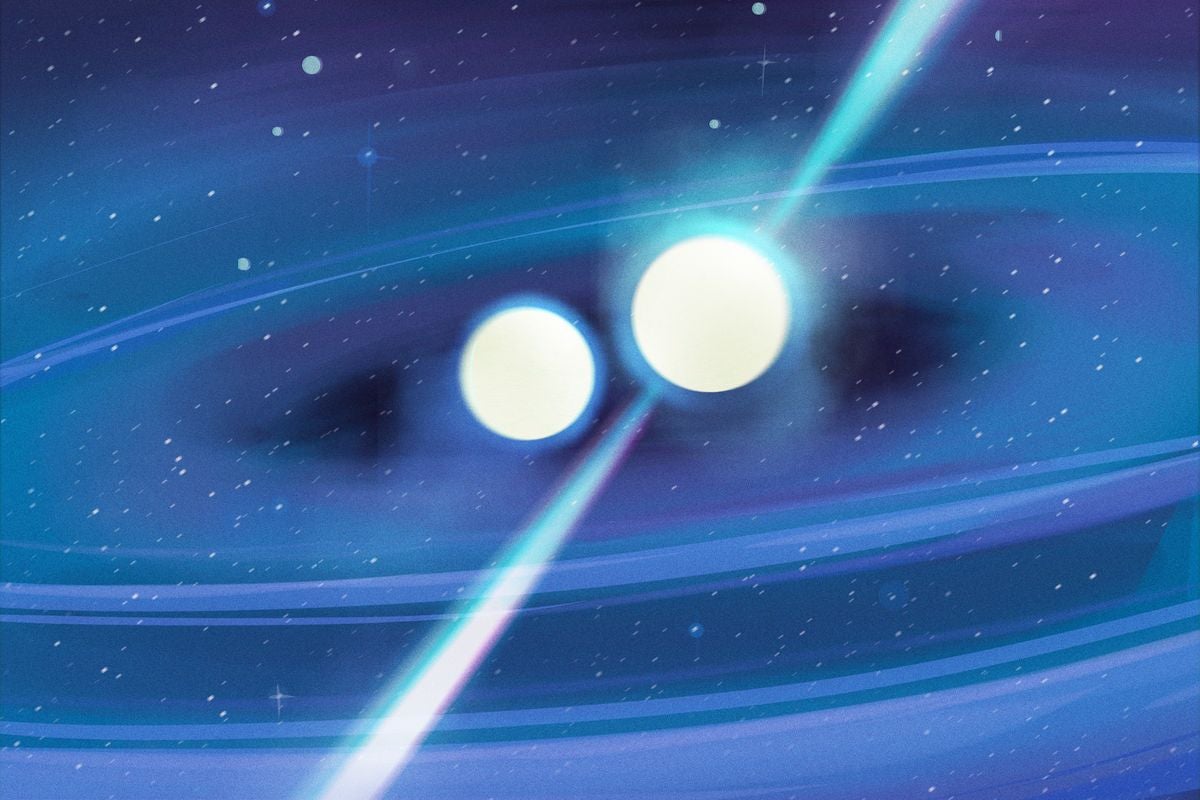
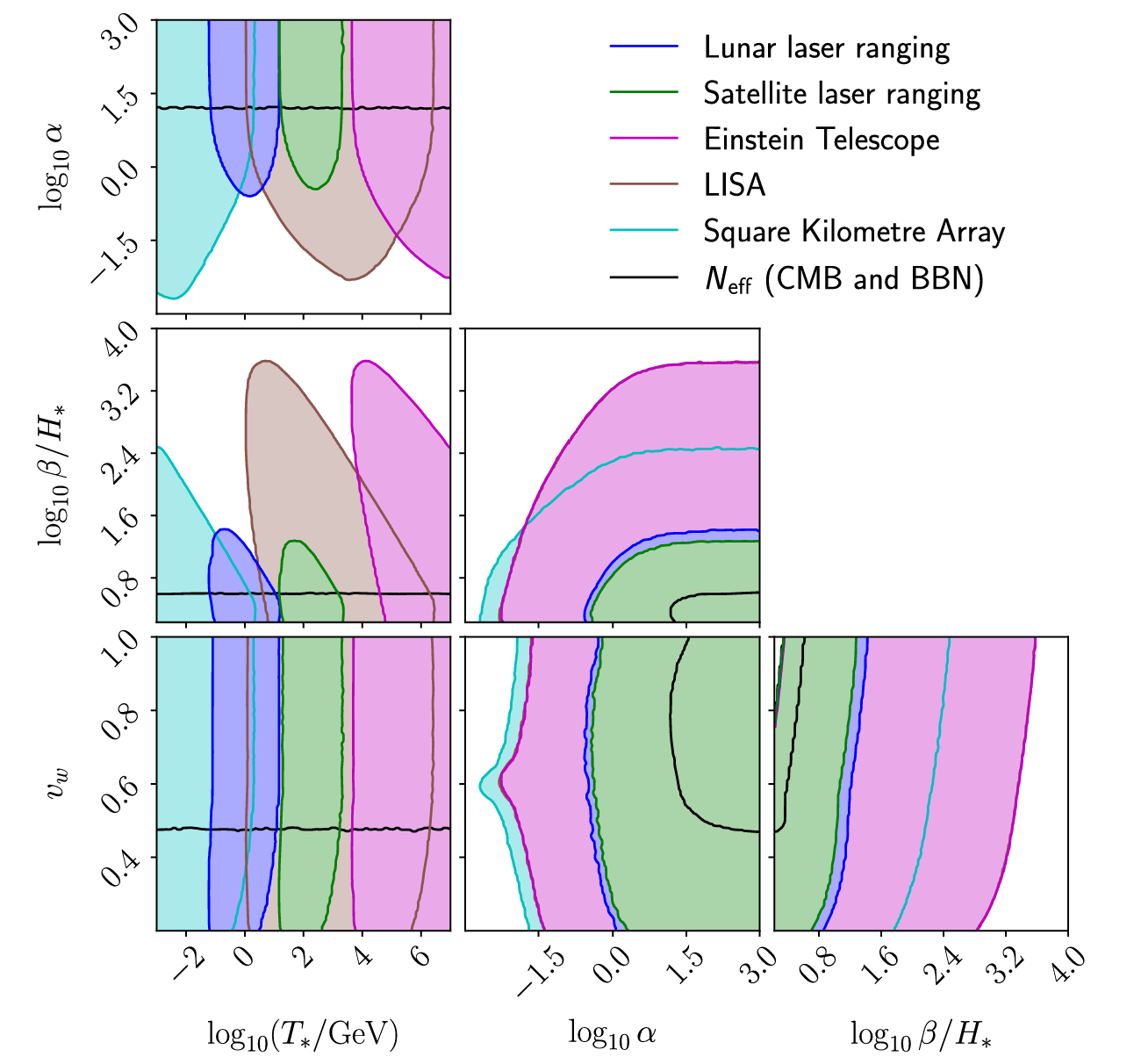
One particularly intriguing target is a gravitational-wave background produced by first-order phase transitions during the universe’s early history.
Such transitions appear in many theories extending particle physics beyond the Standard Model. Instead of matter changing smoothly from one state to another, bubbles of a new phase could have formed, expanded and collided throughout the young universe.
Those violent transitions could have generated gravitational waves that remain detectable today.
Some predicted signals peak specifically within the microhertz region. The researchers found that lunar laser ranging could probe portions of first-order phase-transition parameter space that would remain inaccessible to other planned gravitational-wave experiments.
The method therefore would not replace LISA, pulsar timing arrays or ground-based interferometers. It would fill part of the frequency spectrum between them.
That broader coverage matters because different frequencies preserve information about different physical processes and different eras of cosmic history.
The remarkable part is that much of the required hardware already exists. Mirrors sitting on the Moon, artificial satellites orbiting Earth and pulsars scattered across the Milky Way could together become pieces of a gravitational-wave observatory vastly larger than anything humans could currently build.
These resources explore the physics behind binary gravitational-wave resonances, lunar ranging, pulsar timing and possible signals from the early universe.
Detecting stochastic gravitational waves with binary resonance: Develops the mathematical framework for predicting how a stochastic gravitational-wave background changes all six orbital elements of a binary system, providing the theoretical foundation for using natural binaries as detectors. (Physical Review D, 2022)
Lunar laser ranging: a continuing legacy of the apollo program: Reviews the extraordinarily precise Earth-Moon distance measurements made possible by lunar retroreflectors and their applications to gravity and lunar dynamics. (Science, 1994)
The Laser Interferometer Space Antenna: Unveiling the Millihertz Gravitational Wave Sky: Describes the science case for LISA and the millihertz gravitational-wave sources it is designed to observe, helping define the frequency gap targeted by binary-resonance methods. (Bulletin of the American Astronomical Society, 2019)
Gravitational wave research using pulsar timing arrays: Reviews how precisely timed pulsars can detect extremely low-frequency gravitational waves and explains their role in extending gravitational-wave astronomy beyond conventional interferometers. (National Science Review, 2017)
Gravitational waves from a first-order electroweak phase transition: a brief review: Explains how first-order phase transitions in the early universe could generate stochastic gravitational waves and why those signals could reveal particle physics inaccessible to conventional experiments. (Philosophical Transactions of the Royal Society A, 2018)
Research findings are available online in the journal Physical Review Letters.
The original story “Scientists find a new way to search for gravitational waves using the Moon” is published in The Brighter Side of News.
Like these kind of feel good stories? Get The Brighter Side of News’ newsletter.
The post Scientists find a new way to search for gravitational waves using the Moon appeared first on The Brighter Side of News.


Leave a comment
You must be logged in to post a comment.