One of biology’s most powerful genetic tools may have descended from a weapon viruses once used against one another.
Researchers from Jennifer Doudna’s laboratory at the Innovative Genomics Institute have discovered an ancient RNA-guided system called VIPR that can recognize specific DNA sequences through a coding strategy unlike anything previously known. Evidence suggests the system predates major components of CRISPR-Cas immunity and was primarily used by bacteriophages, viruses that infect bacteria.
The findings, reported in two connected papers in Science, offer a new explanation for an important step in CRISPR’s evolutionary history. Instead of inventing the core targeting machinery themselves, ancient bacteria may have acquired a viral system already being used in conflicts between competing viruses and adapted it into an immune defense.
VIPR, short for Viral Interference Programmable Repeat, also has properties that could make it useful beyond evolutionary biology. It is extremely small, readily programmable, and can recognize DNA without requiring the short neighboring sequence that restricts where widely used CRISPR-Cas enzymes can operate.

CRISPR systems allow bacteria and archaea to remember genetic material from invading viruses and use RNA guides to recognize related invaders later. Class 1 CRISPR systems perform that recognition using groups of proteins known as RAMPs, or repeat-associated mysterious proteins.
Where those ancient proteins originally came from has remained uncertain.
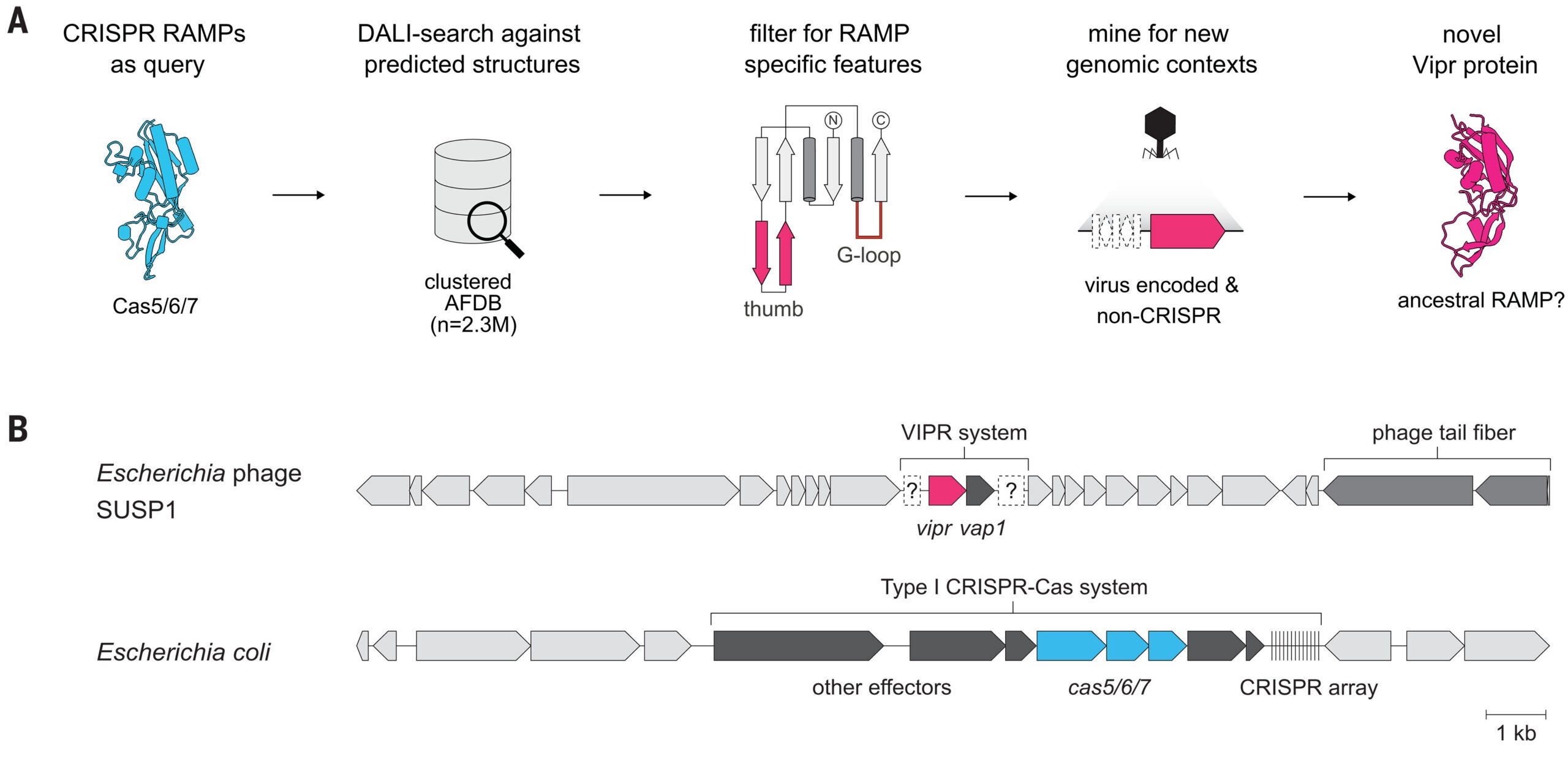
Conventional searches were poorly suited to solving the mystery because related RAMP proteins can differ dramatically in their amino acid sequences. The researchers instead searched for similarities in three-dimensional protein structure, reasoning that evolutionary relationships might remain visible in shape even after their sequences became difficult to recognize.
Using AlphaFold-derived structural information and other computational tools, the team uncovered a previously unknown family of RAMP-like proteins. Thousands of examples appeared in genomic databases, with most associated with viruses or viral sequences rather than ordinary bacterial chromosomes.
That distribution supplied an important evolutionary clue. VIPR proteins are also simpler than modern CRISPR RAMPs and form a distinct early-branching lineage, supporting the proposal that they resemble an ancestral form from which later CRISPR machinery emerged.
The biggest surprise came from the RNA associated with VIPR.

CRISPR guide RNAs normally recognize targets through continuous complementary sequences. Bases in the RNA pair consecutively with matching bases in the target DNA, creating the molecular recognition that directs a CRISPR complex to a particular location.
VIPR breaks that rule.
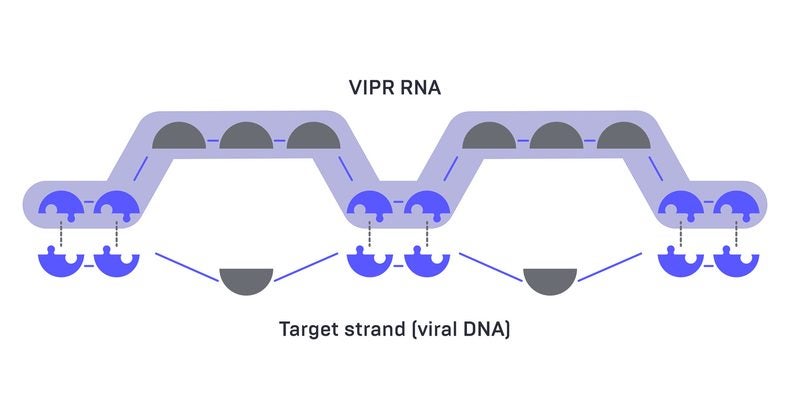
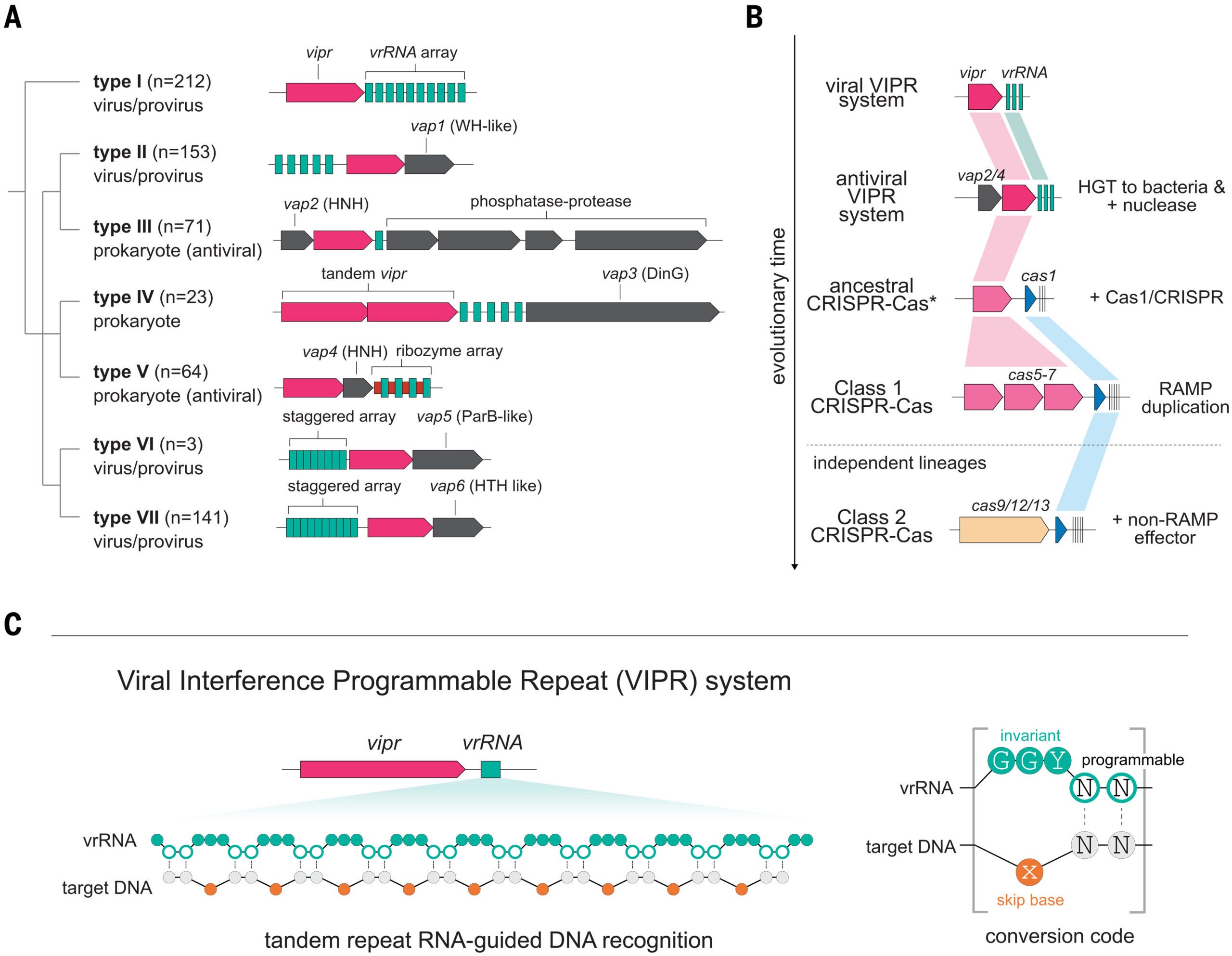
Its guide molecules contain repeating units with conserved bases alternating with highly variable pairs of nucleotides. Those variable pairs provide the targeting information, while portions between them are effectively skipped when the system recognizes DNA.
The resulting pattern follows what the researchers call a one-nucleotide skip rule. Instead of reading a continuous DNA sequence, VIPR samples matching bases at regularly separated positions.
Experiments confirmed that this unusual arrangement was not simply a computational coincidence. VIPR complexes preferentially bound DNA designed according to the skip rule, and changing the variable parts of the RNA redirected the system toward new DNA sequences.
“There’s no system that wraps around DNA like this,” first author Peter Yoon said. “We suspect that this unusual geometry should allow for different kinds of applications people couldn’t do before.”
Understanding the targeting code also allowed the researchers to ask what VIPR does in nature.
The answer points toward an ancient arms race among viruses.
Many VIPR guide RNAs matched sequences belonging to other bacteriophages or related mobile genetic elements. In one group, 18 of 20 predicted targets converged on a satellite phage that appears to parasitize the virus carrying the VIPR system.
Researchers then recreated this type of conflict experimentally. When programmed against an essential regulatory gene in a bacteriophage, VIPR reduced the virus’s ability to form plaques by about five orders of magnitude and protected bacterial cultures from infection.
The system could also manipulate viruses already integrated into bacterial genomes. Targeting a regulatory gene controlling dormancy caused a resident prophage to switch into its destructive lytic state.
VIPR therefore appears capable of functioning as both an offensive and defensive tool in viral competition. That behavior may explain how the machinery eventually became useful to bacterial hosts.
The discovery suggests an intriguing evolutionary sequence.
An ancestral VIPR-like system may first have evolved among bacteriophages as a programmable way to suppress competing viruses. Horizontal gene transfer could then have moved the machinery into bacterial or archaeal cells.
Once inside those hosts, the same ability to recognize viral DNA could be repurposed for defense. Adding other components, including machinery capable of acquiring and storing pieces of invading genomes, may eventually have produced early CRISPR adaptive immune systems.
That model reverses the familiar direction of the biological arms race. Rather than viruses simply evolving ways to escape bacterial immunity, viruses may have supplied part of the molecular machinery from which that immunity arose.
The evolutionary history remains a proposed model rather than a complete reconstruction. Researchers still do not know exactly how VIPR acquires new guide RNAs or which ancestral VIPR lineage gave rise to modern CRISPR systems.
VIPR is also interesting because of what it does not require.
Its core system can operate with a single protein smaller than 200 amino acids and a guide RNA shorter than 100 nucleotides. That makes it dramatically more compact than many familiar CRISPR systems.
Size matters in biotechnology because delivering genetic machinery into cells can be difficult. Viral vectors commonly used for gene therapy have strict cargo limits, making smaller molecular tools attractive.
VIPR also appears to recognize sequences on either DNA strand without an obvious equivalent of the protospacer-adjacent motif, or PAM. Cas9 normally needs an appropriate PAM beside its target, restricting the genomic positions available for editing.
VIPR currently acts primarily as a programmable DNA-binding and regulatory system rather than a ready-made genome-editing replacement for Cas9. Researchers propose that engineered versions could eventually be coupled to other proteins for gene regulation, genome editing, DNA imaging, or epigenetic modification.
“This work is a great reminder of how complex biology is, and how little we still know,” Doudna said. “Fundamental concepts are still out there to be discovered. I think that’s wonderful.”
These resources provide broader context on the evolution, diversity, and biotechnology of RNA-guided genetic systems.
CRISPR provides acquired resistance against viruses in prokaryotes: This landmark experiment established that CRISPR sequences provide bacteria with adaptive resistance against invading viruses. (Science, 2007)
Origins and evolution of CRISPR-Cas systems: This review examines how mobile genetic elements, transposons, and ancient defense systems contributed to the emergence of CRISPR immunity. (Philosophical Transactions of the Royal Society B, 2019)
Evolutionary classification of CRISPR–Cas systems: a burst of class 2 and derived variants: Researchers map the evolutionary relationships among CRISPR classes, types, and their diverse effector proteins. (Nature Reviews Microbiology, 2020)
Structural biology of CRISPR–Cas immunity and genome editing enzymes: This review explains how the structures of CRISPR proteins reveal their mechanisms and evolutionary relationships with mobile genetic elements. (Nature Reviews Microbiology, 2022)
The next generation of CRISPR–Cas technologies and applications: A broad review explores how discovery of diverse natural RNA-guided systems has expanded genome editing, regulation, imaging, and diagnostics. (Nature Reviews Molecular Cell Biology, 2019)
Research findings are available online in the journal Science.
The original story “Scientists find an ancient predecessor of CRISPR hiding in viruses” is published in The Brighter Side of News.
Like these kind of feel good stories? Get The Brighter Side of News’ newsletter.
The post Scientists find an ancient predecessor of CRISPR hiding in viruses appeared first on The Brighter Side of News.


Leave a comment
You must be logged in to post a comment.