Earth’s geographic poles can appear permanent on human time scales, but the planet’s solid exterior has not always remained fixed relative to its rotation axis.
A new study suggests that the crust and mantle underwent several episodes of relatively rapid reorientation during the past 320 million years. Instead of relying mainly on magnetic signatures preserved in rocks, researchers found evidence in an unexpected archive: ancient changes in where oceans flooded the continents.
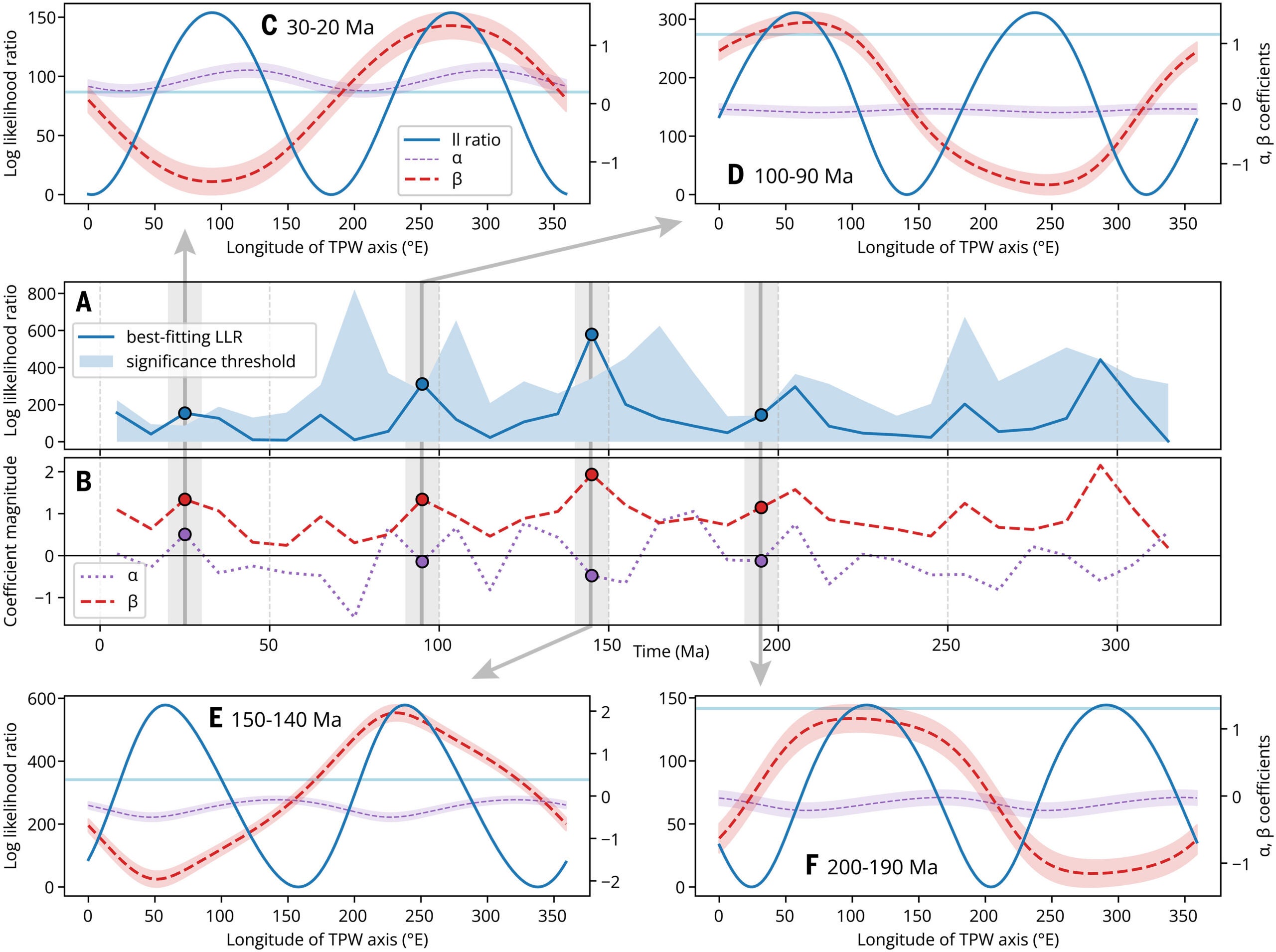
The study, led by Mathew Domeier at the University of Oslo and published in Science, identified four intervals with statistically significant signals consistent with rapid true polar wander. Evidence was strongest between roughly 150 and 140 million years ago and again between 100 and 90 million years ago.
The findings add an independent line of evidence to a long-running debate over whether Earth sometimes reorients in sudden geological bursts rather than only through slow, continuous change.
True polar wander does not mean Earth’s magnetic poles simply move, nor does it describe continents drifting independently through plate tectonics.
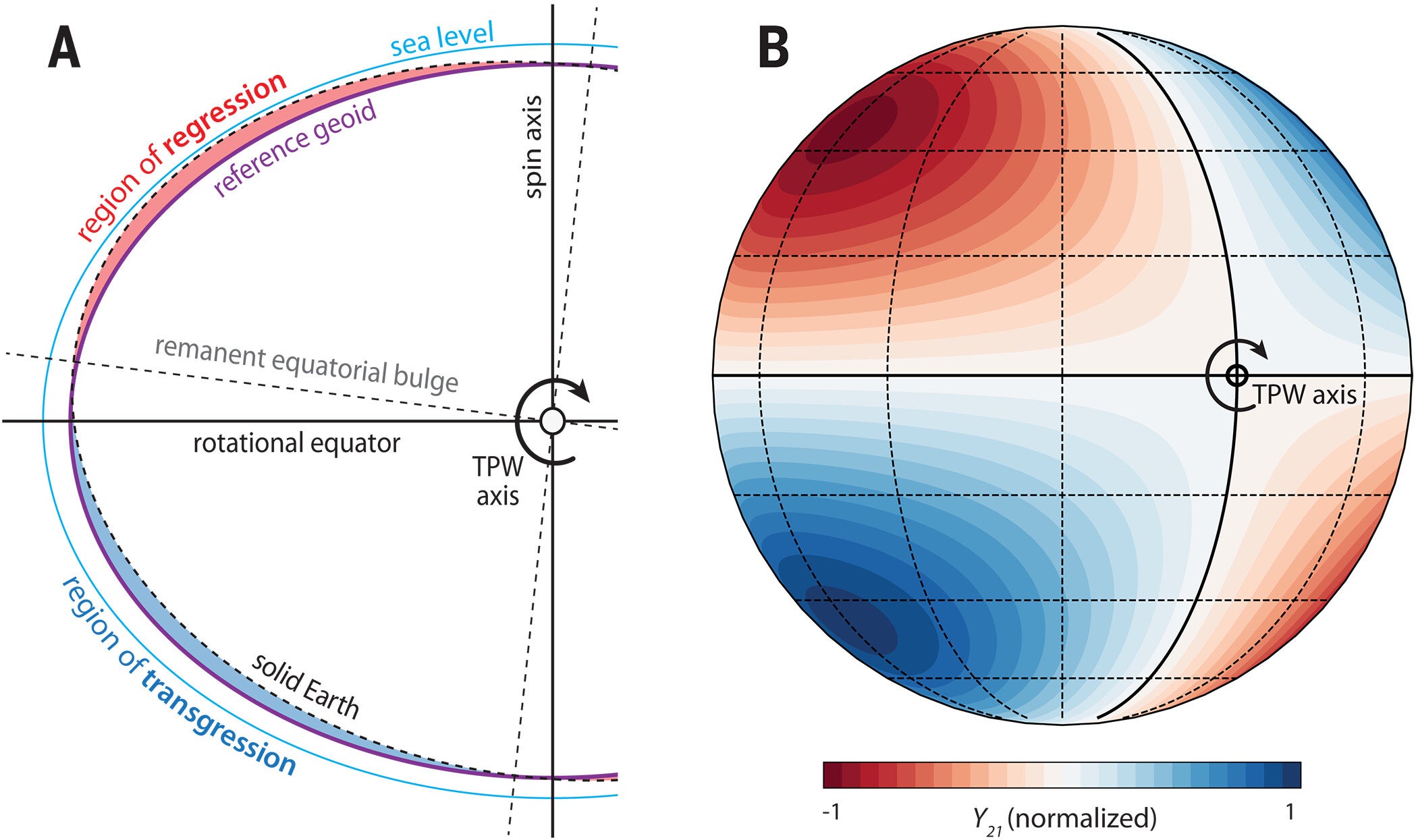
Instead, the crust and mantle rotate together relative to the planet’s spin axis. The core and broad climate belts remain tied to that rotational axis while the solid exterior shifts beneath them.
The process can occur because Earth is not a perfect sphere. Rotation creates an equatorial bulge, and the planet tends to arrange its internal mass so that its largest moment of inertia remains aligned with the spin axis.
Mantle convection, sinking tectonic slabs and other processes redistribute mass. If that distribution becomes sufficiently unbalanced, the solid Earth can reorient itself.
Detecting such movements in deep time is difficult because normal plate tectonics can create very similar signals.
Most reconstructions of true polar wander depend on paleomagnetism. Magnetic minerals can preserve the direction of Earth’s ancient magnetic field, allowing scientists to estimate where a continent once sat relative to the poles.
But interpreting those data requires separating whole-Earth reorientation from the ordinary motion of tectonic plates. Hotspot reference frames can help, but hotspots themselves move, and reliable tracks become scarce deeper in geological history.
Domeier and colleagues instead turned to sea level.
When true polar wander begins, the solid Earth moves relative to its rotational bulge. The oceans can respond almost immediately, while the mantle and lithosphere take longer to reshape themselves.
That mismatch creates a distinctive global pattern. Some continental regions experience rising relative sea level and flooding, while regions elsewhere experience falling seas and exposure.
The expected pattern has four broad lobes, with two regions gaining water and two losing it.
The team analyzed global maps recording which continental areas were submerged or exposed at 10-million-year intervals.
By comparing one map with the next, they identified locations where seas advanced across continents and places where water retreated.
They then used logistic regression to test whether those flooding patterns matched the geometry expected from true polar wander. Importantly, the method searches for the spatial pattern rather than relying on the absolute amount of sea-level change.
The technique does not directly calculate exactly how fast Earth moved. Based on earlier physical modeling, however, the patterns visible at the maps’ 10-million-year resolution would generally require true polar wander rates of at least about 0.6 degrees per million years.
The researchers therefore classified detected events as rapid on geological time scales.
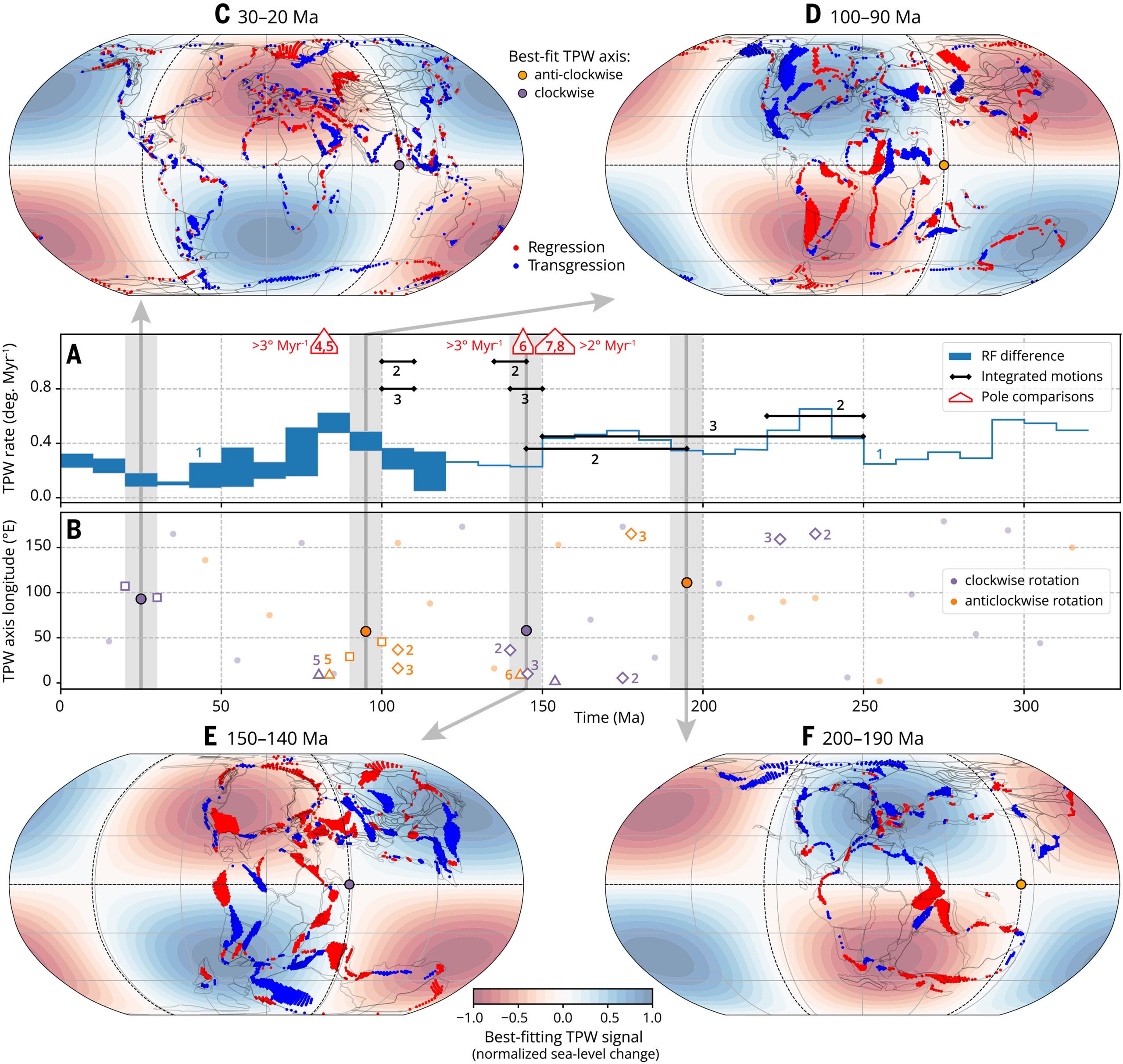
Four intervals crossed the study’s statistical threshold: 200 to 190 million years ago, 150 to 140 million years ago, 100 to 90 million years ago and 30 to 20 million years ago.
Not all four were equally convincing.
The strongest signal appeared between 150 and 140 million years ago, spanning the Late Jurassic and earliest Cretaceous. The flooding pattern showed rising seas across parts of South America, Antarctica and eastern Asia, while southwestern North America, western Europe and eastern Australia experienced retreating seas.
The researchers reconstructed a clockwise reorientation around an axis near 58 degrees east longitude.
That interval closely matches independent studies that have proposed a major Jurassic true polar wander episode from paleomagnetic measurements and plate reconstructions.
The second strong result occurred between 100 and 90 million years ago. South America, western and southern Africa and eastern Asia experienced widespread regression, while much of North America and Europe experienced transgression.
The best-fitting model indicated rotation in the opposite direction around an axis near 53 degrees east.
The Early Jurassic signal between 200 and 190 million years ago was statistically significant but only marginally so. Its fit to the observed flooding pattern was comparatively poor, leading the researchers to treat it cautiously.
A possible event between 30 and 20 million years ago was also weaker than the two major Mesozoic examples.
For most of the Cenozoic, the analysis found little evidence for rapid true polar wander detectable at this temporal resolution.
The study also found no significant signal during the late Carboniferous and Permian that would support the idea that true polar wander was primarily responsible for Pangea’s rapid northward movement.
True polar wander remains contentious because different reconstruction techniques can produce different histories.
A 2025 study in AGU Advances, for example, reconstructed large but generally slow true polar wander during the past 320 million years and found no evidence for previously proposed rapid Cretaceous and Late Jurassic oscillations.
Other paleomagnetic studies have reported much faster movements. A 2024 Nature Communications paper reconstructed an approximately 12-degree southward shift followed rapidly by about 10 degrees of northward movement around the Jurassic-Cretaceous transition.
The new sea-level approach matters because it relies on a largely independent geological signal. Agreement between flooding patterns and some paleomagnetic reconstructions makes the strongest Mesozoic episodes harder to dismiss as artifacts of a single technique.
If rapid true polar wander did occur repeatedly, the consequences would reach far beyond geography. Continents could move quickly through climate belts, altering rainfall, temperature, marine environments and habitats without requiring equivalent changes in atmospheric greenhouse gases.
Earth’s poles may appear stable today, but the geological record increasingly suggests that the solid planet beneath them has sometimes been much more restless.
These recent studies explore competing reconstructions of true polar wander and its potential effects on climate and environments.
Polar wander leads to large differences in past climate reconstructions: Climate simulations show that including true polar wander can change reconstructed regional temperatures by more than 20°C during parts of the Mesozoic. (Communications Earth & Environment, 2025)
Slow True Polar Wander Around Varying Equatorial Axes Since 320 Ma: This reconstruction finds large but mostly slow polar wander and provides an important contrasting interpretation to studies proposing rapid Jurassic and Cretaceous episodes. (AGU Advances, 2025)
European Arid Anomaly Explained With Southward Drift of Eurasia During the Late Jurassic Polar Shift: Paleomagnetic evidence links a Late Jurassic southward shift of Eurasia with widespread aridification across Europe and Asia. (Geochemistry, Geophysics, Geosystems, 2025)
Completing the loop of the Late Jurassic–Early Cretaceous true polar wander event: New paleomagnetic poles from North China record a rapid southward movement followed by a similarly rapid reversal across the Jurassic-Cretaceous boundary. (Nature Communications, 2024)
A Late Cretaceous true polar wander oscillation: High-resolution Italian paleomagnetic records provided evidence for an approximately 12-degree true polar wander oscillation between about 86 and 78 million years ago. (Nature Communications, 2021)
Research findings are available online in the journal Science.
The original story “Scientists find evidence for several Earth axis shifts during the age of dinosaurs” is published in The Brighter Side of News.
Like these kind of feel good stories? Get The Brighter Side of News’ newsletter.
The post Scientists find evidence for several Earth axis shifts during the age of dinosaurs appeared first on The Brighter Side of News.


Leave a comment
You must be logged in to post a comment.