Long ribbons of stars loop around the Milky Way far beyond the galaxy’s familiar flat disk. Astronomers have hoped that disturbances in these stellar streams could expose something otherwise invisible: small clumps of dark matter.
That possibility has made gaps, spurs, kinks and other irregularities in stellar streams especially valuable. A passing concentration of dark matter could gravitationally disturb the stars, leaving behind a recognizable scar.
But those scars may have another source.
A University of Washington study found that realistic galaxies can produce remarkably complicated stellar streams even without encounters with small dark matter clumps.
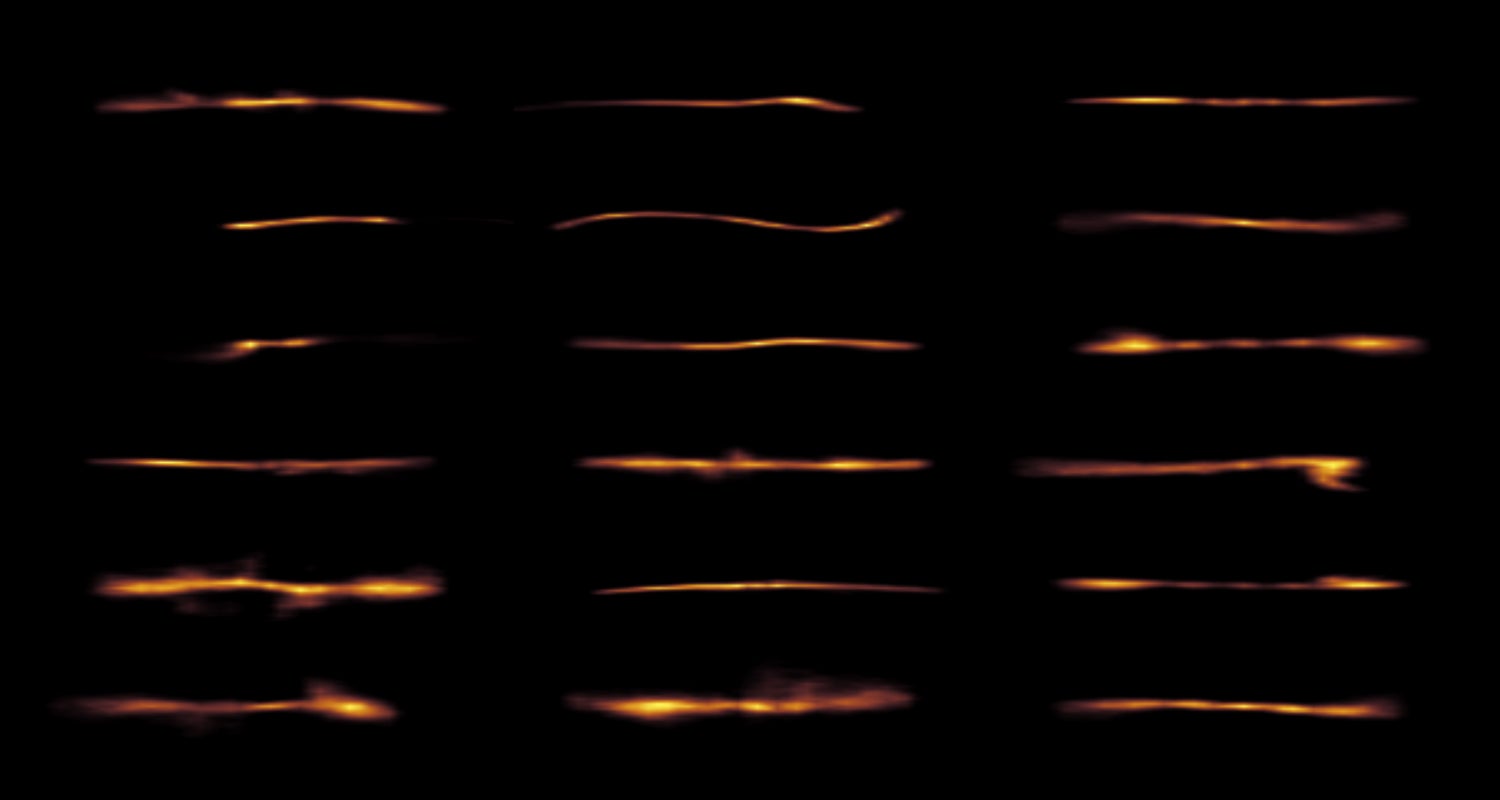
The researchers simulated roughly 15,000 globular cluster streams across four Milky Way-sized galaxies. After five billion simulated years, almost every stream contained some form of structural variation.
“Dark matter makes up most of the mass in the universe and forms the scaffolding that galaxies grow on, but we still don’t know what it is,” said co-author Nora Shipp, a UW assistant professor of astronomy. “The Milky Way is one of the best laboratories we have for figuring that out, and stellar streams are one of the sharpest tools inside it.”
A stellar stream forms when a galaxy’s gravity disrupts a globular cluster or dwarf galaxy. Stars pulled from the smaller system become stretched along its orbit, creating a long ribbon around the host galaxy.
Nearly 100 stellar streams are now known in the Milky Way.
Their shapes can preserve information about the gravitational environment they have crossed. That sensitivity has made them promising probes of dark matter, which does not interact with light but exerts gravity.
One influential idea assumes that globular cluster streams begin relatively thin, cold and smooth. A dark matter subhalo passing nearby could then carve a gap, throw stars off track or create a visible spur.
The GD-1 stream has become an important example. Its prominent gap and spur have been interpreted as possible evidence of an encounter with a dark matter subhalo.
The new work tests a more basic question: What happens to streams when the galaxy itself is allowed to be complicated?
Lead author Arpit Arora, a UW postdoctoral scholar in astronomy, and colleagues used four Milky Way-sized galaxies from the FIRE-2 Latte simulations.
The four systems had different histories. One remained relatively isolated. Another had the largest disk. Two experienced sizable mergers, including analogs of interactions involving the Large Magellanic Cloud and Sagittarius.
The team then inserted thousands of simulated globular cluster streams into the galaxies.
Importantly, the models deliberately excluded dark matter subhalos and other small-scale perturbers. This allowed the researchers to isolate what the host galaxies could do by themselves.
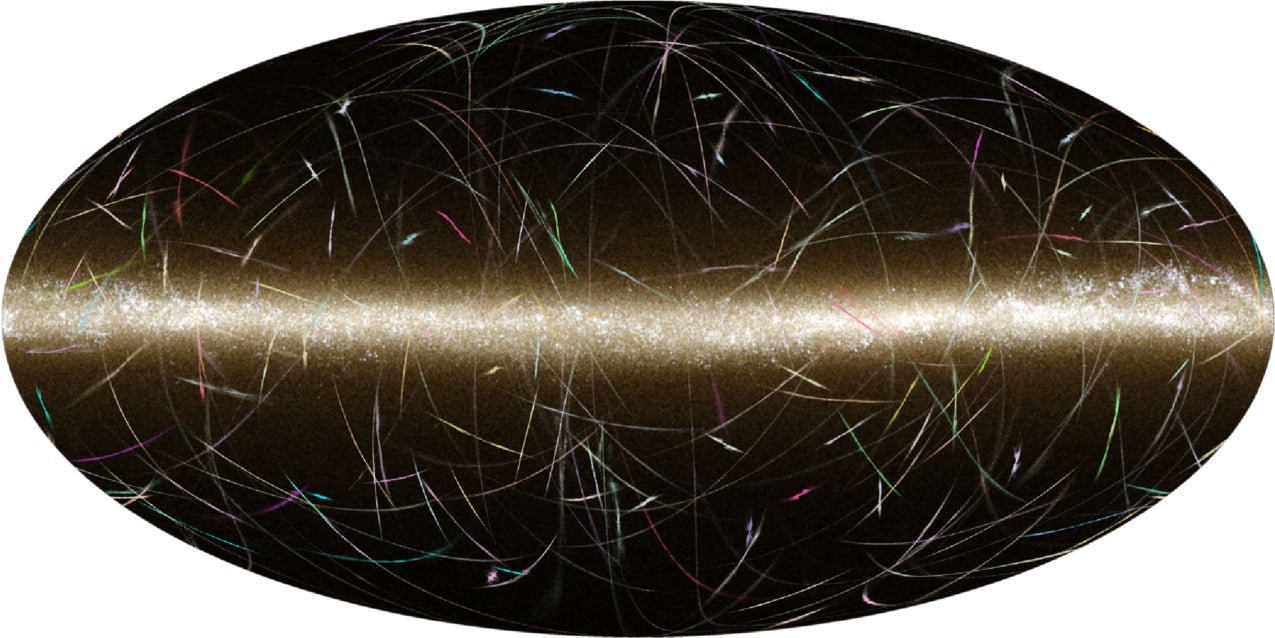
The simulated galaxies were not perfectly smooth or static. Their distributions of matter changed with time and included large-scale asymmetries and structures capable of altering stellar orbits.
“In our simulations, the host galaxies alone caused the same kinds of irregularities that we observe in real stellar streams,” Arora said. “Now that we can predict what the host galaxy does on its own, we can start isolating the part that dark matter is responsible for.”
The variety of structures produced without dark matter subhalo encounters was extensive.
The streams developed gaps, clumps, spurs, kinks, branches and changes in width. Some became broad or bifurcated. Others were heavily disrupted.
“We found that almost all of the streams had some sort of structural variation,” Arora said. “So this idea that streams are naturally thin and smooth wasn’t really necessarily true.”
Of 14,787 streams included in the population analysis after length cuts, only 26% qualified as smooth and lacked significant off-track features.
Another 13% appeared globally smooth but contained at least one notable localized feature. About 27% fell into an intermediate category, while 34% had broadly disrupted, messy structures.
Even streams classified as smooth were not uniform. Their median width variation was about 22%, and none had width variations below 10%.
Most also contained measurable changes in stellar density along their lengths.
Only about 2% of the smooth streams lacked detectable density structure at the study’s sensitivity threshold. Across the full simulated population, only around 70 streams lacked both significant off-track features and detectable along-track density disturbances.
Where a stream traveled mattered greatly.
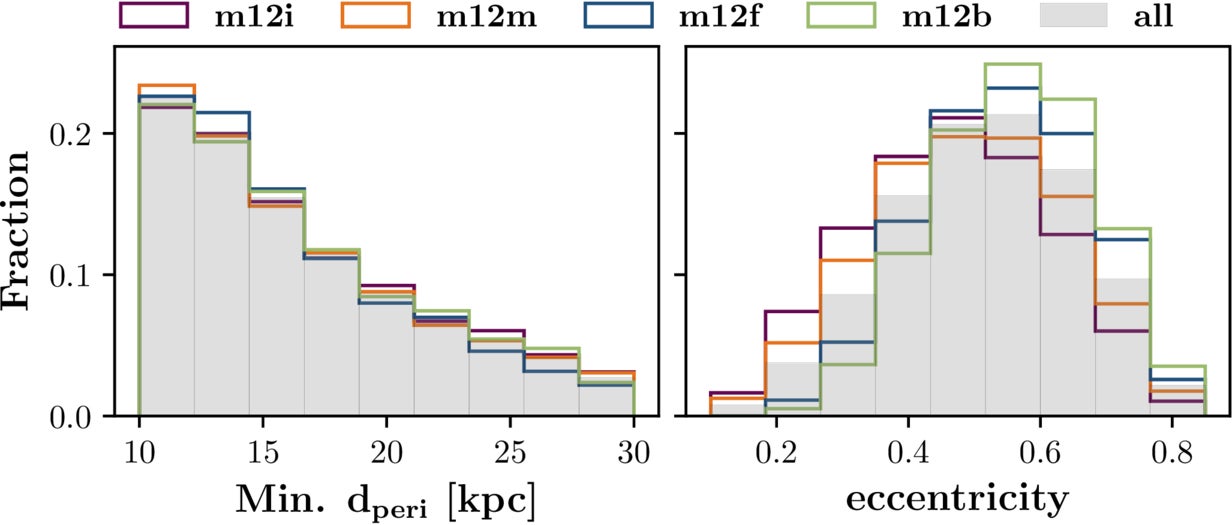
Streams passing closer to the centers of their galaxies generally became more disturbed. A pericenter, the closest point in an orbit to the galactic center, of roughly 15 kiloparsecs separated many smoother streams from more complicated ones.
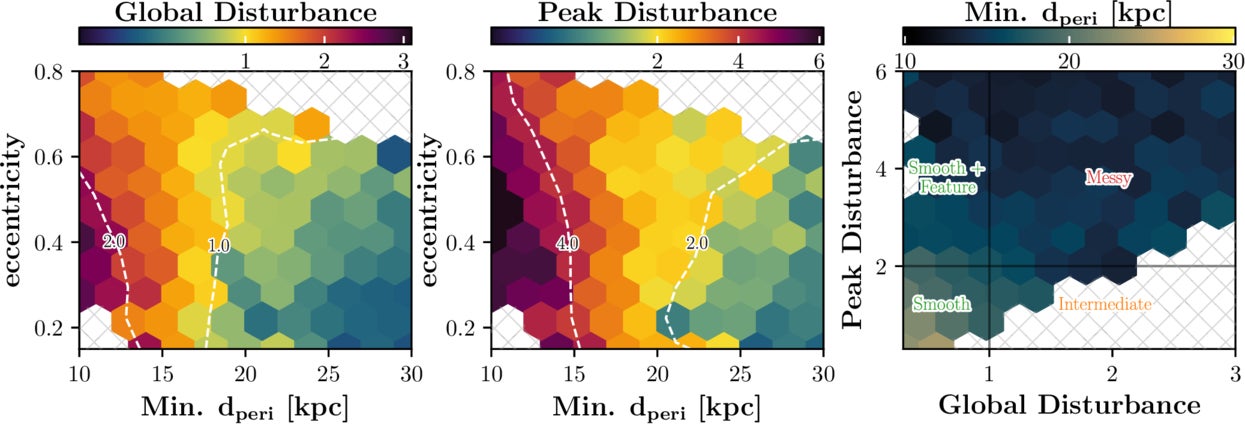
Streams on closer orbits repeatedly encountered the more complex gravitational environment of the inner galaxy. They also completed more orbits during the five-billion-year simulation, giving those effects additional time to accumulate.
The isolated simulated galaxy produced the largest proportion of smooth streams. Galaxies with substantial merger histories produced more disturbed streams across a wider range of distances.
A separate comparison strengthened the case that the evolving galaxy itself mattered. The researchers simulated another 1,000 streams in a static, axisymmetric Milky Way model.
Those streams were systematically less complicated.
One particularly important result involved gaps and density variations along otherwise smooth streams.
The median minimum detectable scale of those variations was about 2 degrees. Many appeared across roughly the same 1- to 5-degree range in which dark matter subhalo encounters are predicted to produce gaps.
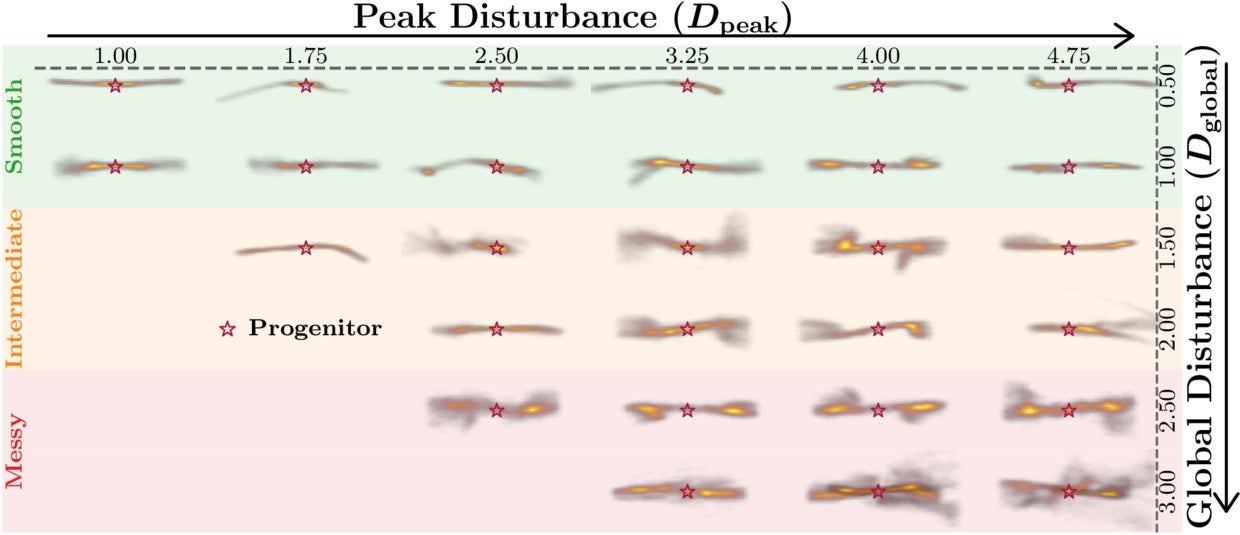
The simulations even generated structures resembling features observed in famous Milky Way streams. Some developed spur-like structures comparable to GD-1, while others produced kink-like features resembling those in the ATLAS-Aliqa Uma stream.
Those similarities appeared without dark matter subhalo impacts.
That does not mean stellar streams have lost their value for dark matter research. Instead, researchers may need a more sophisticated baseline for deciding which disturbances actually require an invisible perturber.
Future simulations will add dark matter subhalos to the same evolving galactic environments. Researchers can then test whether those encounters produce features that differ from disturbances generated by the galaxy itself.
Additional information about stellar velocities may prove especially useful.
The Vera C. Rubin Observatory is also expected to uncover many more Milky Way stellar streams, giving astronomers a much larger population for comparison.
“Sadly there’s no magic wand to reveal the structure of dark matter,” said James Davenport, a research assistant professor of astronomy at the UW. “Streams are complex systems, but they’re still the most interesting way to study the dark matter close to home.”
These studies examine how stellar streams reveal galactic gravitational fields, how dark matter subhalos could perturb them and how new observations may separate those effects.
Measurement of Substructure from the Kinematics of the GD-1 Stellar Stream: Measurements of stellar velocities along GD-1 reveal significant variations that may carry information about dark matter substructure, illustrating why kinematic measurements could complement stream morphology. (The Astrophysical Journal, 2026)
Detectability of dark matter subhalo impacts in Milky Way stellar streams: This analysis estimates how small a dark matter subhalo different stellar streams could detect. It finds that future LSST observations could substantially improve sensitivity compared with current Gaia measurements. (The Open Journal of Astrophysics, 2026)
Evidence for the first globular cluster stellar stream beyond the Milky Way: Deep Hubble observations provide evidence for a globular cluster stream around an ultra-diffuse galaxy and use its structure to constrain the host galaxy’s dark matter halo, extending stream-based dark matter studies beyond the Milky Way. (Nature, 2026)
Evidence of a population of dark subhaloes from Gaia and Pan-STARRS observations of the GD-1 stream: This influential GD-1 analysis used stellar density variations to constrain the abundance of dark subhalos and helped establish why gaps and other stream disturbances became promising dark matter signatures. (Monthly Notices of the Royal Astronomical Society, 2021)
Stellar streams and dark substructure: the diffusion regime: This theoretical work explores the collective influence of numerous low-mass dark matter subhalos on stellar streams and examines which scales of stream structure could rise above observational noise. (Monthly Notices of the Royal Astronomical Society, 2022)
Research findings are available online in the journal The Astrophysical Journal.
The original story “Scientists narrow the search for dark matter using new galaxy simulations” is published in The Brighter Side of News.
Like these kind of feel good stories? Get The Brighter Side of News’ newsletter.
The post Scientists narrow the search for dark matter using new galaxy simulations appeared first on The Brighter Side of News.


Leave a comment
You must be logged in to post a comment.