A lens that changes focus like the human eye may soon become smaller, softer and simpler. Researchers at Queen Mary University of London have developed a transparent graphene-based material that lets a soft lens change focus with electricity, without bulky motors or moving parts.
The work, led by Prof. James Busfield, takes aim at a long-standing challenge in adaptive optics. Cameras, microscopes, medical tools and wearable displays often need lenses that can shift focus quickly. Traditional systems usually rely on rigid lenses, gears or mechanical movement.
The new prototype behaves more like living tissue. When an electrical field is applied, a soft membrane stretches gently. That change alters the lens shape and shifts its focal distance.
Your eyes change focus constantly. They move from a book to a face across the room to a bird overhead without you thinking about it.
Recreating that smooth flexibility in technology has proved difficult. Conventional lenses are usually rigid. To change focus, devices often move lens elements back and forth.
That adds weight, size, noise and complexity. In small devices, every millimeter matters.
Soft lenses offer another path. Instead of moving a hard lens, engineers can change the shape of a flexible lens. The challenge is making that happen while keeping the lens clear.
The Queen Mary team worked with dielectric elastomer actuators. These soft devices can stretch and move when voltage is applied. They act somewhat like artificial muscles.
A typical actuator uses a thin elastic membrane between stretchable electrodes. When electricity creates an electrostatic force, the membrane compresses and expands sideways.
This motion can drive a soft lens. But many electrode materials block light, which creates a design problem.
Traditional electrostatically actuated lenses often place electrodes around the lens edge. That keeps the optical path clear, but makes the device wider and more complex.
The new study tackles that problem with transparent electrodes made from reduced graphene oxide.
Graphene is famous for being thin, strong and electrically useful. It can also be highly transparent, which makes it attractive for optical devices.
But high-quality graphene can be hard to make and place on soft materials. It often requires demanding production steps that do not easily match flexible polymers.
Reduced graphene oxide offers a more practical route. It keeps some useful graphene-like traits but can be dispersed in solvents. That means researchers can spray it as a thin coating.
The team used spray-coated reduced graphene oxide on a soft membrane. This created a stretchable electrode that was partly transparent and electrically active.
By placing the electrode directly under the lens, the researchers reduced the need for bulky side structures.
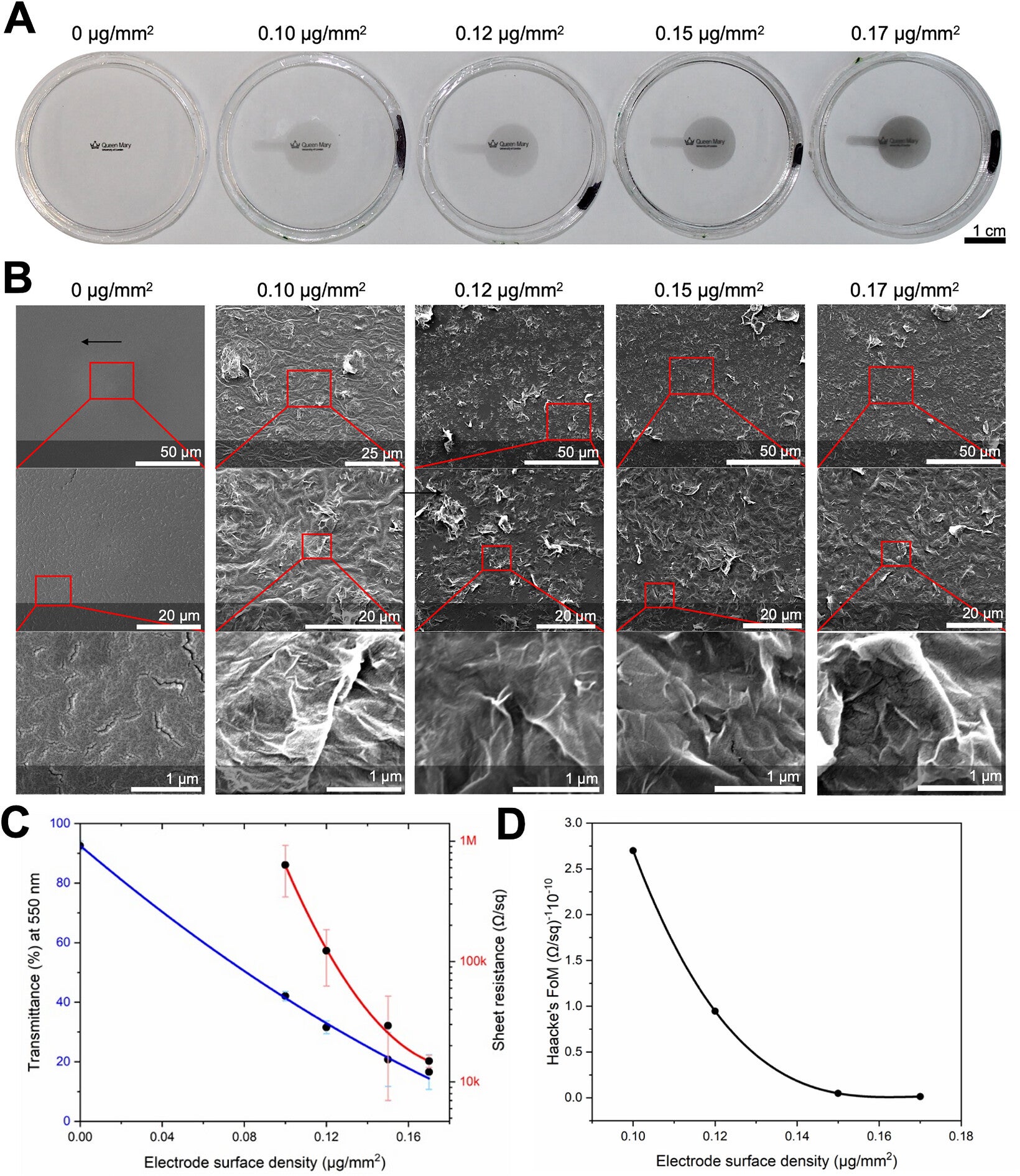
The key challenge was balance. Add too little graphene-based material, and the electrode does not conduct well enough. Add too much, and the lens becomes too dark.
The researchers carefully controlled how much reduced graphene oxide they deposited on the soft membrane. They tested different surface densities to compare electrical performance with optical clarity.
As expected, more material lowered electrical resistance. But it also reduced how much light passed through.
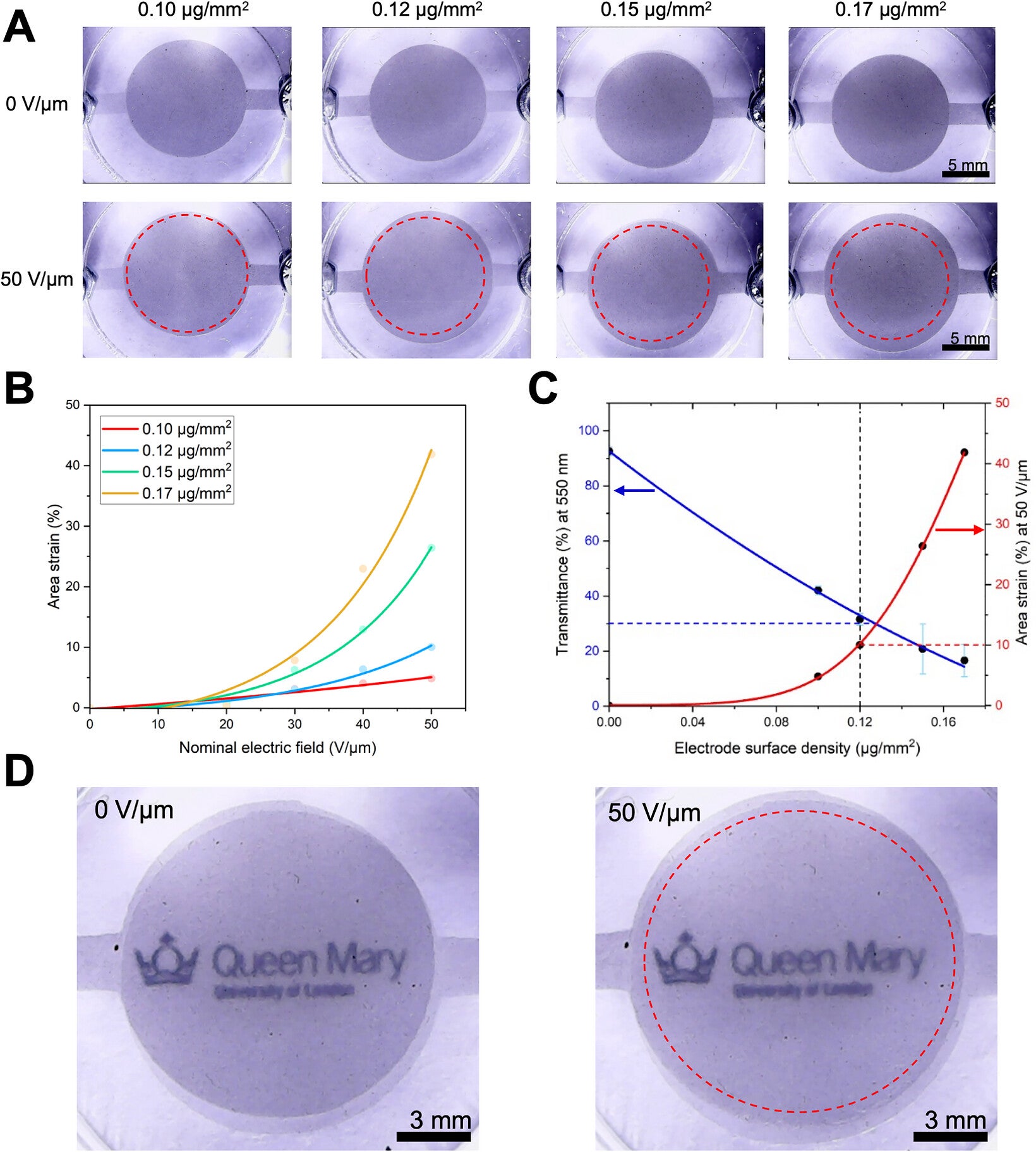
The team selected a density that allowed meaningful actuation while keeping enough transparency for imaging. Their chosen coating reached about 32% transmittance and supported useful membrane strain.
That compromise allowed the prototype lens to work while staying compact.
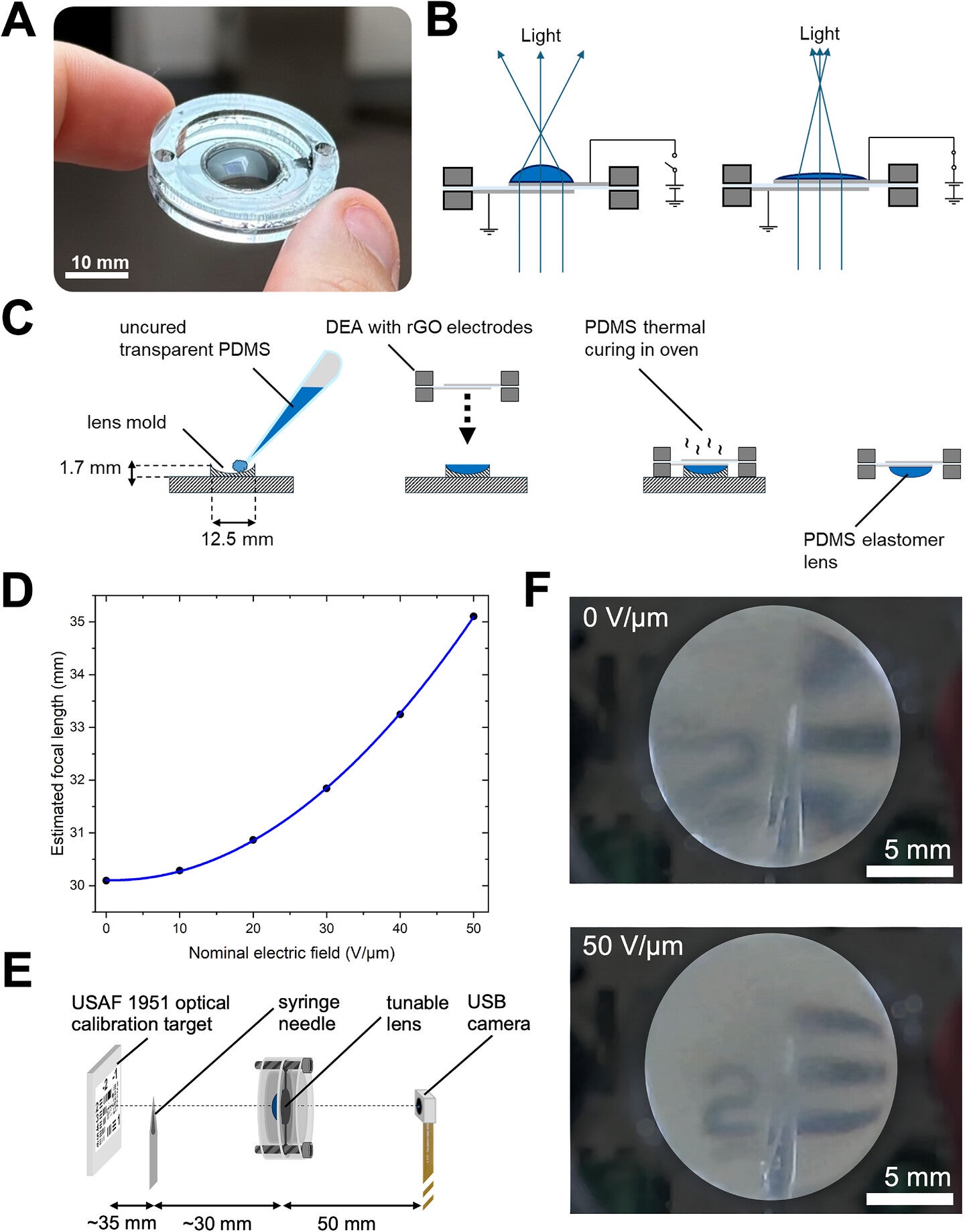
The final device used a soft PDMS plano-convex lens about 12.5 millimeters wide. It was attached to a transparent reduced graphene oxide-based actuator.
When the researchers applied an electric field, the actuator expanded sideways. That stretched the lens and changed its curvature.
Changing curvature changes focal length. In the prototype, the lens shifted focus from about 30 to 36 millimeters.
The device achieved this without motors, gears or a moving rigid lens barrel. It changed focus electronically through soft material deformation.
Although the transparency still needs improvement, the test showed the concept can work.
The manufacturing approach was also important. The researchers used a simple spray-coating process to apply the reduced graphene oxide.
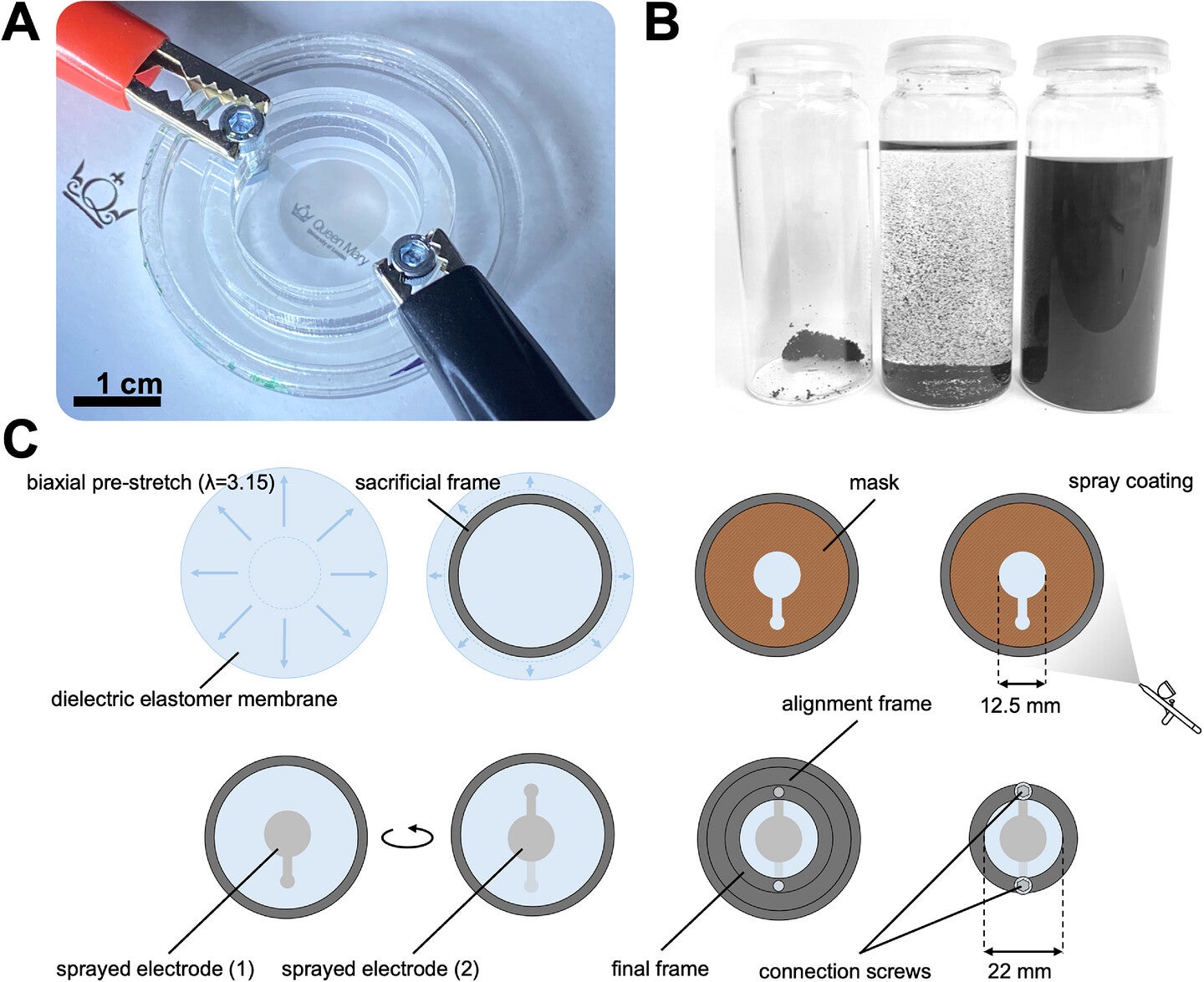
They dispersed the material in tetrahydrofuran, a solvent that evaporates quickly. Then they sprayed the ink onto a pre-stretched acrylic elastomer membrane.
The membrane came from 3M VHB 4905 tape, a material often used in soft actuator research. The team stretched it to reduce its thickness from 500 micrometers to about 50 micrometers.
This pre-stretch improved the actuator’s performance. It helped the membrane handle electrical stress and produce larger movement.
The process used inexpensive materials and straightforward fabrication steps, which could matter for future scaling.
“This is exciting. It means that in the future, similar technology could find applications in autofocus cameras, wearable displays, virtual and augmented reality headsets, miniature medical imaging devices and scientific instruments where conventional mechanical focusing systems add weight, complexity or cost.” says Giacomo Sasso, first author of the study.
Those uses share a common need. They require optical systems that are light, compact and fast.
A phone camera may need autofocus without extra thickness. A medical imaging device may need a tiny adjustable lens inside a narrow tool. A headset may need focus control without heavy hardware near the eyes.
Soft tunable lenses could help solve these problems. They can move silently and smoothly, driven by electrical signals instead of mechanical parts.
The research also shows how soft robotics may reshape everyday technology. Electrically active polymers can change shape in response to signals, much like muscles.
”Instead of relying on motors and gears, electrically active polymers behave more like artificial muscles, changing shape smoothly and silently in response to electrical signals. Coupled with graphene’s exceptional electrical properties, they offer engineers an entirely new approach to designing optical systems.” adds second author of the study, Alec Lamoreux.
This approach could make optical devices thinner and quieter. It could also reduce the number of parts that wear down over time.
The idea is not limited to lenses. Similar systems could one day support adjustable filters, tunable transparency or soft imaging tools.
The prototype remains at the research stage. The reduced graphene oxide electrodes were only semi-transparent, not fully clear.
Future work must improve transparency while keeping strong electrical performance. The electrode coating also needs to become smoother and more uniform.
Microscopy showed rough surfaces, likely from flakes clustering or lying at different angles. Better inks and spray methods could reduce those issues.
Researchers also need to optimize long-term durability, power needs and performance under real-world use. A lab prototype is not yet a consumer device or medical tool.
Still, the study removes a major design constraint. It shows that the actuator can sit directly in the optical path when the electrodes are transparent enough.
These resources provide recent and directly relevant context on dielectric elastomer optics, transparent electrodes and electrically adjustable lens technologies.
Tuneable Lenses Driven by Dielectric Elastomers: Principles, Structures, Applications, and Challenges: This recent review compares dielectric-elastomer lens architectures, operating principles, applications and remaining challenges in adaptive optical systems. (Applied Sciences, 2025)
Polyelectrolyte Elastomer-Based Ionotronic Electro-Mechano-Optical Devices: Researchers created a transparent electrically tunable Fresnel lens with 97.3% visible-light transmittance and about 31% focal-length adjustment. (Small, 2025)
High-performance dielectric elastomers with transparent electrodes for wearable and portable technologies: This review examines transparent electrode materials for dielectric elastomers and their potential use in lenses, wearable devices and portable electronics. (Academia Materials Science, 2025)
Tunable Lens Driven by Electrohydrodynamic Pumping: This study demonstrates another soft-actuation strategy for changing lens focus without conventional mechanical translation, providing a useful comparison with dielectric elastomer designs. (Advanced Engineering Materials, 2024)
Stretchable Transparent Polyelectrolyte Elastomers for All-Solid Tunable Lenses of Excellent Stability Based on Electro-Mechano-Optical Coupling: An all-solid transparent soft lens achieved approximately 46% focal-length tuning while maintaining stable operation over repeated cycles. (Advanced Materials Technologies, 2023)
Research findings are available online in the journal Advanced Functional Materials.
The original story “Scientists redesign the camera lens using graphene and artificial muscles” is published in The Brighter Side of News.
Like these kind of feel good stories? Get The Brighter Side of News’ newsletter.
The post Scientists redesign the camera lens using graphene and artificial muscles appeared first on The Brighter Side of News.


Leave a comment
You must be logged in to post a comment.