Deep beneath the Pacific, one undersea fault has produced nearly identical magnitude 6 earthquakes every few years for decades. Researchers now think strange, water-soaked barrier zones inside the fault act like natural brakes, stopping ruptures in place and raising bigger questions worldwide.
A fault line deep under the eastern Pacific has been doing something earthquakes rarely do: repeating itself.
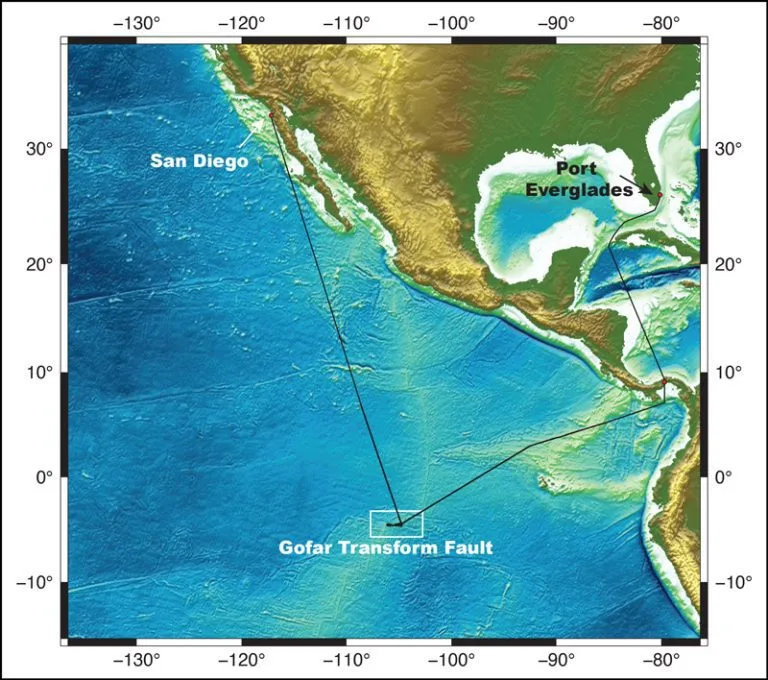
About 1,000 miles west of Ecuador, the Gofar transform fault has produced magnitude 6 earthquakes every five to six years, again and again, on nearly the same patches of seafloor. The shocks tend to start in familiar places, reach familiar sizes, and then stop in familiar places. For earthquake scientists, that kind of regularity is almost unsettling.
Now a study in Science argues that the answer lies in stretches of the fault once treated as quiet gaps. These zones, lodged between the patches that repeatedly rupture, appear to act as durable barriers that keep earthquakes from growing larger.
“We’ve known these barriers existed for a long time, but the question has always been, what are they made of, and why do they keep stopping earthquakes so reliably, cycle after cycle?” said Jianhua Gong, lead author of the study and an assistant professor of Earth and Atmospheric Sciences at Indiana University Bloomington.
The work brings together researchers from Indiana University, Woods Hole Oceanographic Institution, Scripps Institution of Oceanography at UC San Diego, the U.S. Geological Survey, Boston College, the University of Delaware, Western Washington University, the University of New Hampshire, and McGill University.

The Gofar fault sits along the East Pacific Rise, where the Pacific and Nazca plates slide sideways past each other at about 140 millimeters a year. That is fast in tectonic terms, roughly the pace a fingernail grows.
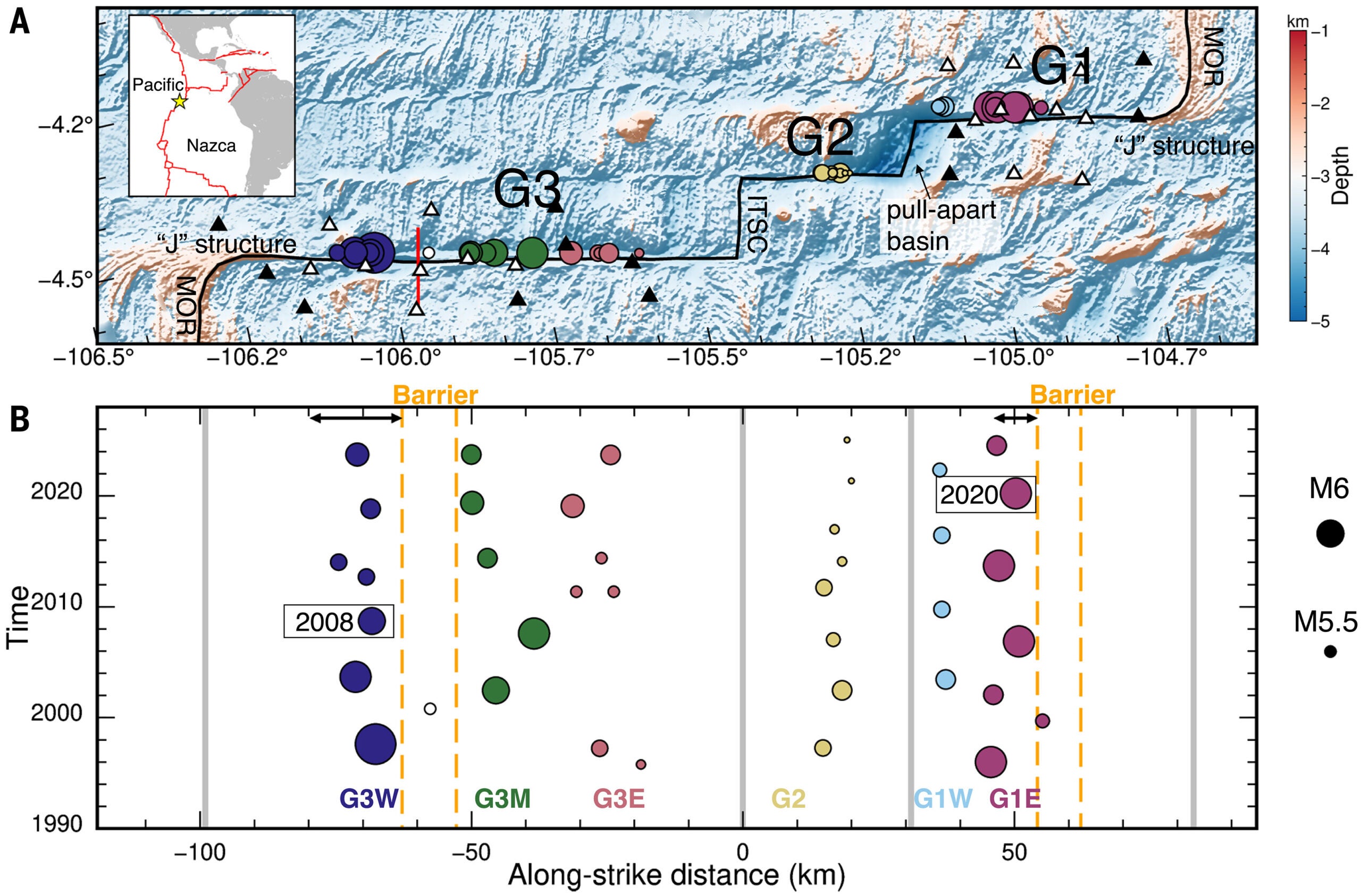
Scientists have tracked its behavior for decades and found six main locked patches along the fault, five of which rupture in a quasiperiodic rhythm. Between them sit “barriers,” stretches that do not produce earthquakes above magnitude 5.5 and seem to release much of their built-up strain without a major rupture.
To understand what those barriers really are, the team used data from two ambitious ocean-floor experiments. One captured a magnitude 6 earthquake in 2008 on the G3 segment of the fault. Another, running from 2019 to 2022, captured a similar event in March 2020 on the G1 segment. Instruments called ocean bottom seismometers sat directly on the seafloor and recorded tens of thousands of tiny earthquakes before, during, and after the larger shocks.
The pattern on both fault segments looked strikingly alike. In the barrier zones, swarms of small earthquakes intensified in the days or weeks before the mainshock. Then, once the larger earthquake hit, activity dropped sharply.
That sudden silence mattered. If the barriers were just passive patches of rock, scientists would not expect such a consistent before-and-after pattern, especially across two segments observed 12 years apart.
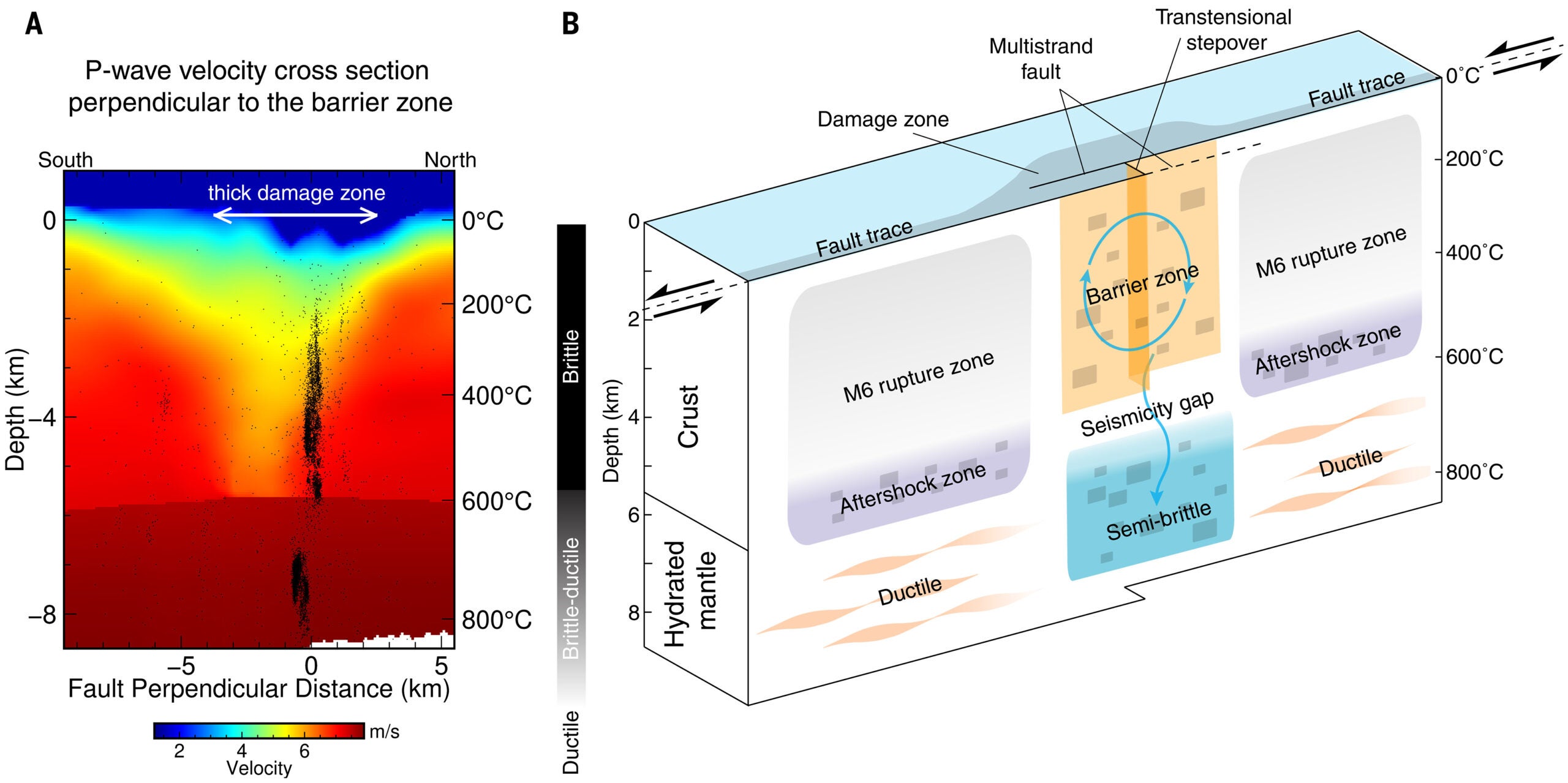
The study found that these barriers are not smooth, simple sections of the fault. They are messy, multistranded zones where the fault bends, splits, or steps sideways by a few hundred meters.
At G1, the upper parts of the barrier are offset by about 300 meters. At G3, several subfaults create similar geometric complications. In both places, the arrangement produces local extension, small zones where the crust is being pulled apart rather than pressed together.
That matters because damaged, stretched fault rock is more likely to let seawater seep down into it. The researchers argue that this fluid-rich, porous structure changes how the barrier behaves when a rupture rushes toward it.
Instead of simply transmitting the earthquake onward, the barrier may briefly strengthen as the rock dilates, or opens slightly, and pore pressure drops. That pressure normally helps trapped fluids push outward against surrounding rock. When it falls suddenly, the fault can lock up.
Gong described the barriers as active parts of the system rather than passive leftovers. “These barriers are not just passive features of the landscape,” he said. “They are active, dynamic parts of the fault system, and understanding how they work changes how we think about earthquake limits on these faults.”
The authors point to a process called dilatancy strengthening as the best explanation. In that framework, a rupture can weaken the fault at first, but then trigger a temporary pore-pressure drop in the damaged barrier zone, making the rock harder to keep slipping. In effect, the fault slams on its own brakes.
That helps solve a long-running puzzle. Oceanic transform faults around the world often release much of their motion without large earthquakes, and when they do rupture, the earthquakes are often smaller than simple geologic calculations would suggest.
Gofar offers a close-up example of how that might happen. The barriers appear to isolate the magnitude 6 patches, keeping each rupture confined instead of allowing one event to cascade across a much larger section of fault.
Geometry alone does not seem to explain it. On continental faults, stepovers usually need to be a few kilometers wide to stop a major rupture reliably. At Gofar, the offsets are typically less than 400 meters, too small by themselves to account for decades of repeated rupture arrest.
Nor do the barriers look like purely stable, quietly creeping zones. They host abundant microearthquakes, plus occasional moderate events, which means much of the fault surface there still behaves in a way that can fail seismically. That pushed the authors away from simpler models based only on strongly stable friction.
Instead, they argue that geometry and fluid infiltration work together. Seismic imaging at G3 has shown low wave speeds, elevated Vp/Vs ratios, and high conductivity, all signs consistent with fractured rock and trapped brines. Deep seismicity also suggests seawater has altered the fault zone below the upper crust.
The result is a fault architecture built to interrupt rupture again and again.
The Gofar fault is remote, and its earthquakes pose little direct danger to people. But the underlying physics could matter far beyond one patch of the Pacific.
Oceanic transform faults are common along mid-ocean ridges. If many of them contain similar damaged, water-rich barriers, that could explain why these faults so often show low seismic coupling, limited rupture size, and surprisingly regular earthquake cycles.
The findings may also help explain why fast-slipping oceanic transform faults often produce intense foreshock sequences and swarms. At Gofar, the same barrier behavior was seen before both the 2008 and 2020 earthquakes, hinting that the barriers do more than stop ruptures. They may help pace the cycle itself, isolating neighboring locked patches so stress can rebuild in a more orderly way.
The study does not claim the problem is settled. The authors note that other models, including ones involving spatial differences in normal stress or thermal healing, may also help explain the seismicity patterns. Those ideas have not yet been tested thoroughly for oceanic transform faults. And while the data from G1 and G3 are unusually rich, researchers still need more well-instrumented barriers to know how widely this mechanism applies.
This work gives earthquake scientists a more concrete way to think about why some undersea faults produce repeating, limited-size earthquakes instead of larger ruptures. By linking fault geometry, seawater infiltration, and pore-pressure changes, the study offers a physical explanation that can be tested in other marine fault systems.
That could sharpen seismic models for oceanic transform faults, especially those closer to populated coastlines. It also points to what future field campaigns should measure: not just earthquake timing, but fault structure, fluid flow, rock alteration, and changes in mechanical behavior over time.
In a part of earthquake science where prediction usually remains elusive, Gofar shows that repeat patterns may come from equally repeatable fault conditions.
Source material provided by the Indiana University. The original university release was written by Vic Ryckaert and has been expanded and edited for content, style, clarity, and length.
Research findings are available online in the journal Science.
The original story “Scientists solve the 30-year mystery of ‘clockwork’ earthquakes” is published in The Brighter Side of News.
Like these kind of feel good stories? Get The Brighter Side of News’ newsletter.
The post Scientists solve the 30-year mystery of ‘clockwork’ earthquakes appeared first on The Brighter Side of News.

