When a migraine is pounding or painful joints make movement difficult, exercising can feel like the wrong response. Evidence gathered from more than 220,000 people suggests the opposite may often be true.
Researchers at Adelaide University pooled findings from 157 systematic reviews containing 2,736 randomized controlled trials and 221,279 participants. Exercise significantly reduced pain across conditions ranging from osteoarthritis and low back pain to migraines, fibromyalgia, rheumatoid arthritis and cancer-related pain.
The umbrella review, published in Pain Reports, is among the broadest attempts yet to determine whether exercise relieves pain across different conditions and, importantly, how exercise should be prescribed.
Overall, exercise produced a large standardized reduction in pain. When researchers examined studies using a familiar 0-to-10 visual analog scale, the average reduction was about 1.1 points.

“When we exercise, our body releases chemicals including endorphins and serotonin that can help reduce how strongly we feel pain and increase our pain tolerance,” lead researcher Ben Singh said.
Exercise has long appeared in clinical recommendations for painful conditions, but the evidence has been fragmented.
One review might examine resistance training for osteoarthritis, while another evaluates yoga for fibromyalgia or aerobic exercise for migraine. That makes it difficult for clinicians to know whether the effects represent isolated benefits or a broader pain-relieving property of exercise.
The Adelaide researchers addressed that problem with an umbrella review, which combines existing systematic reviews and meta-analyses rather than analyzing individual clinical trials from scratch. Their database search covered peer-reviewed research through August 2024.
The included reviews examined adults experiencing acute and chronic pain. Conditions included knee and hip osteoarthritis, low back and neck pain, fibromyalgia, osteoporosis, rheumatoid arthritis, headaches, neurological disorders, pregnancy-related pain and cancer.
Exercise types were equally diverse. Researchers assessed aerobic and resistance exercise alongside aquatic exercise, Pilates, yoga, tai chi, qigong, dance, virtual-reality exercise and programs combining several approaches.
Across 144 meta-analyses involving 197,392 participants with suitable standardized data, exercise produced an overall standardized mean difference of minus 0.59 compared with control conditions.
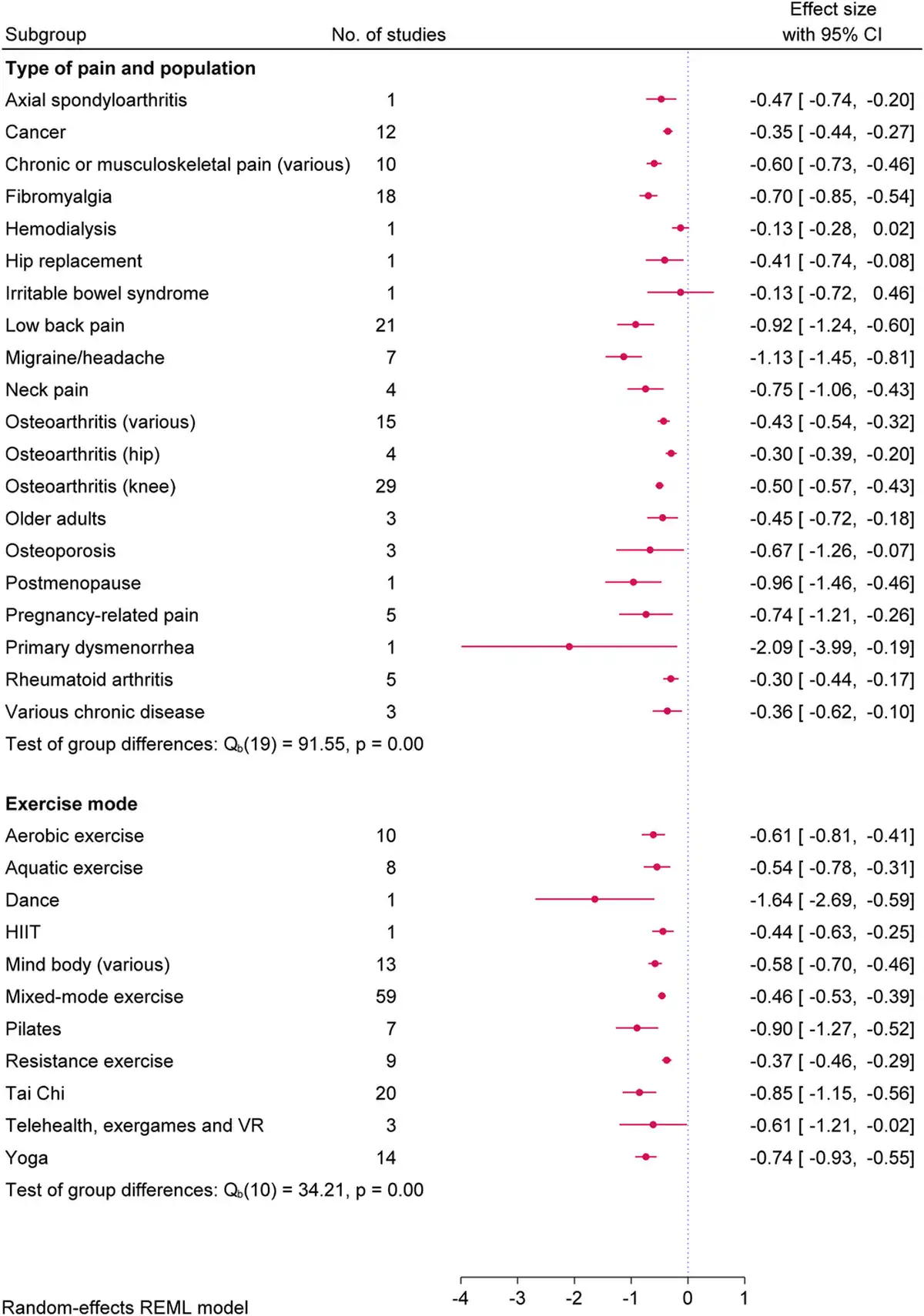
The benefit was not confined to musculoskeletal pain.
Significant reductions appeared across chronic musculoskeletal conditions, cancer, fibromyalgia, migraine and headache, rheumatoid arthritis, pregnancy-related pain and several other groups. Acute and chronic pain both improved, with no statistically significant difference between their overall effects.
Migraine and headache produced one of the larger condition-specific effects, with a standardized mean difference of minus 1.13. Primary dysmenorrhea produced an even larger estimate, although each result came from a single systematic review and therefore requires particular caution.
The same issue applies when comparing exercise styles. Dance produced the largest estimated reduction, followed by Pilates and tai chi, but the dance estimate came from only one systematic review focused on fibromyalgia.
The broader finding is more robust: many different forms of movement were associated with reduced pain.
“Our study found that exercise was associated with substantial reductions in acute and chronic pain across all forms of exercise,” Singh said.

One of the most striking findings involved exercise dose.
Lower-intensity exercise produced a larger average reduction than moderate-to-vigorous activity. Programs lasting less than 12 weeks also showed larger effects than longer interventions.
Weekly exercise duration produced another unexpected pattern. Programs totaling less than 120 minutes per week showed greater average pain reductions than programs involving two hours or more.
That does not mean people should stop exercising after 12 weeks or deliberately remain below a fixed weekly threshold. The researchers emphasize that subgroup analyses combine highly varied populations, programs and conditions.
Longer trials may also suffer declining adherence once structured support disappears. A smaller measured effect could therefore reflect participants exercising less consistently rather than longer-term exercise becoming ineffective.
The findings instead support beginning with manageable activity that people in pain can tolerate and sustain.
“More exercise wasn’t necessarily better,” Singh said. “Shorter-duration and lower-intensity programs showed greater reductions in pain, suggesting people may not need to exercise harder or for longer to experience meaningful benefits.”

There is no single biological explanation for exercise-related pain relief.
Movement can increase endogenous opioids such as endorphins and alter neurotransmitters including serotonin and norepinephrine. These systems influence how the brain and spinal cord process painful signals.
Exercise can also alter inflammatory and immune signaling. Another pathway involves endocannabinoids such as anandamide, molecules produced naturally by the body that participate in pain, mood and inflammatory regulation.
Repeated movement may produce additional benefits through greater strength, mobility and physical confidence. Those changes can make everyday activity easier and potentially reduce fear of movements previously associated with pain.
The mechanisms probably differ among conditions and individuals. Exercise for knee osteoarthritis, for example, may involve mechanical and muscular benefits that are less relevant to migraine.
That diversity is one reason the researchers argue against treating exercise as one uniform intervention.
Despite the enormous amount of data, the evidence is not flawless.
Overall statistical heterogeneity was high, meaning effect sizes varied considerably among reviews. Many systematic reviews were rated as having low or critically low methodological quality, and the researchers detected signs of possible publication bias.
After statistically adjusting for that potential bias, the estimated benefit became smaller but remained meaningful. The team rated the overall certainty of evidence as moderate.
The reported 1.1-point reduction on a 0-to-10 pain scale has also been compared with pain reductions reported in separate medication trials. That comparison was not a head-to-head experiment, so it cannot establish that exercise outperforms a particular pain medication.
Exercise should likewise not be presented as a universal replacement for medication, physical therapy or other clinical care. Different conditions, physical limitations and causes of pain require different approaches.
Instead, the enormous review strengthens a simpler conclusion: movement deserves a routine place in multimodal pain management, and effective programs may be considerably more achievable than patients expect.
Rather than telling someone in pain simply to “stay active,” the next challenge is determining which movements, intensity and schedule best match that individual.
These recent resources examine exercise dose, specific pain conditions and how clinicians can more precisely prescribe movement for pain.
Effectiveness of Painful Versus Nonpainful Exercise on Pain Intensity, Disability, and Other Patient-Reported Outcomes in Adults With Chronic Musculoskeletal Pain: An Updated Systematic Review With Meta-Analysis: This updated analysis examines whether exercise must remain pain-free to improve chronic musculoskeletal pain and disability, finding no clear advantage for painful or nonpainful approaches. (Journal of Orthopaedic & Sports Physical Therapy, 2025)
Role of exercise on pain, functional capacity, and inflammatory biomarkers in osteoarthritis: A systematic review and meta-analysis: This recent meta-analysis evaluates exercise effects on osteoarthritis pain, physical function and inflammatory biology. (Annals of Physical and Rehabilitation Medicine, 2025)
Efficacy of various exercise interventions for migraine treatment: A systematic review and network meta-analysis: Researchers compare several exercise approaches for migraine frequency, intensity, duration and disability, while emphasizing limitations in evidence certainty. (Headache, 2024)
The Best Exercise Modality and Dose for Reducing Pain in Adults With Low Back Pain: A Systematic Review With Model-Based Bayesian Network Meta-analysis: This analysis of 82 trials investigates how exercise type and weekly dose relate to pain relief in adults with chronic nonspecific low back pain. (Journal of Orthopaedic & Sports Physical Therapy, 2024)
The Impact of Exercise Prescription Variables on Intervention Outcomes in Musculoskeletal Pain: An Umbrella Review of Systematic Reviews: This umbrella review examines intensity, frequency, duration and other prescription variables while highlighting how little high-quality evidence exists for one universally optimal exercise dose. (Sports Medicine, 2024)
Research findings are available online in the journal PAIN Reports.
The original story “Scientists study 221,000 people to find which exercise works best for pain relief” is published in The Brighter Side of News.
Like these kind of feel good stories? Get The Brighter Side of News’ newsletter.
The post Scientists study 221,000 people to find which exercise works best for pain relief appeared first on The Brighter Side of News.


Leave a comment
You must be logged in to post a comment.