A shattered glass can fall apart, but its pieces do not spontaneously leap from the floor and reconstruct the glass. Smoke spreads through a room but does not normally gather itself back into a candle flame.
This fundamental asymmetry between past and future is known as the arrow of time. Researchers at the CUNY Graduate Center’s Initiative for the Theoretical Sciences have developed a mathematical framework for asking a more subtle question: When a complicated system contains many interacting parts, where does its irreversibility actually come from?
Their answer suggests complexity may emerge from surprisingly simple interactions.
In research published in Physical Review Letters, the team showed that a local measure of irreversibility can be divided into contributions from individual components, pairs, triplets and increasingly larger groups. Applying the method to neural recordings from a salamander retina revealed that interactions between pairs of neurons provided most of the measured arrow of time.
“Our findings provide the first step toward understanding how the arrow of time that we experience in daily life emerges from these more microscopic details,” said first author Christopher Lynn, then a postdoctoral fellow with the Initiative for the Theoretical Sciences.
The physical arrow of time is closely related to the second law of thermodynamics. Systems away from equilibrium dissipate energy and produce entropy, giving their behavior a preferred temporal direction.
At the microscopic level, however, identifying that direction can become surprisingly difficult. Many fundamental physical equations work whether time is mathematically run forward or backward.
The researchers approached the problem using probability. They asked how easy it would be to distinguish a recorded sequence of events from the same sequence played backward.
If forward and backward trajectories are equally probable, the observed dynamics provide no evidence about time’s direction. If one direction is much more probable, the system possesses a stronger measurable arrow of time.
The team quantified this distinction using an information-theoretic measure called Kullback-Leibler divergence. In certain nonequilibrium thermodynamic systems, the rate at which this evidence for time’s direction accumulates corresponds to the system’s rate of entropy production.
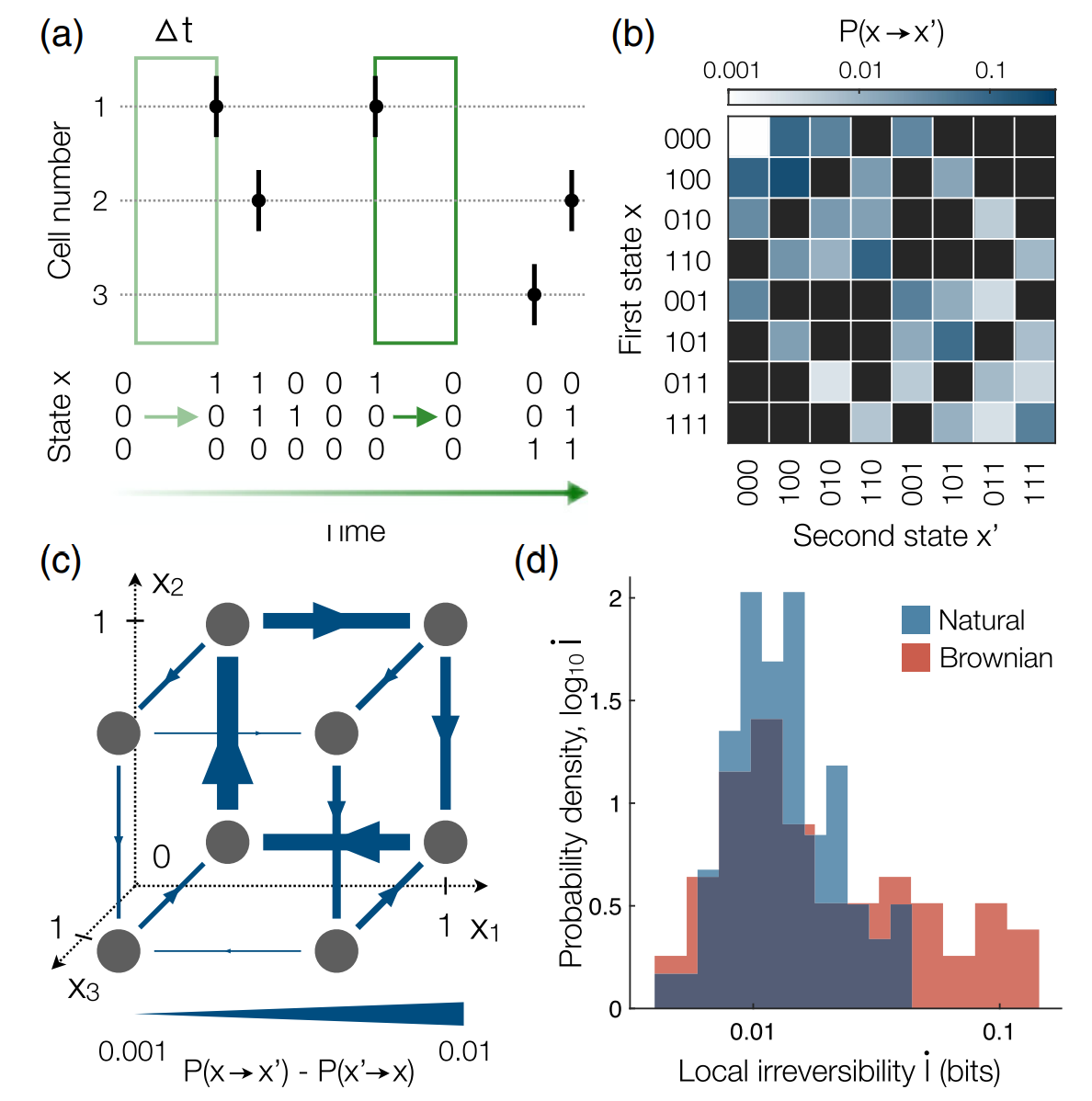
Their analysis focused specifically on local irreversibility, meaning the evidence contained in short transitions between system states rather than the entire history of a system.
Real systems rarely consist of a single variable. A cell contains interacting molecules, an ecosystem contains interacting organisms and the brain contains vast networks of neurons.
The researchers wanted to determine how the arrow of time seen at the collective scale emerges from those smaller pieces.
They first separated local irreversibility into two components. One comes from the independent behavior of individual elements. The other comes from interactions among them.
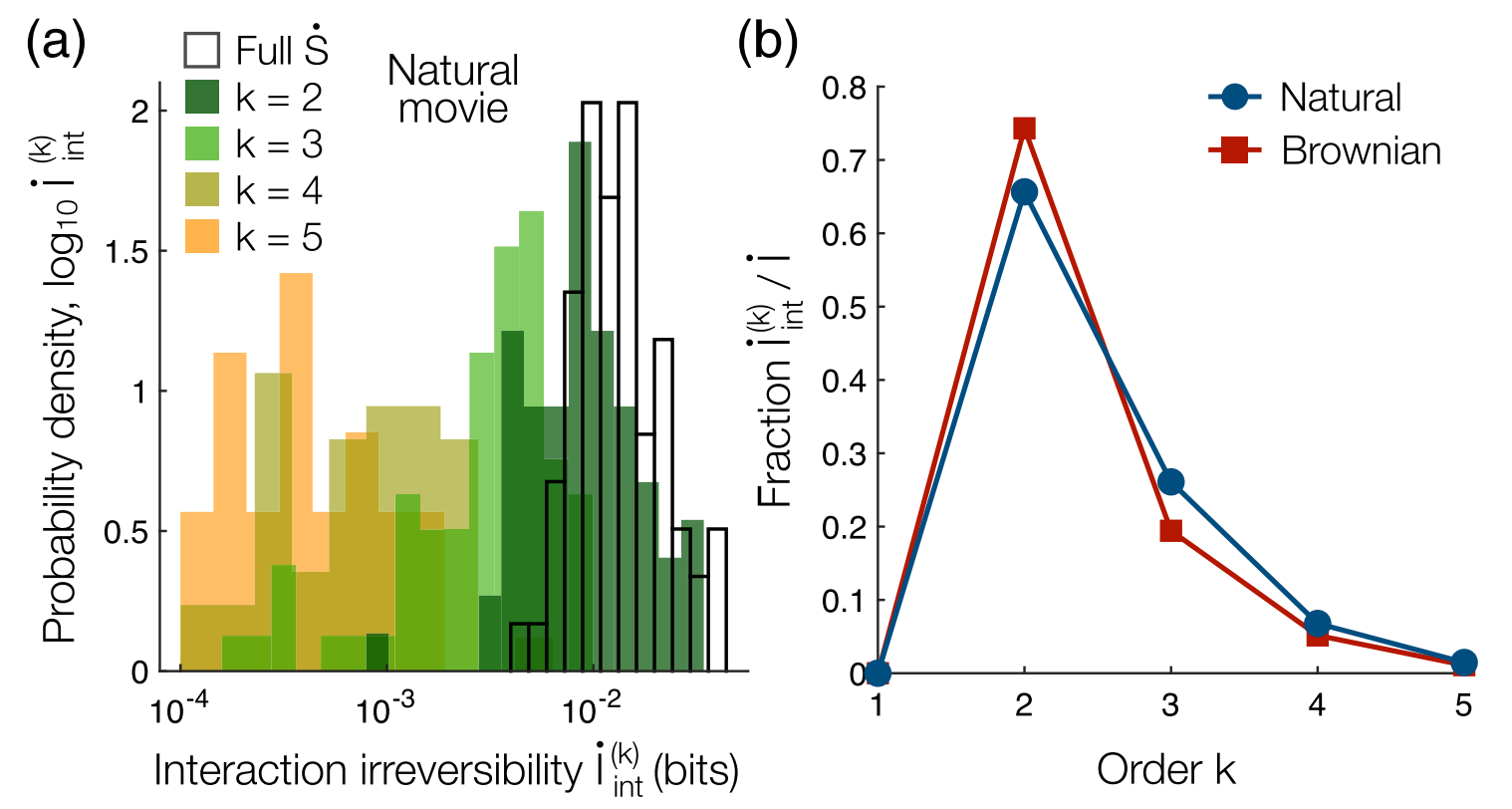
The interaction contribution could then be broken down further into effects associated with pairs, triplets and higher-order combinations.
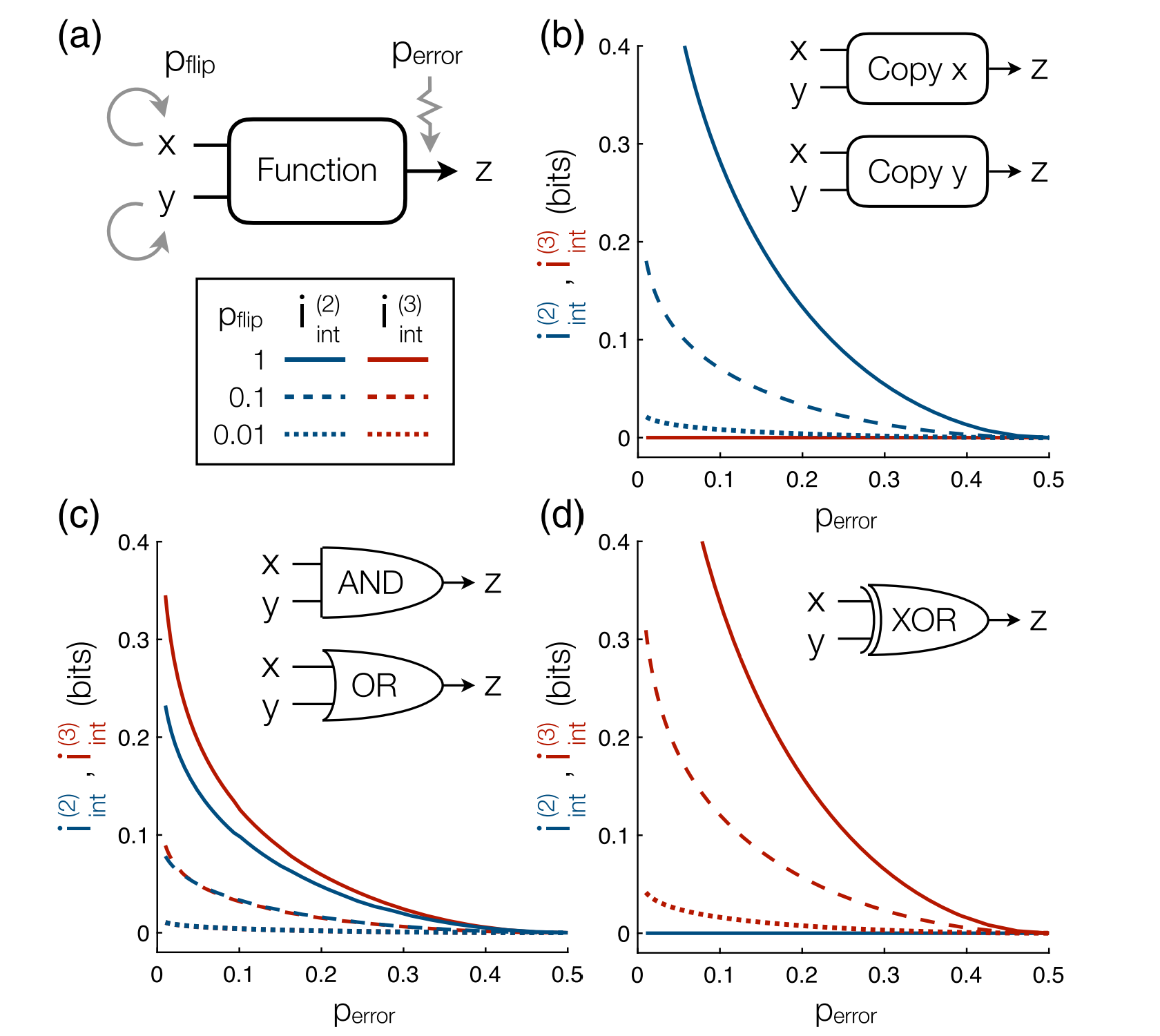
Importantly, every level adds a non-negative amount of information about irreversibility. Knowing more about interactions can reveal additional evidence for time’s direction, but it cannot erase evidence already established at a simpler level.
Simple computational examples showed why this distinction matters. In some systems, pairwise relationships contain everything needed to identify the arrow of time. Other systems require information from three variables simultaneously before their irreversible structure becomes visible.
The researchers then turned to experimental recordings from 53 retinal ganglion cells in a salamander.
These neurons transmit visual information from the retina toward the brain. Their activity can be represented simply: during a short 20-millisecond window, a neuron either fires an electrical spike or remains silent.
By sliding that window through the recordings, the researchers tracked how groups of neurons moved between different activity states. If transitions between two states occurred at different rates in opposite directions, the neural network violated detailed balance and displayed local irreversibility.
More than two-thirds of randomly selected five-neuron groups showed statistically significant local arrows of time.
Because individual neurons were treated as binary variables in a steady state, their isolated dynamics could not generate this local irreversibility under the framework. The arrow therefore had to arise from relationships among neurons.
Pairwise dynamics dominated. Across the visual conditions, interactions between pairs of cells accounted for roughly 66% to 74% of local irreversibility, substantially more than triplet or higher-order effects.
The most surprising result came from changing what the salamander watched.
One stimulus was a natural movie containing complex scenes whose sequence clearly distinguishes forward from backward playback. Another showed a single bar moving according to Brownian motion generated by an equilibrium process.
Statistically, the Brownian stimulus obeyed detailed balance. Playing its trajectory backward should therefore be just as plausible as playing it forward.
The retina did not behave the same way.
Neural activity remained irreversible while viewing the Brownian stimulus and, unexpectedly, displayed a stronger local arrow of time than during the natural movie. The result held across neural groups containing two through five cells.
The finding means the retina does not simply inherit the temporal asymmetry of what it sees. Its own internal processing can generate irreversible dynamics even when the external stimulus contains no preferred direction in time.
That distinction is important. The experiment does not demonstrate how humans consciously perceive past and future, nor does it establish that retinal activity creates subjective time. Instead, it provides a quantitative way to ask how irreversible behavior emerges inside biological information-processing networks.
The mathematical approach is not restricted to neurons.
Many biological and physical systems operate far from thermal equilibrium and contain large numbers of interacting components. Cells, biochemical networks and other complex systems could potentially be examined using the same hierarchy to determine whether their irreversibility emerges from isolated components or collective interactions.
“Chris’ decomposition of local irreversibility, also known as the arrow of time, is an elegant, general framework that may provide a novel perspective for exploring many high-dimensional, nonequilibrium systems,” said David Schwab, a CUNY Graduate Center professor of physics and biology and the study’s principal investigator.
For neuroscience, the framework also raises questions about whether the organization of temporal irreversibility changes between neural systems, stimuli or brain states.
The broader result is deceptively simple. A system containing enormous numbers of interacting components may display a clear direction through time, yet much of that direction can sometimes be traced back to relationships between only two elements at once.
Understanding those microscopic relationships could help explain how one of nature’s most familiar large-scale features emerges from the dynamics underneath.
These resources explore nonequilibrium physics, neural irreversibility and how interactions among biological components can create measurable temporal asymmetry.
Emergence of local irreversibility in complex interacting systems: Develops the irreversibility framework in greater depth across cellular sensing, logical systems and retinal neural activity, showing how pairwise and higher-order interactions contribute differently to the local arrow of time. (Physical Review E, 2022)
Nonequilibrium physics of brain dynamics: Reviews modern evidence that neural activity displays broken detailed balance and time irreversibility across scales, linking entropy production with emerging approaches to understanding brain dynamics. (Physics Reports, 2026)
Time irreversibility in active matter, from micro to macro: Reviews how microscopic energy consumption and interactions generate time-asymmetric behavior in active systems, providing broader physical context for irreversibility in living matter. (Nature Reviews Physics, 2022)
The INSIDEOUT framework provides precise signatures of the balance of intrinsic and extrinsic dynamics in brain states: Uses temporal irreversibility to distinguish wakefulness, deep sleep and anesthesia, illustrating how the arrow of time can serve as a quantitative measure of large-scale neural dynamics. (Communications Biology, 2022)
Sparse low-order interaction network underlies a highly correlated and learnable neural population code: Examines activity from large populations of salamander retinal neurons and shows how relatively low-order interactions can capture important structure in highly correlated neural responses. (Proceedings of the National Academy of Sciences, 2011)
Research findings are available online in the journal Physical Review Letters.
The original story “Scientists trace the arrow of time to interactions between neurons” is published in The Brighter Side of News.
Like these kind of feel good stories? Get The Brighter Side of News’ newsletter.
The post Scientists trace the arrow of time to interactions between neurons appeared first on The Brighter Side of News.


Leave a comment
You must be logged in to post a comment.