A ghostlike particle from deep space sent astronomers chasing one of the Universe’s hardest mysteries. The trail led somewhere unexpected. Instead of a ravenous black hole, the signal appears linked to a distant galaxy packed with fast, furious star formation.
The particle was a high-energy neutrino, detected on Sept. 22, 2021, by the IceCube Neutrino Observatory at the South Pole. Known as IC 210922A, the event carried an energy of about 750 teraelectronvolts. It ranked among IceCube’s most notable alerts that year.
Neutrinos are notoriously difficult to trace. They rarely interact with matter, which makes them useful cosmic messengers but frustrating ones. Although a few galaxies have already been tied to neutrino production, those known sources still do not explain the full background of high-energy neutrinos arriving at Earth.
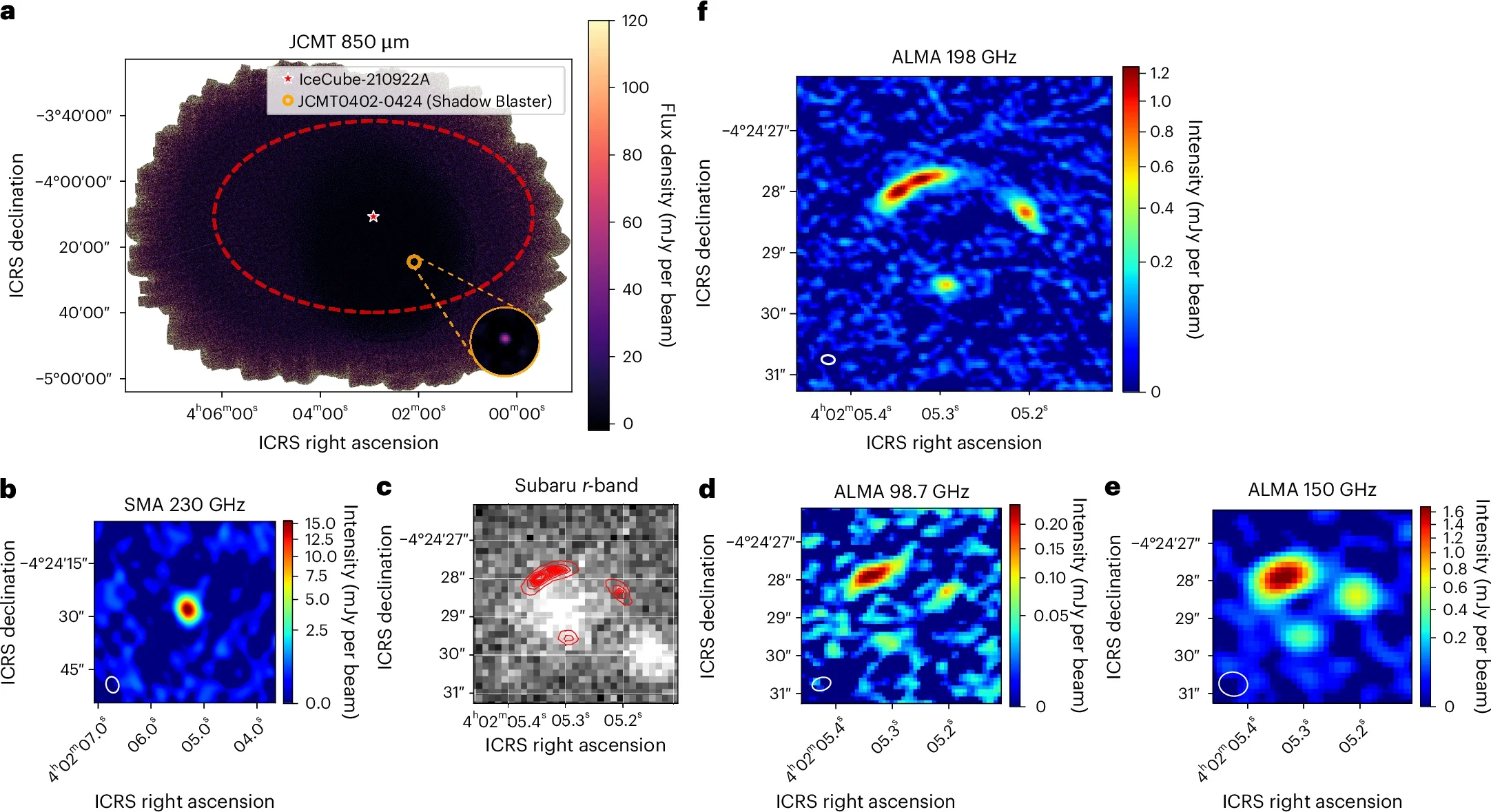
When an international team followed up on IC 210922A with the Atacama Large Millimeter/submillimeter Array, or ALMA, and other observatories, they found an unusually bright galaxy about 11 billion light-years away. Consequently, it became the prime suspect.
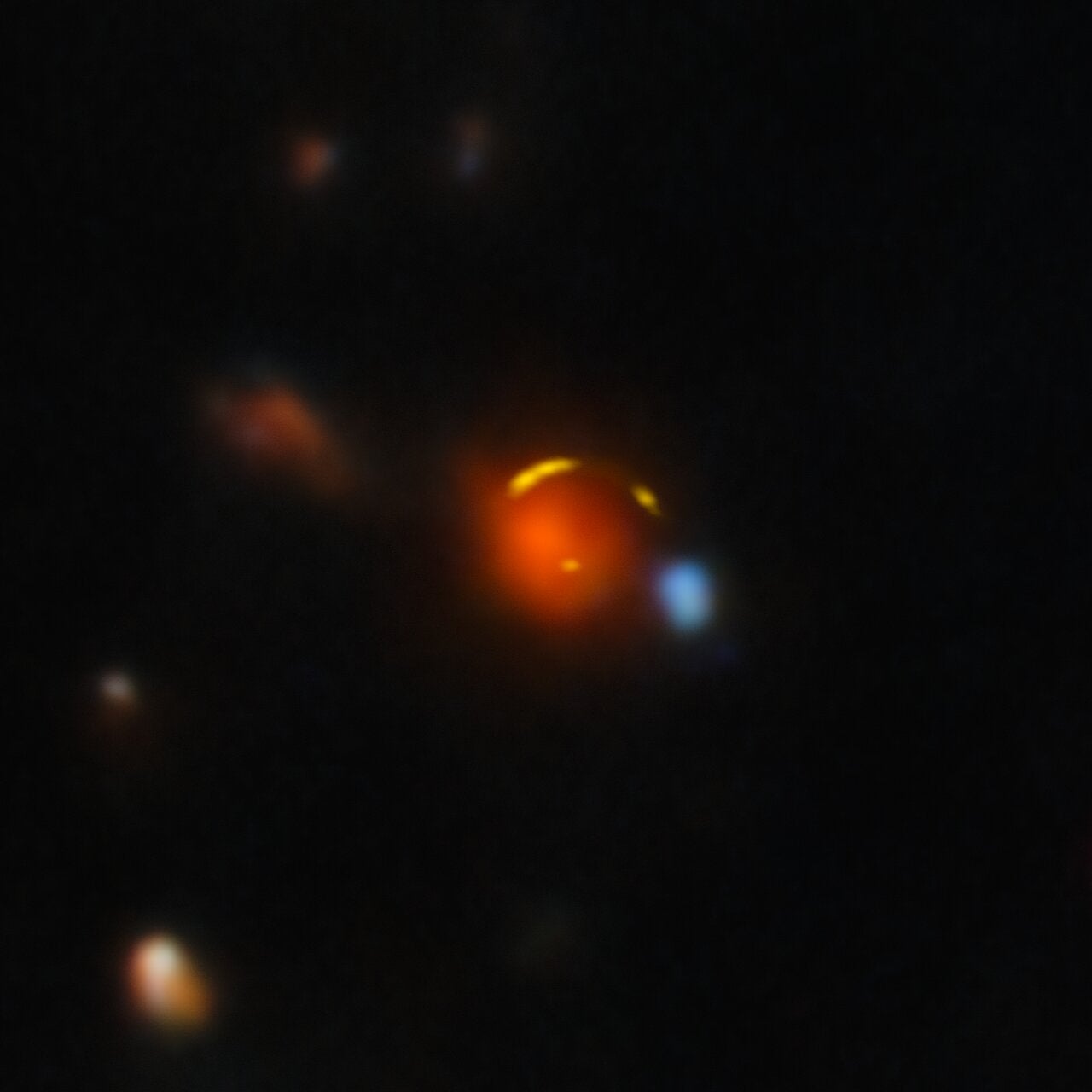
The galaxy, designated JCMT0402−0424 and nicknamed “Shadow Blaster,” stood out because it glowed strongly at submillimeter wavelengths while remaining faint in visible light. That is a classic sign of a dusty galaxy. In these galaxies, starlight is being absorbed and re-emitted by thick clouds of dust.
Early on, a supermassive black hole looked like the obvious explanation. The few neutrino sources identified before this have been powered by such black holes. But this case kept resisting that pattern.
Follow-up observations found no energetic emission that would point to an active black hole dominating the system. No convincing gamma-ray, X-ray, optical transient, or hard X-ray source turned up in the field. Swift, NuSTAR, Fermi-LAT, Fermi-GBM, HAWC, ANTARES, the Zwicky Transient Facility, and DESI all came up empty for a more familiar counterpart.
That left astronomers with a stranger possibility. Maybe the engine behind the galaxy’s brilliance, and perhaps the neutrino itself, was not a black hole at all. Instead, it could be a compact and extreme burst of star formation.
The odds of this galaxy appearing in the IceCube localization by chance were already low. Based on bright submillimeter source counts, the chance coincidence probability was estimated to be about 0.3%. This makes Shadow Blaster statistically uncommon in that patch of sky.
The team got a crucial break from gravity itself.
A foreground galaxy happened to sit in just the right place to bend and amplify the radio waves coming from Shadow Blaster behind it. This effect, called gravitational lensing, acted like a natural telescope. Therefore, it made the distant source appear brighter and larger than it otherwise would.
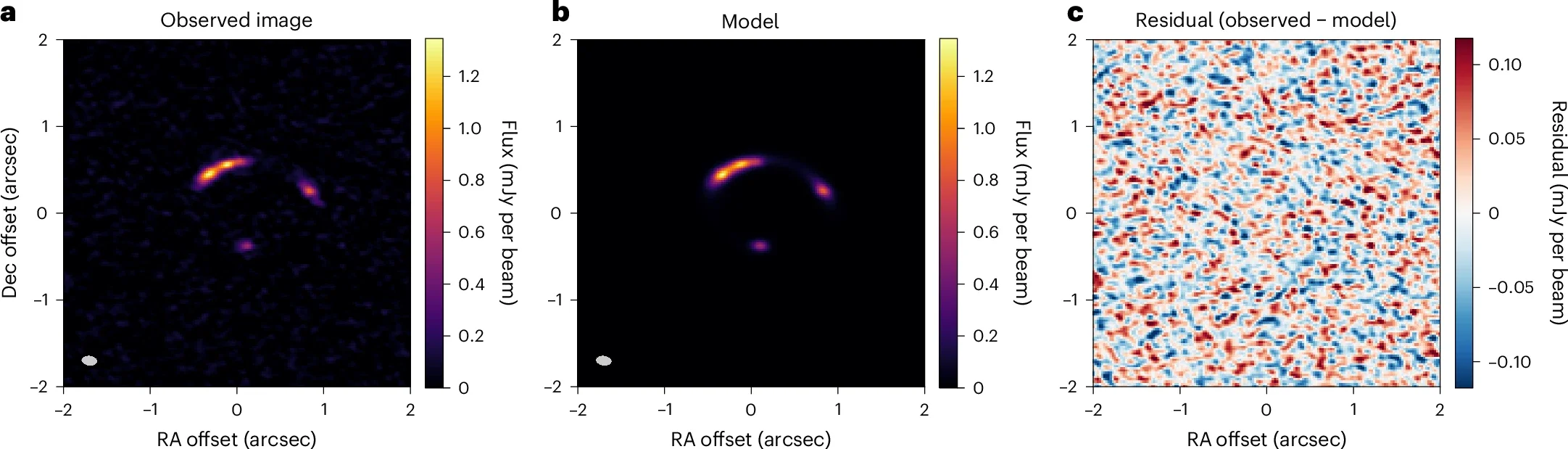
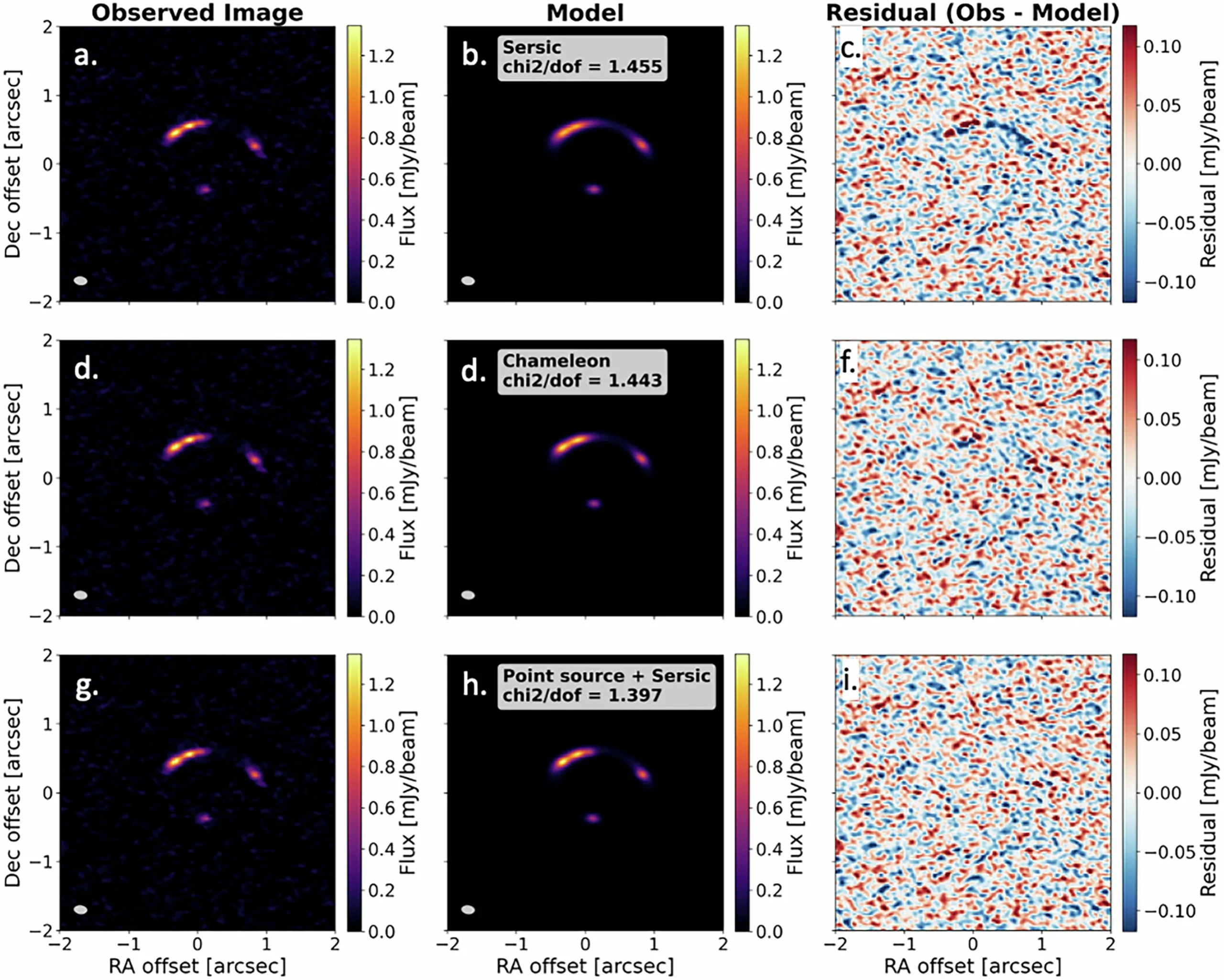
ALMA’s high-resolution imaging showed that what looked compact at first was actually a strongly lensed system split into four images. The lensing galaxy sits near the center of that configuration. Modeling showed it could account for the geometry with remarkable precision.
That magnification let astronomers probe the galaxy’s internal structure. What they found was a compact core loaded with gas and dust in a region only about 1,500 light-years across. More detailed lens modeling resolved an extended component with an intrinsic size of roughly 520 parsecs, or about 1,700 light-years. There was also an unresolved point-like component nearby.
The source lies at a redshift of 2.9880, placing it near the peak era of cosmic star formation. Its infrared luminosity, after correcting for lensing, is about 2.7 trillion times that of the Sun. This puts it firmly in the class of ultraluminous infrared galaxies. Its star formation rate was estimated at roughly 270 to 470 solar masses per year.
The case for star formation grew stronger as the physical picture sharpened.
ALMA detected several molecular and atomic lines, including CO transitions and neutral carbon. This allowed the team to estimate the galaxy’s gas content and internal motions. The broad line component had widths of about 400 to 500 kilometers per second. This is typical of compact starburst galaxies at this epoch and narrower than the extreme molecular outflows often linked to powerful active galactic nuclei.
Depending on the method used, the molecular gas mass ranged from about 7 billion solar masses to as much as 40 billion to 100 billion solar masses. The dynamical mass in the central region was estimated at roughly 10 billion to 30 billion solar masses. Even with those uncertainties, the picture stayed consistent. A large share of the mass is concentrated in dense molecular gas.
That matters because such compact, gas-rich environments are efficient places for cosmic rays to slam into surrounding material. Those collisions can generate neutrinos.
In other words, Shadow Blaster seems to meet the calorimetric conditions needed for neutrino production. Rather than relying on a black hole jet, it may be using extreme star formation and dense gas as its particle accelerator.
For any single object, though, the expected neutrino yield remains modest. The team estimated that a source like this would produce at most an expected number of detected events of less than about 0.06 over 10 years. That sounds small, but it is in line with expectations for other proposed neutrino sources considered one by one.
What makes this result important is not just one galaxy. It is the population behind it.
Dusty star-forming galaxies were already considered plausible neutrino factories on theoretical grounds, especially during “cosmic noon,” when galaxies were rapidly building stars between redshifts of about 1 and 4. However, proving their role observationally has been difficult.
The new work argues that compact dusty starburst galaxies like Shadow Blaster could make a meaningful, though subdominant, contribution to the diffuse high-energy neutrino background. Population modeling in the study suggests compact-core dusty star-forming galaxies may account for around 15% of that background. They could possibly make as much as about 20% over the 30 TeV to PeV range considered.
That does not mean all dusty star-forming galaxies are neutrino-bright. The proposed contributors are a compact subset, likely caught in especially intense phases. Strongly lensed systems like Shadow Blaster are simply easier to spot.
The broader implication is that high-energy neutrinos may come from more than one kind of cosmic engine. Supermassive black holes remain part of the story, but they may not have to carry it alone.
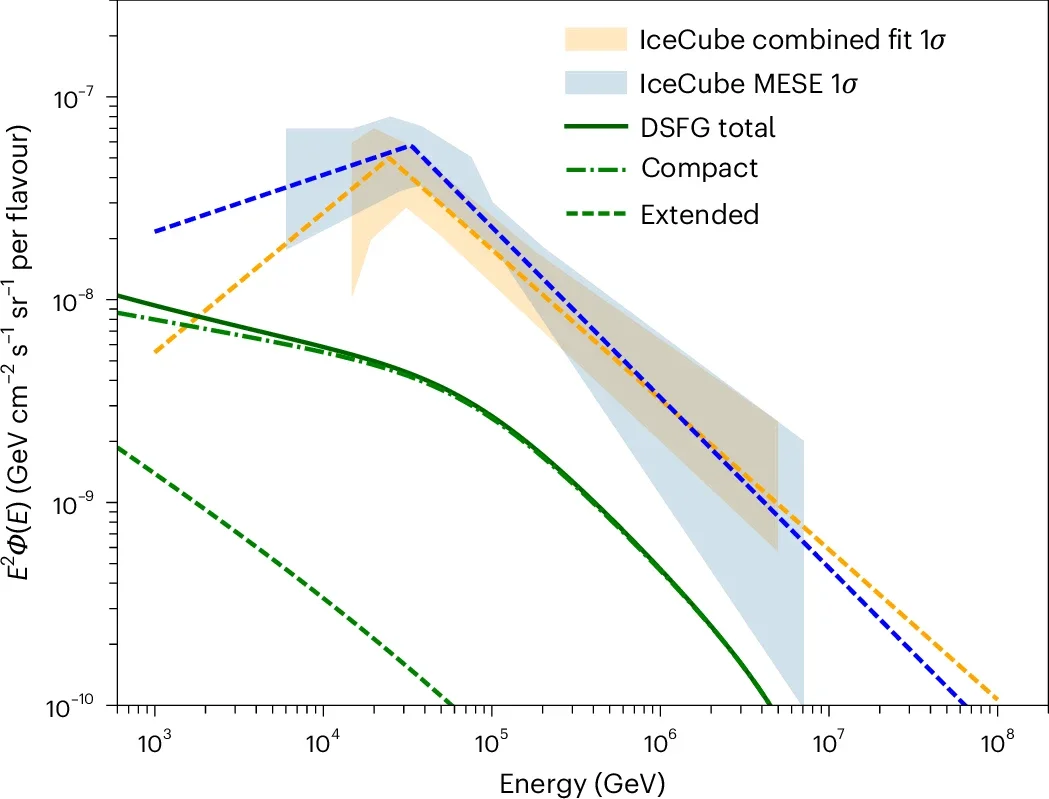
This work gives astronomers a new class of targets in the search for the origin of cosmic neutrinos. Instead of focusing mainly on bright black hole systems, future searches can look harder at compact, dust-obscured starburst galaxies that are nearly invisible in ordinary light.
It also strengthens the case for wider and deeper submillimeter sky surveys, since the study suggests many of the relevant sources are likely fainter, unlensed dusty galaxies that current instruments cannot easily map across large IceCube error regions.
If that population can be identified more systematically, researchers may finally be able to explain a larger share of the diffuse neutrino background. Additionally, they can better understand how extreme star formation helps accelerate particles across the Universe.
Research findings are available online in the journal Nature Astronomy.
The original story “Shadow Blaster points to starburst galaxies as hidden sources of cosmic neutrinos” is published in The Brighter Side of News.
Like these kind of feel good stories? Get The Brighter Side of News’ newsletter.
The post Shadow Blaster points to starburst galaxies as hidden sources of cosmic neutrinos appeared first on The Brighter Side of News.

