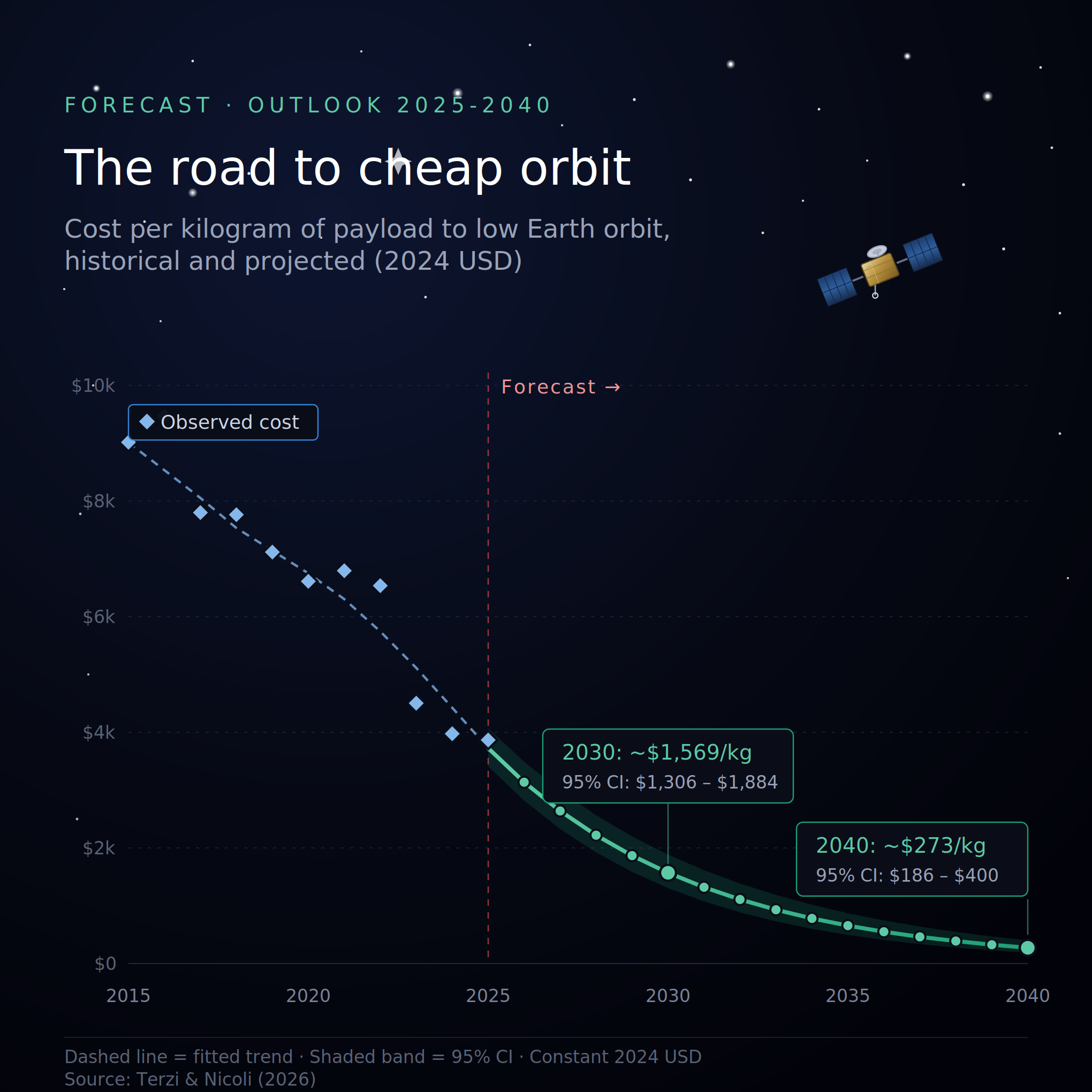
The cost of reaching orbit is on track to fall sharply, potentially transforming space from an expensive frontier into a broad commercial marketplace. New research projects that launch costs could drop 58 percent by 2030 and about 93 percent by 2040.
The Cambridge-led study estimates that sending one kilogram of payload into low Earth orbit cost an average of $3,868 in 2025. That figure could fall to $1,569 by the end of this decade and as low as $273 by 2040.
The analysis, published in PNAS Nexus, draws on more than 4,400 rocket launches between 1960 and 2025. Researchers assembled what they describe as the largest global dataset yet used to study the long-term economics of space launch technology.
The records cover 16 major spacefaring regions and countries, more than 330 rocket configurations, and launches by the United States, Russia, China, India, Europe, Japan and others.
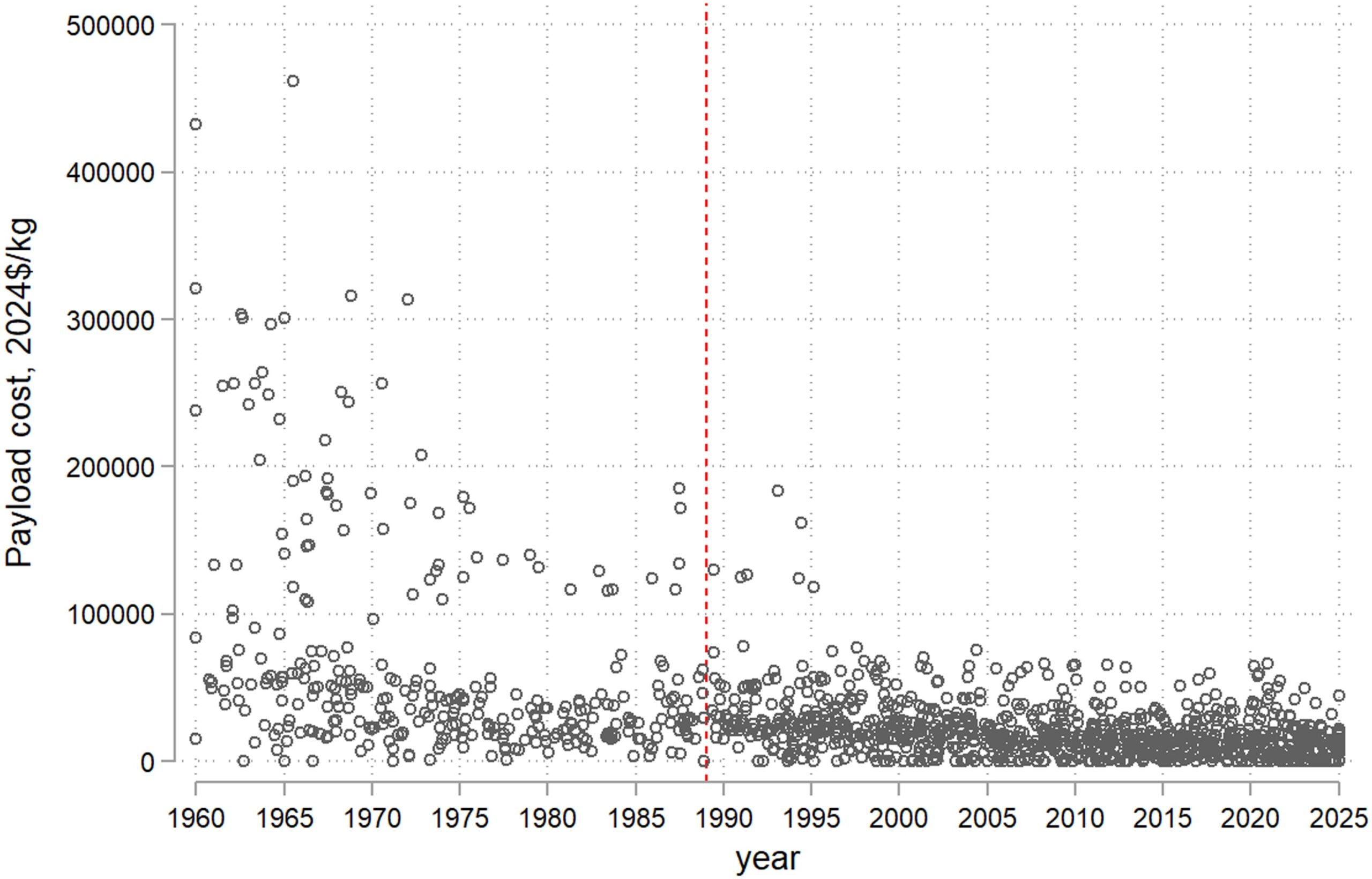
The team found that average launch costs have dropped by more than 96 percent since 1960. At the beginning of that period, sending one kilogram into orbit cost more than $87,000 in 2024 dollars.
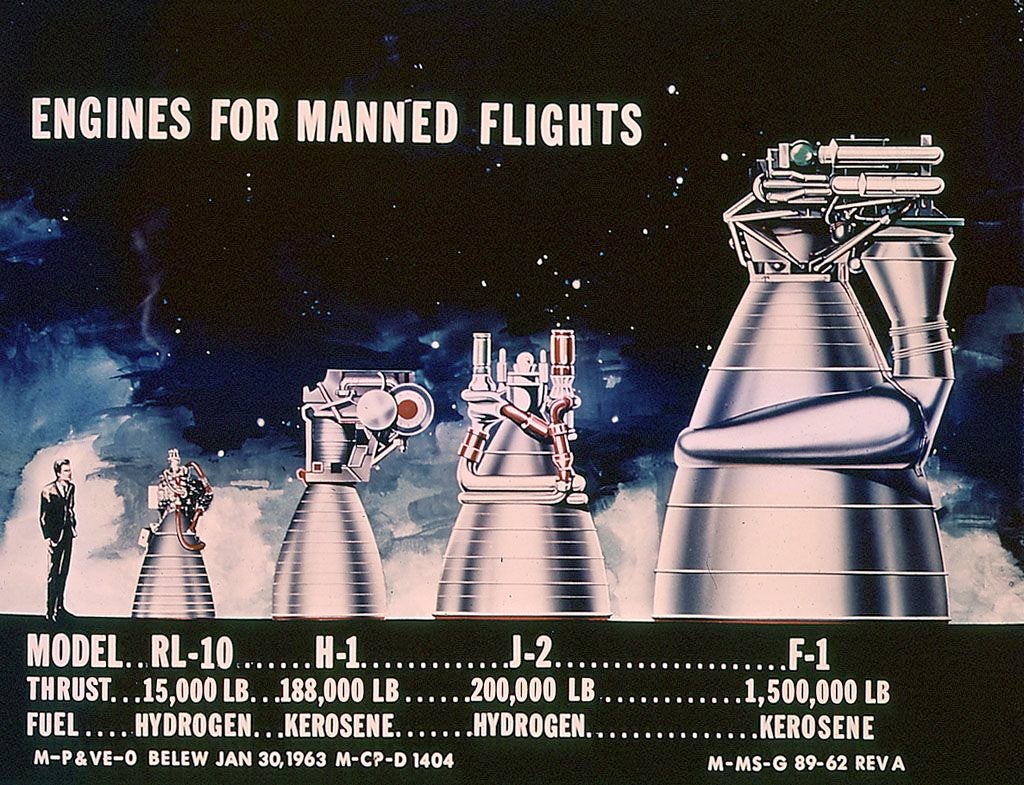
Costs fell quickly during the Space Race and reached about $20,000 per kilogram by the early 1970s. Progress then stalled after the Apollo program ended and the Saturn V rocket was phased out.
Launch expenses remained broadly stable until the early 1990s. Costs began falling again as private companies entered the market and commercial satellite activity expanded.
Dr. Alessio Terzi of Cambridge’s Bennett School of Public Policy led the study with Dr. Francesco Nicoli of the Politecnico Institute of Turin.
“Space is no longer a science-fiction fantasy or a purely scientific pursuit, it is becoming a marketplace,” Terzi said.
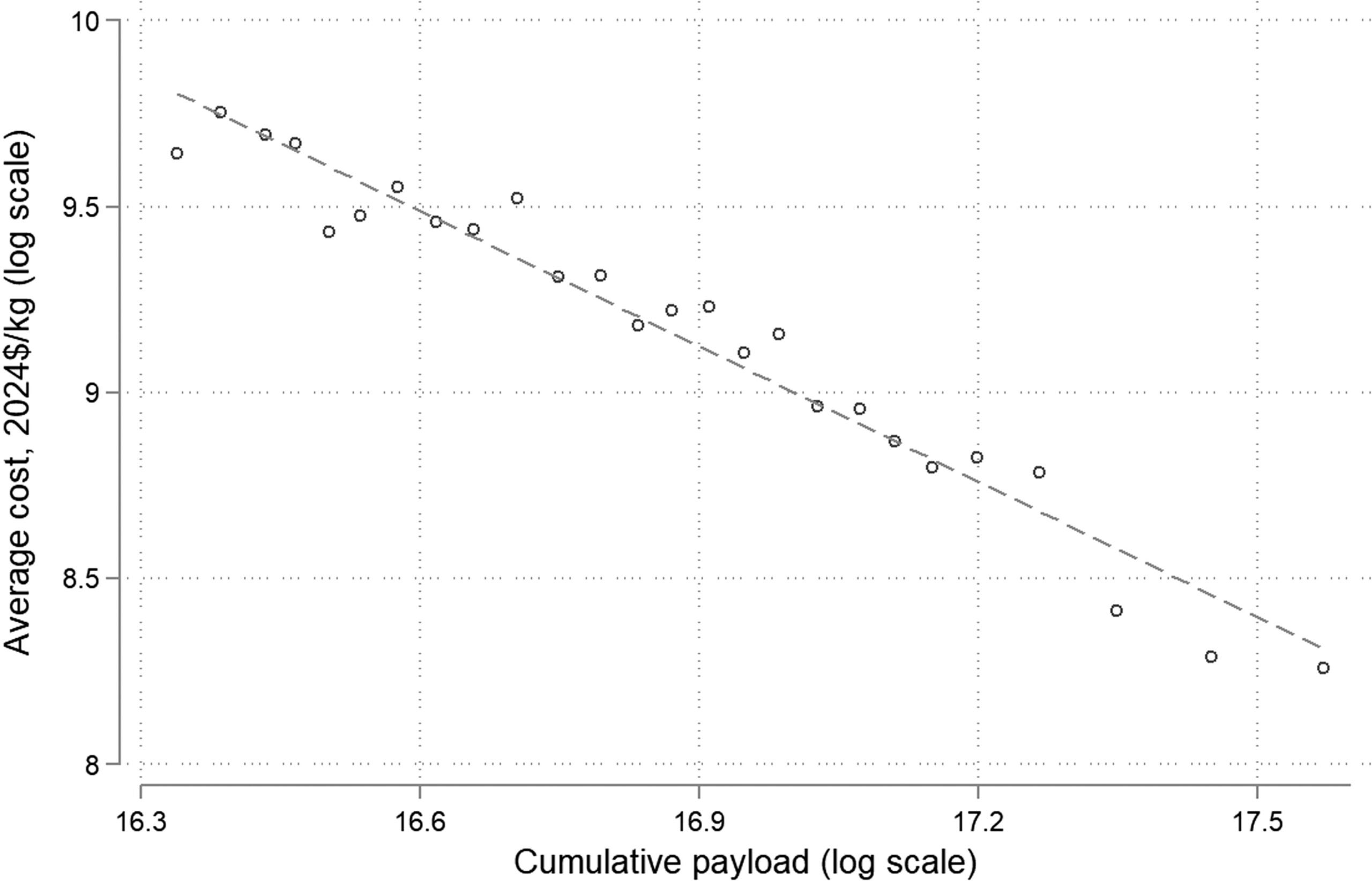
The researchers tested whether space launch technology follows Wright’s Law. The principle holds that costs tend to fall at a steady rate as cumulative production rises.
Their results showed that every doubling of cumulative payload reduced the average launch cost per kilogram by 21.2 percent. Since 2000, the relationship between payload growth and cost decline has been especially strong.
The pattern changed markedly after the Cold War. During the Cold War, costs fell about 17 percent each time cumulative payload doubled. After 1989, the decline reached roughly 44 percent per doubling.
“State-led competition during the Cold War did not foster cost efficiency on the same scale as the ensuing era of international space cooperation and private sector involvement,” Nicoli said.
The team separated cost reductions caused by learning within individual rocket families from those caused by shifting payloads toward cheaper launch systems.
Before the mid-1990s, lower average costs came mainly from moving payload to different rockets. Costs within established rocket families often rose.
After 1995, both factors contributed. Rocket operators improved through repeated use, while customers increasingly selected cheaper launchers. The second force remained more important over the past three decades.
The findings also place space launch technology ahead of several celebrated transport and energy transitions.
The researchers compared launch costs with steamship freight during the 19th century. Each doubling of cumulative wheat and cotton freight reduced shipping costs by about 15.5 percent.
Space launch costs fell faster, at 21.2 percent per doubling of payload.
“The cost of space launch technology is now falling faster than during one of history’s greatest transport revolutions,” Terzi said.
The team also compared rockets with solar photovoltaic technology, known for rapid cost declines. Solar module prices fell 99.8 percent between 1975 and 2023, while space launch costs fell 85.3 percent.
Yet rockets achieved that reduction with far less growth in total deployment. When measured against cumulative scale, the space launch experience curve was steeper.
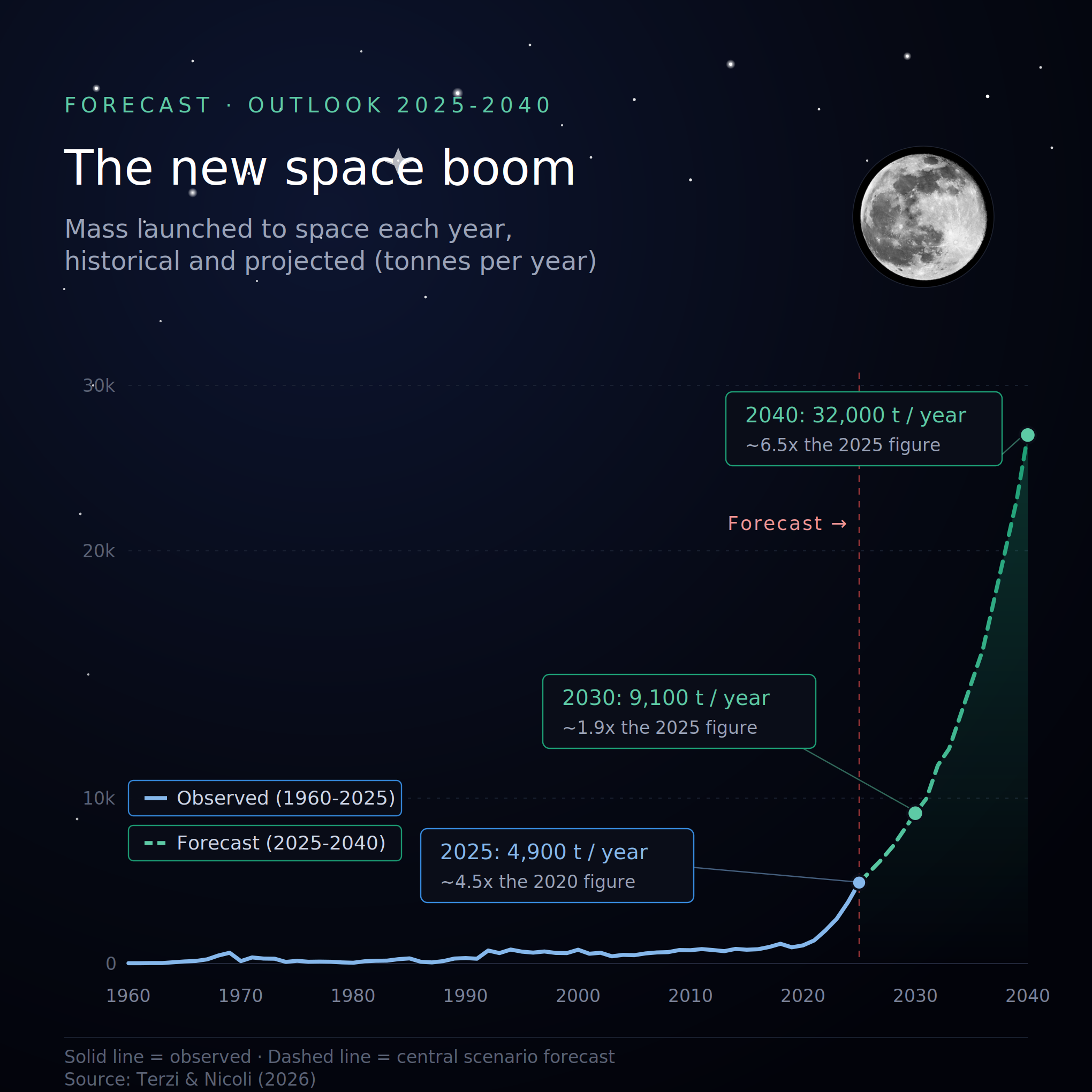
Payload growth has accelerated since 2020. The annual amount sent into orbit has increased by 31 percent, compared with average yearly growth of 4 percent between 2000 and 2019.
About 4,900 tonnes reached orbit in 2025. Under the central forecast, annual global capacity could rise to 9,100 tonnes by 2030 and 32,000 tonnes by 2040.
Lower costs could support industries that remain too expensive today. The study points to microgravity research, orbital tourism, fibre-optic manufacturing, pharmaceutical production and 3D-bioprinted organs.
Other possibilities include orbital solar power, asteroid mining, and systems that produce fuel, food or infrastructure in space.
“Rapidly falling launch costs could open the way to space colonisation and commercial activity far beyond low Earth orbit,” Terzi said.
The forecasts still depend on continued growth in payload volume. In the researchers’ most conservative scenario, launch costs would fall 45 percent by 2030 and 75 percent by 2040.
Market concentration presents another risk. SpaceX currently carries roughly three-quarters to four-fifths of the world’s annual orbital payload, depending on the measure used.
A dominant provider could charge prices well above underlying costs. Geopolitical tensions could also push governments toward more expensive domestic launch systems to preserve strategic independence.
Space debris may impose further limits. Rapid growth in satellites and other objects could make low Earth orbit more hazardous and slow future expansion.
Cheaper launches could lower the barrier for universities, smaller companies and governments seeking access to orbit. More frequent missions may also make scientific experiments and commercial manufacturing easier to repeat and scale.
The findings give policymakers and investors a clearer way to estimate how launch economics may change. They also show that falling technical costs will not automatically produce equally low market prices.
Competition policy, international cooperation and debris management could determine whether projected savings reach customers. Without those safeguards, monopoly power and strategic rivalry may delay the wider economic benefits of cheaper access to space.
Research findings are available online in the journal PNAS Nexus.
The original story “Space launch costs could fall 93% by 2040, opening orbit to new industries” is published in The Brighter Side of News.
Like these kind of feel good stories? Get The Brighter Side of News’ newsletter.
The post Space launch costs could fall 93% by 2040, opening orbit to new industries appeared first on The Brighter Side of News.

