A sugar found in raspberries and sunless tanning products has turned up near the Milky Way’s center. The discovery marks the first direct detection of a true sugar in interstellar space, and it complicates a familiar view of cosmic chemistry.
The molecule, erythrulose, was identified in the molecular cloud G+0.693−0.027, about 8.2 kiloparsecs from Earth. The cloud lies in the Galactic Center region and ranks among the richest known reservoirs of complex molecules.
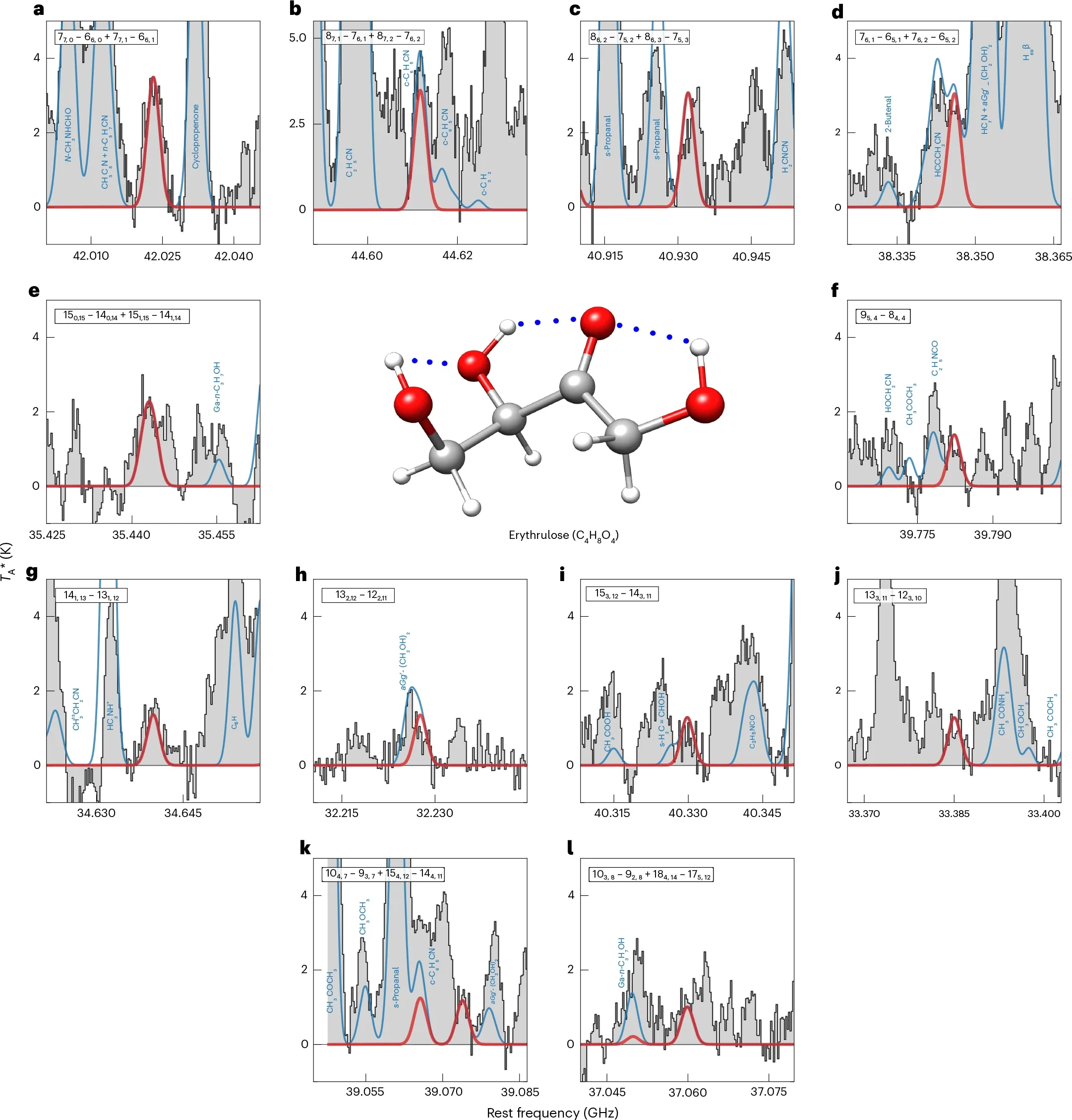
An international team led by Izaskun Jiménez-Serra of Spain’s Center for Astrobiology, or CAB, matched 12 sets of radio signals from the cloud with erythrulose’s laboratory spectrum. Those sets accounted for 17 individual transitions.
The result matters because sugars sit at the heart of biology. They form part of DNA and RNA and support metabolism. Yet origin-of-life experiments have struggled to produce them efficiently under conditions thought to resemble early Earth.
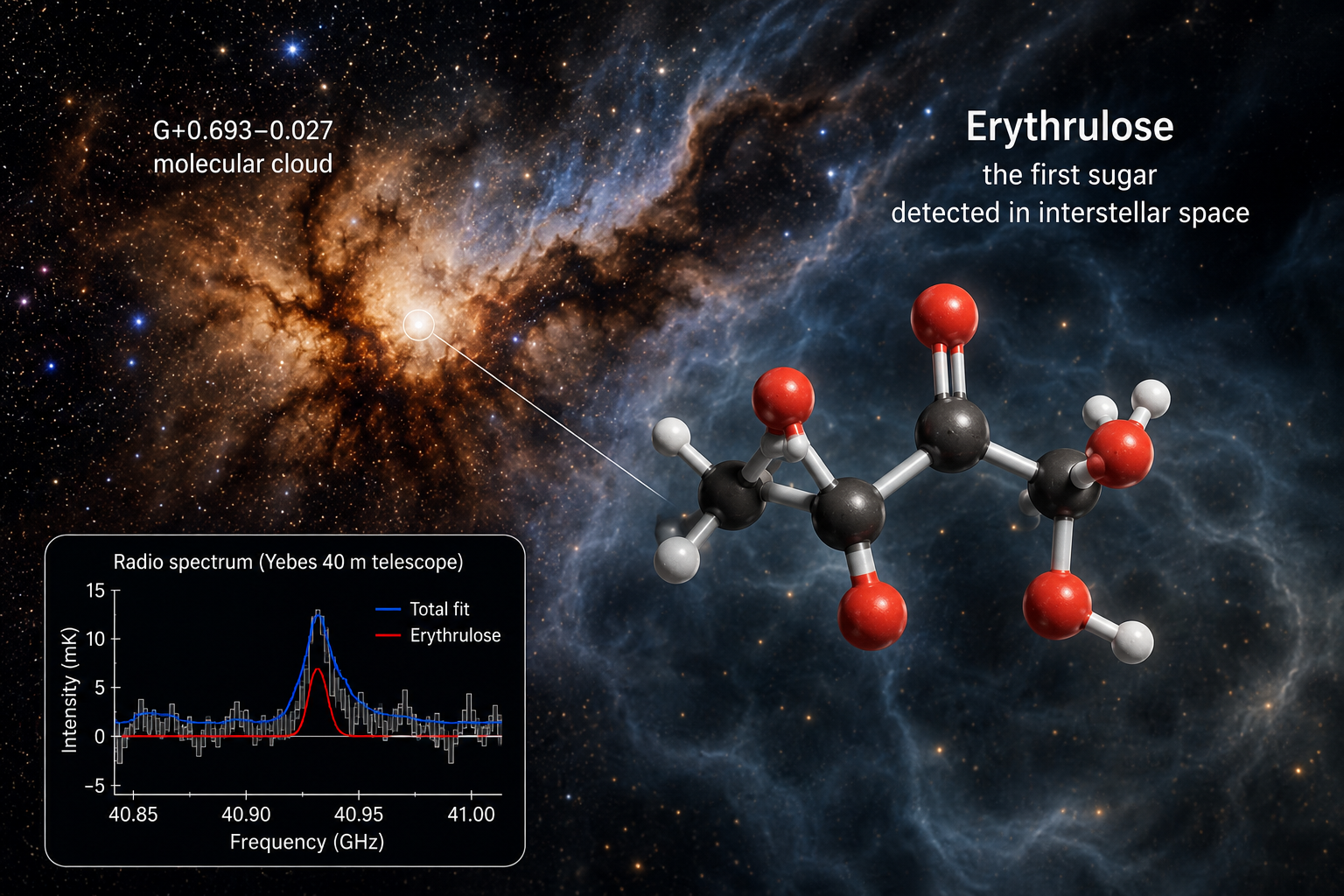
Astronomers used highly sensitive surveys from the 40-meter Yebes radio telescope and the IRAM 30-meter telescope.
Finding one molecule in G+0.693 is difficult because the cloud contains signals from more than 180 identified molecular species and their isotopic forms. Many lines overlap.
Six of the erythrulose line sets were mostly unblended, with contamination at or below 25 percent. Other lines overlapped with unidentified or known molecules, but the complete spectral model still closely matched the observations.
The chance that all six cleanest lines aligned randomly was estimated at 0.2 percent. Even using only three or four lines would produce confidence levels of 95.2 percent and 98.3 percent.
Erythrulose is the only possible four-carbon ketose, a sugar containing a ketone group. With 14 atoms, it is also the largest non-cyclic molecule yet identified in interstellar space and the first detected there with four oxygen atoms.
It is also only the second chiral molecule reported in the interstellar medium. Chiral molecules can exist in mirror-image forms, a property central to biological chemistry.
The team expected smaller three-carbon sugars to be easier to find. Instead, glyceraldehyde and dihydroxyacetone were absent.
Erythrulose appeared at least eight to 17 times more abundant than those three-carbon sugars. That runs against a common astrochemical pattern in which each added carbon atom lowers a molecule’s abundance by roughly tenfold.
“This finding was unexpected, as the prevailing view in astrochemistry is that interstellar molecules grow in size through the sequential addition of carbon atoms,” Jiménez-Serra said.
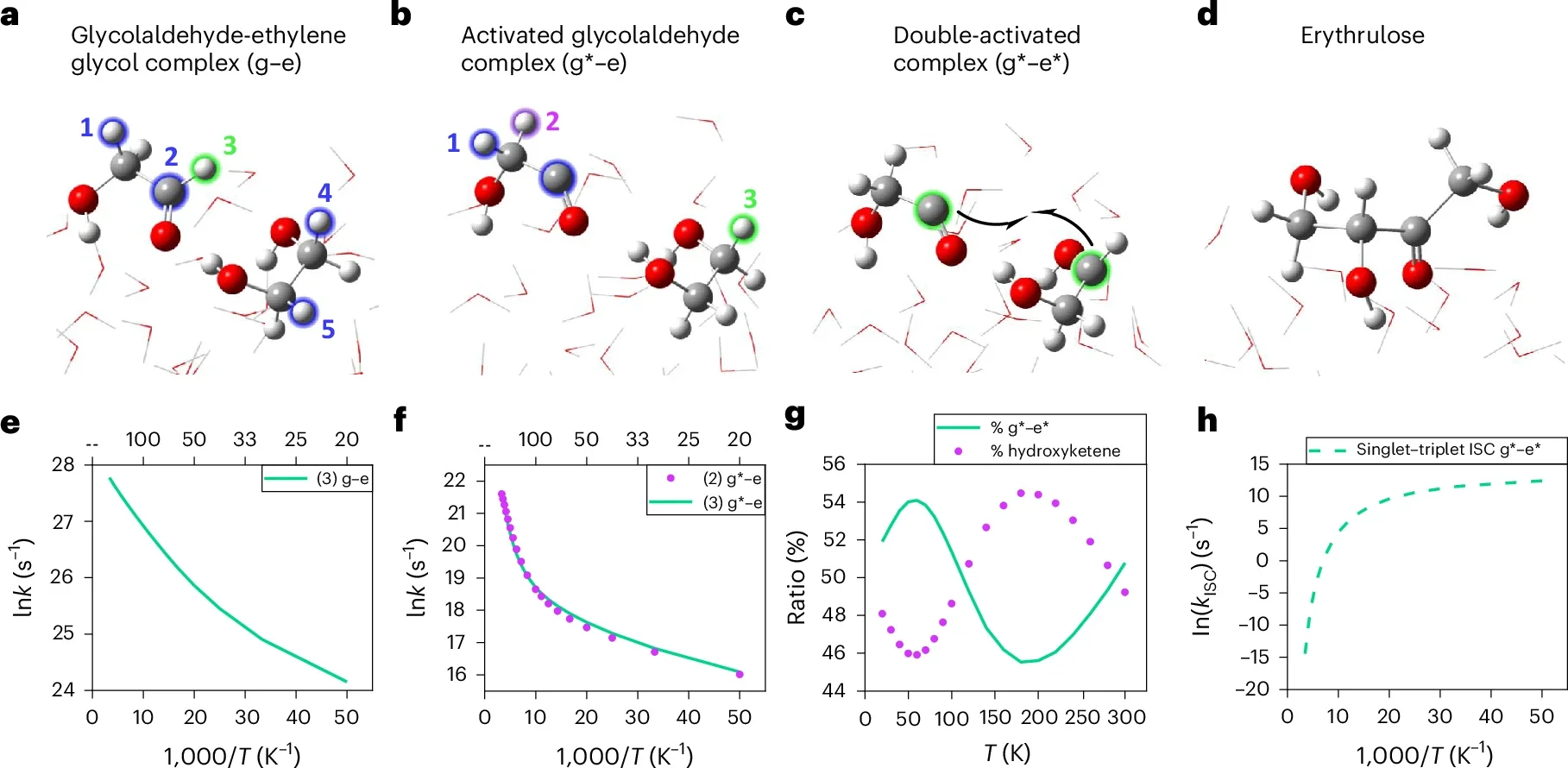
The researchers therefore examined whether erythrulose could form by joining two-carbon ingredients already present in the cloud. Their work focused on glycolaldehyde and ethylene glycol, both detected at comparable or higher abundances.
Chemical calculations found a possible pathway on amorphous water ice coating interstellar dust grains. Hydrogen atoms first remove hydrogen from the two molecules, creating reactive radicals. Those radicals can eventually join to form erythrulose.
The slowest stage involves a change in electron spin before the carbon atoms can combine. At dust temperatures of about 20 to 30 kelvin, the full process remained fast enough to operate under Galactic Center conditions.
Because the pathway has two mirror-image versions with equal energy, it would produce both forms of erythrulose in equal amounts.
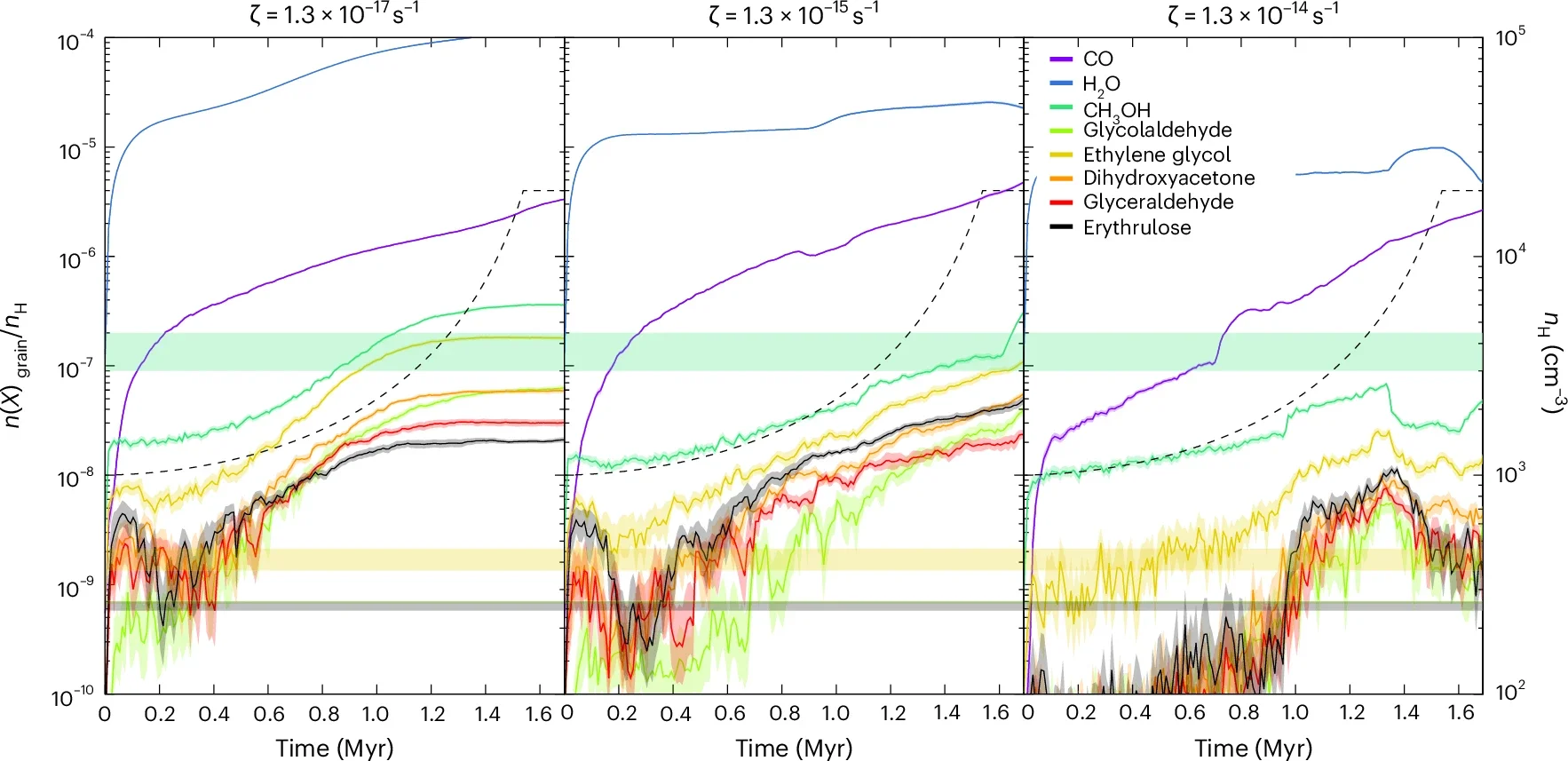
The team added the proposed reactions to computer simulations of ice forming inside a collapsing cloud. The model included several three-carbon and four-carbon sugars, related compounds, ultraviolet destruction and different cosmic-ray ionization rates.
Erythrulose became the most efficiently produced four-carbon sugar under most conditions. It often reached slightly greater abundances than the smaller sugars, especially when cosmic-ray activity was high and the chemical evolution time was shorter.
The researchers linked that pattern to faster ultraviolet destruction of the three-carbon sugars. Larger molecules may spread absorbed energy across more internal motions, making them harder to break apart.
Models with cosmic-ray ionization rates 1,000 times the standard Galactic value came closest to the observed amounts. Such intense rates have previously been used to explain other molecules in G+0.693.
The cloud may also be undergoing a collision that drives a shock near 20 kilometers per second. That disturbance could knock molecules from icy grains into the gas, where radio telescopes can detect them.
The simulations did not reproduce every measurement. They overproduced the two undetected three-carbon sugars by factors of about 25 to 70.
Several uncertainties could explain the mismatch. Only part of the ice may leave the grains. Sugars may quickly freeze back onto cold dust, or gas-phase reactions may destroy them after release. Reaction rates and ultraviolet destruction efficiencies also remain uncertain.
Sugars including ribose and glucose have already been found in primitive meteorites and samples from asteroid Bennu. Those discoveries raised the possibility that some of Earth’s early sugar supply came from space.
Erythrulose now pushes that chemistry back into the interstellar medium, before asteroids and planets formed.
Laboratory work has shown that mixtures containing erythrulose can help produce ribonucleotides, the building blocks of RNA. In water, erythrulose can also change into threose.
Threose forms the backbone of threose nucleic acid, a simpler RNA alternative proposed for a possible pre-RNA world.
Using the abundance measured in G+0.693, the team estimated that roughly 0.5 million to 50 million tonnes of erythrulose could have reached Earth during heavy bombardment between about 4.1 and 3.9 billion years ago. The authors noted that the scale and timing of that bombardment remain debated.
Small sugars and related molecules can survive meteorite impacts in experiments, supporting a possible delivery route to planetary surfaces.
“The detection of erythrulose is very exciting because it opens up the possibility of discovering in space other sugars such as ribose, which is part of RNA, and other important molecules for the origin of life,” said co-author Carlos Briones.
The discovery gives origin-of-life chemistry a plausible natural source for sugar ingredients that are often added to experiments without explaining where they came from.
It also gives astronomers a tested spectral target and a workable search method for other sugars. Accurate laboratory measurements made the detection possible after years in which sugars were too fragile and moisture-sensitive for conventional analysis.
The finding does not show that interstellar sugars created life on Earth. It does show that chemically useful sugars can form without biology, survive in extreme environments and potentially enter young planetary systems.
Future searches for ribose and other sugars can now test how far that chemistry extends, both in the Milky Way and in material that later becomes comets, asteroids and planets.
Research findings are available online in the journal Nature Astronomy.
The original story “Sugar found in interstellar space may have seeded life on Earth” is published in The Brighter Side of News.
Like these kind of feel good stories? Get The Brighter Side of News’ newsletter.
The post Sugar found in interstellar space may have seeded life on Earth appeared first on The Brighter Side of News.

