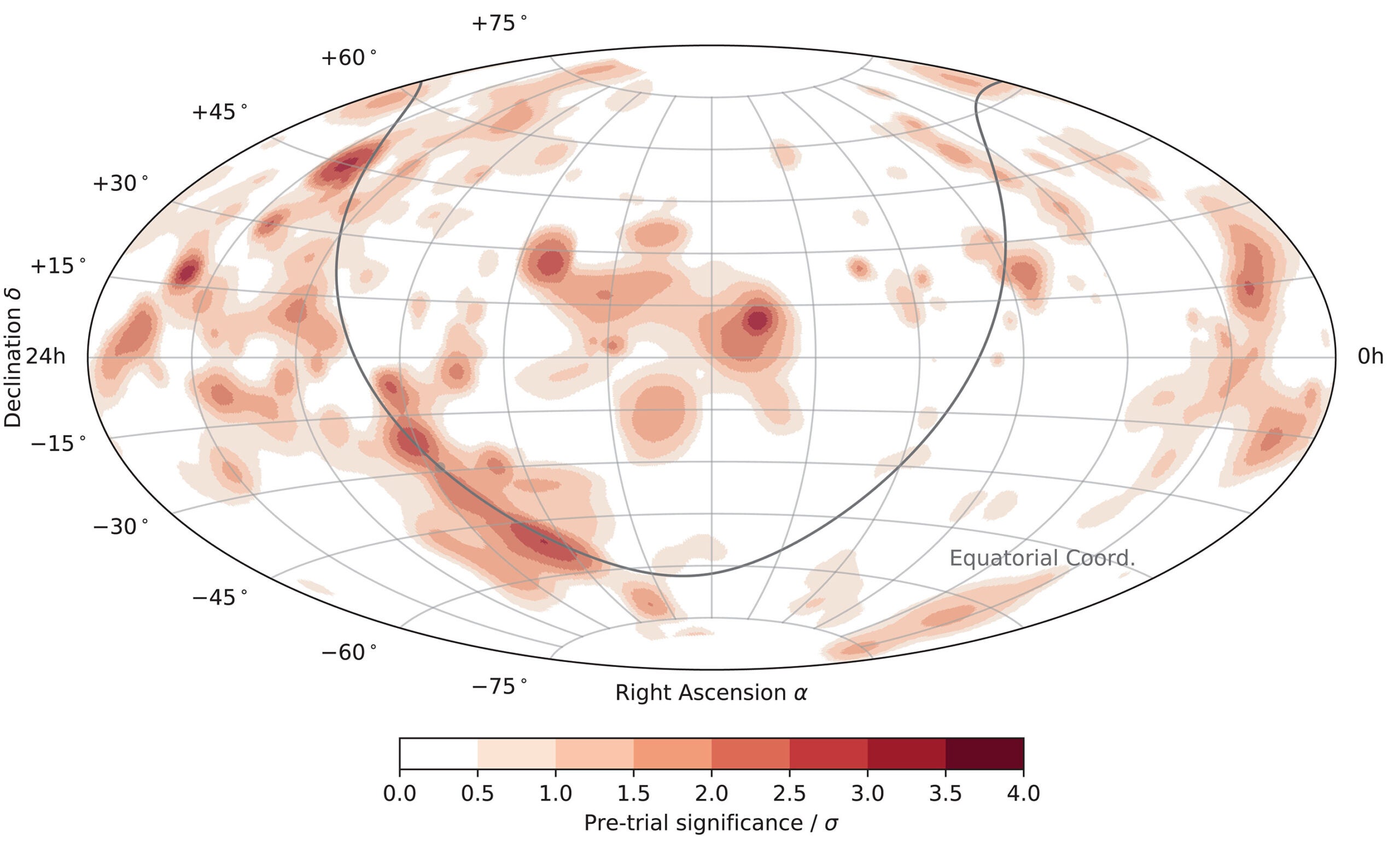
The Milky Way has long been mapped in starlight, radio waves and gamma rays. Now it has appeared in an entirely different form: a ghostly image traced by high-energy neutrinos, with the strongest signal concentrated toward the galaxy’s center.
The image comes from 10 years of observations by the IceCube Neutrino Observatory at the South Pole. The results, published in Science, provide strong evidence that the Milky Way itself produces high-energy neutrinos.
Members of the IceCube Collaboration at Stockholm University and Uppsala University helped analyze the data. Their work suggests cosmic-ray interactions near the Galactic Center may be more intense than earlier models predicted.
“Seeing our galaxy with neutrinos is something that we dreamed of, but which seemed out of reach for our project for many years to come,” said Chad Finley, associate professor at Stockholm University’s Department of Physics. “What made this result possible today is the revolution in Machine Learning, allowing us to explore much deeper into our data than before.”
Neutrinos are tiny particles that rarely interact with matter. That makes them difficult to detect, but useful as cosmic messengers because they travel through matter and space with little disturbance.
The Galactic plane was already considered a likely neutrino source. High-energy cosmic rays, including energetic protons and atomic nuclei, collide with gas and dust in the Milky Way. Those collisions create particles called pions.
Neutral pions decay into gamma rays, while charged pions produce neutrinos. Because both can emerge from related cosmic-ray interactions, astronomers expected a broad neutrino glow along the Galactic plane. Gamma-ray observations had already mapped much of this activity, but predictions for neutrinos remained uncertain.
IceCube offered a way to test those expectations directly. Its 5,160 digital optical modules sit between 1.5 and 2.5 kilometers below the Antarctic surface. They detect Cherenkov radiation produced when neutrinos interact with nuclei in the ice or bedrock.
Finding astrophysical neutrinos requires separating them from an enormous background. IceCube observes events at about 2.7 kilohertz, mostly from atmospheric particles, and records about 100 million atmospheric muons for every astrophysical neutrino.

The team focused heavily on cascade events, compact particle showers produced mainly by electron and tau neutrinos and certain interactions involving all three neutrino flavors.
Cascades have poorer directional precision than long particle tracks, but they bring advantages in the Southern sky, where the Galactic Center lies. They reduce atmospheric-neutrino contamination by about an order of magnitude at tera-electron volt energies and allow an analysis threshold near 1 TeV.
Deep neural networks dramatically increased the usable sample. The new selection retained more than 20 times as many events as the method used in an earlier IceCube cascade analysis of the Galactic plane. It also improved angular resolution by up to a factor of two at tera-electron volt energies.
The researchers analyzed data collected from May 2011 through May 2021. Their final sample contained 59,592 events across the sky, from 500 GeV to several peta-electron volts. An earlier selection had retained 1,980 events from seven years of observations.
About 6% of the final sample was estimated to come from atmospheric muons and roughly 7% from astrophysical neutrinos. The remaining 87% were atmospheric neutrinos.
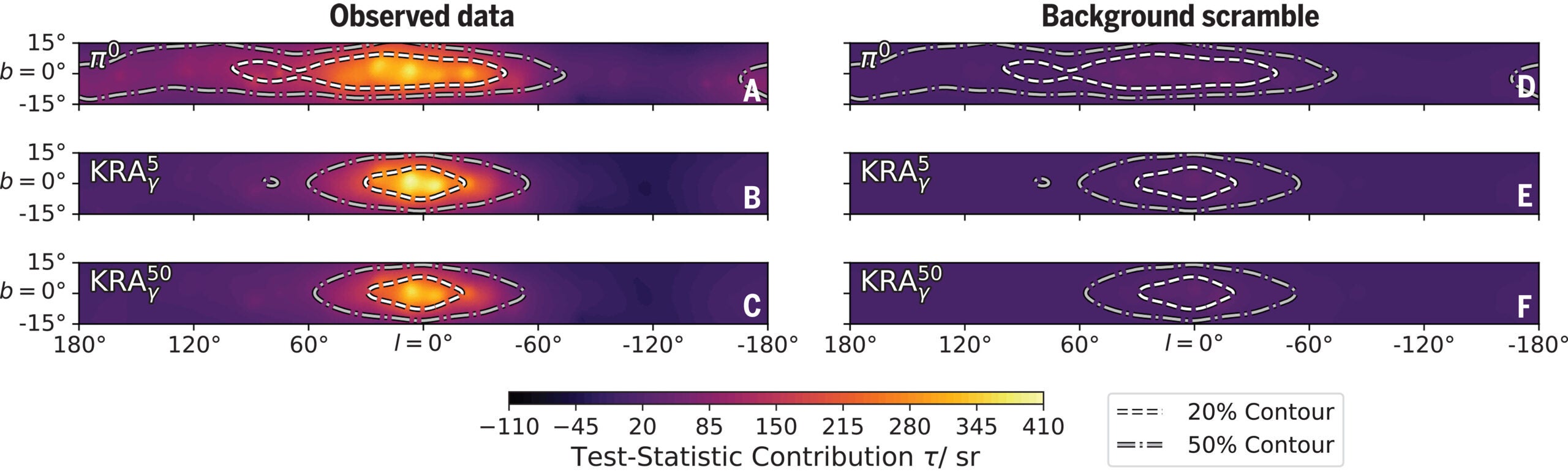
The analysis tested three models for diffuse neutrino emission from the Milky Way. Each was based on gamma-ray observations but used different assumptions about cosmic-ray behavior and the distribution of emission.
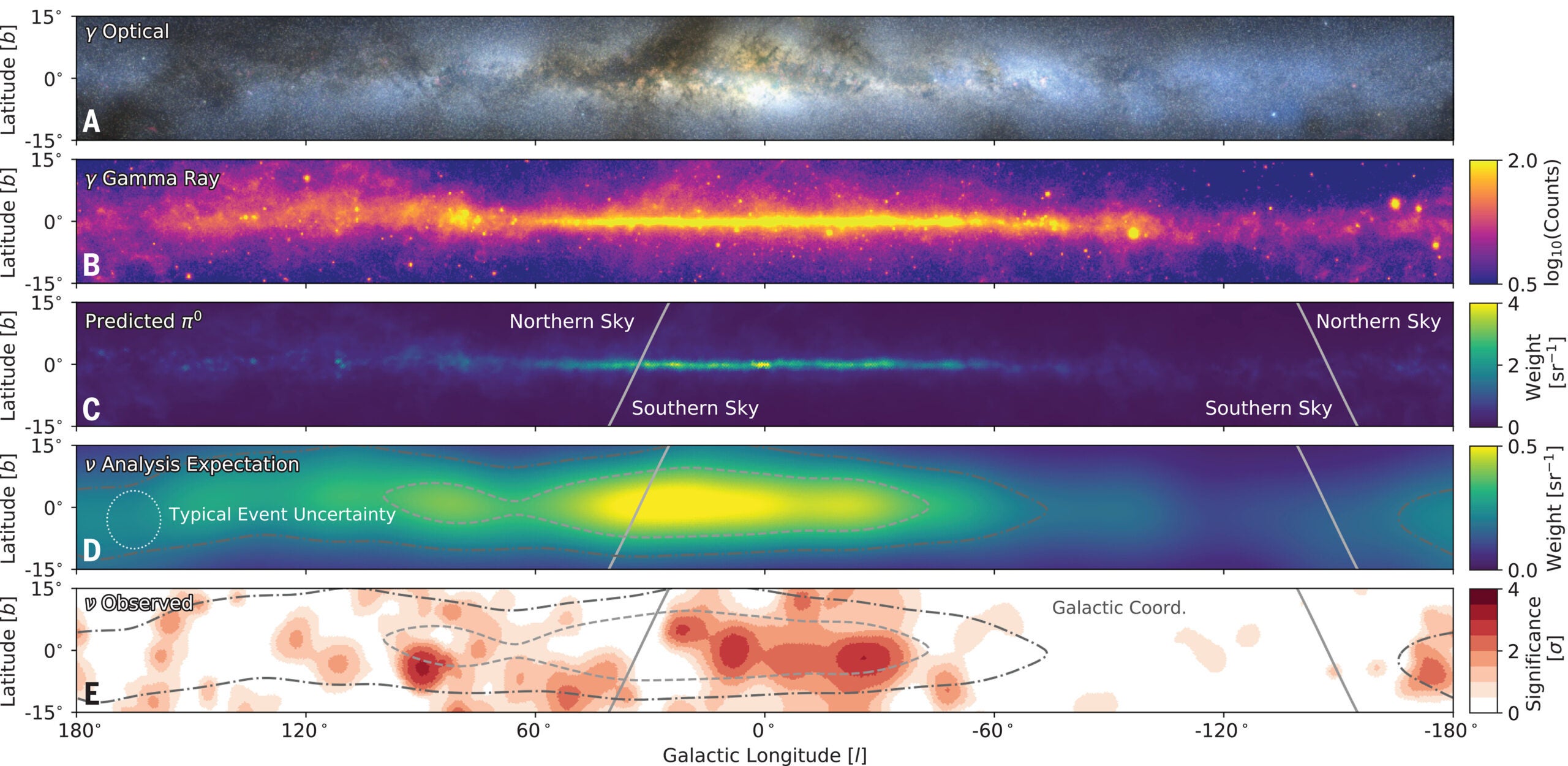
All three produced evidence above the background-only expectation. Their significances were 4.71 sigma, 4.37 sigma and 3.96 sigma. After a conservative correction for testing three related models, the strongest result corresponded to 4.48 sigma.
One model predicted neutrinos spread more evenly along the Galactic plane, while the others concentrated more emission near the Galactic Center. The data could not determine which model best describes the true source pattern.
A separate all-sky search examined individual locations. Some excesses coincided with known gamma-ray emitters, including the Crab Nebula, 3C 454.3 and the Cygnus X region. None remained statistically significant after accounting for the many locations tested.
That indicates the Galactic signal is not dominated by one obvious point source.
Catalog searches involving supernova remnants, pulsar wind nebulae and unidentified Galactic gamma-ray sources each produced excesses at or above 3 sigma. The team did not claim detections because those objects overlap with regions where diffuse Galactic emission is already expected to be strongest.
The observed neutrino flux leaves major questions unresolved. In the simpler neutral-pion model, the best-fitting high-energy flux was about five times above the model prediction.
The mismatch could reflect differences in cosmic-ray propagation near the Galactic Center, changes in their energy spectrum, or contributions from unresolved neutrino sources.
Tests favored diffuse emission along the Galactic plane, but the data could not confidently distinguish among the tested models or identify embedded point sources.
Depending on the model, the inferred Milky Way signal contributes about 6% to 13% of the previously observed astrophysical neutrino flux at 30 TeV.
“Previous discoveries with IceCube have involved neutrino emission from much greater distances and it is really exciting that we can now see a neutrino image of our own galaxy,” said Klas Hultqvist, professor at Stockholm University’s Department of Physics.
The result gives astronomers another way to examine where particles interact inside the Milky Way. Neutrinos travel with little interference, so they can trace cosmic-ray interactions even where photons may be absorbed or altered.
The next step is to learn whether specific Galactic objects contribute to the signal and how much comes from diffuse interactions with interstellar gas.
“This opens the door to studying further processes using neutrinos. The first step is to try to identify objects in the Milky Way as neutrino sources. IceCube-Gen2, an upgrade of IceCube that we are now planning, would give us much greater sensitivity for further studies of events in the galaxy.”
These resources explore how astronomers are refining the Milky Way’s neutrino map, searching for specific Galactic sources and connecting neutrino observations with cosmic rays and gamma rays.
The Galactic Neutrino Sky: Predictions from Gamma-ray Observations
This recent analysis uses Galactic gamma-ray measurements to refine predictions for the high-energy neutrino sky and examine what current and future observations can reveal about cosmic-ray interactions across the Milky Way. (arXiv, 2026)
Measuring the Astrophysical Galactic Plane Neutrino Flux and Searching for Galactic PeVatrons using the IceCube Multi-Flavor Astrophysical Neutrino Sample
IceCube researchers combine more than 12 years of multiple neutrino event types to improve measurements of the Galactic plane and search for powerful cosmic-ray accelerators, including candidates in the Cygnus region. (International Cosmic Ray Conference, 2025)
Analysis of the Diffuse Astrophysical Flux from the Galactic Plane with 12.1 Years of IceCube Starting Tracks, Throughgoing Tracks and Cascades
This IceCube analysis combines three detection channels to measure the Galactic neutrino spectrum from TeV to PeV energies and examine different regions of the Milky Way with less dependence on fixed emission models. (International Cosmic Ray Conference, 2025)
The origin of very high-energy diffuse γ-ray emission
This research examines the origin of the Milky Way’s diffuse very-high-energy gamma-ray glow and its connection to cosmic-ray interactions, providing important multimessenger context for interpreting Galactic neutrinos. (Astronomy & Astrophysics, 2025)
Characterization of the astrophysical diffuse neutrino flux using starting track events in IceCube
Using more than a decade of IceCube observations, this study measures the broader astrophysical neutrino spectrum, helping establish the high-energy neutrino background against which the Milky Way’s contribution must be understood. (Physical Review D, 2024)
Research findings are available online in the journal Science.
The original story “The Milky Way glows brightly in first-of-its-kind neutrino image” is published in The Brighter Side of News.
Like these kind of feel good stories? Get The Brighter Side of News’ newsletter.
The post The Milky Way glows brightly in first-of-its-kind neutrino image appeared first on The Brighter Side of News.


Leave a comment
You must be logged in to post a comment.