Earth’s unusually large Moon may not have assembled gradually from a vast ring of debris after all. Under the right conditions, much of it could have emerged as an intact body only hours after another world slammed into the young Earth.
That possibility comes from new simulations that add something surprisingly important to one of planetary science’s best-known collision models: the strength of rock and metal.
Researchers from the Southwest Research Institute and University of Arizona found that accounting for the physical strength of the proto-Earth and a Mars-sized impactor called Theia can fundamentally change the aftermath of their collision. The results, published in The Astrophysical Journal Letters, suggest the temperature of Theia before impact could determine whether the Moon formed quickly as a large surviving remnant or gradually from orbiting debris.
“We discovered that the preexisting geology of the Mars-sized proto-moon matters,” said lead author Adeene Denton, formerly of the University of Arizona’s Lunar and Planetary Laboratory and now at Southwest Research Institute.
The giant-impact hypothesis has dominated discussions of lunar origins for decades. In the canonical version, a body roughly the size of Mars struck the proto-Earth about 4.5 billion years ago at an oblique angle.
The enormous collision dispersed material into orbit. That material formed a hot protolunar disk, which eventually accumulated into the Moon.
Many simulations have treated Earth and Theia essentially as fluids because the collision was energetic enough to produce tremendous melting and vaporization. Under that assumption, the internal strength of rock appeared too small to matter.
“Because the collision was considered violent enough to melt and vaporize large portions of Earth and Theia, those previous papers assumed that it is okay to approximate them as fluids,” said University of Arizona researcher Erik Asphaug. “Based on our new results, however, we think that it is time to reconsider that.”
Denton and her colleagues used smoothed-particle hydrodynamics simulations that incorporated temperature-dependent geological strength. Their models gave rocky mantles and metallic cores realistic resistance to deformation while allowing them to weaken as temperatures approached melting.
The simulations started with a proto-Earth containing 0.877 Earth masses and a Theia containing 0.133 Earth masses. Each had a rocky mantle and iron core, with the collision occurring at roughly 9 kilometers per second under the canonical 45-degree impact geometry.
The researchers then changed the pre-impact temperatures.
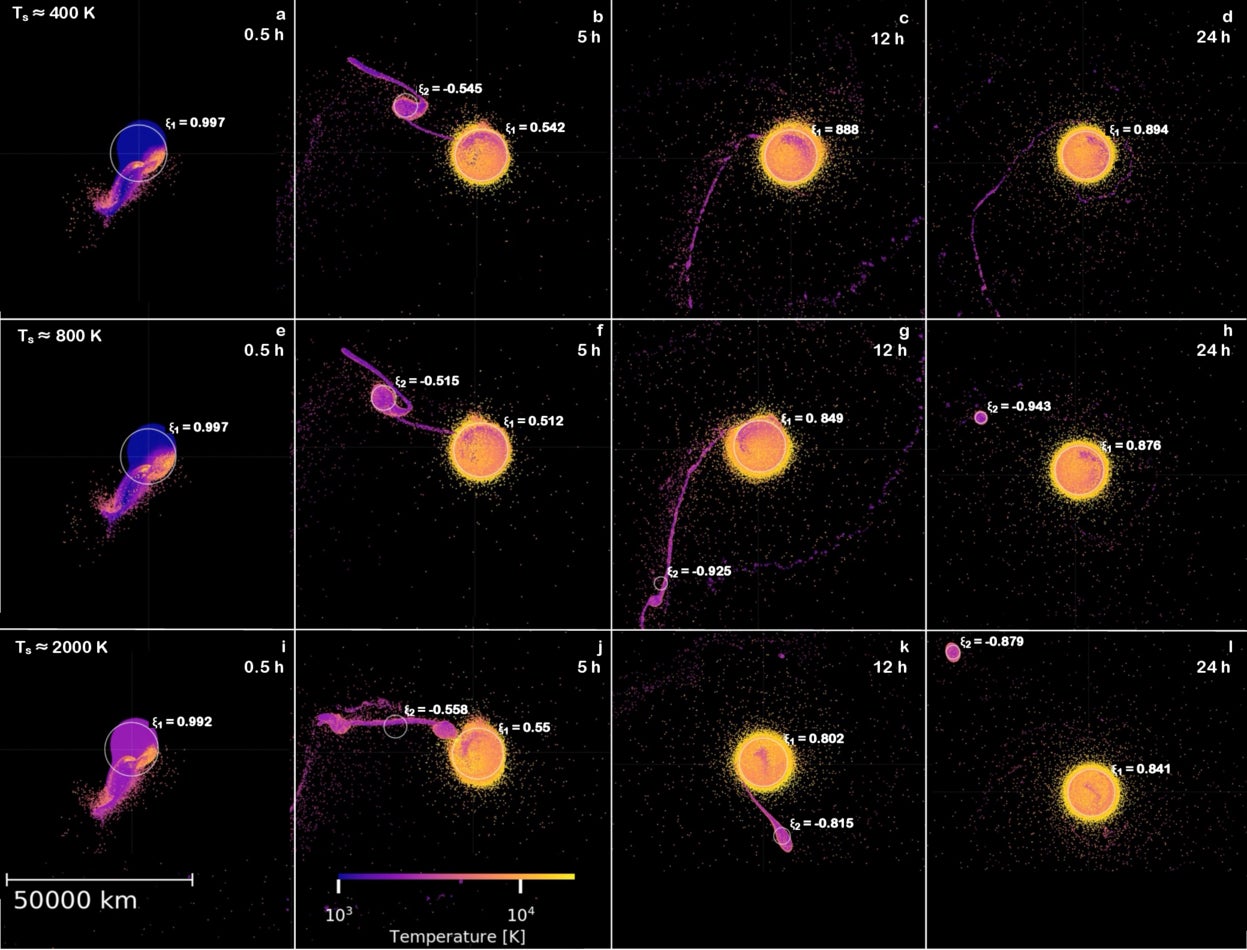
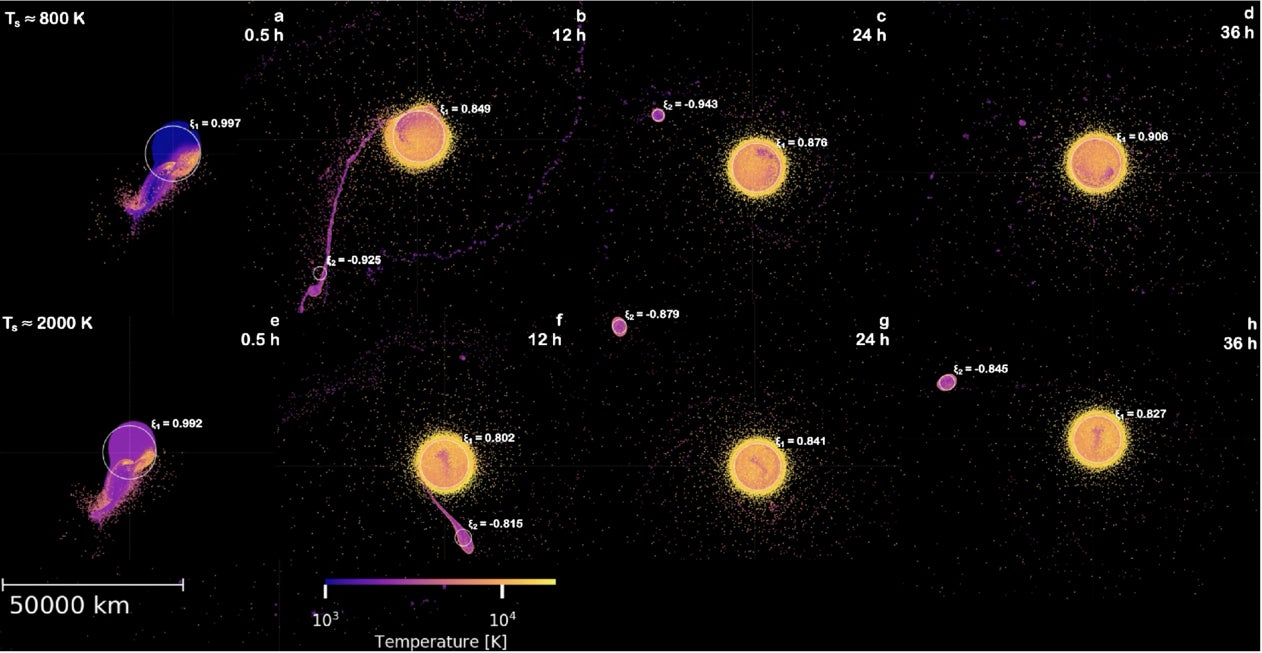
Their hottest models used surface temperatures around 2,000 kelvins, producing interiors that were weak but still mostly below their melting points. Warm simulations used roughly 800 kelvins, while colder and mechanically stronger bodies started around 400 kelvins.
The outcomes differed sharply.
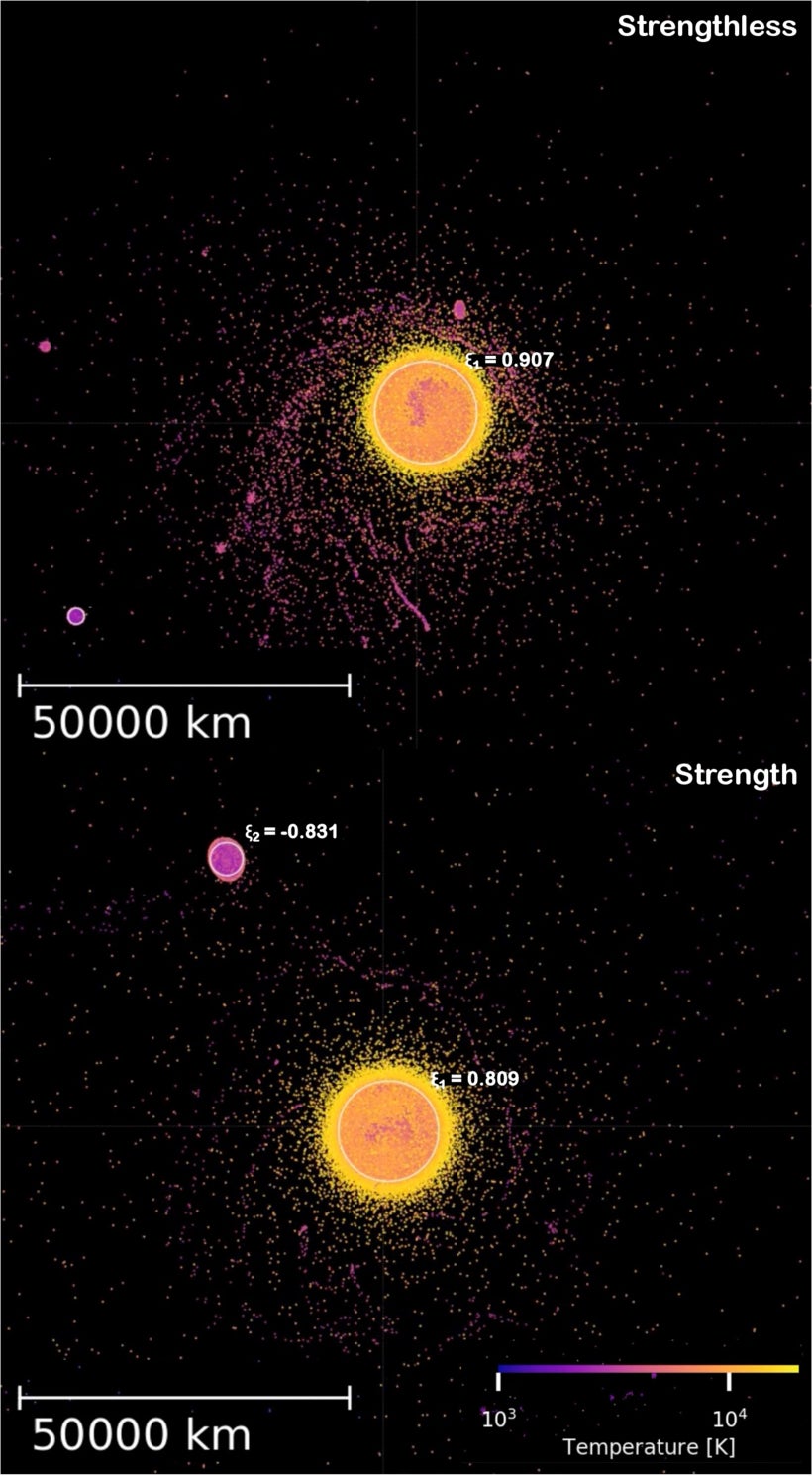
When material strength was ignored, the hot canonical collision behaved much like previous simulations. Earth accreted about 91% of Theia, while a relatively small portion of material entered orbit as a melt-dominated debris disk.
Adding strength changed the same impact dramatically. Theia did not simply flow apart. Instead, its rebounding material split into large components, allowing gravitational torques to throw the outer remnant into orbit.
After subsequent stripping and deformation, the simulations left a massive satellite that remained intact.
The transformation happened remarkably quickly. Separation of the satellite into orbit began within roughly five hours of impact.
The outer piece of Theia initially followed a close and eccentric orbit around Earth. As material was stripped from it and fell inward, gravitational interactions pushed the surviving satellite farther outward, a process the researchers nicknamed “walking the dog.”
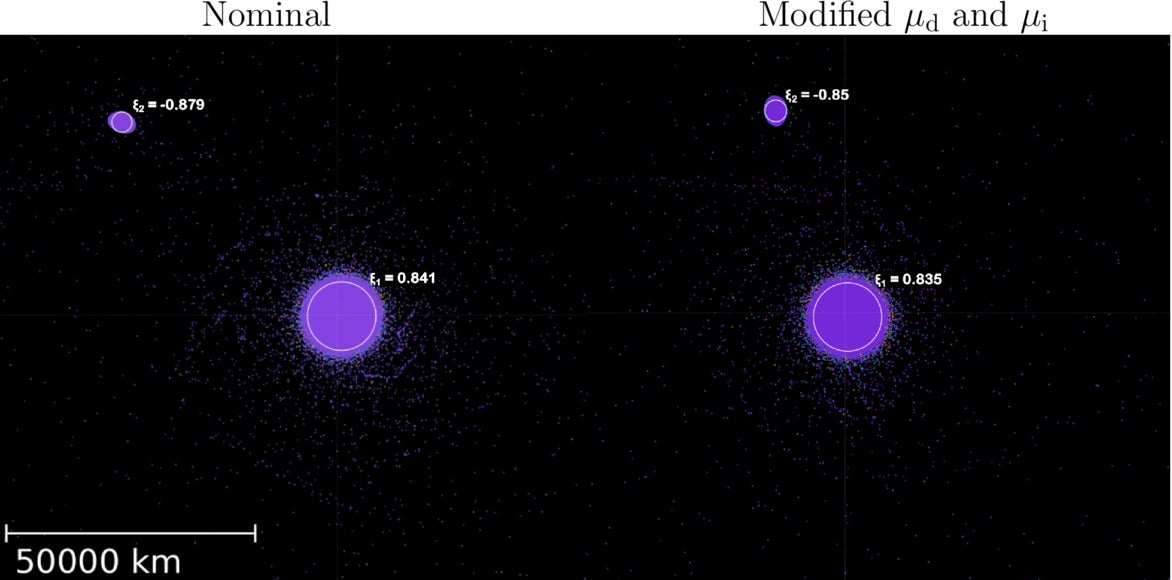
By the end of the hot simulation, the body had stabilized as a likely molten proto-Moon with about 1.78 times the mass of the present Moon. Other nearby combinations of impact velocity and angle produced satellites closer to the Moon’s actual mass.
A 45-degree collision at 1.05 times the mutual escape velocity, for example, produced an intact remnant of about 1.46 lunar masses.
These results do not establish that the real Moon formed intact. Instead, they demonstrate that direct satellite formation becomes a common possibility once geological strength is included under some canonical-like conditions.
It might seem logical that a colder and stronger Theia would be more likely to survive the collision intact. The simulations revealed something subtler.
At roughly 400 kelvins, Theia resisted deformation so effectively that much of it stayed together and eventually collided with Earth again. The final result was a substantial debris disk rather than a stable intact Moon.
At about 800 kelvins, the impact temporarily produced a smaller satellite containing roughly 0.63 lunar masses. It could not maintain a stable orbit and was eventually torn apart by Earth’s tides, feeding another debris disk.
The hotter, near-melting Theia occupied a useful middle ground. It was weak enough to deform and split, but still strong enough for a major fragment to remain coherent as gravitational interactions placed it into orbit.
“For a Theia near but below the melting point, a weak solid, we identify a range of scenarios where the Moon forms directly as an intact satellite,” the researchers conclude.
The link between temperature and structural strength could give scientists a new way to investigate when the Moon-forming collision occurred.
Protoplanets were hotter earlier in solar system history and generally cooled with time. If the giant impact happened relatively early, Theia could have remained hot enough for the intact-satellite pathway seen in the simulations.
The study notes that a hot, mostly solid Theia could be consistent with lunar formation occurring less than roughly 60 million years after the solar system began forming. A colder impactor could fit later timelines around 100 to 150 million years and would favor Moon formation from a disk.
“These surprising and exciting new results imply a potential connection between the physical properties of the moon today, including perhaps its volatile content, and the thermal state of the Earth and Theia at the time of the giant impact,” said Southwest Research Institute’s Robin Canup, who was not involved in the new study.
The new simulations do not solve every problem facing the giant-impact hypothesis.
In all of the scenarios examined, much of the material that ultimately becomes the Moon still originates from Theia. Yet lunar samples show a striking isotopic similarity to Earth, creating the longstanding question of why two initially separate worlds apparently produced such similar material.
One possibility is that Earth and Theia formed from similar parts of the young solar system. Other proposed Moon-formation models attempt to produce greater mixing between the two bodies.
The new work instead changes a more fundamental assumption about the collision itself. Planet-sized impacts may not be governed only by gravity, pressure and fluid flow. Even during catastrophic collisions, the geological strength of partly solid worlds can influence what survives.
“We now know that the geophysical state of Earth and Theia play a fundamental role in shaping the outcome of the collision,” said study co-author Namya Baijal.
The Moon’s history may therefore depend not only on how two worlds collided, but on how hot and solid they were when they met.
These studies provide broader context for the competing models, compositional problems and physical processes scientists use to reconstruct the Moon’s violent origin.
Origin of the Moon in a giant impact near the end of the Earth’s formation: This foundational simulation established the canonical Mars-sized impactor scenario and showed how an oblique collision could produce an iron-poor Moon while matching major dynamical properties of the Earth-Moon system. (Nature, 2001)
Immediate origin of the Moon as a post-impact satellite: High-resolution simulations found that a giant impact can immediately place a Moon-mass satellite into orbit, providing an important alternative to slow accretion from a debris disk. (The Astrophysical Journal Letters, 2022)
The Origin of the Moon Within a Terrestrial Synestia: Proposes that a high-energy impact created a hot, vaporized synestia within which the Moon grew and chemically equilibrated with Earth-derived vapor. (Journal of Geophysical Research: Planets, 2018)
Moon-forming impactor as a source of Earth’s basal mantle anomalies: Uses giant-impact modeling to investigate whether remnants of Theia could remain deep inside Earth, linking lunar formation with large structures now observed in the lower mantle. (Nature, 2023)
On the origin of Earth’s Moon: Reviews the giant-impact model, lunar chemistry, protolunar-disk evolution and the major observational constraints that any successful Moon-formation theory must explain. (Journal of Geophysical Research: Planets, 2016)
Research findings are available online in The Astrophysical Journal Letters.
The original story “The Moon may have formed almost intact within hours of Theia smashing into Earth” is published in The Brighter Side of News.
Like these kind of feel good stories? Get The Brighter Side of News’ newsletter.
The post The Moon may have formed almost intact within hours of Theia smashing into Earth appeared first on The Brighter Side of News.


Leave a comment
You must be logged in to post a comment.