Five drinking cups from Athens lay among the possessions placed beside a man buried in southern Italy. Recovered during the University of Basel’s 2026 excavations at Francavilla Marittima, they belonged to an unusually rich collection of imported pottery. Together with earlier discoveries of weapons and woodworking tools, they reveal a community that engaged selectively with the Greek world.
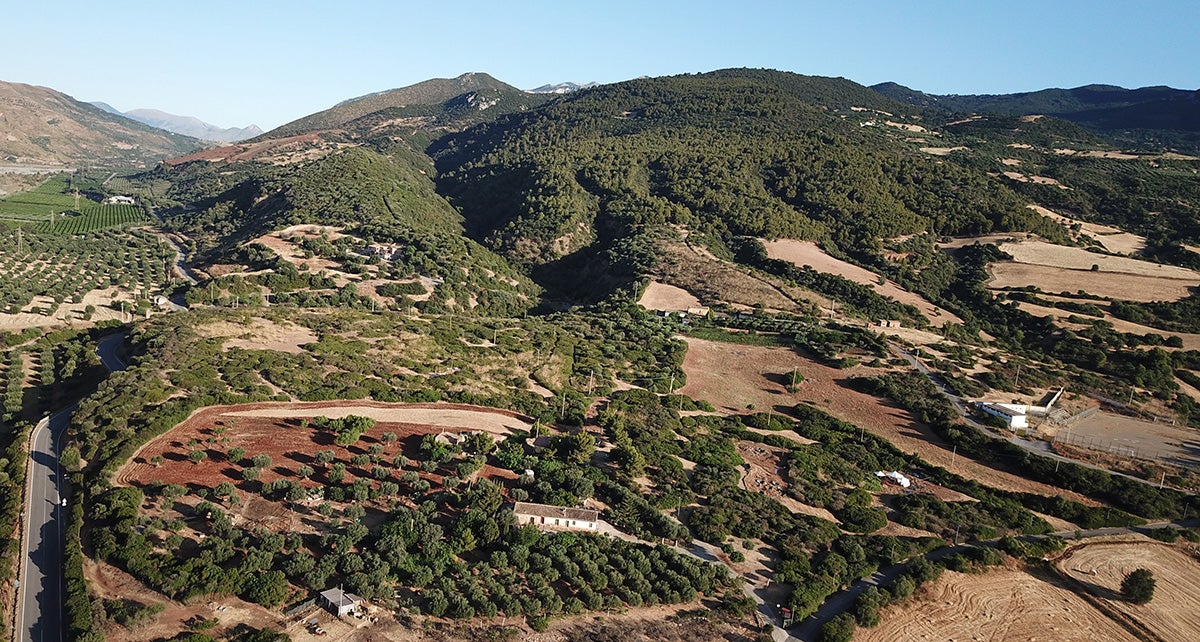
The setting is Calabria, near the Gulf of Taranto, where traditions connect the landscape to Epeius, the legendary builder of the Trojan Horse. Archaeologists are investigating a different, material history: how people already living there responded to arriving Greek settlers. Their evidence comes from the Macchiabate burial ground, associated with the settlement of Timpone Motta.
Martin A. Guggisberg, professor of classical archaeology at Basel, has directed the university’s excavations since 2009. A September 29 university account connects the finds with the circulation of Homeric traditions. The excavation project also examines how local communities navigated the destruction of neighboring Sybaris.
Greek settlement expanded across Sicily and southern Italy during the centuries when the Homeric epics took shape. Although their stories inhabit a legendary heroic past, their audiences lived amid migration, trade and encounters with unfamiliar communities. Odysseus offered a powerful figure through whom those experiences could be understood.
Guggisberg interprets parts of the epic’s geography through that western Mediterranean setting. Scylla and Charybdis have been associated with the dangers of the Strait of Messina. Other traditions placed the entrance to the underworld in the volcanic landscape near Naples.
These associations concern how ancient people understood stories and places. They do not turn the poem into a verified travel itinerary. Their archaeological importance lies in showing how heroic traditions could acquire meaning far from the Greek mainland.
Those meanings were available to more than settlers. Local communities could adopt, adapt or reject objects and stories arriving through Mediterranean networks. The question at Francavilla is how such choices shaped social relationships, rather than whether Greek culture simply replaced everything already there.
Epeius supplies a particularly suggestive connection. In the Odyssey, he is credited with building the wooden horse with Athena’s help. Later traditions linked him to a city near Francavilla and the dedication of his tools at a sanctuary of the goddess.
Excavated woodworking implements give that tradition an intriguing context. Burins and chisels suggest that skilled craft mattered within the communities using the cemetery. Their presence among grave goods indicates that technical expertise could form part of how a person’s standing was represented after death.
“Not only a man with military skills but also a good craftsman could be a leader,” Guggisberg said. Odysseus, too, combines martial cunning with practical skill: the epic describes him making a raft and constructing his marriage bed. A carpenter-hero could therefore offer an attractive model of achievement alongside the warrior.
The tools do not identify Epeius’s possessions or establish where he was buried. Instead, they help explain why a community might find his legend meaningful. Archaeological objects and heroic traditions illuminate one another here without becoming interchangeable forms of evidence.
An ornate longsword recovered by the Basel team provides another example of cultural choice. According to Guggisberg, the weapon type originated in Greece and was adopted by local leaders toward the end of the eighth century BCE. Its importance in southern Italy continued as military practices changed in Greece.
He connects the longsword with the heroic duels described in Homer. More tightly organized fighting formations, meanwhile, placed different demands on weapons. An object losing prominence in one setting could retain prestige in another.
Conservation has helped recover details otherwise hidden by deterioration. The project’s reports describe an iron sword with a wooden sheath covered in decorated bronze sheet. Punched concentric circles and other ornaments survive, alongside traces of a figured scene whose interpretation remains unresolved.
Such details show that imported forms were not passive markers of outside influence. Their selection and display could serve local priorities. A Greek-style weapon does not, by itself, establish the ancestry or cultural identity of the person buried with it.
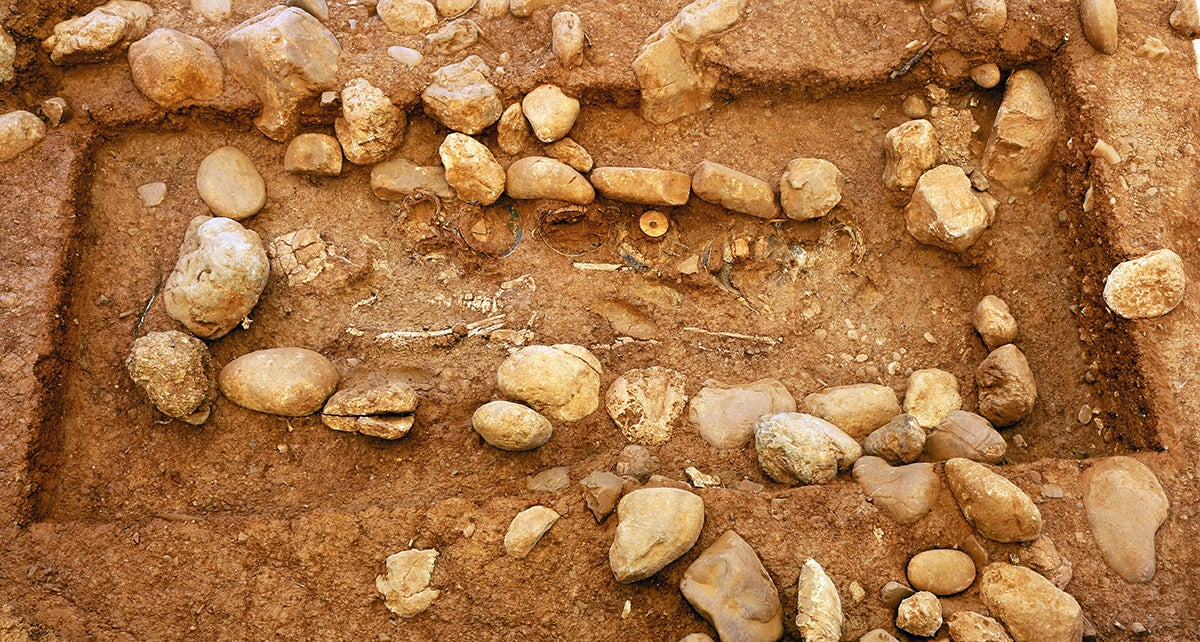
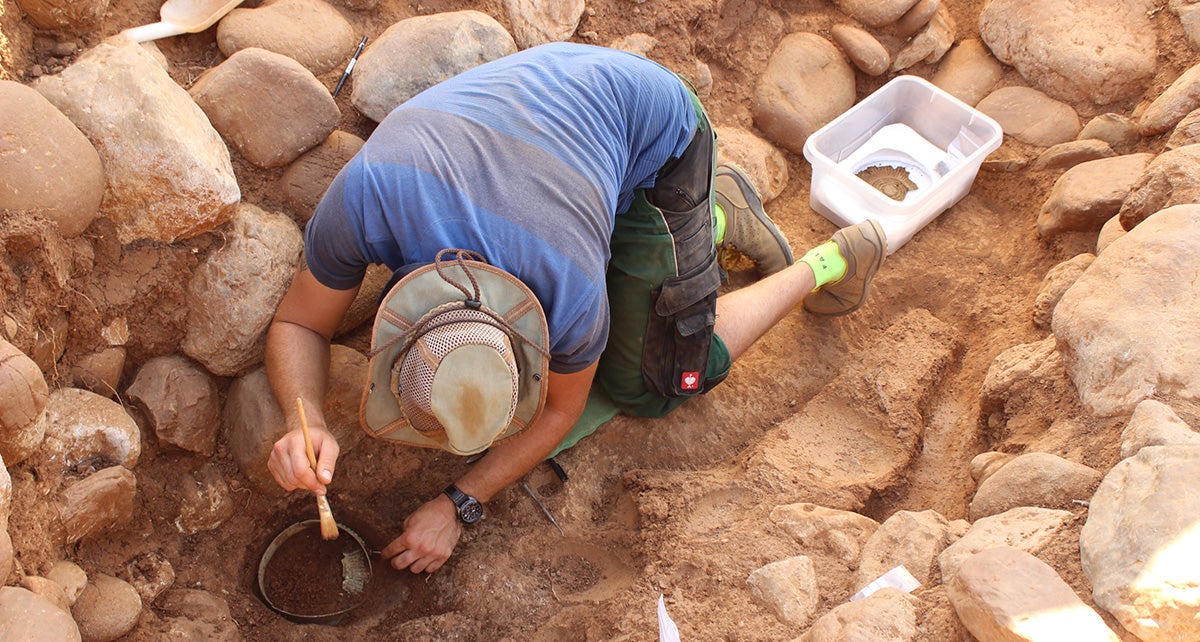
The 2026 campaign concentrated on the cemetery’s Rialzo area. Beneath a large oval stone structure, archaeologists uncovered a rectangular grave containing a man laid on his back. Iron fittings at the corners probably belonged to a wooden structure, possibly a coffin.
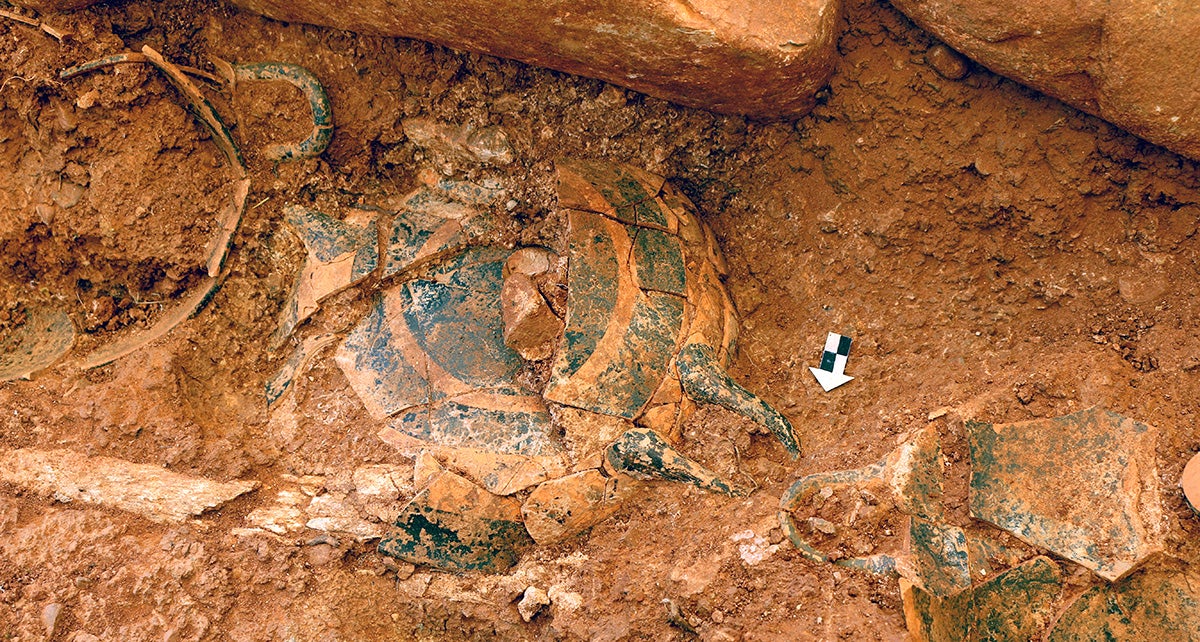
Nine vessels had been placed along his left side. The assemblage included an amphora and five Attic drinking cups of types known as lip cups and band cups. Three vessels were stacked inside one another, recording how the grave goods had been arranged.
The excavation team describes this concentration of Attic pottery as previously unknown in the cemetery. Together with the elaborate burial structure, it may indicate privileged social standing. Its imported vessels demonstrate access to wider exchange networks, although they do not establish a direct trading relationship between this individual and Athens.
One cup discussed in the university account depicts two fighting men, each accompanied by a woman. Guggisberg suggests a possible connection with heroic scenes involving divine companions. Without securely identified figures, however, naming Achilles, Hector or particular goddesses would go beyond what the image establishes.
The later graves also address a broader historical problem. Ancient sources place the destruction of Sybaris by rival Croton around 510 BCE. Because Sybaris exerted considerable influence over nearby communities, its fall raises questions about what happened beyond the city itself.
Basel’s Rethinking Collapse project examines that transition through the cemetery’s latest phases. Late-sixth- and early-fifth-century pottery suggests activity continued to the period of destruction and possibly afterward. The precise dating and implications remain subjects of investigation.
A related doctoral project by Niccolò Savaresi compares Attic imports across the wider region. It asks whether communities followed shared trading patterns or maintained distinct local practices. The answer could clarify how connections changed when a major regional center disappeared.
The emerging picture gives local people a more active role in this history. Weapons, tools and drinking cups record choices made across generations of contact and disruption. Understanding those choices offers a firmer account of cultural exchange than treating every Greek object as evidence of a community becoming Greek.
These resources explain the excavation evidence, Mediterranean exchange and approaches to interpreting cultural identity.
Scavi 2022–2026: Provides campaign reports, including the 2026 burial with imported Attic drinking cups. (University of Basel, 2026)
Rethinking Collapse: Outlines research into the fall of Sybaris and the transformation of surrounding communities. (University of Basel, 2022–2026)
Ancient Greek Colonization and Trade and their Influence on Greek Art: Explains how settlement and maritime networks carried objects and artistic practices across the Mediterranean. (The Metropolitan Museum of Art, 2007)
Athenian Vase Painting: Black- and Red-Figure Techniques: Introduces the production and imagery of the decorated pottery found in Mediterranean archaeological contexts. (The Metropolitan Museum of Art, 2002)
Postcolonial concepts and ancient Greek colonization: Examines interpretive approaches to identity and interaction in ancient colonial settings. (Modern Language Quarterly, 2004)
Research findings are available online in the journal Cell.
The original story “The Odyssey: Ancient graves in southern Italy reveal how Greek heroes and goods crossed cultures” is published in The Brighter Side of News.
Like these kind of feel good stories? Get The Brighter Side of News’ newsletter.
The post The Odyssey: Ancient graves in southern Italy reveal how Greek heroes and goods crossed cultures appeared first on The Brighter Side of News.


Leave a comment
You must be logged in to post a comment.