Black holes are famously difficult to see, but their darkness has not stopped astronomers from trying to answer an enormous question: How many of them are out there?
One calculation puts the number at roughly 40 quintillion, or 40 billion billion, within the observable universe. Written out, that is 40,000,000,000,000,000,000 stellar-mass black holes.
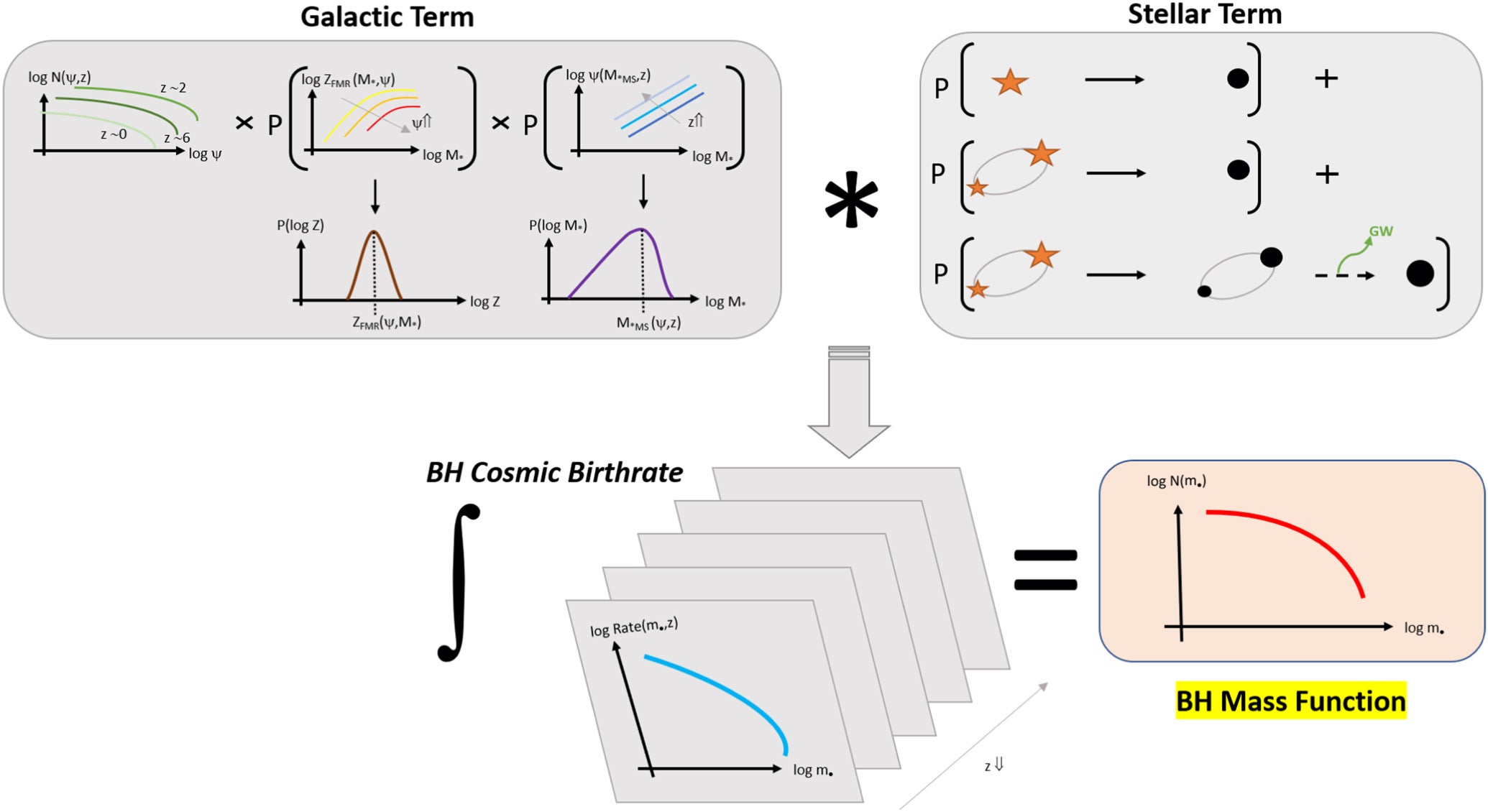
The estimate comes from research published in The Astrophysical Journal by Alex Sicilia of the International School for Advanced Studies, or SISSA, in Italy, working with Andrea Lapi, Lumen Boco and other collaborators. Rather than attempting to count black holes directly, the team reconstructed how generations of stars and galaxies could have produced them across cosmic history.
Their calculations indicate that stellar-mass black holes collectively lock away nearly 1% of the universe’s ordinary, or baryonic, matter.
The study focused on stellar-mass black holes, remnants produced during the final stages of massive stars. The researchers considered black holes ranging from roughly 5 to 150 times the mass of the Sun.
Unlike supermassive black holes, which can reach millions or billions of solar masses, stellar black holes begin with stars. They can form through the evolution of isolated stars, stars in binary systems and, particularly at the heavier end of the population, interactions within dense stellar environments.
Counting that population poses an obvious problem. A black hole does not produce light simply because it exists. Some become visible indirectly as X-ray sources, while merging black holes can reveal themselves through gravitational waves. Those detections provide only a glimpse of a much larger population.
Sicilia and his colleagues instead built their estimate from the underlying processes that create black holes.
“The innovative character of this work is in the coupling of a detailed model of stellar and binary evolution with advanced recipes for star formation and metal enrichment in individual galaxies,” Sicilia said. “This is one of the first, and one of the most robust, ab initio computation of the stellar black hole mass function across cosmic history.”
The team coupled the stellar and binary evolution code SEVN with observations and models describing galaxies at different periods in cosmic history. Among the key ingredients were galaxies’ star-formation rates, stellar masses and metallicities.
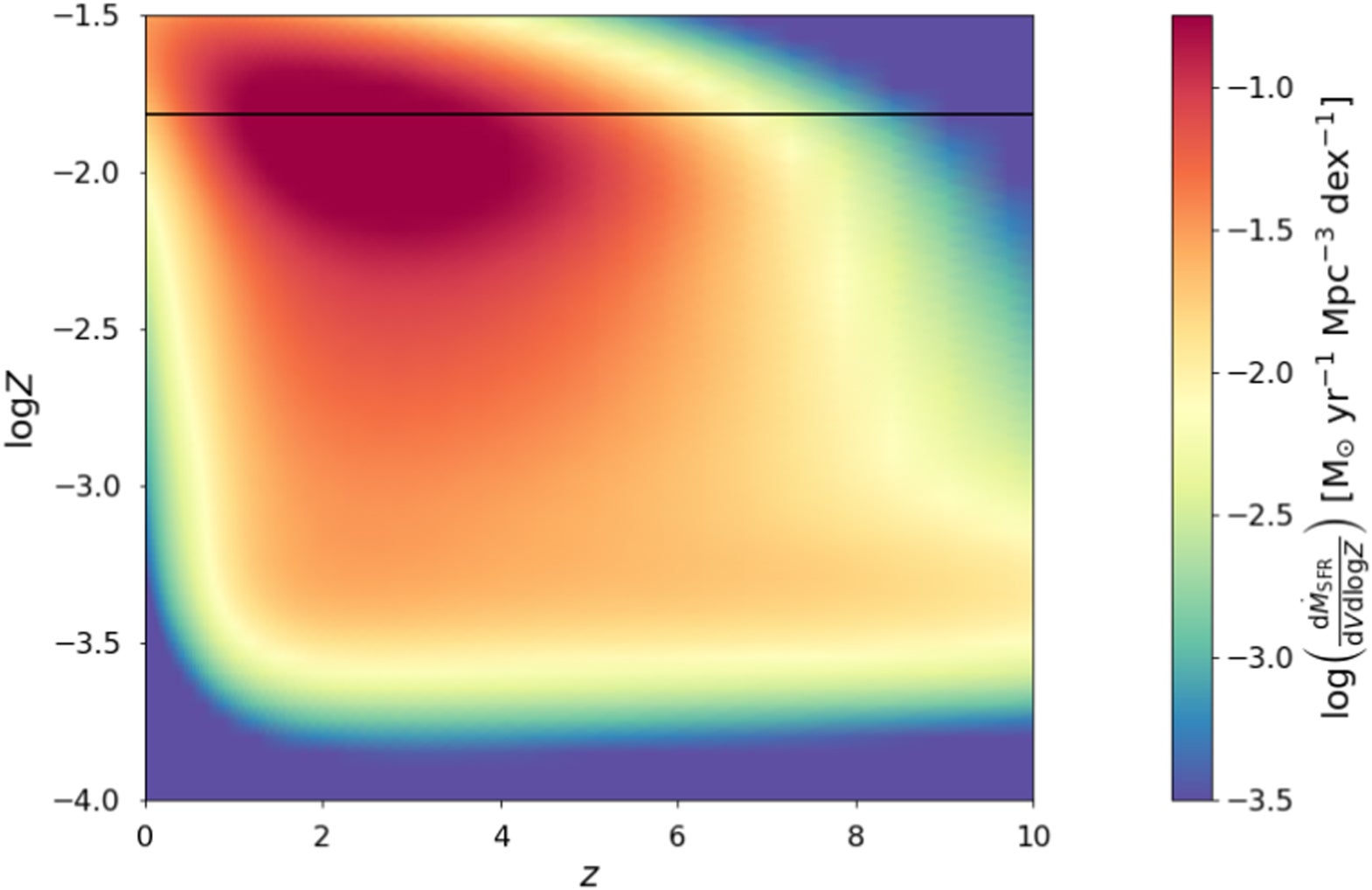
Metallicity, the abundance of elements heavier than hydrogen and helium, plays an important role in determining what happens to a massive star. It affects stellar winds, mass loss, stellar collapse and interactions between stars in binary systems.
The researchers calculated how many black holes of different masses would form for a given amount of star formation and then combined those results with changing galaxy populations across cosmic time.
The calculation included black holes born from isolated stars, failed black hole binaries and surviving binary black hole systems. Failed binaries occur when a stellar binary does not end as two bound black holes. One companion may instead be ejected, destroyed or consumed, leaving an isolated remnant.
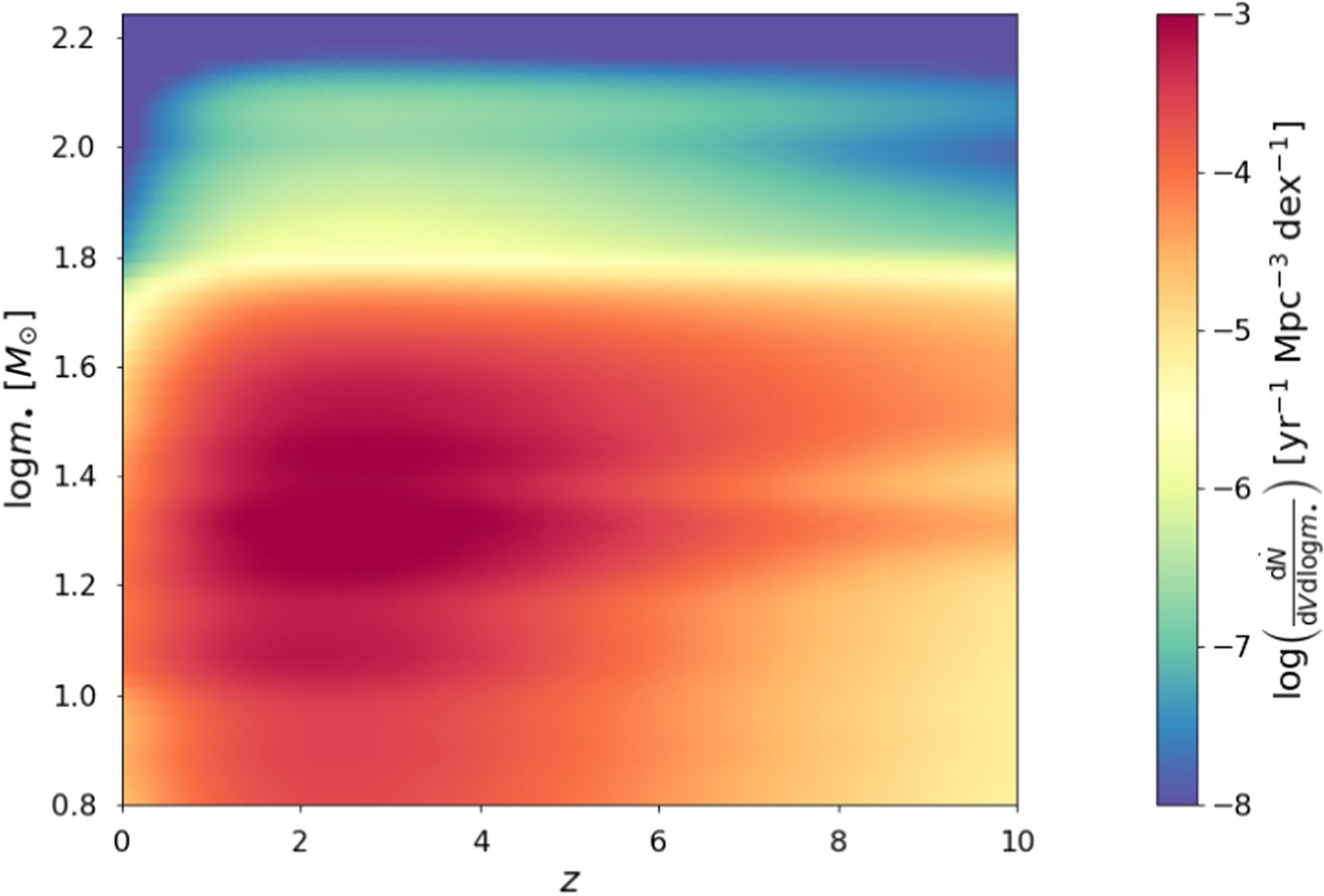
The resulting population builds rapidly through the periods of intense cosmic star formation before growing more slowly closer to the present.
At the current epoch, the researchers calculated a stellar-black-hole mass density of about 50 million solar masses per cubic megaparsec. That translates to stellar black holes containing less than, but close to, 1% of local baryonic matter.
The calculations also reveal how that enormous population is distributed by mass. Most stellar black holes fall within a relatively modest range rather than piling up at the highest masses.
The modeled mass function remains roughly flat between about 5 and 50 solar masses before declining sharply. Most of the total stellar-black-hole mass density comes from objects between roughly 20 and 50 solar masses.
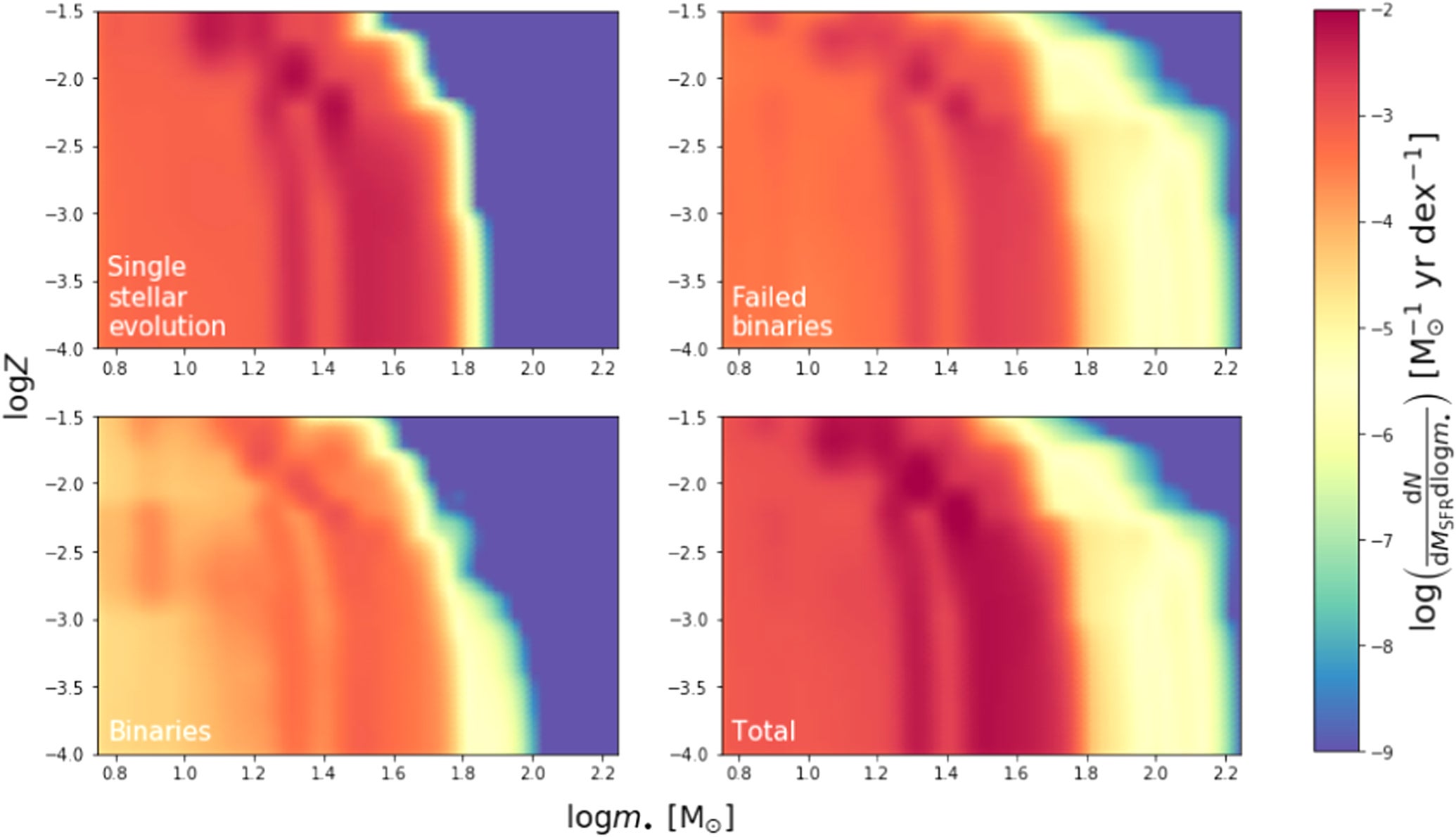
Metallicity changes that picture as astronomers look farther back in cosmic history. At high redshift, lower-metallicity conditions favor black holes of roughly 30 to 50 solar masses. Smaller black holes below about 20 solar masses become less common under those conditions.
The formation route changes at higher masses as well. Below roughly 50 solar masses, isolated stellar evolution and failed binary systems make comparable contributions, while black holes remaining in binaries are less common.
Above that point, isolated stellar evolution drops sharply. The researchers found that failed binaries become particularly important for producing heavier remnants, with stellar mergers during binary evolution capable of creating black holes beyond the masses normally produced by single stars.
Gravitational-wave observations provide an independent way to test those predictions. The researchers compared their modeled distribution of merging black holes with measurements from the LIGO and Virgo collaborations.
Their calculation agreed well with the observed distribution up to primary black hole masses of about 40 solar masses. Above that level, however, gravitational-wave observations contained more heavy black holes than isolated binary evolution alone could easily explain.
Dense star clusters offered a possible answer.
Inside such environments, repeated gravitational interactions can alter stellar and black hole orbits, encourage exchanges between binary partners and create systems that would be unlikely to form in isolation. The team’s calculations indicated that including this dynamical formation route extends the black hole population toward higher masses and brings the models closer to gravitational-wave observations.
“Specifically, the researchers have shown that such events are required to explain the mass function of coalescing black holes as estimated from gravitational wave observations by the LIGO/Virgo collaboration,” the research team reported.
The calculation also reaches into another black hole mystery: how the first much larger black holes began.
Stellar black holes present at redshifts above about 6 could act as “light seeds” for later black hole growth. The researchers found that their stellar and binary evolution models produce an important population of seeds below roughly 150 solar masses during these early periods.
Those objects could provide starting points for the subsequent growth of more massive black holes. The intermediate range between stellar and supermassive black holes remains much less certain, while observations have revealed enormous black holes exceeding a billion solar masses when the universe was still extremely young.
The estimate of 40 quintillion therefore represents more than an attempt to attach a number to an invisible population. It connects the lives of massive stars, the history of galaxies, gravitational-wave mergers and the possible beginnings of the largest black holes in the cosmos.
For a universe filled with objects defined by their ability to hide, the numbers suggest black holes are anything but rare.
These resources explore how astronomers are mapping the stellar-black-hole population, testing predicted mass ranges and uncovering the different environments that produce merging black holes.
GWTC-5.0: Population Properties of Merging Compact Binaries: The latest LIGO-Virgo-KAGRA population analysis uses 267 mergers to examine the masses, spins and merger rates of compact objects, providing a much larger observational sample for testing models of stellar-black-hole formation. (LIGO-Virgo-KAGRA Collaboration, 2026)
Evidence of the pair-instability gap from black-hole masses: Analysis of the fourth LIGO-Virgo-KAGRA gravitational-wave catalog finds evidence for a predicted gap in black hole masses and indications that some unusually massive objects may be products of earlier black hole mergers. (Nature, 2026)
Gravitational-wave constraints on the pair-instability mass gap and nuclear burning in massive stars: This study uses gravitational-wave observations to locate the lower edge of the pair-instability mass gap at roughly 44 solar masses, connecting the observed black hole population directly with the physics of massive-star evolution. (Nature Astronomy, 2026)
GW231123: A Binary Black Hole Merger with Total Mass 190–265 M⊙: The LIGO-Virgo-KAGRA collaboration reports an exceptionally massive binary black hole merger, providing an important test for theories explaining how black holes reach masses difficult to produce through ordinary isolated stellar evolution. (The Astrophysical Journal Letters, 2025)
Stellar-Mass Black Holes: This review examines stellar black holes found through X-ray binaries, astrometric binaries, microlensing and gravitational waves, while discussing why the vast underlying Galactic population remains so difficult to detect directly. (Symmetry, 2025)
Research findings are available online in The Astrophysical Journal.
The original story “The universe may contain a staggering 40 quintillion black holes” is published in The Brighter Side of News.
Like these kind of feel good stories? Get The Brighter Side of News’ newsletter.
The post The universe may contain a staggering 40 quintillion black holes appeared first on The Brighter Side of News.


Leave a comment
You must be logged in to post a comment.