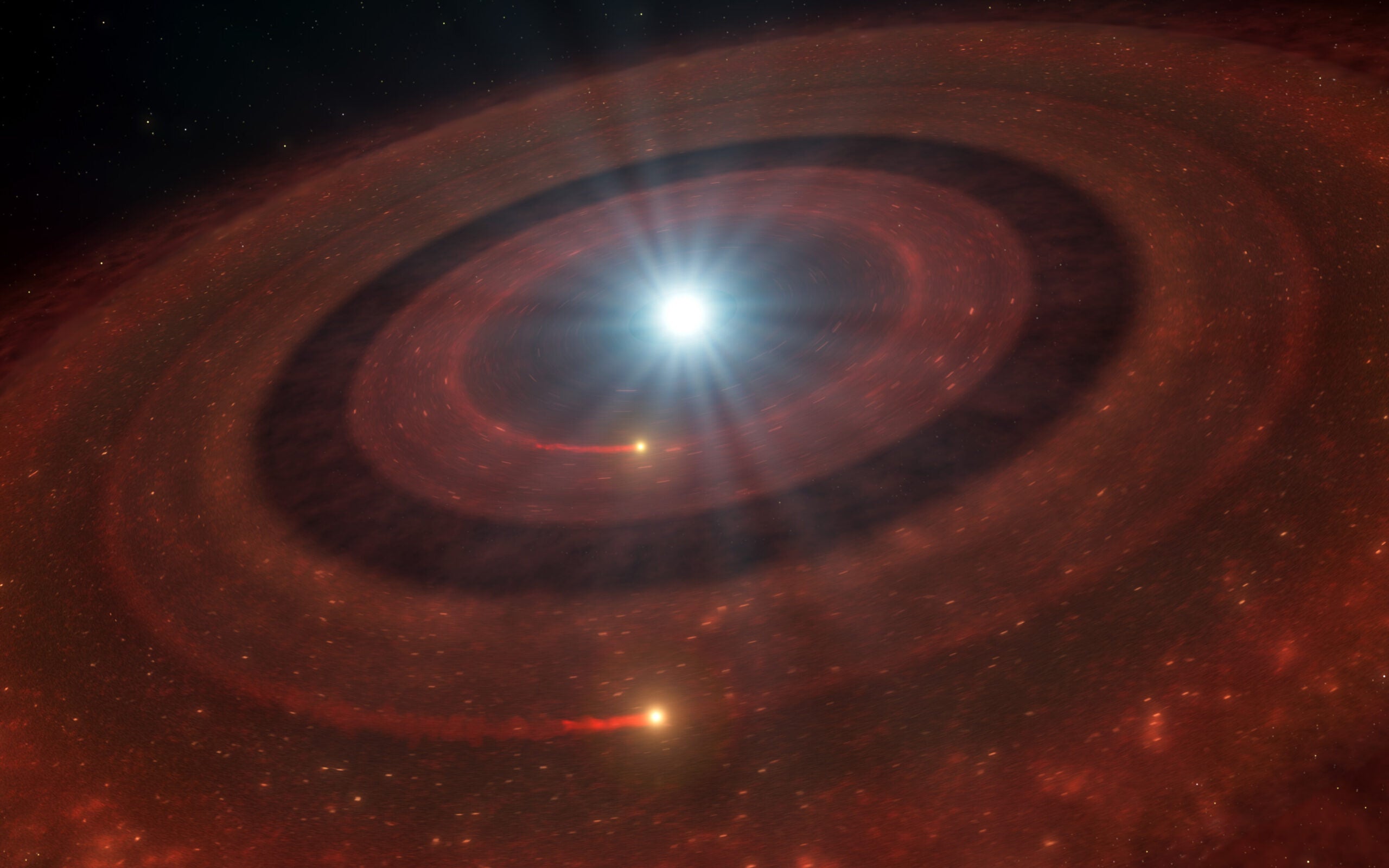
The remains of a planetary system have settled into an unexpected arrangement around a dead star: two rings of gas, separated by a gap. Their chemical differences suggest that the wreckage preserves more than one chapter of planetary history. Two surviving bodies may help maintain the structure, although astronomers have not detected either directly.
An international team led by Nicola Pietro Gentile Fusillo at the University of Trieste and INAF’s Astronomical Observatory of Trieste describes the system in Nature Astronomy. The researchers used the European Southern Observatory’s Very Large Telescope in Chile to investigate the white dwarf J1328−1450. Their findings offer a possible preview of the complex remains that stars like the Sun can leave behind.
White dwarfs are the dense cores left after stars exhaust their fuel and shed their outer layers. Nearby planets may be engulfed during that transformation, while more distant bodies can survive. Some remaining rocky material eventually breaks apart and forms debris discs around the stellar remnant.
The team first noticed excess infrared light from J1328−1450, a sign of surrounding dust. They then used the telescope’s X-shooter spectrograph to separate the system’s light by wavelength. That revealed both material reaching the star and gas orbiting around it.
Absorption lines from calcium, magnesium and silicon appear in the star’s atmosphere. These features show that planetary material has accumulated there. Separate emission lines reveal the surrounding gas, allowing the researchers to distinguish what is orbiting from what has reached the star.
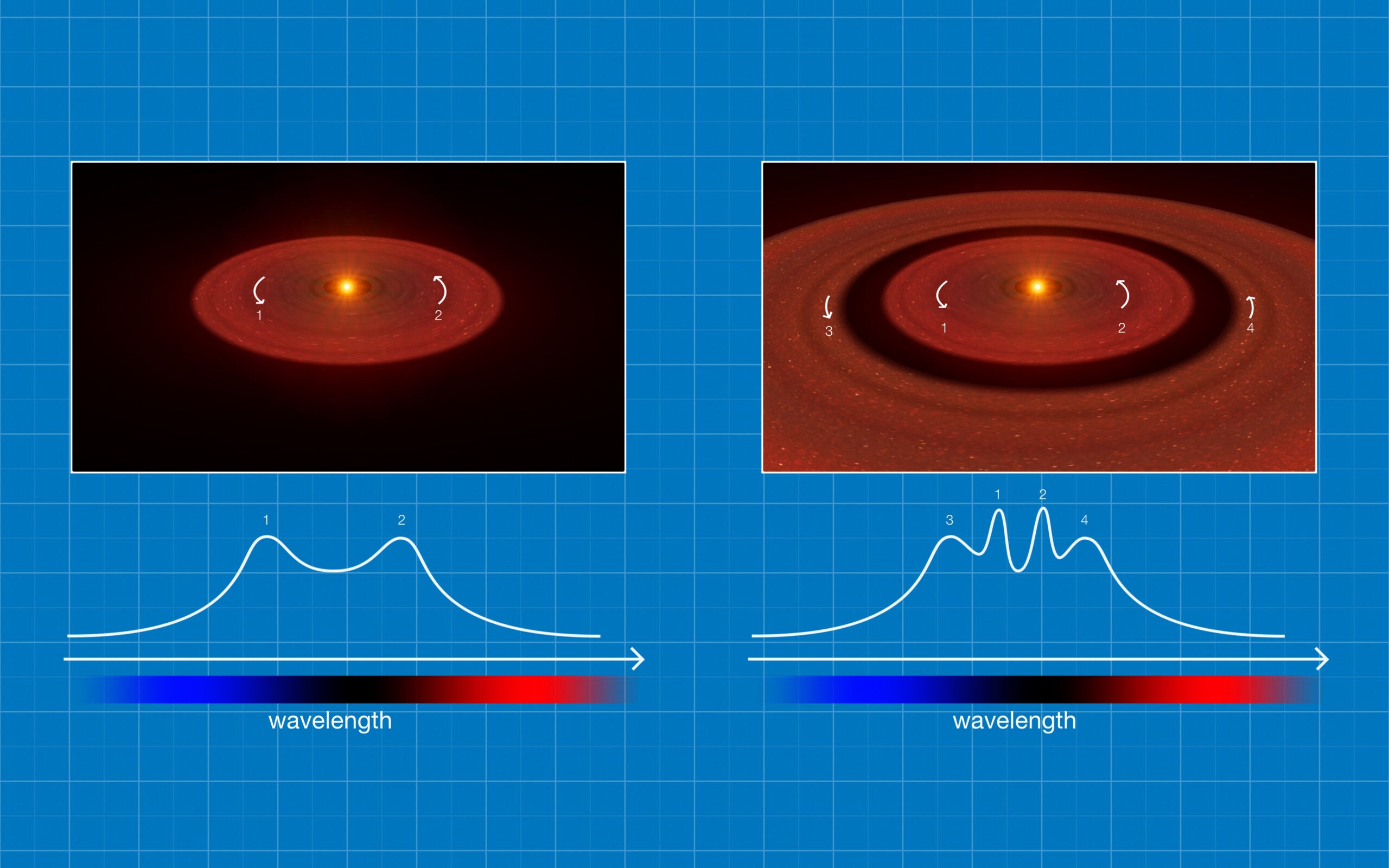
The crucial clue appeared in emission lines, bright features produced by particular elements in the gas. A rotating disc normally produces two peaks because material on opposite sides moves toward and away from the observer. Those motions shift the light to different wavelengths.
Calcium and oxygen emission from J1328−1450 instead showed four peaks. The researchers interpreted them as the combined signals of two concentric gas rings. This differed from the double-peaked signatures of all 21 previously published gaseous debris discs considered in the study.
The finding is a reconstruction from light, rather than a resolved photograph of the rings. Their nearly symmetric spectral profiles remained unchanged for more than two years. That stability supports a relatively circular arrangement, although small asymmetries suggest the gas is not distributed perfectly evenly.
Researchers modeled two circular rings lying in the same plane. The inner ring extends from about 0.14 to 0.34 times the Sun’s radius from the white dwarf’s center. The outer ring spans roughly 0.54 to 1.93 solar radii, leaving a clear interval between them.
These dimensions describe the gas, not necessarily the dust. Infrared observations establish that dust is present but cannot reveal its detailed radial distribution in the same way. A gap in the gas therefore does not establish an equally empty gap in the solid debris.
“The structure we see in this system is particularly intriguing because the two gaseous rings are remarkably stable and remain separated by a gap,” said co-author Felipe Lagos-Vilches. He is an astronomer at the University of Warwick and Universidad Técnica Federico Santa María in Chile. The arrangement challenges explanations that generate gas throughout a continuous debris disc.
Gas normally spreads as it orbits, so a lasting separation needs a mechanism that limits mixing. The authors propose that gas produced near particular sources cools and condenses back into solids as it moves outward. If condensation happens faster than spreading, the gas can remain confined near those sources.
Two embedded planetesimals, small planetary bodies, could supply those sources by interacting with surrounding dust. In that interpretation, each body continually helps generate gas in its own ring. The explanation builds on evidence for a surviving planetesimal in another white dwarf debris system, rather than a direct detection here.
The gas contains calcium, oxygen, magnesium and iron, elements familiar from rocky Solar System material. However, the two rings do not have matching chemical signatures. Magnesium emission appears only in the inner ring.
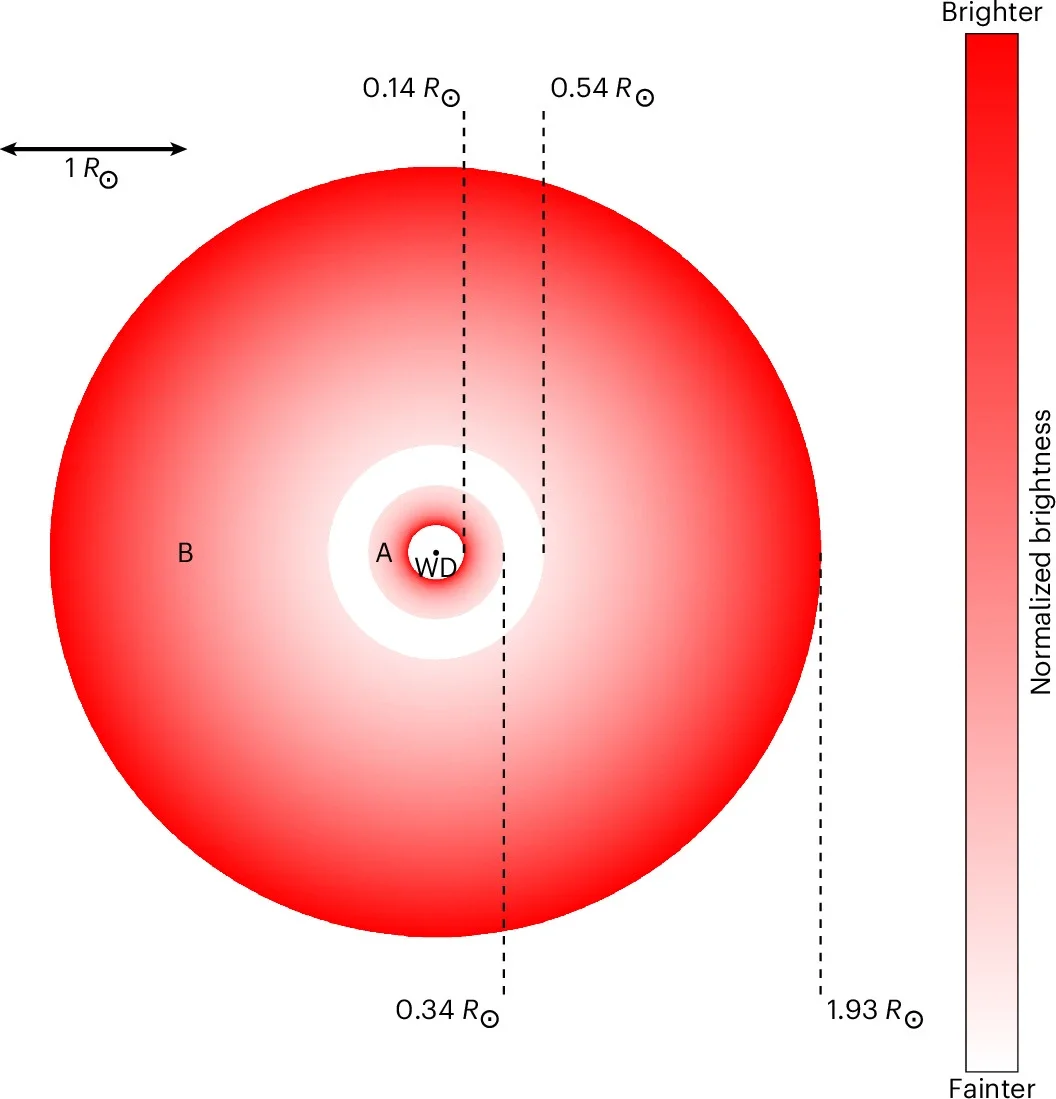
The researchers tested whether the missing outer-ring signal could simply reflect insufficient sensitivity. If both rings shared the same calcium-to-magnesium ratio, the outer magnesium emission should have been readily detectable. Its absence provides evidence that the outer gas is substantially depleted in magnesium relative to the inner gas.
One explanation is that separate parent bodies supplied material with different compositions and formation histories. Another is that the material came from different layers of one body that had separated into chemically distinct regions. Magnesium-rich mantle material and magnesium-poor crust offer an example of that possibility.
The measurements do not identify a particular destroyed planet or establish which explanation is correct. They do show why treating all the surrounding rubble as one uniform reservoir would miss important information. The rings retain differences that constrain how the system formed and how thoroughly its material has mixed.
Any body embedded this close to the white dwarf faces strong tidal forces. Gravity pulls more strongly on its nearer side than its farther side, tending to tear it apart. Its density, internal strength and orbital distance determine whether it can remain intact.
The researchers used those factors to calculate possible upper sizes for the proposed survivors. These are limits under particular assumptions, not measurements of two newly imaged worlds. Their exact orbits also remain unknown within the rings.
For an iron-density body with typical rocky internal strength, the inner ring allows maximum diameters of roughly 45 to 172 kilometers. Farther out, the permitted size increases substantially. Near the outer ring’s edge, an iron-density object could reach about 2,340 kilometers across, comparable to Pluto.
A lower-density rocky body with moderate internal strength could reach roughly 3,500 kilometers at that outer boundary, approaching the Moon’s diameter. The comparison illustrates what might survive under favorable conditions. It does not mean the team has confirmed a Pluto-sized or Moon-sized object.
The double-ring interpretation fits the observations, but the authors considered alternatives. A single disc with a vertically extended region casting a shadow could produce a similar spectral pattern. They note that existing theoretical models do not provide physical support for that configuration.
The dust model also permits multiple arrangements that fit the infrared measurements. Meanwhile, the white dwarf’s atmospheric chemistry contains uncertainties, including a magnesium measurement based on one potentially blended absorption line. Those limits make the distinct gas signatures especially important to the argument.
For the Solar System, the significance is a comparison rather than a prediction of an identical fate. The Sun will eventually become a white dwarf, and its transformation may destroy Earth. Surviving bodies and disrupted material could continue interacting long after that transition.
J1328−1450 shows how much structure such remains may retain. The central question now is whether two surviving bodies really sustain its separate gas rings. More detailed observations could test that explanation and clarify how planetary debris stays organized around a dead star.
These studies connect recent discoveries with foundational evidence for planetary debris and surviving bodies around stellar remnants.
Discovery of a second-generation planet candidate accreting onto a white dwarf
Unusual chemical abundances support a candidate planet formed from material released during stellar evolution, illustrating another possible path for planetary systems after a star’s main life. (Nature Astronomy, October 2026)
Discovery of an icy and nitrogen-rich extrasolar planetesimal
Ultraviolet observations reveal evidence of water-rich planetary material reaching a white dwarf, broadening the chemical picture beyond rocky debris. (Monthly Notices of the Royal Astronomical Society, September 2025)
Rapid formation of exoplanetesimals revealed by white dwarfs
This study combines debris chemistry with models to investigate when planetary building blocks formed and developed distinct interiors. (Nature Astronomy, November 2022)
Research findings are available online in the journal Nature Astronomy.
The original story “Two rings around a white dwarf offer a glimpse of our Solar System’s possible future” is published in The Brighter Side of News.
Like these kind of feel good stories? Get The Brighter Side of News’ newsletter.
The post Two rings around a white dwarf offer a glimpse of our Solar System’s possible future appeared first on The Brighter Side of News.


Leave a comment
You must be logged in to post a comment.