Water ice squeezed to more than two million times atmospheric pressure developed a less symmetrical crystal structure. Rather than simply packing into a smaller version of its existing arrangement, the solid shifted toward a denser configuration. The result reveals another structural transition in a substance whose behavior becomes increasingly complex under extreme compression.
The work, reported in Communications Chemistry, comes from a team including the University of Nevada, Las Vegas, UC Berkeley and Argonne National Laboratory. UNLV physicist Ashkan Salamat, director of its Nevada Extreme Conditions Lab, led the research. Its central finding concerns solid water at room temperature, with possible relevance to pressures inside water-rich planets.
“Water beyond Earth-like conditions has more complex behavior than we ever previously imagined,” Salamat said. “It’s amazing how water can behave under pressure.” The measurements support that complexity, although they leave the precise arrangement of atoms unresolved. Two candidate structures remain plausible, and the experiments did not reproduce the high temperatures inside Uranus or Neptune.
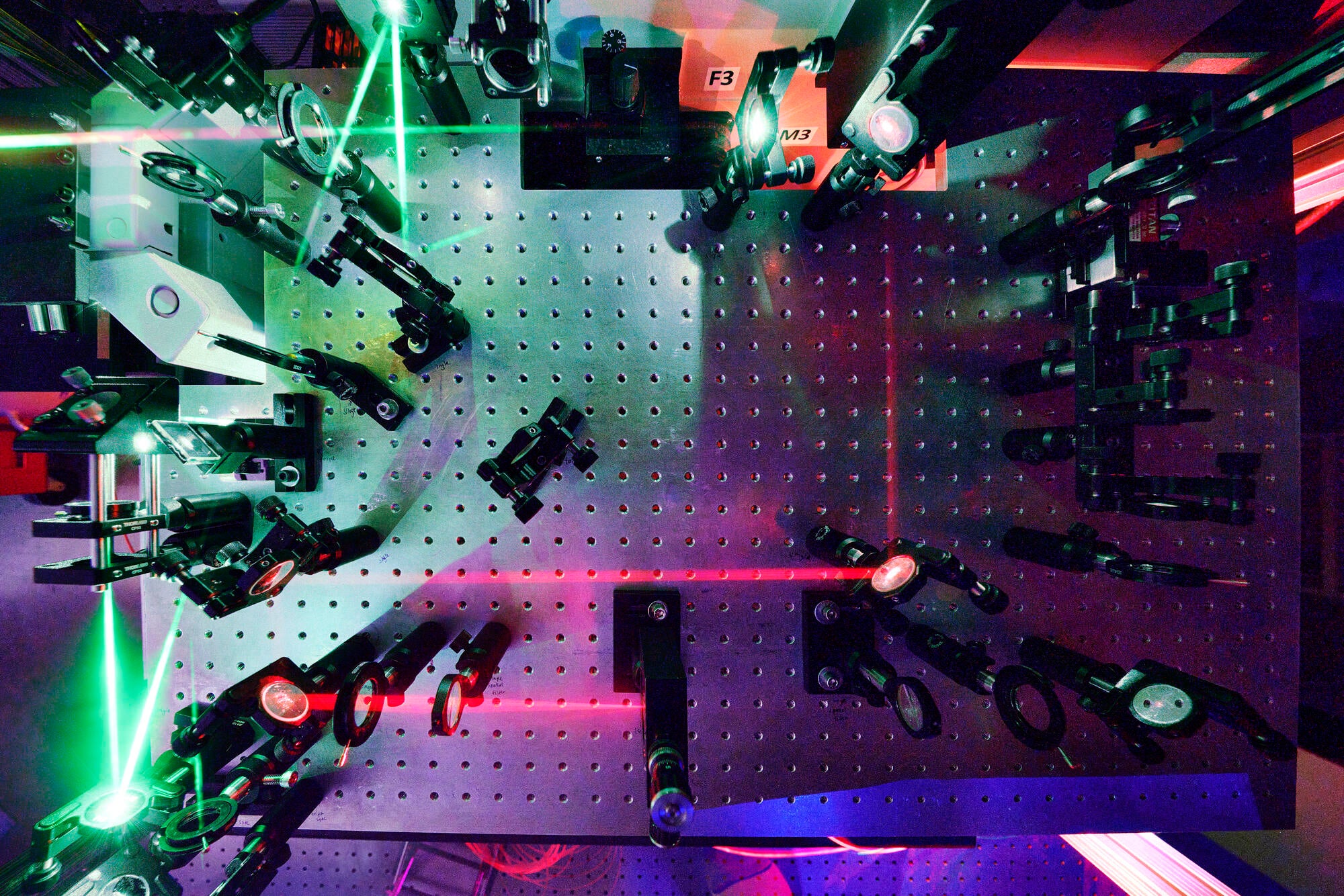
Ordinary ice forms when water cools, but temperature alone does not determine whether water becomes solid. Pressure also changes which atomic arrangements are stable. Under enough compression, water can occupy solid structures at room temperature, far beyond the conditions encountered in daily life.
Scientists distinguish these structures as different ice phases, each with its own arrangement or behavior of atoms. The study describes a landscape containing more than 20 experimentally detected or theoretically predicted phases. Much of that variety reflects changes in the hydrogen-bond network that organizes water at lower pressures.
Hydrogen bonds connect neighboring water molecules, but extreme compression changes the nature of those connections. In ice X, hydrogen occupies symmetrical positions between neighboring oxygen atoms. Its oxygen framework has cubic symmetry, meaning its repeating crystal pattern retains equivalent features along particular directions.
The team sought the upper pressure boundary of that arrangement. Their X-ray measurements confirmed ice X beginning at about 78 gigapascals and followed it toward 222 gigapascals. A gigapascal equals one billion pascals, the standard pressure unit, putting these measurements far beyond ordinary laboratory pressures.
To reach those conditions, the investigators squeezed a tiny sample between diamond anvils. Concentrating force across the diamonds’ small tips generates enormous pressure inside the sample chamber. The highest X-ray measurement reported in the study reached approximately 230 gigapascals, equivalent to about 33 million pounds per square inch.
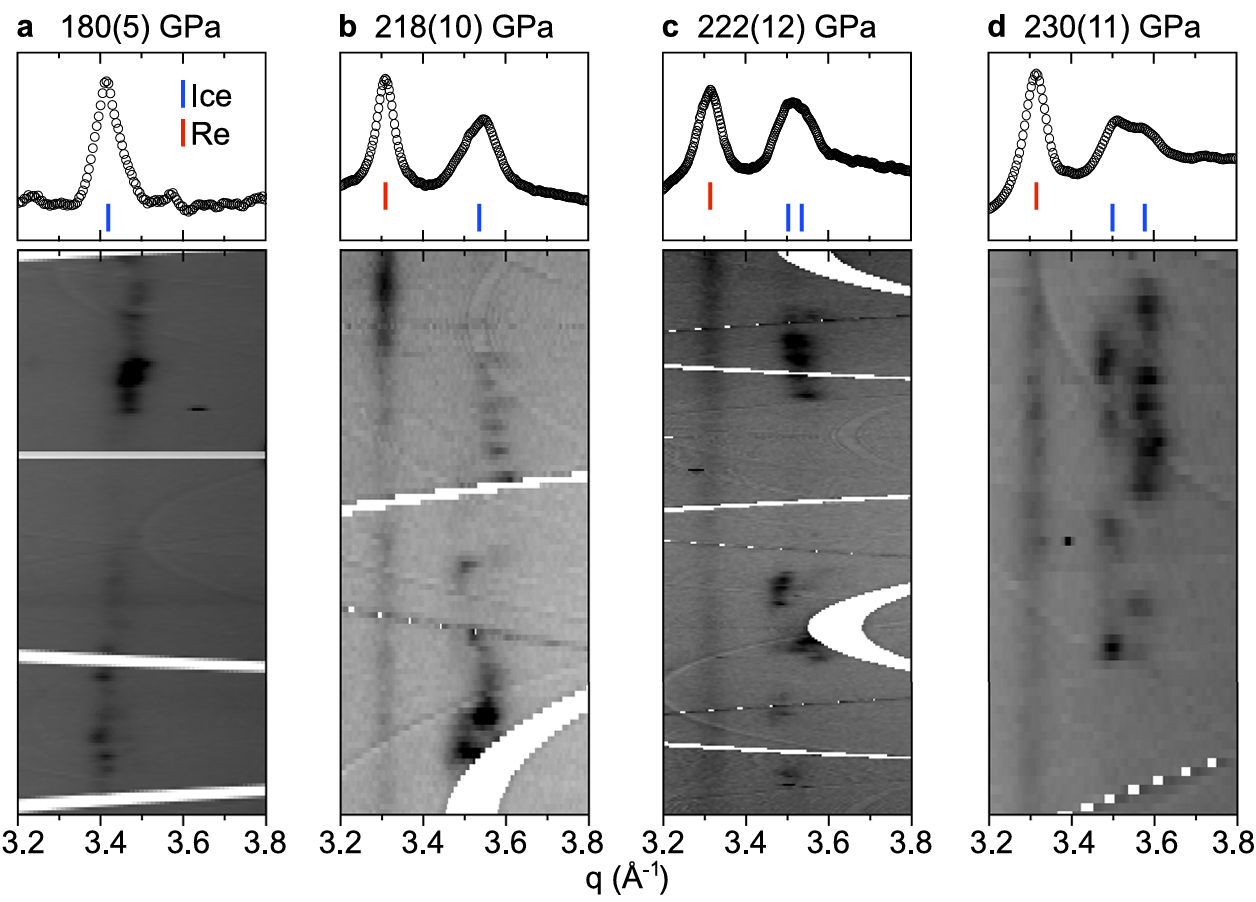
A synchrotron supplied the X-rays used to examine the compressed ice. As X-rays scatter from a crystal, they produce diffraction patterns that carry information about its repeating structure. Changes in those patterns can reveal when the existing atomic arrangement no longer describes the sample.
At approximately 180 gigapascals, the ice produced a single distinct diffraction ring associated with ice X. Increasing pressure distorted and broadened the signal, reflecting uneven stresses in the sample. At about 222 gigapascals, with an uncertainty of 12 gigapascals, a second feature began to emerge.
By approximately 230 gigapascals, that second feature was clearly separated. The resulting split pattern pointed to a departure from the cubic oxygen lattice. The investigators interpreted it as evidence that ice X had transformed into a denser phase with lower symmetry.
Uneven compression creates a major obstacle in experiments at these pressures. It can stretch crystals differently along different directions, altering their diffraction signals. The team therefore examined whether stress, rather than a structural transition, could explain the observed changes.
One test treated the split signal as two regions of cubic ice X under different pressures. That explanation required a pressure difference equivalent to approximately 190 versus 262 gigapascals. The researchers judged that difference implausibly large, arguing that pressure gradients alone could not explain the feature.
They also checked whether rhenium from the sample chamber’s gasket could account for the new signal. Its diffraction features did not overlap the relevant ice features. These tests strengthened the structural interpretation, while leaving important limits on how specifically the new arrangement could be identified.
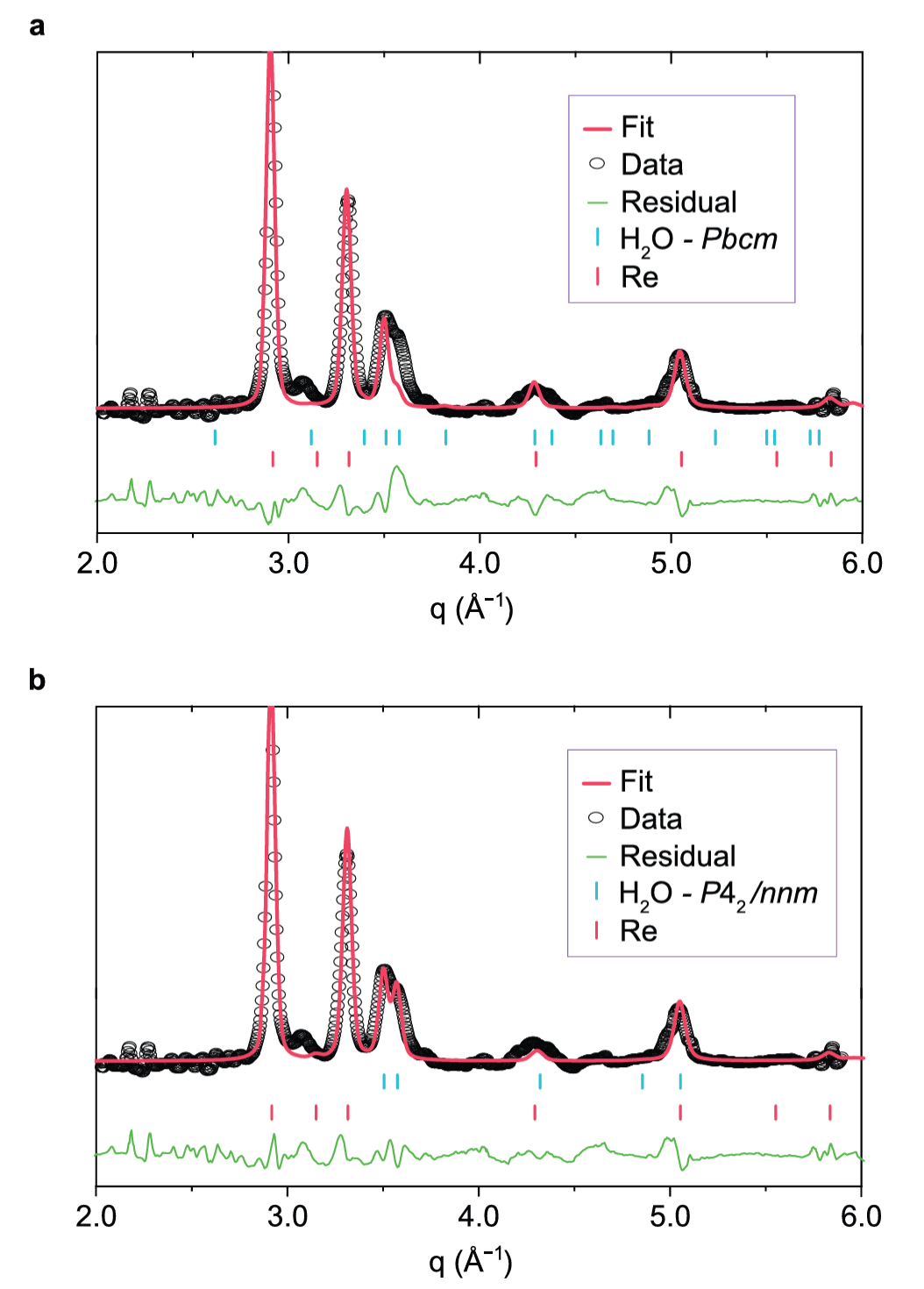
The sample scattered X-rays weakly, and the beam illuminated an area only about one micrometer across in each direction. Each measurement captured a stationary image rather than averaging many sample orientations. Those constraints limited the information available for reconstructing the complete crystal structure.
Computer calculations helped identify plausible arrangements beyond ice X. Two leading candidates carry the crystallographic labels Pbcm and P4₂/nnm. Those labels describe the symmetry of repeating atomic patterns, rather than different chemical formulas: both candidates remain forms of H₂O.
The candidates distort ice X in different ways. The tetragonal arrangement changes the relative dimensions of the crystal, while the Pbcm arrangement involves buckling of its oxygen framework. Both changes increase density, which can make an arrangement more favorable under strong compression.
Neither model secured a definitive identification from all the available evidence. The tetragonal model fitted the measured diffraction pattern more accurately, while the evolution of lattice dimensions favored Pbcm. The authors concluded that the restricted data could not establish which structure was truly valid.
Calculations also placed the transition at different pressures depending on their treatment of atomic interactions. Predictions spanned roughly 220 to 350 gigapascals, with some widely used approaches favoring around 300 gigapascals. Uneven experimental stresses may help structures form through pathways that differ from idealized calculations.
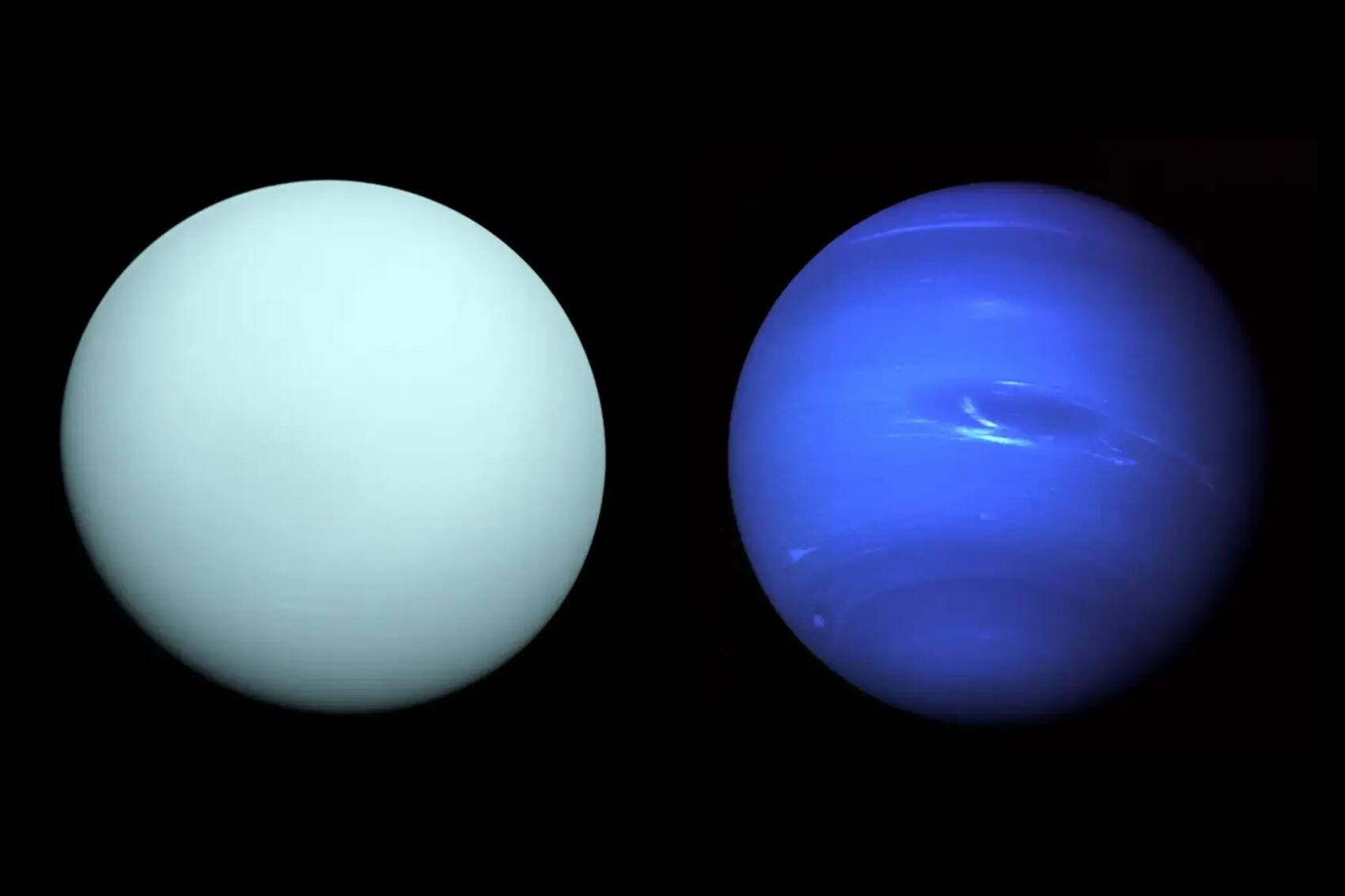
The planetary relevance comes from water’s behavior under pressures hidden beneath distant worlds’ outer layers. Its structure influences density, electrical conduction and heat transport, all important ingredients in models of planetary interiors. Understanding those properties helps scientists assess how water-rich layers might behave.
Temperature remains an essential qualification. The experiment examined room-temperature ice, whereas planetary interiors can be much hotter and contain other materials. The authors explicitly note that the observed low-symmetry phase may not remain stable at those interior temperatures.
The findings therefore offer a constraint for future models, rather than a direct identification of material inside Uranus or Neptune. They also raise questions about whether altered oxygen-hydrogen bonding could change reactions with surrounding substances. The study does not demonstrate such reactions or the formation of compounds with different hydrogen-to-oxygen ratios.
Spectroscopy offers another way to investigate the transition because atomic vibrations respond to crystal symmetry. Different arrangements should produce different combinations of vibrational signals, giving researchers a separate structural test. At these pressures, however, diamond fluorescence, strained material and weak scattering make those signals difficult to isolate. The calculations supply targets for future experiments rather than an additional experimental confirmation of the new phase.
Identifying the new structure more securely will require additional measurements. The team calculated vibrational signatures that could distinguish the competing models, but obtained no discernible sample Raman signal at 230 gigapascals. Testing those predicted signatures would help determine which atomic arrangement actually follows ice X under extreme compression.
These studies explore competing ice structures, experimental challenges and the connection between compressed water and planetary interiors.
Observation of a mixed close-packed structure in superionic water
Shock-compression experiments found evidence for a mixed crystal arrangement in hot superionic water, where hydrogen moves through an oxygen framework. This provides context for distinguishing room-temperature ice from hotter planetary forms. (Nature Communications, December 2025)
Phase transition kinetics of superionic H₂O ice phases revealed by Megahertz X-ray free-electron laser-heating experiments
The experiments examine how heating timescales and the pressure-temperature path influence which superionic structures form. They explain why experimental conditions matter when comparing ice studies. (Nature Communications, September 2024)
Thermodynamics of high-pressure ice phases explored with atomistic simulations
Simulations investigate the relationship between ice X and a predicted Pbcm structure near 300 gigapascals. This work provides a theoretical benchmark for the structural transition examined in the UNLV-led experiments. (Nature Communications, August 2022)
Structure and properties of two superionic ice phases
High-pressure, high-temperature measurements identify two superionic oxygen frameworks and map their stability. The findings connect laboratory measurements with possible water-rich layers inside giant planets. (Nature Physics, October 2021)
Nanosecond X-ray diffraction of shock-compressed superionic water ice
This study uses rapid X-ray measurements to investigate the crystal structure of water under shock compression. It offers a complementary experimental approach to static compression between diamonds. (Nature, May 2019)
Research findings are available online in the journal Communications Chemistry.
The original story “UNLV scientists test water to levels beyond Earth-like conditions” is published in The Brighter Side of News.
Like these kind of feel good stories? Get The Brighter Side of News’ newsletter.
The post UNLV scientists test water to levels beyond Earth-like conditions appeared first on The Brighter Side of News.


Leave a comment
You must be logged in to post a comment.