A fading star in a nearby galaxy offered astronomers an unusually complete set of clues about a long-predicted stellar death. Its surroundings, changing brightness and chemical signatures pointed toward an electron-capture supernova, an explosion triggered when a stellar core loses part of its internal support.
The object, SN 2018zd, became a leading candidate after a study in Nature Astronomy. Daichi Hiramatsu, then at the University of California, Santa Barbara and Las Cumbres Observatory, led the international team. Collaborators included UC Berkeley’s Alex Filippenko and Tel Aviv University’s Iair Arcavi.
The finding also raised hopes of explaining the explosion that created the Crab Nebula in 1054. However, subsequent research has complicated that connection. Both objects remain valuable tests of stellar physics, rather than settled examples of one explosion mechanism.
Stars survive through a balance between gravity and internal pressure. Nuclear fusion supplies energy during much of a star’s life, but different processes take over as its fuel changes. A star’s initial mass helps determine whether its final remnant becomes a white dwarf, neutron star or black hole.
Many relatively low-mass stars, including the Sun, eventually leave white dwarfs supported by electron degeneracy pressure. This quantum effect resists compression even without continuing fusion. Some white dwarfs in binary systems later undergo thermonuclear supernovae, although having a companion does not guarantee that outcome.
More massive stars can develop iron cores that collapse, often producing supernovae. Between these evolutionary paths lies a particularly sensitive region, commonly described as roughly eight to 10 solar masses. The precise boundaries depend on stellar composition, mass loss and other details of evolution.
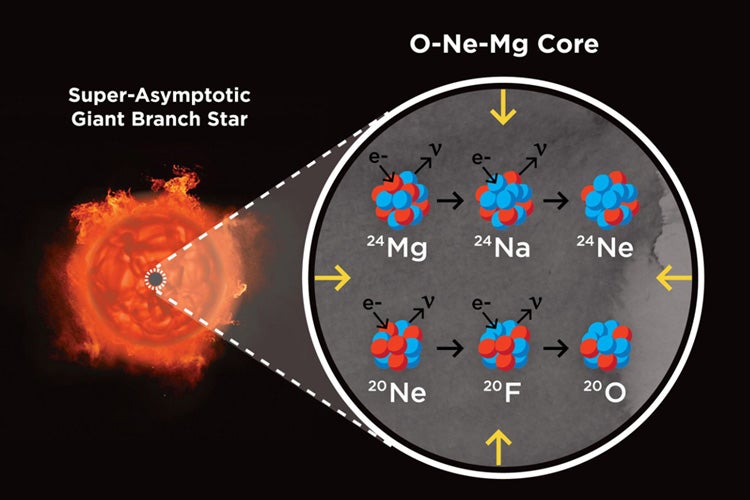
Some stars in that range develop dense oxygen-neon-magnesium cores. Under extreme conditions, nuclei capture electrons, reducing the electron pressure that helps support the core. The resulting collapse can trigger an electron-capture supernova and leave a neutron star. The mechanism was proposed in work published in 1980, decades before SN 2018zd appeared.
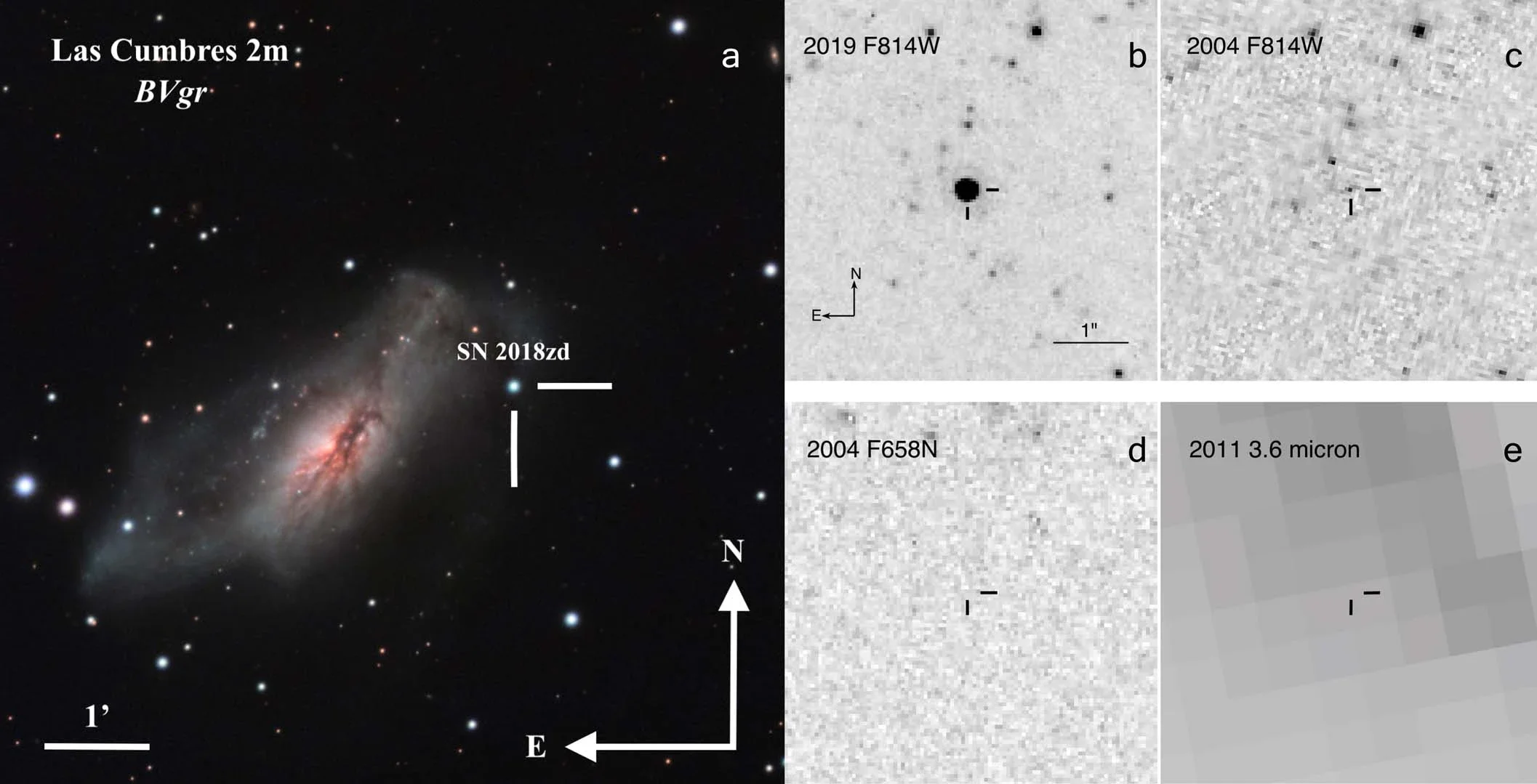
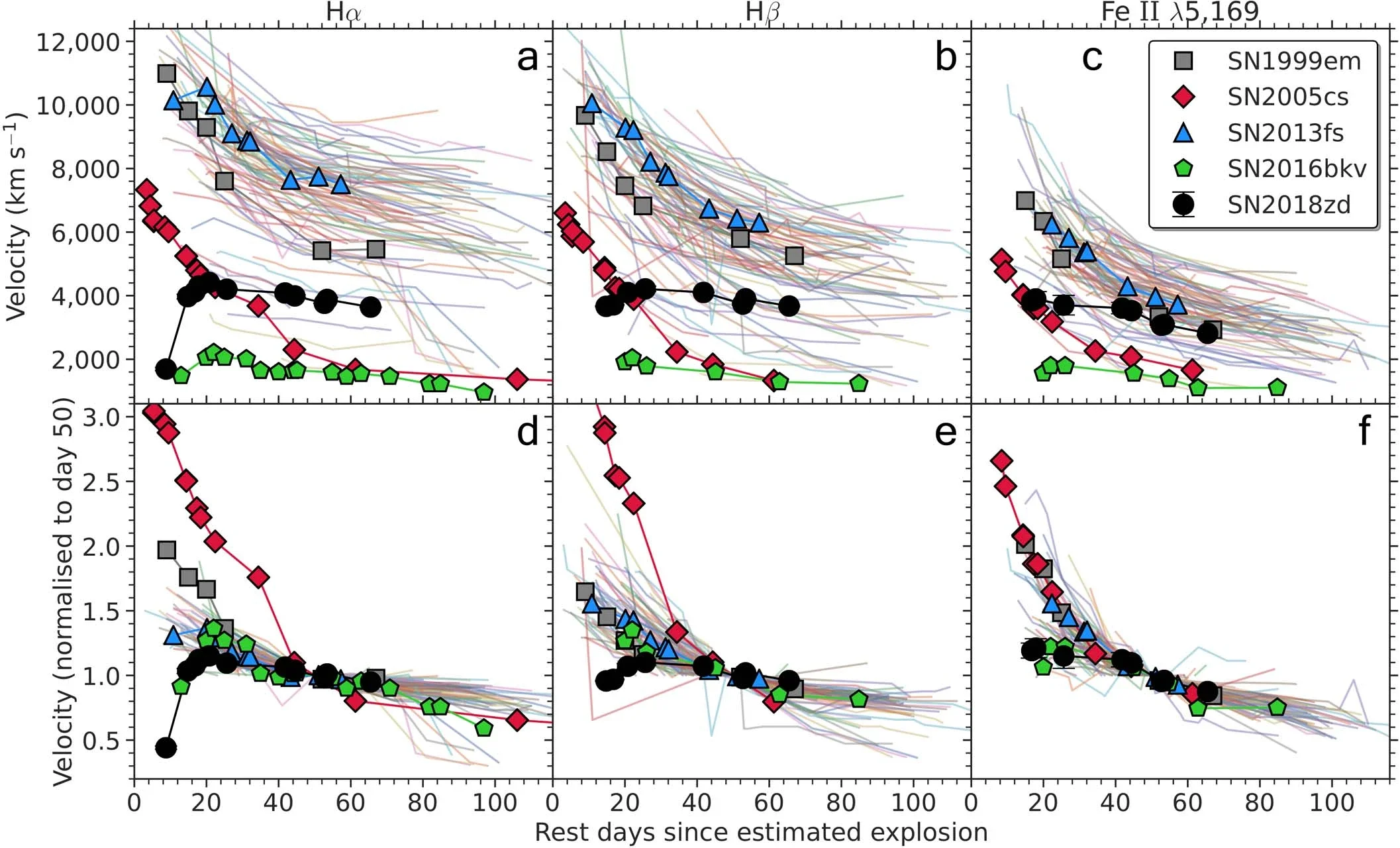
Japanese amateur astronomer Koichi Itagaki discovered SN 2018zd in March 2018, in the outskirts of NGC 2146. Astronomers followed its changing light and spectra using observations from Earth and space. Hydrogen signatures and a prolonged brightness plateau placed it within the Type II-P observational class.
That label describes what astronomers observe, rather than uniquely identifying what caused the explosion. An electron-capture event can resemble a supernova produced by iron-core collapse. Distinguishing them requires combining several kinds of evidence, including information about the star before it exploded.
Archival Hubble images revealed a faint candidate progenitor at the explosion’s position. Hiramatsu’s team interpreted its limited measurements as more consistent with a dusty super-asymptotic giant branch star than a conventional red supergiant. The identification was an important clue, although the original paper acknowledged uncertainties in the faint source.
The frequently quoted distance of 31 million light-years also needs qualification. It comes from the team’s adopted estimate of 9.6 million parsecs. Other estimates placed NGC 2146 farther away, affecting calculations of the star’s luminosity and the explosion’s radioactive output.
The researchers examined six predicted indicators: the progenitor, surrounding material, chemical composition, explosion energy, light curve and newly produced elements. They argued that SN 2018zd provided strong evidence for, or remained consistent with, all six. The strength of the case came from their combination.
Early observations indicated dense material around the star, suggesting substantial mass loss before the explosion. Spectral comparisons favored gas enriched in helium, carbon and nitrogen but depleted in oxygen. Those characteristics fit expectations for material expelled by a super-asymptotic giant branch star.

Its brightness later fell by about 3.8 magnitudes from the plateau to the radioactive tail. That steep decline pointed toward a small supply of radioactive nickel-56, whose decay helps power late emission. At the adopted distance, the team estimated approximately 0.0086 solar masses of nickel-56.
Late spectra also showed relatively strong stable-nickel emission compared with iron, consistent with neutron-rich material predicted by electron-capture models. Stable nickel and radioactive nickel-56 play different roles in this argument. The former provides a composition clue, while the latter influences how the fading explosion stays illuminated.
“We started by asking ‘what’s this weirdo?’” Hiramatsu said when the findings were announced. His team concluded that the electron-capture scenario could explain the unusual features together. Their analysis made SN 2018zd a particularly useful candidate for testing that prediction.
A competing analysis posted in 2021, led by E. Callis, favored iron-core collapse in a relatively low-mass red supergiant. That team adopted a larger distance, about 15.6 million parsecs, and inferred more radioactive nickel. Its interpretation of the nickel-to-iron evidence also differed.
The disagreement illustrates why a checklist alone cannot settle the mechanism. Distance, surrounding gas and spectral modeling influence what physical properties astronomers infer from the light. Low-energy iron-core explosions can overlap with electron-capture predictions, making an apparently distinctive signal less decisive when considered alone.
SN 2018zd nevertheless remains influential in the search. A 2026 paper in The Astrophysical Journal, led by Masato Sato, selected 10 additional candidates using their colors during the brightness plateau. Three had supporting spectra that disfavored strong interaction with surrounding gas as the explanation for their blue appearance.
The authors classified those three as stronger candidates and the remaining seven as less secure. Their modeled energies were compatible with electron-capture predictions, but they emphasized the need for further spectroscopy. Finding candidates and confirming the mechanism remain separate steps.
The 1054 supernova was bright enough to appear in daylight, according to historical records. Its surviving debris, the Crab Nebula, contains a pulsar and unusual chemical signatures. Those features have long made it a candidate for an electron-capture explosion.
However, a 2024 Webb study, led by Tea Temim, found a lower nickel-to-iron abundance ratio than earlier estimates suggested. Measurements from two filament regions yielded ratios roughly three to eight times the Sun’s. The team favored a low-mass iron-core-collapse origin, while leaving electron capture possible.
That result prevents a simple claim that SN 2018zd solved the Crab’s origin. Instead, the two objects show how modern observations can refine competing explanations for stellar death. Better distances, earlier spectra and more complete observations of future explosions should help establish which signatures truly distinguish electron capture.
These resources explore competing interpretations, progenitor evidence and newer searches for this elusive explosion mechanism.
How low can you go? SN 2018zd as a low-mass Fe core-collapse supernova: Presents an alternative explanation for SN 2018zd and examines the importance of its uncertain distance. (arXiv preprint, 2021)
The disappearances of six supernova progenitors: Uses later Hubble observations to investigate whether candidate progenitor stars, including SN 2018zd’s, disappeared. (Monthly Notices of the Royal Astronomical Society, 2023)
Dissecting the Crab Nebula with JWST: Pulsar Wind, Dusty Filaments, and Ni/Fe Abundance Constraints on the Explosion Mechanism: Reassesses the Crab’s chemical evidence and favors a low-mass iron-core explosion without excluding electron capture. (The Astrophysical Journal Letters, 2024)
Electron-capture Supernova Candidates from Light Curves: Implications for Their Progenitors and Explosion Properties: Identifies 10 candidates and explains why additional spectroscopy is needed to confirm their nature. (The Astrophysical Journal, 2026)
The Formation of Electron-capture Supernovae: A Review: Reviews possible progenitor pathways, neutron-star formation and the remaining observational challenges. (Research in Astronomy and Astrophysics, 2026)
Research findings are available online in the journal Nature Astronomy.
The original story “Unusual supernova solves 1,000 year mystery revealing a third way stars might explode” is published in The Brighter Side of News.
Like these kind of feel good stories? Get The Brighter Side of News’ newsletter.
The post Unusual supernova solves 1,000 year mystery revealing a third way stars might explode appeared first on The Brighter Side of News.


Leave a comment
You must be logged in to post a comment.