Earth and Venus are remarkably similar in size and mass, yet one obvious feature separates the neighboring worlds. Earth has a large moon, while Venus has none.
A new analysis suggests Venus may not have needed a second catastrophic collision to lose a satellite. If a moon formed early in the planet’s history, ordinary tidal interactions between the two bodies could have eventually driven it back toward Venus under many plausible conditions.
The research, led by Stephen Kane of the University of California, Riverside and published in The Astrophysical Journal, models the intertwined evolution of Venus’s rotation and a hypothetical moon’s orbit. The results reveal a competition between the moon moving outward and Venus slowing its spin.
The study does not establish that Venus ever possessed a moon. Instead, it shows that if one formed, keeping it could have been surprisingly difficult.
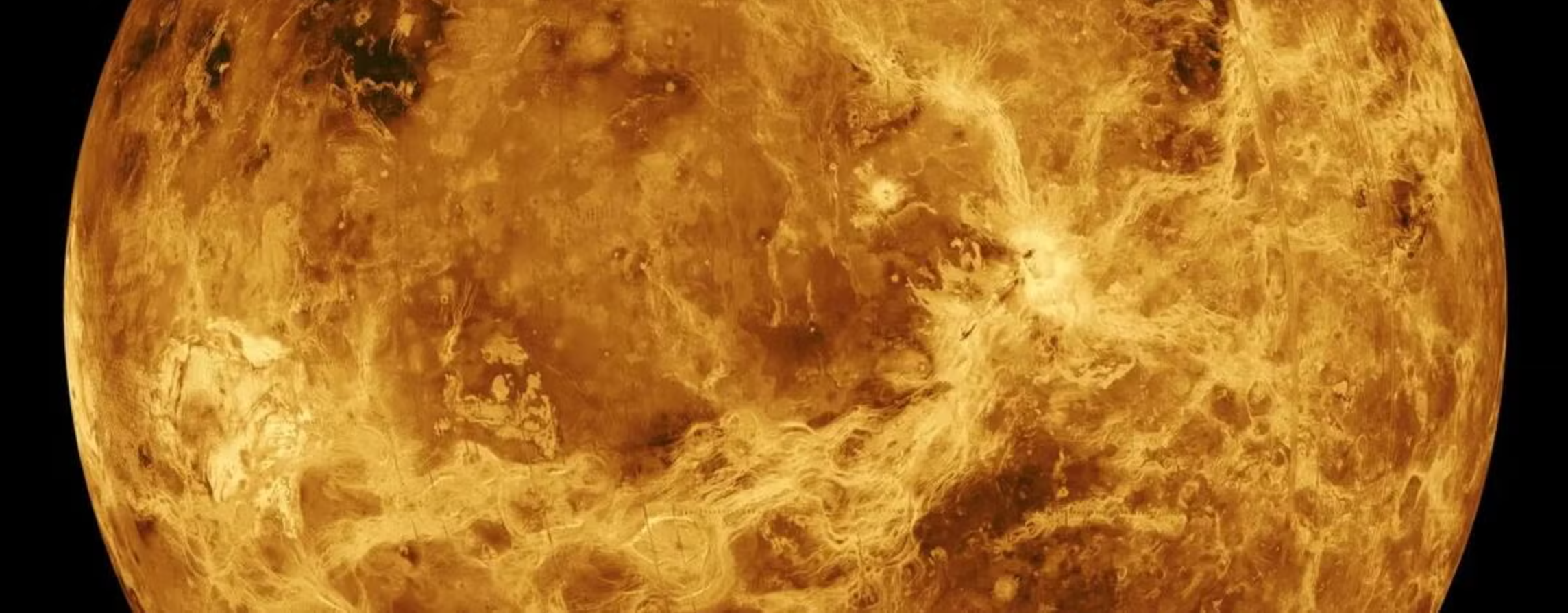
“My study shows Venus didn’t require a catastrophe to arrive at what we can see today,” Kane said. “It turns out the gravity of the planet itself combined with the rate at which it spins naturally caused the moon to collapse on top of it.”
Earth provides the familiar example of tidal evolution. Our planet rotates once roughly every 24 hours, while the Moon orbits much more slowly. Tidal interactions transfer rotational angular momentum from Earth into the Moon’s orbit, pushing the Moon outward by about four centimeters each year.
Whether a moon moves inward or outward depends partly on the location of the planet’s synchronous radius. At that orbital distance, the moon’s orbital period matches the planet’s rotation period.
A moon beyond the synchronous radius generally migrates outward. A moon inside it instead loses orbital energy and moves toward its planet.
Venus today takes 243 Earth days to complete one rotation and spins in the opposite direction from most planets. At that extremely slow rate, the synchronous radius would lie far beyond the region where a stable satellite could orbit.
Any moon around present-day Venus would therefore tend to migrate inward.
But early Venus probably rotated differently, so Kane and his colleagues examined a wide range of starting conditions rather than simply applying Venus’s current rotation.
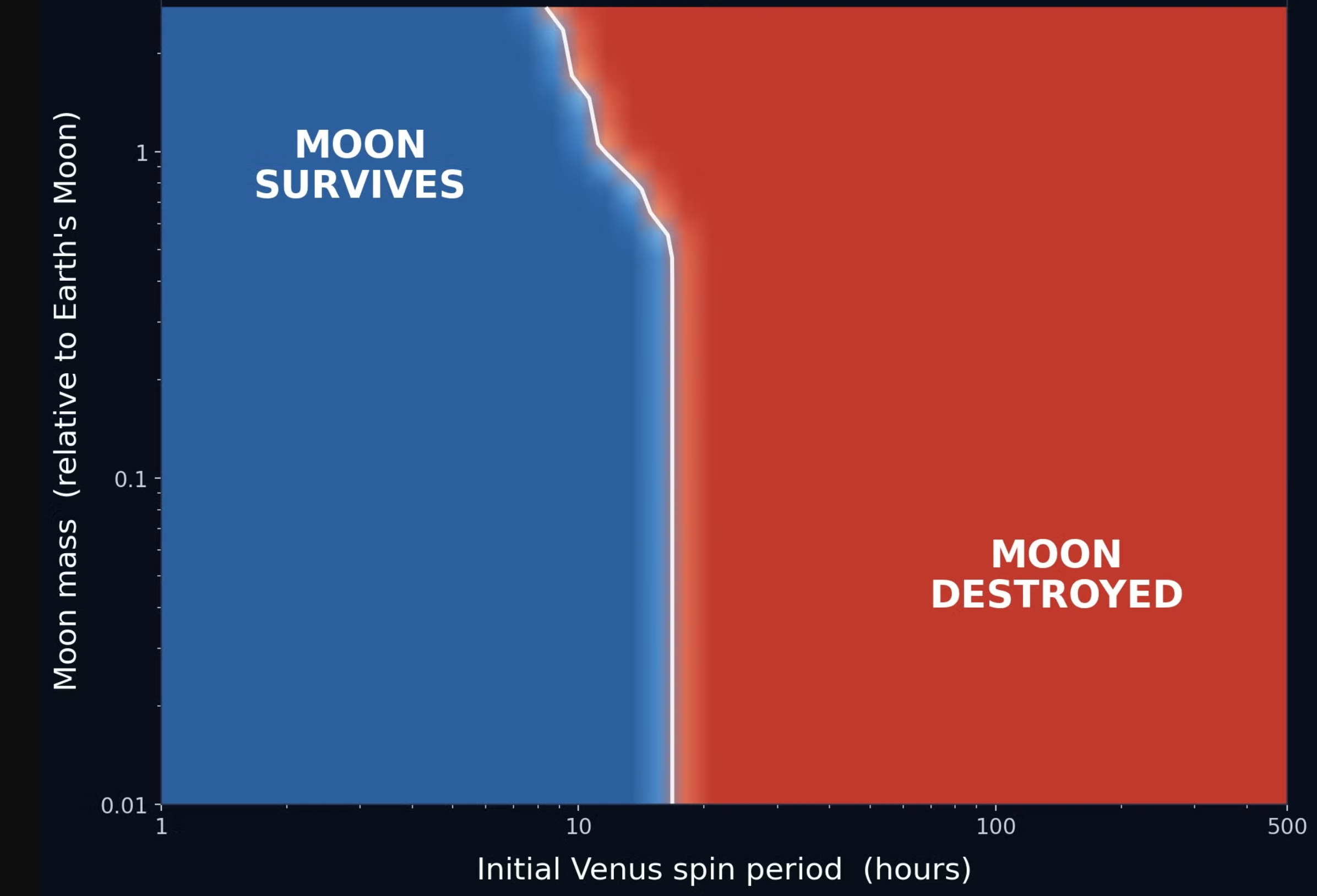
The researchers varied Venus’s initial rotation from five to 100 hours and tested satellites ranging from one-hundredth to 10 times the mass of Earth’s Moon. They also varied orbital distance, eccentricity and assumptions about how efficiently Venus dissipated tidal energy.
The results were not as simple as every hypothetical moon crashing into Venus.
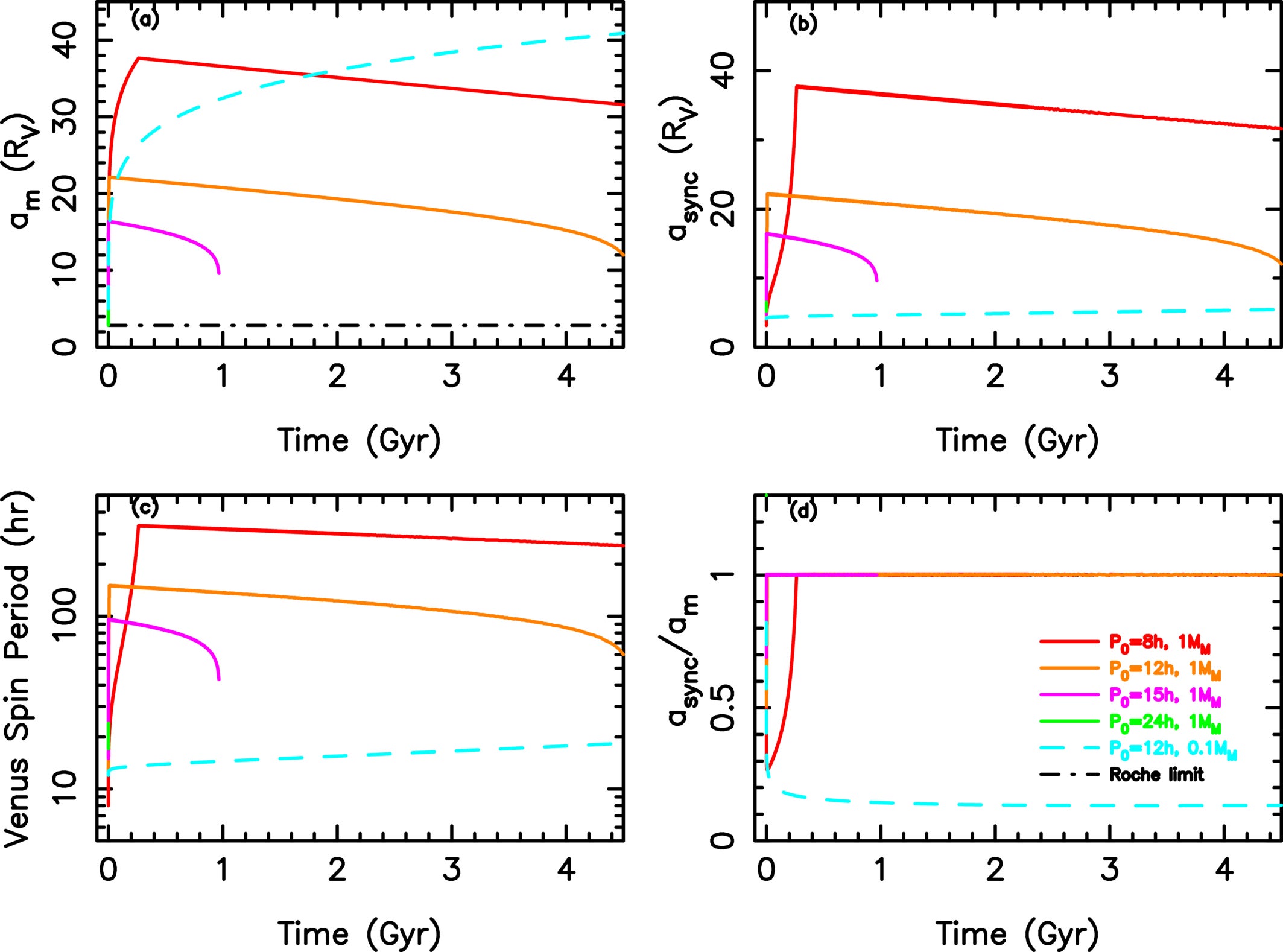
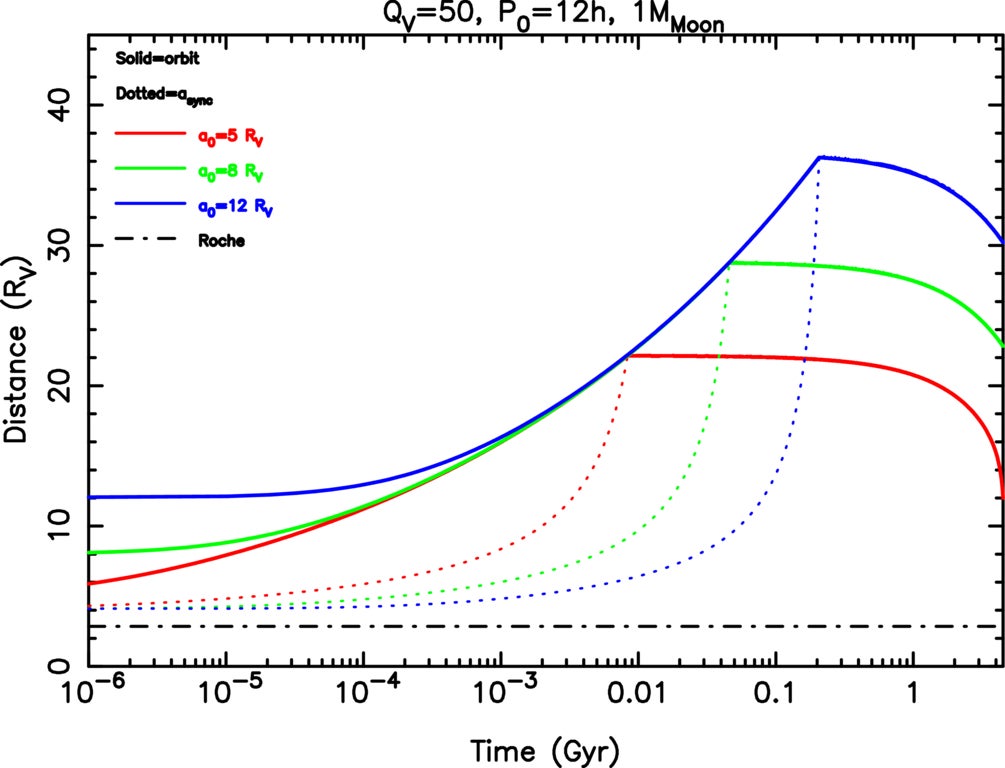
For a Moon-mass satellite on a nearly circular orbit, a young Venus rotating in roughly 12 hours or less could initially drive the moon outward fast enough for it to survive for the 4.5-billion-year duration of some simulations.
Slower rotation changed the outcome dramatically. In the models, a moon beginning five Venus radii from the planet faced a critical initial rotation period of about 16.1 hours. Beyond that point, it began inside the synchronous radius and moved rapidly inward.
Those moons could reach the Roche limit, where tidal forces would tear them apart, in less than about one million years.
The calculations therefore suggest that Venus’s missing moon cannot be explained by slow rotation alone without knowing how fast the young planet spun and what kind of satellite it might have formed.
Satellite mass introduced another unexpected effect.
A heavier moon experiences stronger tidal interactions. That can push the satellite outward, but it also slows the planet’s rotation more efficiently. As Venus slows, its synchronous radius moves outward.
The moon’s outward migration scales roughly with satellite mass, while the expansion of the synchronous radius caused by Venus’s despinning scales more strongly, approximately with the square of satellite mass in the modeled framework.
That means an especially massive moon can contribute to its own demise.
Under one constant-Q tidal model, moons at least twice as massive as Earth’s Moon could slow Venus enough for the synchronous radius to catch their orbits. The tidal direction would then reverse, sending the satellites inward toward destruction.
For a two-Moon-mass satellite, modeled destruction times ranged from tens of millions of years to roughly 1.7 billion years depending on Venus’s initial rotation.
The exact outcome remains uncertain because different models of rocky-planet tidal behavior diverge near synchronization. A constant-time-lag model sometimes allowed massive moons to settle into long-lived near-synchronous states rather than fall back into Venus.
That uncertainty is important. The interior response of early Venus is poorly known, so the simulations define plausible evolutionary pathways rather than reconstructing one proven history.
If Venus did possess a substantial moon for hundreds of millions of years, the satellite might have influenced the planet long before disappearing.
A large moon can affect planetary tilt, rotation and tides. If early Venus once possessed liquid water, lunar tides could also have affected ocean circulation, heat transport and the planet’s evolving spin.
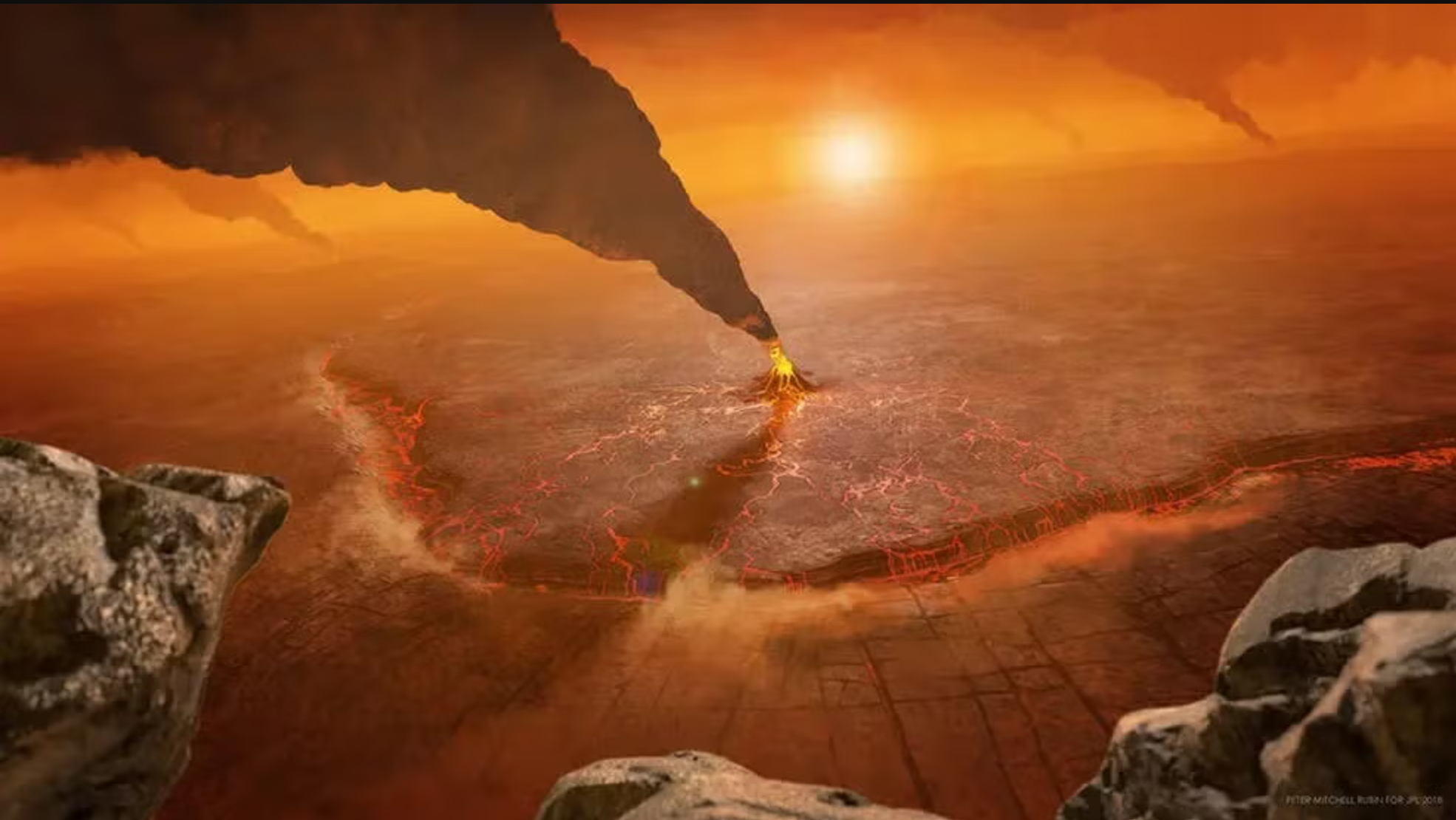
Its eventual destruction would have been dramatic. A satellite reaching the Roche limit could break apart into debris, with much of that material eventually returning to Venus.
However, the planet’s comparatively young surface complicates the search for geological evidence. Large-scale resurfacing hundreds of millions of years ago may have erased much older traces of such an event.
The research notes that NASA’s DAVINCI mission could potentially provide another route to testing aspects of Venus’s early history. Measurements of noble gases and isotopic ratios in the atmosphere may constrain major events that affected the planet, although separating a possible moon signature from volcanism and atmospheric loss would be difficult.
The study also changes how astronomers might think about moons around terrestrial exoplanets.
Rocky planets close to their stars can rotate slowly because of strong tidal interactions. Their smaller gravitational domains can also force moons into tighter orbits, where tidal forces become much stronger.
For some Venus-like worlds, forming a moon may therefore be only the beginning. The planet must also retain the right rotational and orbital conditions to keep it.
The researchers caution that their quantitative models were designed specifically for Venus, not as a comprehensive survey of exoplanets. Still, the basic physics suggests that slowly rotating rocky worlds close to their stars may have difficulty retaining large satellites.
“My feeling is there are benefits to having a moon, but it isn’t required for habitability,” Kane said. “The moon has definitely changed the way Earth has evolved through time, but we don’t fully know how important that role is.”
The missing moon of Venus therefore remains an open historical question. The new results show that if a satellite once existed, its disappearance may not require an extraordinary later catastrophe. Under the right conditions, the long-term gravitational relationship between Venus and its moon could have been enough.
These resources explore Venus’s early evolution, giant impacts, habitability and future measurements that could help reconstruct how Earth’s neighboring planet reached its present state.
The possibility of a giant impact on Venus: Models a range of early impacts and finds that scenarios consistent with Venus’s current rotation often produce little long-lived circumplanetary debris, providing an alternative route to a moonless Venus. (Astronomy & Astrophysics, 2025)
Venus as an anchor point for planetary habitability: Examines why the evolutionary divergence between Earth and Venus is central to understanding the habitability of rocky planets inside and outside the Solar System. (Nature Astronomy, 2024)
Atmospheric dynamics of a near tidally locked Earth-sized planet: Explores how slow rotation affects the atmospheric behavior and climate of Venus-like terrestrial planets, providing context for the connection between spin and planetary evolution. (Nature Astronomy, 2022)
Was Venus the First Habitable World of our Solar System?: Climate simulations show that ancient Venus could have maintained moderate surface conditions under some atmospheric, ocean and rotation scenarios. (Geophysical Research Letters, 2016)
Revealing the Mysteries of Venus: The DAVINCI Mission: Describes NASA’s DAVINCI mission and its planned atmospheric measurements designed to reconstruct the origin, evolution and possible water history of Venus. (The Planetary Science Journal, 2022)
Research findings are available online in The Astrophysical Journal.
The original story “Venus may have swallowed its own moon, new models finds” is published in The Brighter Side of News.
Like these kind of feel good stories? Get The Brighter Side of News’ newsletter.
The post Venus may have swallowed its own moon, new models finds appeared first on The Brighter Side of News.


Leave a comment
You must be logged in to post a comment.