The human body underwent massive structural changes to accommodate walking on two legs. During this evolutionary shift, the gluteus maximus expanded significantly to provide the stability required for an upright posture and running. This physical adaptation transformed the gluteal region into a prominent secondary sexual characteristic, making it a focal point of human physical attractiveness.
For many years, evolutionary psychologists believed that men were instinctively drawn to women with a low waist-to-hip ratio because it signaled high fertility and robust health. However, recent nutritional research provides evidence that this preference might actually be rooted in slightly different biological indicators. To explore why specific body proportions appeal to men, researchers analyzed health and nutritional data from more than 12,000 female participants in the United States.
The study, published in Evolution and Human Behavior (2019), examined whether small waists and low body mass index scores were genuinely linked to higher fertility rates. The researchers found that these traits do not necessarily indicate better overall health or increased fertility in well-nourished women. Instead, the authors noted that a low waist-to-hip ratio serves as a reliable indicator that a woman is young, has never been pregnant, and possesses maximal stores of brain-building fatty acids.
These specific fatty acids, known as docosahexaenoic acid, are a type of omega-3 nutrient stored heavily in the fat of the hips and thighs. This nutrient is highly important during pregnancy and breastfeeding, as it aids in fetal brain development. The researchers suggest that men evolved to prefer a low waist-to-hip ratio because it identifies young women who possess the necessary nutritional reserves to successfully sustain a first pregnancy.
Scientists have long debated whether our aesthetic preferences are shaped purely by cultural media or if they stem from innate, evolutionary programming. To investigate the role of visual information in shaping these desires, scientists conducted an experiment with 19 men who had been entirely blind from birth. The study, published in Evolution and Human Behavior (2010), also included 19 sighted men who visually evaluated mannequins, and another 19 sighted men who evaluated them while blindfolded.
The researchers presented the participants with two mannequins that possessed the exact same overall volume but featured different waist-to-hip ratios of 0.70 and 0.84. Because the total volume was identical, the participants could not simply choose a mannequin based on it being generally smaller or larger. They had to evaluate the specific curves and proportions of the figures through touch or sight.
The participants across all three groups consistently preferred the mannequin with the 0.70 waist-to-hip ratio. The authors explain that visual input from Western media is not strictly necessary for these preferences to develop. They suggest that these physical preferences might stem from evolved predispositions, or perhaps generic psychological mechanisms where individuals associate a narrower waist with the biological female sex.
This widespread preference for specific body proportions appears to influence cognitive functions beyond simple visual attraction. A study published in Evolution and Human Behavior (2016) tested whether a woman’s waist-to-hip ratio affects how many biographical details men can remember about her after a brief interaction. The authors manipulated a photograph of a single Caucasian woman to display ratios ranging from 0.50 up to 0.90.
Male undergraduates viewed one of these photographs and then took a memory test regarding the woman’s physical appearance and biographical information, such as her hobbies and occupation. The participants recalled significantly more details when viewing the woman with a ratio of 0.60, 0.70, or 0.80 compared to the extreme ratios of 0.50 or 0.90. The authors propose that men might pay closer attention to women displaying traditionally attractive proportions.
This increased attention and memory retention might be linked to how the brain processes rewards. The authors reference previous brain-imaging studies showing that the anterior cingulate cortex, a region of the brain associated with reward processing, activates when men look at women with a waist-to-hip ratio near 0.70. This neurological response could explain why men unconsciously dedicate more cognitive resources to remembering details about these individuals.
To achieve these desired contours in a clinical setting, aesthetic surgeons rely on a deep understanding of the region’s underlying biology. A literature review published in Clinical Anatomy (2025) details the specific biological structures that dictate the outward appearance of the buttocks. The author points out that aesthetic surgeons focus on structural features that are often missing from traditional medical anatomy textbooks, which rarely discuss the concept of physical beauty.
For instance, the fat in the gluteal region is not a single, continuous layer. It is separated into distinct compartments by a network of connective tissues and fibers. Adding volume to the superior-medial compartment, located near the upper center, enhances the upper cleavage and creates a more aesthetically pleasing shape. On the other hand, removing too much fat from the inferior-lateral compartment on the lower outside edge can create an unnatural sagging deformity.
The study also highlights an intramuscular zone called FROD’s space, which provides a unique opportunity for surgical enhancement. This space is described as a clean area within the gluteus maximus muscle that is free of significant blood vessels and nerve endings. Researchers suggest that this specific space has great potential for safely accommodating gluteal implants during contouring operations.
Additionally, the author notes that male and female buttocks have completely different structural ideals based on their anatomical foundations. Male buttocks tend to display sharper transitions and a more square shape due to thicker gluteal connective tissue and a higher density of muscle mass. The ideal female buttock is generally characterized by softer curves, a wider pelvic tilt, and a rounder overall appearance that requires distinct surgical approaches.
Early attempts to classify these aesthetic features helped establish safety guidelines and visual targets for gluteal surgery. A foundational study published in Aesthetic Plastic Surgery (2004) analyzed 2,400 photographs of female figures to identify the consistent visual traits of beautiful buttocks. A panel of certified plastic surgeons evaluated the images to isolate the specific anatomical signs that create harmony.
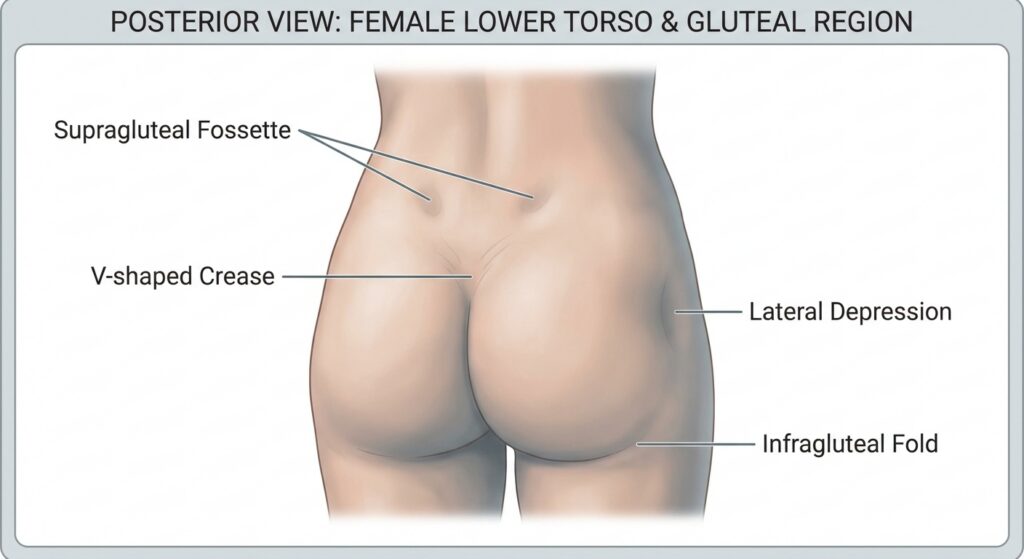
The researchers pinpointed four main visual features that contribute to an attractive appearance. The first is a lateral depression, which is a subtle hollow on the side of the hip formed by the surrounding muscle attachments. The second feature is the infragluteal fold, the horizontal crease located just beneath the buttocks where the muscle meets the back of the upper thigh.
The third feature consists of the supragluteal fossettes, commonly known as dimples of Venus, which are small depressions on the lower back above the gluteal cleft. The fourth feature is a V-shaped crease that extends upward and outward from the gluteal cleft toward these dimples. To quantify these visual traits, the researchers physically measured 132 female patients and calculated the proportions of their lower bodies.
The authors expanded on this work in an article published in Clinics in Plastic Surgery (2006), where they defined the ideal side-profile projection. They determined that the distance from the side of the hip bone to the back of the buttocks should be exactly twice the distance from the hip bone to the front of the pelvis. This two-to-one ratio allows surgeons to evaluate whether a patient needs more volume or simply a reshaping of existing tissues.
Based on this two-to-one ratio, the researchers established five distinct patient typologies to help surgeons plan specific contouring procedures. Type 1 patients have the ideal projection but possess excess fat on the edges of the buttocks. Type 2 patients have adequate width but lack the desired rearward projection, giving them a flatter appearance from the side.
Type 3 patients exhibit a postural curvature of the lower spine, which creates the illusion of rearward projection but lacks actual muscle volume. Type 4 patients have athletic, cylindrical builds with very little fat or projection in any direction. Type 5 patients display signs of aging, such as sagging tissues and loss of muscle tone, requiring more extensive surgical lifting rather than simple volume injections.
Some researchers rely heavily on mathematical concepts to guide aesthetic enhancements and explain human visual preferences. A study published in Plastic and Reconstructive Surgery (2024) explored the connection between the female buttock and the golden ratio. The golden ratio is a mathematical proportion of approximately 1.618 that appears frequently in nature and is highly pleasing to the human eye.
The authors discovered that the perimeter of a golden spiral closely matches the curve of an attractive female buttock in both standing and sitting positions. This mathematical spiral is created by drawing arcs inside progressively smaller rectangles that follow the golden ratio. When applying this spiral to images of the human body, the authors noticed that the most prominent points fall in slightly different locations than commonly assumed.
According to their geometric analysis, the point of maximum lateral width is positioned lower on the hip than the precise midpoint of the curve. Similarly, the lowest point of the downward curve sits closer to the center of the body rather than in the exact middle of the leg line. They suggest that matching this mathematical spiral during surgery can produce a more harmonious and natural profile.
This geometric approach is expanded upon in a review published in the European Journal of Plastic Surgery (2023). To help less experienced surgeons plan their operations, the authors recommend visualizing three parallel horizontal lines across the torso and legs. One line crosses the narrowest part of the waist, one crosses the front of the hip bones, and one crosses the widest part of the outer thighs.
In an ideally proportioned figure, these three lines should be perfectly equidistant from one another. This even spacing ensures a balanced visual transition from the torso to the lower body. For the posterior view, the authors suggest the angle formed between the vertical line of the hip bone and the lower curve of the buttocks should measure exactly 170 degrees. The review also details that a diamond-shaped space between the inner thighs is considered an attractive sign of fitness.
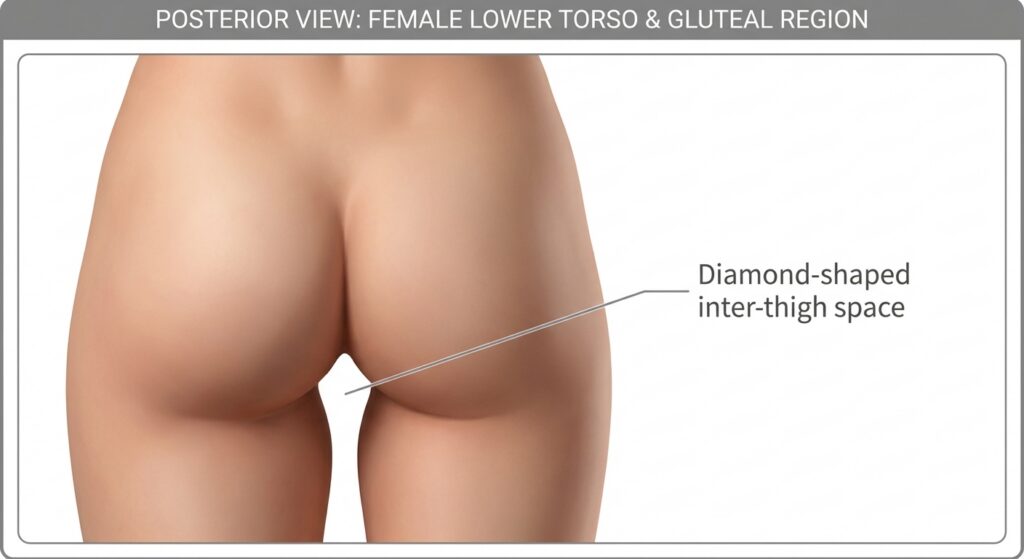
The authors highlight that the overall shape of the buttocks from behind should resemble an ‘A’ or an ‘O’ shape, which are seen as feminine and athletic. Shapes that resemble a square ‘H’ or an inverted ‘V’ are generally considered less aesthetically pleasing.
While historical clinical guidelines often cite the 0.70 waist-to-hip ratio, public preferences appear to be shifting toward more exaggerated proportions. A population analysis published in Plastic and Reconstructive Surgery (2016) investigated whether modern media trends and fashion have altered the aesthetic ideal. The researchers surveyed 1,146 online participants using digitally altered images with varying anatomical proportions.
The results revealed a strong preference for a dramatically curvier figure from the posterior view. Around 44 percent of the respondents chose a waist-to-hip ratio of 0.65 as the most attractive option. Another 25 percent preferred an even lower, more extreme ratio of 0.60, suggesting that the traditional standard of 0.70 is no longer the primary ideal for the posterior angle.
From a lateral side-profile view, the participants favored a slightly more moderate shape. From this angle, a waist-to-hip ratio of 0.70 was rated as the most attractive. The respondents also preferred the maximum rearward projection to be located exactly in the vertical middle of the buttocks, representing an even fifty-fifty top-to-bottom vertical ratio.
Interestingly, this study did not find any significant differences in preferences based on the demographics of the respondents. Men and women, as well as participants from different age groups and ethnicities, generally agreed on the 0.65 waist-to-hip ratio ideal for the posterior view. The authors concluded that this represents a broad cultural paradigm shift toward a more voluptuous aesthetic, likely driven by modern media and celebrity culture.
While some research points to a universal modern standard, other studies provide evidence that beauty ideals are heavily influenced by cultural and demographic backgrounds. A global survey published in Plastic and Reconstructive Surgery (2017) explored how a person’s geographic location affects their perception of the ideal buttock size. The researchers collected 1,032 responses from plastic surgeons and the general public across more than 40 different countries.
Participants used an interactive digital slider tool to adjust the size and proportions of a single computer-generated model. Overall, 39 percent of the total survey population selected a waist-to-hip ratio of 0.70 as their ideal, maintaining it as a strong baseline standard globally. However, when the researchers analyzed the data using demographic sub-groups, significant variations emerged.
The statistical analysis showed that gender, age, and ethnicity all impacted attractiveness perceptions. Men generally preferred larger buttock sizes compared to women. Younger participants favored larger sizes compared to older age groups, and non-Caucasian respondents perceived larger buttocks to be more attractive than Caucasian respondents did.
The researchers also discovered notable geographic differences among the plastic surgeons who participated in the study. Surgeons practicing in Latin America preferred the largest buttocks on average. They were followed by surgeons in Asia, North America, and Europe, indicating that regional cultural trends strongly influence professional aesthetic goals and surgical practices.
There was also an interaction effect between a surgeon’s gender and their specific region of practice. In Latin America, North America, and Asia, male surgeons tended to prefer larger buttocks than their female colleagues. On the other hand, female surgeons practicing in Europe preferred larger sizes than male surgeons in that same region, highlighting the complex nature of aesthetic opinions.
To capture accurate measurements of real human bodies rather than digital models, researchers often use a technique called photogrammetry. This method involves taking precise mathematical measurements from standardized photographs. A study published in Surgical and Radiologic Anatomy (2018) utilized this technique to evaluate the lower bodies of 200 healthy young adults.
The researchers photographed 100 men and 100 women between the ages of 19 and 21, then used specialized software to calculate their linear proportions. Afterward, they asked participants to rate the physical attractiveness of the varying body shapes. The results revealed distinct differences in what is considered ideal for male versus female figures.
For female figures, the most attractive waist-to-hip ratio from a posterior view was found to be 0.75, which is slightly wider and less dramatic than the findings in studies utilizing altered digital illustrations. For male figures, the ideal posterior ratio was significantly narrower at 0.85. From a lateral profile view, both male and female ideals converged at a ratio of 0.70.
Regional preferences were further explored in a study conducted in northern Italy, published in the European Journal of Plastic Surgery (2026). Researchers showed 18 computer-generated models featuring different gluteal characteristics to 1,064 adult volunteers. The participants were asked to select the models they found most aesthetically pleasing based on volume, crease length, and lower back features.
Instead of the traditional waist-to-hip ratio, this study evaluated the glute-to-waist ratio, which measures how many times larger the hips are compared to the waist. The majority of respondents chose a ratio of 1.5 as the most attractive option. This measurement translates to a waist-to-hip ratio of roughly 0.66, which aligns closely with the modern preference for a curvier figure.
The survey also investigated preferences regarding the length of the infragluteal sulcus, the crease where the buttocks meet the thigh. Participants viewed models with crease lengths ranging from one-fifth to five-fifths of the total width of the leg. The most highly rated model featured a crease that extended exactly three-fifths of the way across the thigh.
Finally, the researchers asked participants to evaluate the presence of Venus dimples on the lower back. A significant majority, around 60 percent, found the models with visible dimples to be more aesthetically pleasing than those without. By combining these three winning traits, the authors rendered a single composite image representing the ideal Southern European female buttock.
While the waist-to-hip ratio is heavily emphasized in evolutionary psychology, some scientists question whether it oversimplifies the perception of beauty. To test this concept, researchers conducted two experiments using line drawings of female figures. The study, published in Scientific Reports (2024), investigated whether overall curviness might predict attractiveness better than a strict mathematical ratio.
In the first experiment, 80 adults rated 12 line drawings where curviness and the waist-to-hip ratio were perfectly aligned, meaning they could not be evaluated separately. The participants consistently preferred the 0.70 ratio, matching previous research findings. In the second experiment, 98 adults evaluated 25 drawings where the researchers separated curviness from the waist-to-hip ratio, creating a wider and more diverse variety of body shapes.
The results of the second experiment challenged traditional assumptions about physical beauty. For larger body widths, a fixed 0.70 ratio was no longer the most attractive metric. If a wider body maintained a strict 0.70 ratio, the hips appeared unrealistically large or the waist appeared unnaturally compressed.
Instead of relying on the ratio, a moderate level of curviness became a more reliable indicator of beauty for wider figures, regardless of the exact waist-to-hip measurements. The authors conclude that relying solely on a mathematical ratio is an incomplete way to measure human attractiveness. They suggest that the actual contour and shape of the body provide a better understanding of what people find visually appealing.
While previous research identified surface level traits of ideal buttocks, the underlying anatomical differences remained largely unexplored. To bridge this gap, scientists set out to investigate how the deeper structures of the gluteal region differ between women with aesthetically ideal proportions and those with average proportions. Their findings were published in Aesthetic Plastic Surgery (2022).
The researchers conducted a matched case control study involving ten female participants. They first selected five women deemed to have ideal buttocks by an expert panel of plastic surgeons and laypeople who evaluated photographs of 23 volunteers. These five models, who had never undergone cosmetic surgery, were then paired with five control participants of the exact same age, height, body mass index, and pregnancy history.
To analyze the anatomical differences, the researchers gathered detailed physical measurements using calipers and measuring tapes. They also took standardized photographs from multiple angles. Finally, the participants underwent magnetic resonance imaging scans, a medical imaging technique that allowed the researchers to precisely measure the volume and thickness of both the gluteus maximus muscle and the overlying fat.
The physical measurements revealed distinct differences in the skeletal and surface proportions of the two groups. The women categorized as having ideal buttocks possessed significantly narrower waists and narrower upper hip bones. However, they displayed wider measurements at the mid hip and lower hip, resulting in an average waist to hip ratio of roughly 0.69, compared to 0.76 for the control group.
The magnetic resonance imaging scans provided evidence that the desirable shape was primarily driven by muscle rather than fat. The models possessed significantly larger and thicker gluteus maximus muscles, which added rearward projection and raised the point of maximum projection higher on the body. Interestingly, the total volume and thickness of the subcutaneous fat sitting above the muscle did not differ between the two groups.
These findings suggest that an attractive gluteal region depends heavily on muscle development and bone structure rather than simple fat accumulation. A potential misinterpretation of aesthetic surgery is that adding large volumes of fat will automatically create an ideal shape. This research indicates that fat alone cannot replicate the firmness and specific projection provided by a well developed muscle.
But the authors note that their study features a very small sample size of only ten individuals, partly due to the high cost of medical imaging scans and the difficulty of finding natural models. They also point out that the aesthetic standards evaluated may reflect specific Latin American cultural preferences.
While these studies provide a wealth of data for aesthetic surgeons and evolutionary biologists, they also present several conflicting findings regarding demographic preferences. For instance, the 2016 survey of 1,146 individuals found that a ratio of 0.65 was universally preferred across all ages, genders, and ethnicities. In contrast, the 2017 global survey found significant demographic divides, showing that men and younger generations distinctly preferred larger sizes than older demographics.
These differing results may stem from differences in how the surveys were designed and administered. One study utilized a selection of multiple static images, while the other used an interactive digital slider that allowed participants to actively alter the shape of the model. The method of interaction might influence how people perceive and report their ideal beauty standards.
There is also debate over the exact mathematical ideal for the posterior angle. While older literature established 0.70 as the gold standard, modern digital surveys frequently point to 0.65 or 0.60 as the new ideal. However, studies using photogrammetry on real human volunteers often find that a ratio of 0.75 is rated as the most attractive, suggesting that digital illustrations might skew public perception toward exaggerated and sometimes physically impossible proportions.
The current body of research on gluteal aesthetics carries several limitations. Many of the large-scale surveys rely on two-dimensional, static images that artificially isolate the buttocks from the rest of the body. In reality, the attractiveness of this region is heavily dependent on how it transitions into the thighs, waist, and lower back in three-dimensional space.
In addition, studies utilizing digital models often alter a single base image, typically of a Caucasian woman. This approach fails to account for how diverse skin colors, body fat distributions, and varying bone structures might influence a viewer’s perception of beauty. While this method isolates the specific mathematical variables being tested, it reduces the real-world applicability of the findings.
Future research in this field aims to utilize advanced three-dimensional scanning technology to evaluate bodies in a more holistic manner. By studying diverse populations across different geographical regions, scientists hope to build more inclusive and accurate models of physical attractiveness. Until then, aesthetic surgeons must balance these mathematical guidelines with the unique anatomical features and personal preferences of each individual patient.
The study, “Curviness is a better predictor of a woman’s body attractiveness than the waist-to-hip ratio”, was authored by Ronald Hübner and Emily Sophie Ufken.
The study, “Blind men prefer a low waist-to-hip ratio”, was authored by Johan C. Karremans, Willem E. Frankenhuis, and Sander Arons.
The study, “Evidence supporting nubility and reproductive value as the key to human female physical attractiveness”, was authored by William D. Lassek and Steven J. C. Gaulin.
The study, “Shaping men’s memory: the effects of a female’s waist-to-hip ratio on men’s memory for her appearance and biographical information”, was authored by Carey J. Fitzgerald, Terrence G. Horgan, and Susan M. Himes.
The study, “Buttocks Anatomy: A Review of Its Beauty and Shape as Considered by the Plastic Surgery Literature”, was authored by Joel A. Vilensky.
The study, “What Makes Buttocks Beautiful? A Review and Classification of the Determinants of Gluteal Beauty and the Surgical Techniques to Achieve Them”, was authored by Ramon Cuenca-Guerra and Jorge Quezada.
The study, “Beautiful Buttocks: Characteristics and Surgical Techniques”, was authored by Ramon Cuenca-Guerra and Ignacio Lugo-Beltran.
The study, “Relationship between the Ideal Female Buttock and the Golden Ratio”, was authored by Edoardo Raposio, Sara Brocca, and Giorgio Raposio.
The study, “The ideal buttock: some aesthetic and morphometric considerations”, was authored by Edoardo Raposio, Ilaria Baldelli, Monica Vappiani, Alessandro Gualdi, and Giorgio Raposio.
The study, “Redefining the Ideal Buttocks: A Population Analysis”, was authored by Wendy W. Wong, Saba Motakef, Yi Lin, and Subhas C. Gupta.
The study, “The Ideal Buttock Size: A Sociodemographic Morphometric Evaluation”, was authored by Paul I. Heidekrueger, Sammy Sinno, Neil Tanna, Caroline Szpalski, Sabrina Juran, Daniel Schmauss, Denis Ehrl, Reuben Ng, Milomir Ninkovic, and P. Niclas Broer.
The study, “Physical attractiveness: analysis of buttocks patterns for planning body contouring treatment”, was authored by Gkionoul Nteli Chatzioglou, Figen Govsa, Ahmet Bicer, Mehmet Asim Ozer, and Yelda Pinar.
The study, “The “ideal” Southern European female buttocks: a socio-demographic analysis”, was authored by Edoardo Raposio, Alice Morello, Elisa Bertulla, and Gregorio Santori.
The study, “What Makes a Beautiful Buttock Beautiful? A Case-Control Study Comparing Buttocks Models versus Normal Women by Magnetic Resonance Imaging, Photography and Anthropometry”, was authored by Stefan Danilla, Ekaterina Troncoso, Rocio Jara, Carlos Dominguez, Claudia Albornoz, Cristian Erazo, Sergio Sepulveda, Johanna Nielsen, Sofia Serra, and Naomi Yamada.

