A faint arc only about 72 parsecs wide is peeling away from a star cluster 115 million light-years from Earth. If the interpretation holds, it gives astronomers a new way to map dark matter far beyond the Milky Way.
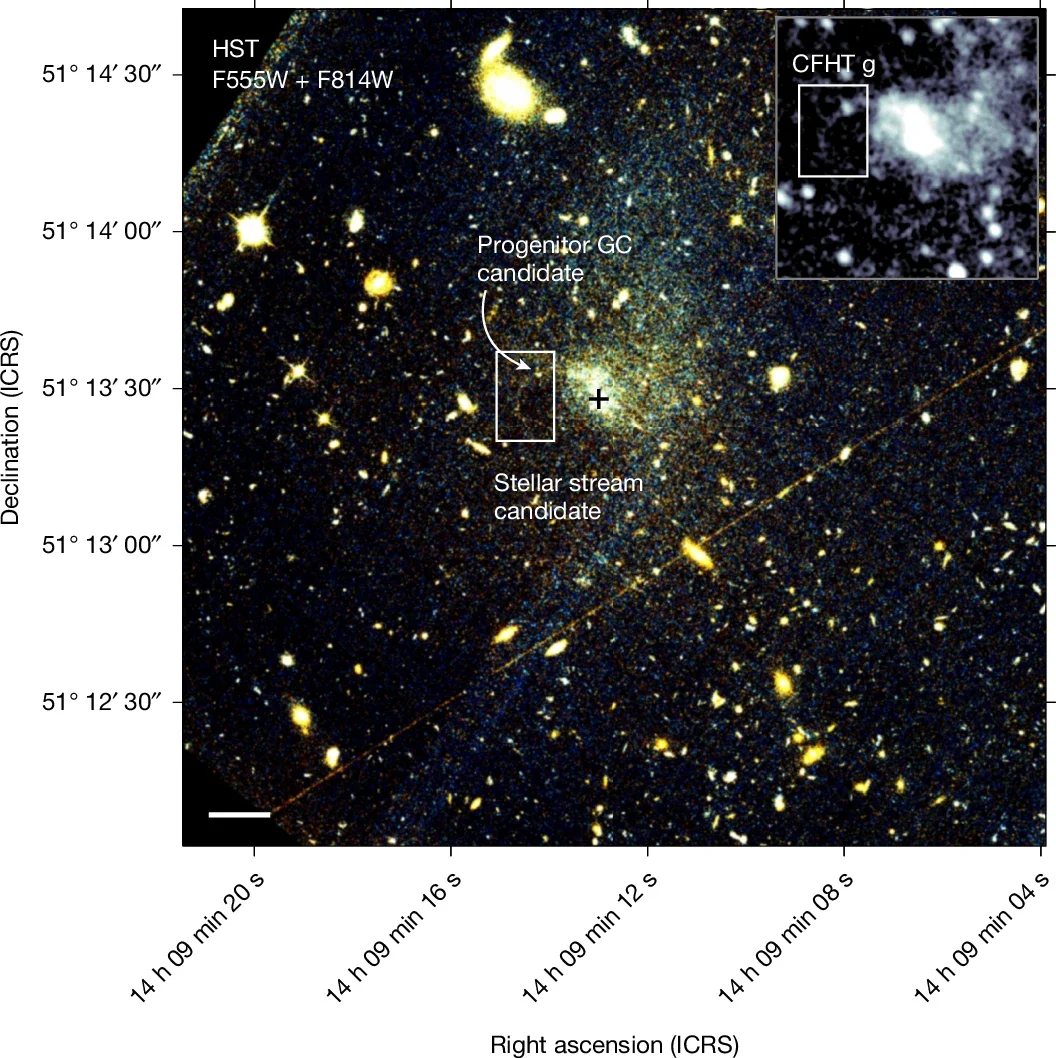
The feature lies in UGC 9050-Dw1, an ultra-diffuse galaxy with a sparse population of stars. Astronomers named the arc Oyashio, after a cold Pacific Ocean current. It stretches about 2 kiloparsecs from a globular cluster candidate roughly 2.5 kiloparsecs from the galaxy’s center.
The work was co-led by Julie Kiel Holm of the University of Copenhagen and Sarah Pearson of the Technical University of Denmark. Northwestern University astrophysicist Tjitske Starkenburg was among the co-authors.
Globular clusters are dense collections of stars held together by gravity. As one circles a galaxy, tidal forces can pull stars from its edges. The escaped stars keep moving along similar orbits, creating thin streams that preserve information about the gravitational field around them.
Astronomers have identified dozens of globular-cluster streams inside the Milky Way. Finding the same kind of structure around another galaxy has proved much harder because the streams are extremely faint.
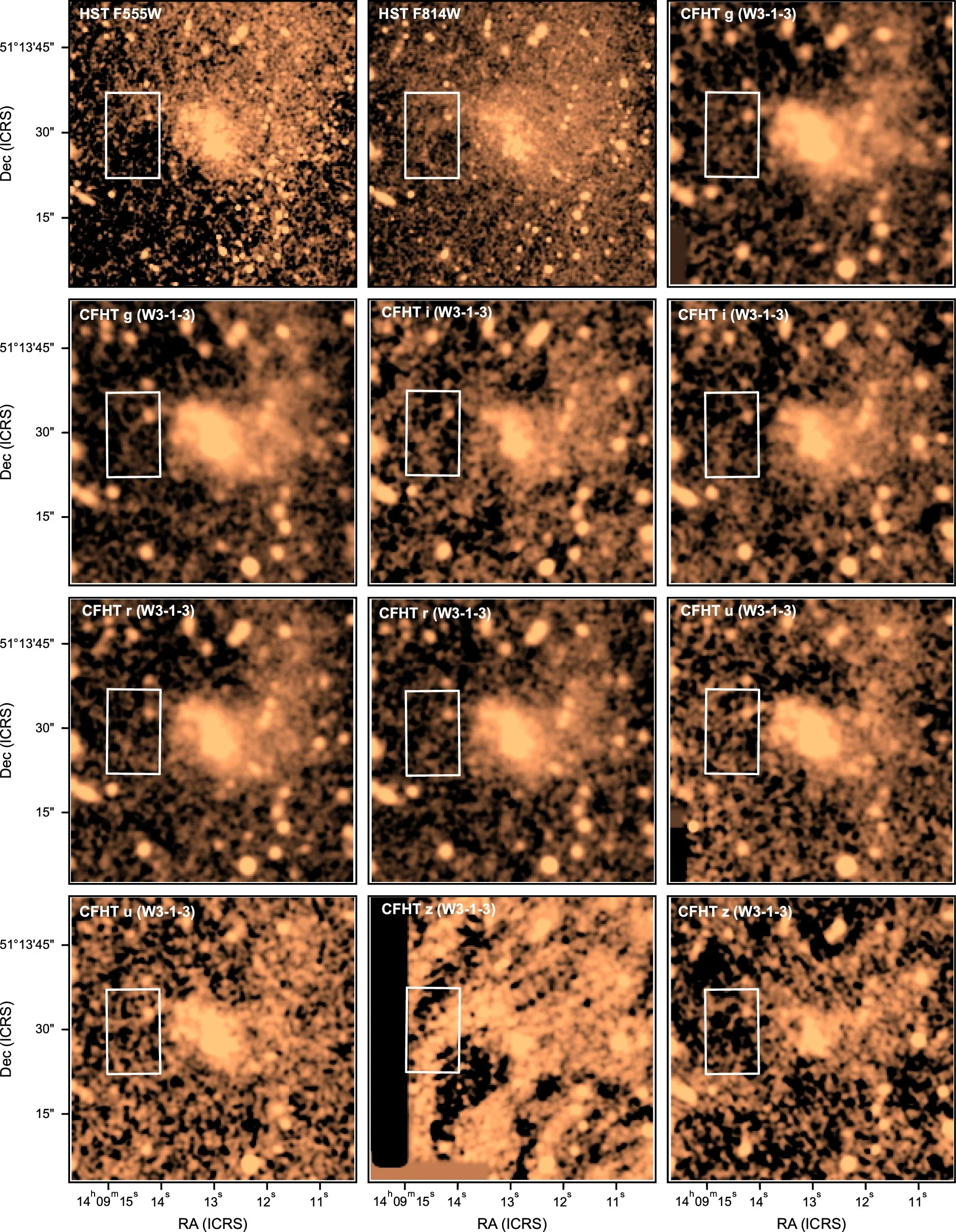
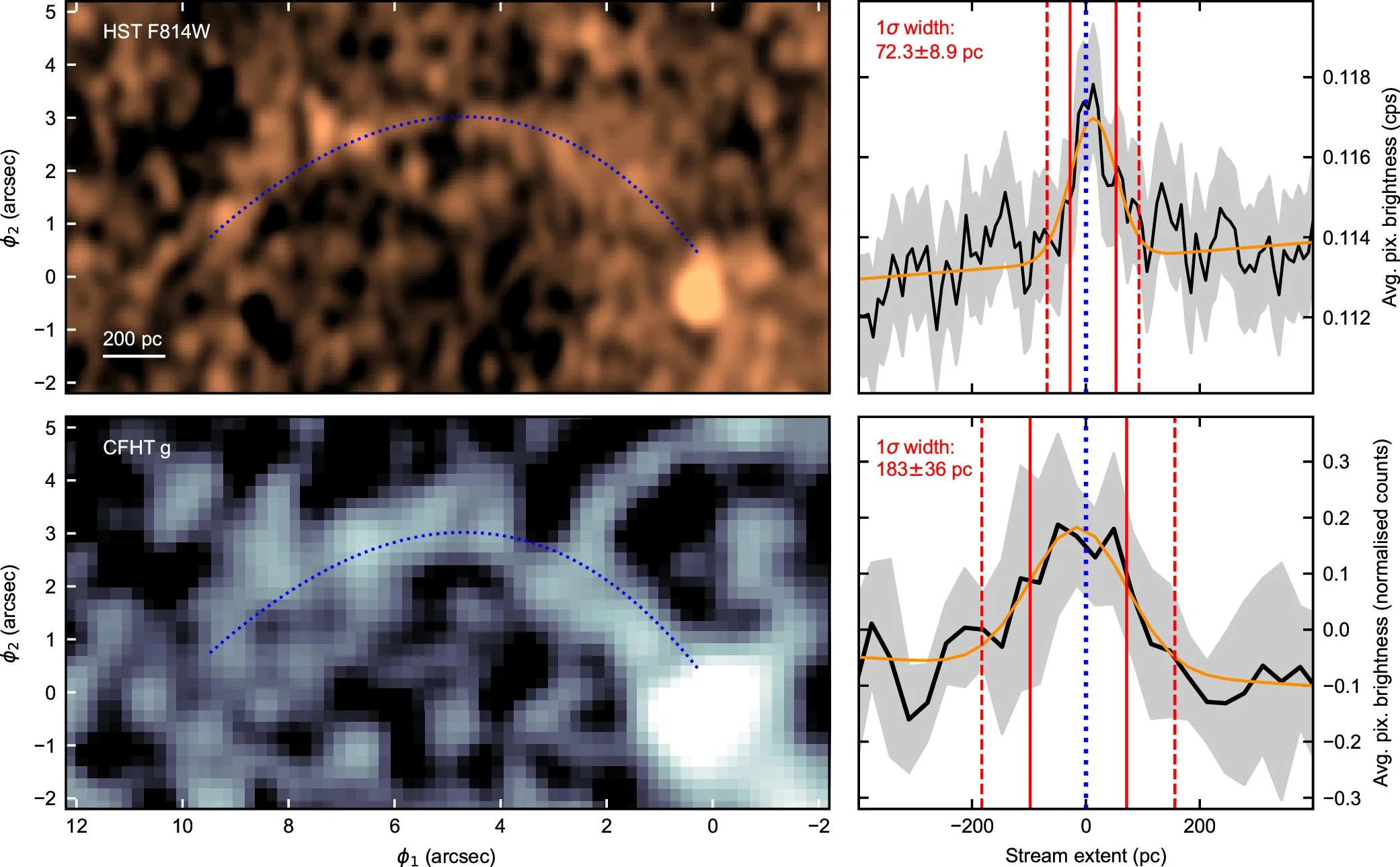
UGC 9050-Dw1 offered an unusual advantage. Its low surface brightness creates a relatively dark background, making a delicate structure easier to distinguish. Oyashio first stood out in archival Hubble Space Telescope images and was independently visible in Canada-France-Hawaii Telescope data.
That independent detection helped rule out an imaging or data-processing artifact. Hubble measurements put the stream’s width at 72.3 ± 8.9 parsecs. Its visible arm extends roughly 2 kiloparsecs.
Its narrowness also matters. Known Milky Way globular-cluster streams range from a few tens to a few hundred parsecs wide. Oyashio is narrower than known streams produced by dwarf-galaxy progenitors, supporting a globular-cluster origin.
The colors provide another clue. A cluster and stars stripped from it should share the same age and metallicity. The candidate cluster has an F555W-F814W color of 1.1 ± 0.1, while the arc measures 1.0 ± 0.2.
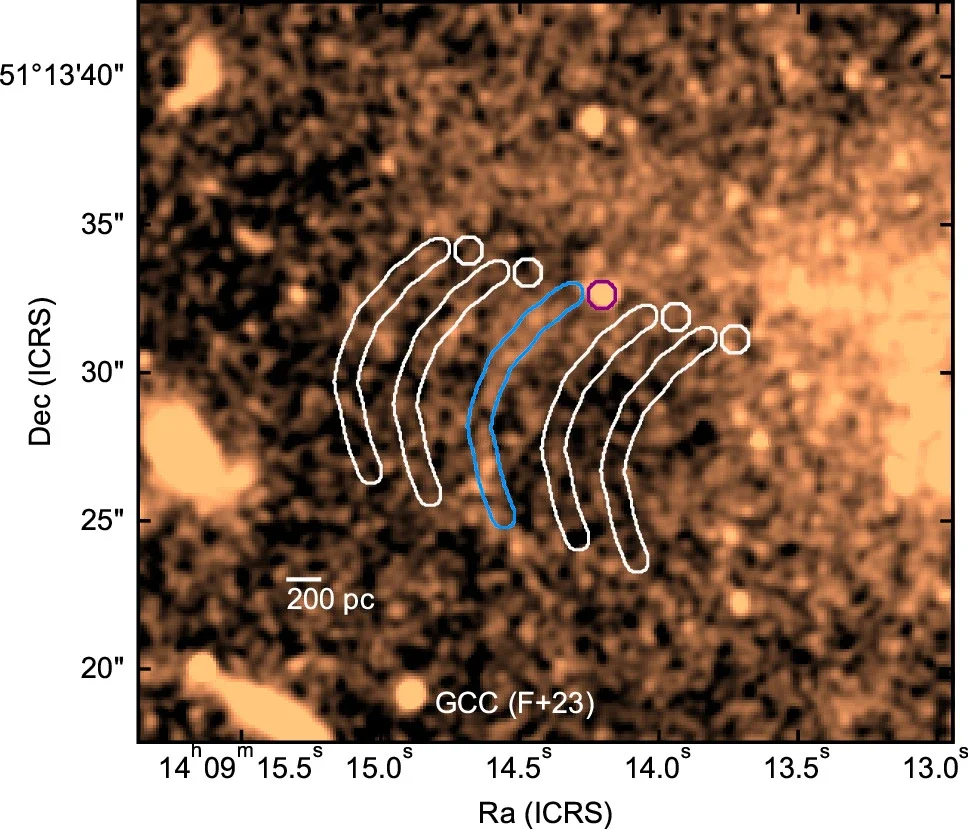
The team tested whether a disrupting globular cluster could dynamically create the observed structure. Using the X-Stream sampler, the astronomers generated models connecting the stream’s shape with properties of its progenitor and the galaxy’s dark-matter halo.
“The stars in a stellar stream all travel along nearly the same orbit, and that orbit is shaped by the galaxy’s gravity,” Starkenburg said. “By modeling that gravity, we can estimate the galaxy’s total mass. We already know roughly how much of that mass comes from visible matter like stars, so the rest must be dark matter.”
For the preferred model runs, the progenitor’s initial mass was less than 2.5 million times the Sun’s mass at 95% confidence. That range is consistent with a globular cluster rather than a dwarf galaxy.
Surface brightness supplied another constraint. A stream modeled after the Milky Way cluster Palomar 5 would need a progenitor about 20 times more massive, or roughly 2 million solar masses, to match Oyashio’s brightness. A younger population could reproduce the observations with an initial mass as low as 165,000 solar masses.
One representative model placed the cluster 2.52 kiloparsecs from the galaxy’s center today. Within that radius, the inferred enclosed mass was 13.6 billion solar masses. The model’s total halo mass was 156 billion solar masses, close to earlier estimates based on the galaxy’s globular-cluster population.
“Our results are consistent with previous studies and what they have shown about dark matter in this ultra-diffuse galaxy,” Kiel Holm said. “We are measuring it with a completely new tool for this type of galaxy, demonstrating that this method also works beyond our own galaxy.”
The team considered several ways a thin arc could appear without being a globular-cluster stream. Merger-driven tidal tails can form in dwarf galaxies, but those structures are expected near a host galaxy’s center. Oyashio lies more than 2 kiloparsecs away.
A collision can produce a shell, but Oyashio’s center of curvature is offset from the host’s center. Gravitational lensing could create an arc, yet the images show no other arcs or plausible lens. The astronomers also found no color pattern suggesting a dust patch created the feature.
A stream from a small dwarf galaxy remains another possibility. However, both the measured width and dynamical mass constraints favor a globular cluster. Simulations indicated a dwarf-like stream would cover a larger area and have lower surface brightness.
Chance alignment cannot be completely excluded. Deeper Hubble or James Webb Space Telescope observations could distinguish the feature more clearly from the background. Spectroscopy with telescopes such as Keck could compare the stream with the presumed parent cluster and test whether their stellar populations match.
Oyashio demonstrates a possible new way to measure ultra-diffuse galaxies. Their sparse stars make conventional measurements of rotation or velocity dispersion difficult. A stellar stream offers another route because its orbit responds to the surrounding gravitational field.
Thin streams may also record encounters with small concentrations of dark matter. Such interactions can create gaps or clumps along a stream. Extending these searches beyond the Milky Way could provide galaxies with fewer ordinary-matter structures that might confuse the signal.
Cold dark matter models predict low-mass subhalos without stars. If those concentrations pass through stellar streams, they could leave detectable changes in stellar density, potentially helping astronomers test the properties of dark matter.
Euclid and NASA’s Nancy Grace Roman Space Telescope should expand the search area substantially. Roman can view an area about 100 times larger than Hubble, increasing the chances of finding similar structures around other galaxies.
For now, Oyashio remains a candidate whose origin can be tested with deeper imaging and spectroscopy. If those observations confirm a globular-cluster stream, astronomers would have a new class of tracers for probing dark matter well beyond the Milky Way.
These resources explore how stellar streams form, how astronomers use them to detect dark matter structure, and what ultra-diffuse galaxies can reveal about the invisible mass surrounding galaxies.
StarStream on Gaia: Stream Discovery and Mass-loss Rate of Globular Clusters
Using Gaia data and an automated detection method, astronomers identified 87 stellar streams associated with Milky Way globular clusters, greatly expanding the available population for studying cluster disruption and galactic gravity. (The Astrophysical Journal Supplement Series, 2026)
Advancing stellar streams as a dark matter probe – I: effects of subhalo density profile
This analysis examines how dark matter subhalos create gaps in stellar streams and finds that realistic subhalo models can substantially change the predicted number and appearance of those disturbances, strengthening the case for using streams to test dark matter models. (Monthly Notices of the Royal Astronomical Society, 2026)
Detectability of dark matter subhalo impacts in Milky Way stellar streams
The researchers calculated how small a dark matter subhalo could be detected through its gravitational effects on different stellar streams, showing that future observations could probe structures far below the mass of visible dwarf galaxies. (The Open Journal of Astrophysics, 2026)
The GD-1 Stellar Stream Perturber as a Core-collapsed Self-interacting Dark Matter Halo
Simulations show that the unusual gap and spur in the Milky Way’s GD-1 stream could have resulted from an extremely dense self-interacting dark matter subhalo, illustrating how disturbances in thin streams might reveal dark matter’s microscopic properties. (The Astrophysical Journal Letters, 2025)
On the dark matter content of ultra-diffuse galaxies
This study compares observed ultra-diffuse galaxies with galaxy-formation models and finds that their wide range of inferred dark matter content can remain consistent with standard cold dark matter expectations, while unusually globular-cluster-rich systems may reflect distinctive evolutionary histories. (The Open Journal of Astrophysics, 2024)
Research findings are available online in the journal Nature.
The original story “2-kiloparsec trail of stars could reveal how dark matter shapes galaxies” is published in The Brighter Side of News.
Like these kind of feel good stories? Get The Brighter Side of News’ newsletter.
The post 2-kiloparsec trail of stars could reveal how dark matter shapes galaxies appeared first on The Brighter Side of News.


Leave a comment
You must be logged in to post a comment.