Life in the oceans did not always belong to creatures born there. In the wake of Earth’s greatest mass extinction, some animals began a slow and uncertain return to the water. A newly described fossil from China now offers one of the clearest views of that transition, capturing both the body and inner workings of a reptile that made the sea its home nearly 245 million years ago.
The fossil, identified as Austronaga minuta, was studied by an international team including scientists from the State Museum of Natural History Stuttgart, the University of Hohenheim, and institutions in China, Europe, and the United States. Their findings reveal not only a nearly complete skeleton, but also the oldest known example of a largely intact digestive system in any reptile.
“This fossil is the oldest known example of a largely complete digestive system in a reptile,” said Dr. Wei Wang, lead author and marine reptile expert at the Institute of Vertebrate Palaeontology and Palaeoanthropology in Beijing.
The fossil was discovered in marine deposits in southwestern China, a region known for preserving life from the Triassic period. This era followed the end-Permian extinction, when ecosystems were rebuilding and new forms of life began to emerge.
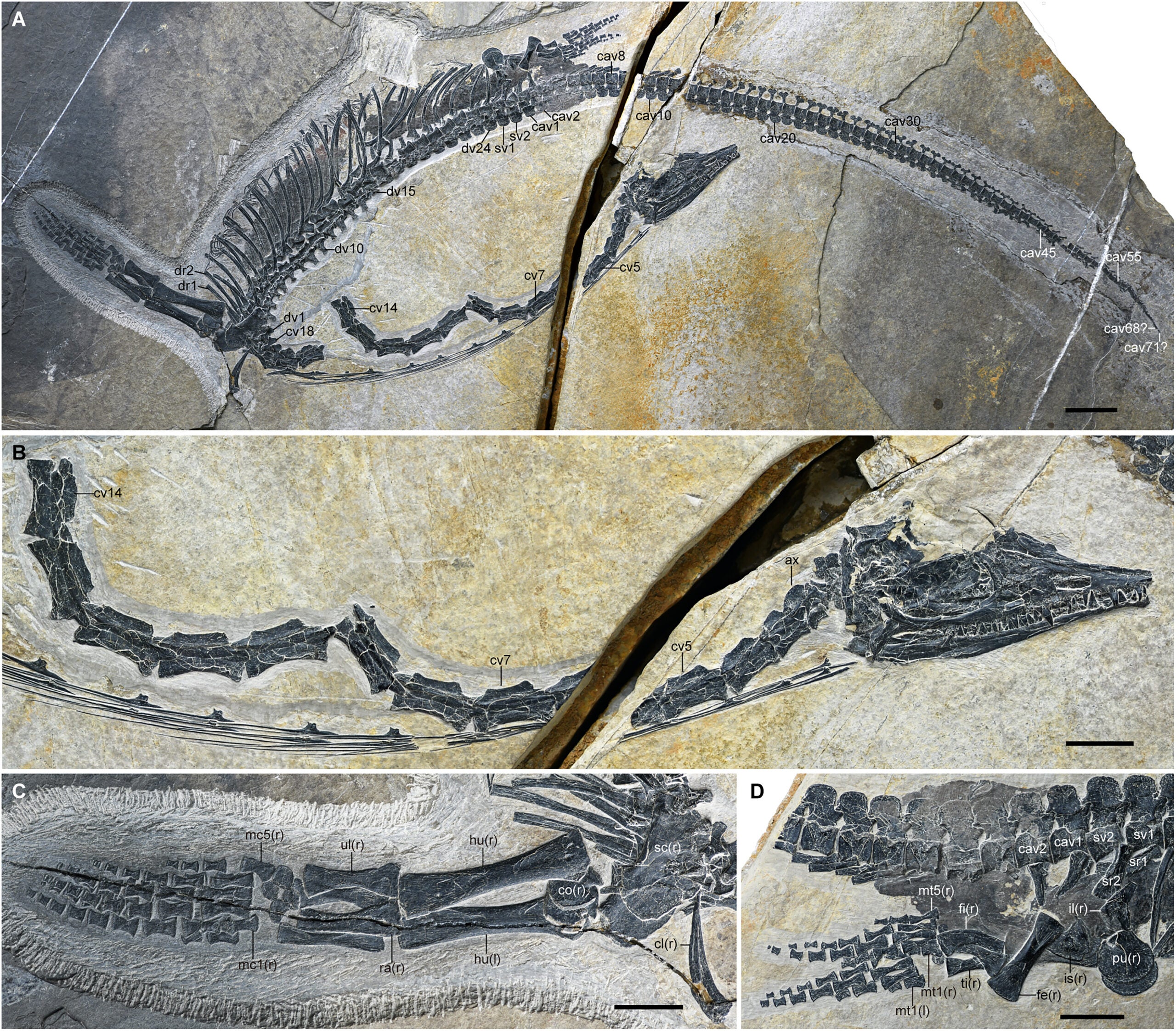
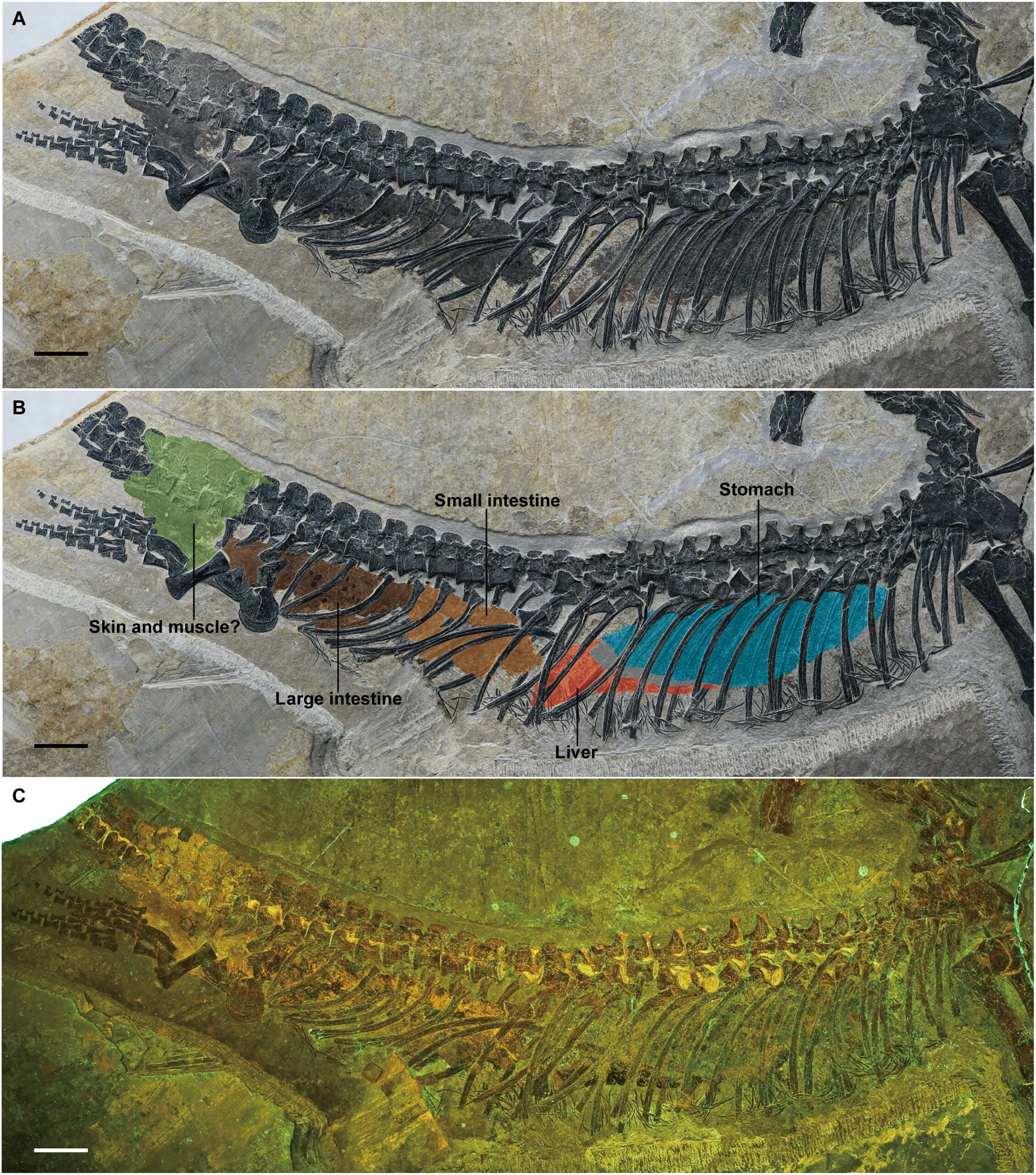
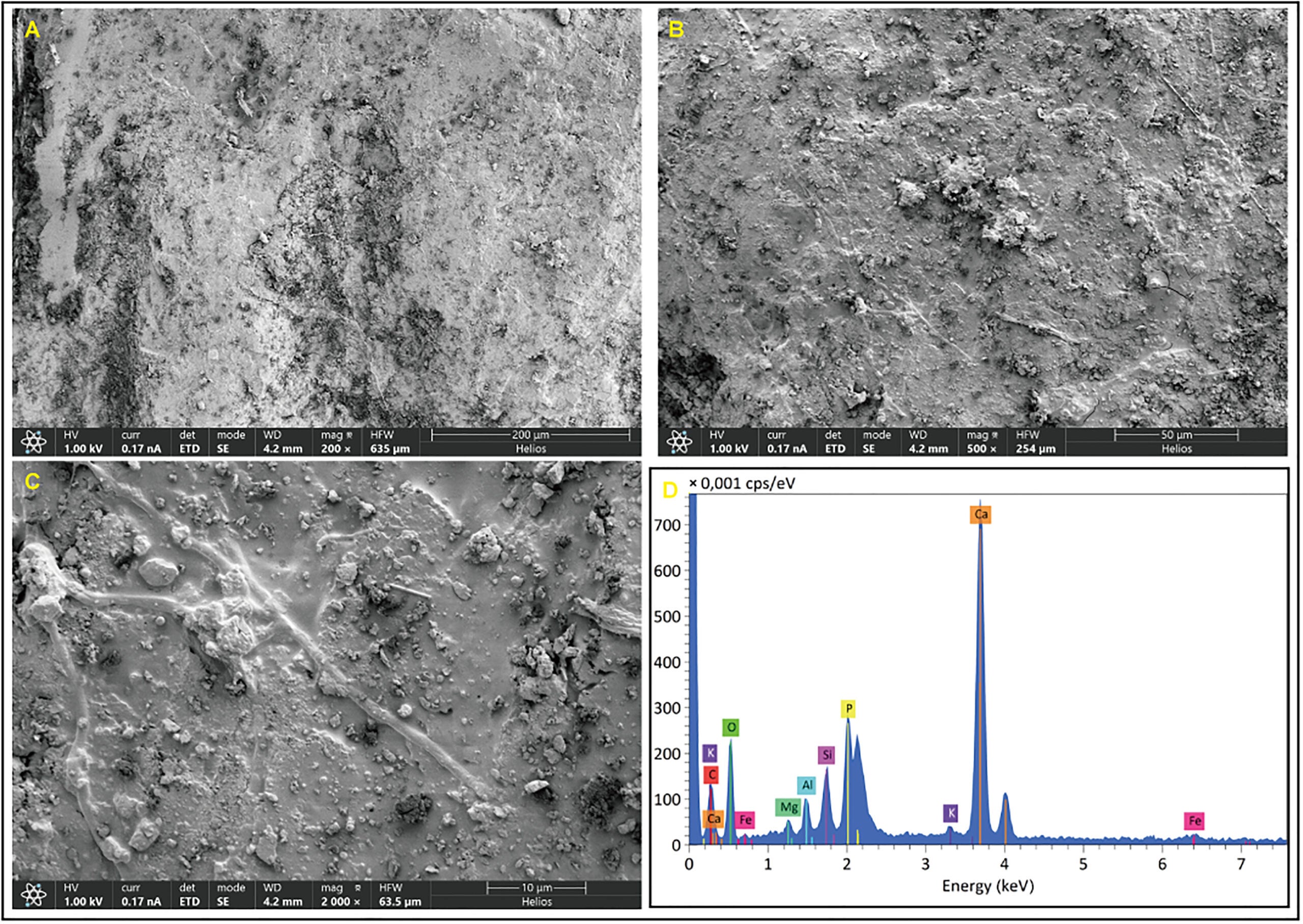
Unlike many fossils that preserve only bones, this specimen captured far more. Researchers identified traces of internal organs, including the stomach, liver, and intestines. These features appeared as dark and colored regions between the ribs, later confirmed using ultraviolet imaging and chemical analysis.
The level of preservation is extraordinary. It allows scientists to study not only how this reptile looked, but also how it functioned.
At just 60 centimeters long, Austronaga minuta was small. Yet its body shows clear signs of advanced adaptation to life in the sea.
The animal had a long neck and tail, along with front limbs shaped like fins. These front limbs likely handled steering and stability. The tail provided propulsion, pushing the animal forward through the water.
Its hind limbs, by contrast, were greatly reduced. They played little role in movement, a sign that the reptile had fully committed to an aquatic lifestyle.
This body plan is striking because Austronaga does not belong to the same group as better-known marine reptiles like ichthyosaurs or mosasaurs. Instead, it is related to early archosaurs, the broader group that later gave rise to crocodiles and dinosaurs.
“The archosaurs and their ancestors were the most diverse group of reptiles on land during the time of the dinosaurs, but we always thought that their adaptation to life in the sea was limited,” said Dr. Stephan Spiekman, a co-author of the study. “However, the discovery of Austronaga shows that early representatives of this lineage had already developed complex adaptations to life in the oceans.”
The fossil’s internal anatomy provides a rare glimpse into how early reptiles processed food. The preserved digestive system appears simple compared to modern relatives.
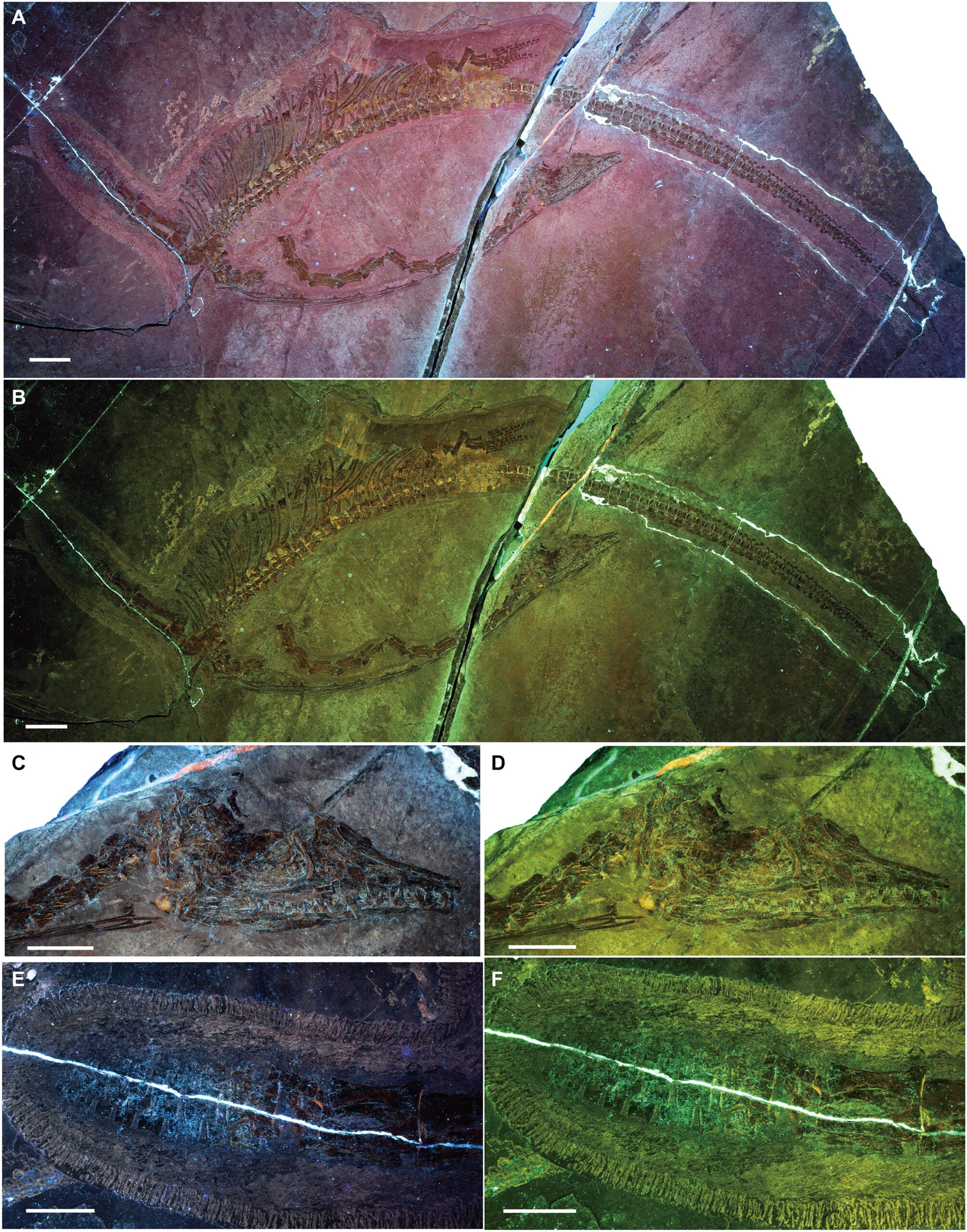
At the front sits a large, sac-like stomach. Behind it lies the liver, still marked by traces of hemoglobin. Farther back, a long tube forms the intestines.
The structure lacks the complexity seen in modern birds and crocodiles, which have multi-chambered stomachs. Instead, Austronaga had a single chamber.
“While today’s birds and crocodiles have a two-part stomach, Austronaga had only a single stomach chamber,” said Dr. Nick Fraser of National Museums Scotland. “This shows that the stomachs of archosaurs were initially quite simple and only evolved later in the evolutionary process.”
The overall layout resembles that of modern fish-eating reptiles. It suggests a straightforward digestive process, likely suited for a carnivorous diet.
The shape of the teeth offers clues about feeding habits. They are sharp and conical, ideal for catching slippery prey like fish. Combined with the body’s streamlined design, this points to an active predator moving through shallow seas.
The digestive tract supports this idea. Its simplicity and length suggest quick processing of protein-rich meals rather than plant material.
Despite its advanced swimming features, the internal organs show fewer changes. This contrast reveals something important about evolution. Different parts of the body can adapt at different speeds.
In this case, the skeleton transformed rapidly for aquatic life, while the digestive system retained a more basic design.
The discovery challenges long-held assumptions about how reptiles moved into the oceans. Scientists once believed that early members of the archosaur lineage stayed mostly on land during this period.
Austronaga tells a different story. It shows that some branches of this group explored marine environments much earlier and more successfully than expected.
Its features rival those of other marine reptiles that dominated later oceans. Yet it evolved these traits independently, not as part of those well-known groups.
This suggests that the move from land to sea happened more than once in reptile history. Different lineages found their own paths into the water, developing similar solutions to the same challenges.
Fossils like this are rare. Most specimens preserve only fragments, leaving scientists to piece together incomplete stories.
Here, the nearly complete skeleton and preserved soft tissues provide a fuller picture. They allow researchers to connect anatomy with behavior and function.
The discovery also highlights the value of continued fieldwork. Even in regions already known for fossils, new finds can reshape understanding.
“This discovery illustrates why fieldwork remains indispensable to understanding life’s history,” said Andres Giallombardo, the study’s lead author.
The Triassic period was a time of experimentation. After the mass extinction, life adapted in many directions. Some animals stayed on land. Others ventured into the air. And some, like Austronaga, returned to the sea.
This fossil captures that moment of transition. It shows a reptile that had already committed to aquatic life, yet still carried traces of its land-based past.
Its existence suggests that marine ecosystems were more diverse than previously thought. It also shows that early reptiles were more flexible and adaptable than once believed.
This discovery deepens understanding of how major animal groups adapt to new environments. By revealing how reptiles transitioned from land to water, it provides insight into broader patterns of evolution.
The preserved digestive system offers rare data on internal anatomy, which can help scientists compare ancient and modern species. This may improve models of how organs evolve alongside body structures.
The findings also highlight the importance of fossil-rich regions like southwestern China. Continued exploration in these areas could uncover more species that fill gaps in evolutionary history.
For researchers, the study provides a new framework for examining early marine ecosystems. It shows that multiple lineages independently developed similar traits, which can inform studies of convergence in evolution.
For the public, the fossil serves as a reminder of how life adapts after crisis. It reflects resilience, change, and the ability of organisms to find new paths in uncertain environments.
These resources explore how reptiles adapted to marine life, how archosaur relatives diversified during the Triassic, and how ocean ecosystems rebuilt after the end-Permian mass extinction.
The timing and nature of marine ecosystem recovery following the Permian-Triassic mass extinction
This 2026 perspective reviews evidence for how marine ecosystems recovered after Earth’s largest mass extinction, including debate over whether recovery was gradual or whether complex food webs returned surprisingly quickly. (npj Biodiversity, 2026)
Earliest long-necked sauropterygian Lijiangosaurus yongshengensis and plasticity of vertebral evolution in sauropterygian marine reptiles
This study describes an early Middle Triassic marine reptile from southwestern China with 42 neck vertebrae, showing how dramatically different body plans were already evolving among marine reptiles soon after the end-Permian extinction. (Communications Biology, 2025)
Dinocephalosaurus orientalis Li, 2003: a remarkable marine archosauromorph from the Middle Triassic of southwestern China
This detailed analysis examines another highly specialized marine archosauromorph from southwestern China, providing an important comparison for understanding how early relatives of archosaurs independently developed adaptations for aquatic life. (Earth and Environmental Science Transactions of the Royal Society of Edinburgh, 2024)
A new pseudosuchian from the Favret Formation of Nevada reveals that archosauriforms occupied coastal regions globally during the Middle Triassic
A Middle Triassic pseudosuchian found in marine deposits in Nevada adds evidence that early archosauriforms occupied coastal environments across widely separated regions, broadening the picture of how this reptile lineage interacted with aquatic habitats. (Biology Letters, 2024)
Aquatic Habits and Niche Partitioning in the Extraordinarily Long-Necked Triassic Reptile Tanystropheus
This influential study used skull anatomy and other evidence to show that the remarkable archosauromorph Tanystropheus was adapted to aquatic life, helping establish that marine specialization arose in several unusual Triassic reptile lineages. (Current Biology, 2020)
Research findings are available online in the journal Science Advances.
The original story “245-million-year-old reptile fossil preserves the oldest known intact digestive system” is published in The Brighter Side of News.
Like these kind of feel good stories? Get The Brighter Side of News’ newsletter.
The post 245-million-year-old reptile fossil preserves the oldest known intact digestive system appeared first on The Brighter Side of News.


Leave a comment
You must be logged in to post a comment.